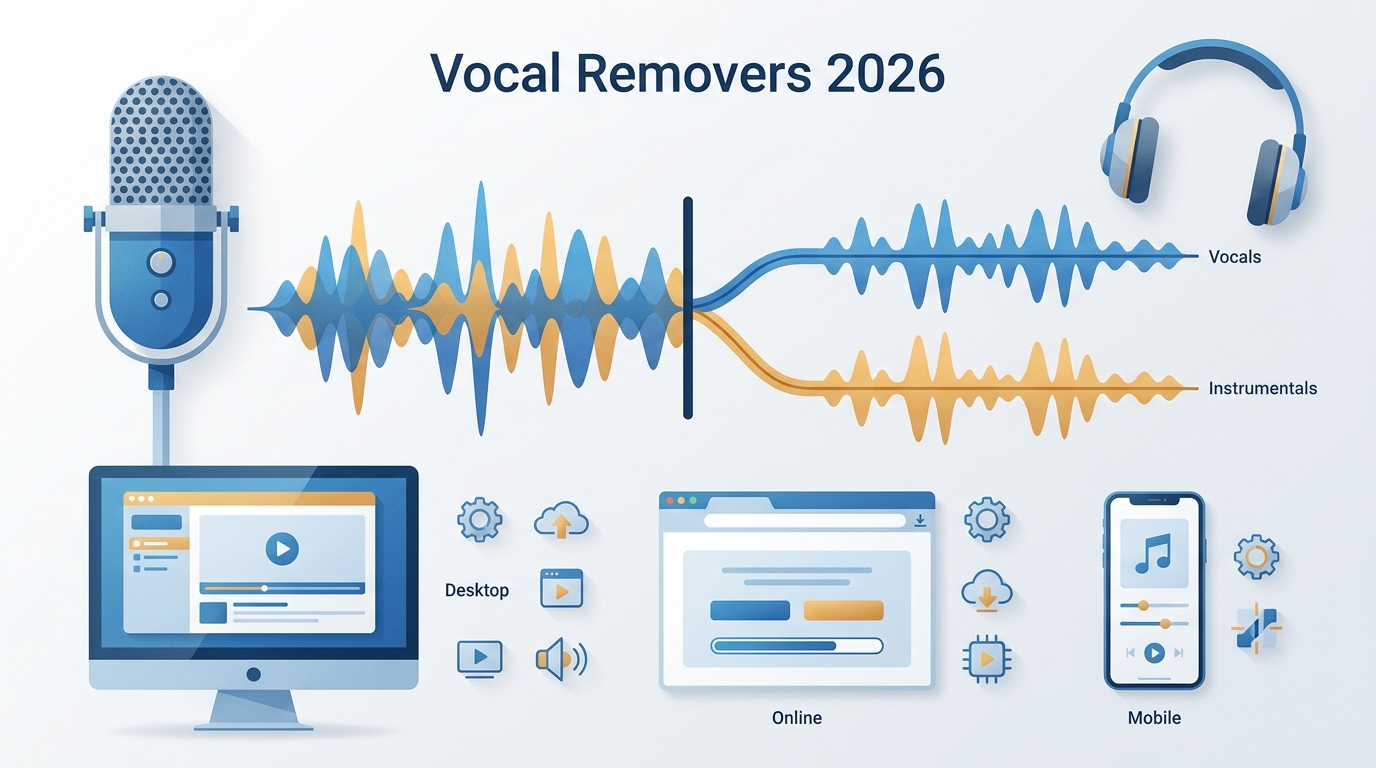
The right vocal remover depends less on a bold quality claim than on four practical facts: whether the usable download is free, how well the model preserves instruments, where the file is processed, and whether the tool fits a desktop, browser, or mobile workflow. For best vocal remover, verify this point on the actual source before processing the complete file.
People searching for the best AI vocal remover tools 2026 or the best AI vocal remover apps 2026 often meet unclear credits, preview-only results, and inconsistent stem quality. This comparison separates those tradeoffs across desktop software, browser services, and mobile apps so the shortlist is easier to trust. For best vocal remover, verify this point on the actual source before processing the complete file.
How Modern Vocal Removers Actually Work
Quick answer: best vocal remover should be chosen or configured by matching the source, viewing device or platform, quality target, privacy needs, and export limits. Test a representative clip, compare the result at full size, and avoid settings that add artifacts or unnecessary recompression. The latest GSC comparison shows that the optimization priority is impressions contracted while weighted average position worsened, indicating reduced query coverage and lower serp visibility.
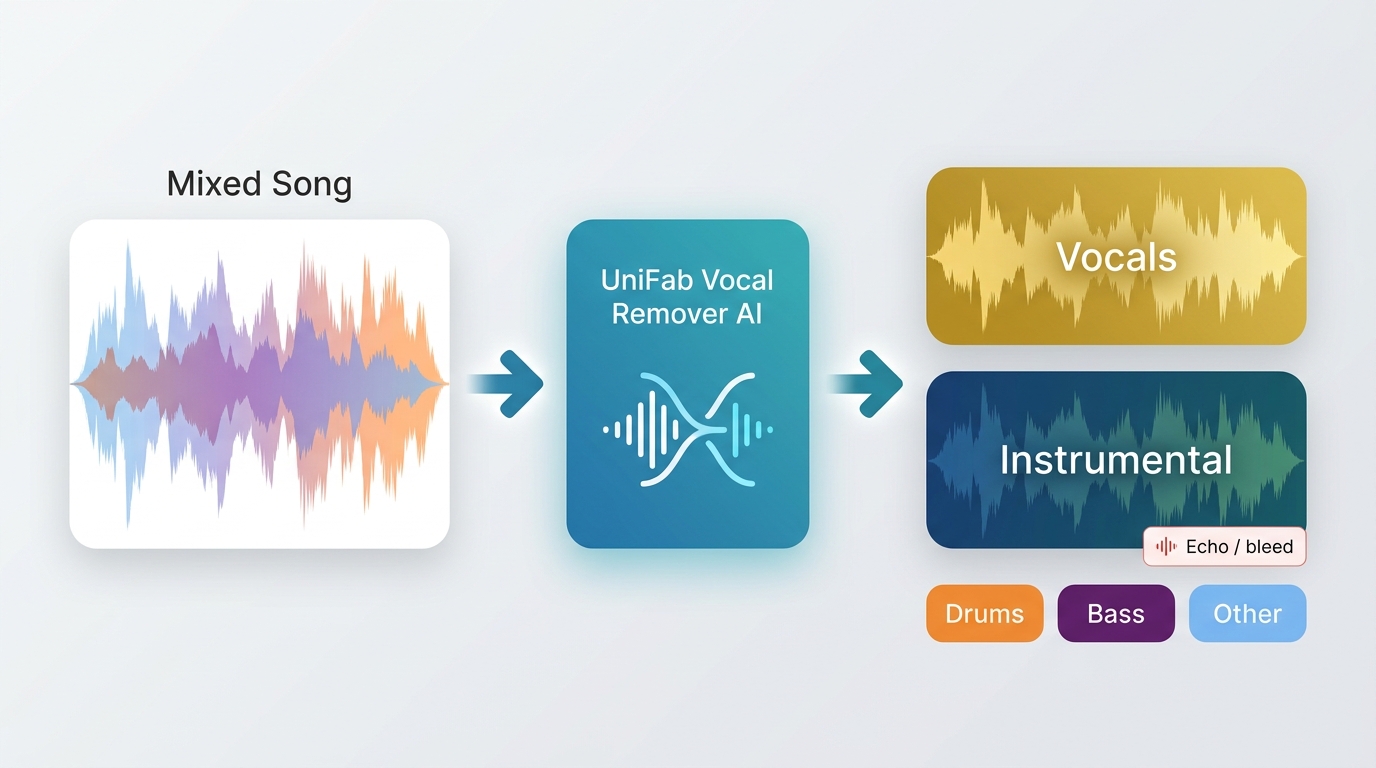
An AI voice remover identifies patterns associated with vocals and instruments, then reconstructs separate stems. An AI stem separation tool can go further by splitting drums, bass, and other parts instead of producing only a vocal and instrumental pair. For best vocal remover, verify this point on the actual source before processing the complete file.
The difficult part is overlap. Reverb, doubled vocals, dense guitars, and centered drums can share the same frequency and timing cues, so an AI vocal separator may leave vocal bleed or remove part of another instrument. Source quality and model choice often matter more than a tool's marketing label. For best vocal remover, verify this point on the actual source before processing the complete file.
Vocal removal, vocal isolation, and acapella extraction are related but not identical. A remover prioritizes an instrumental, while an isolate-vocals workflow prioritizes the voice stem.
What Matters When Comparing Vocal Removers
The best AI vocal remover is the one that delivers a usable export under limits you understand. A vocal remover alternative is not genuinely free if it allows an upload but blocks the full download or provides too little processing time for the intended project. For best vocal remover, verify this point on the actual source before processing the complete file.
- Free access: Check minutes, credits, previews, download access, recurring quotas, and watermarks rather than relying on a free label.
- Account requirement: A local app may work without an account, while browser and mobile services commonly tie allowances to sign-in.
- Compatibility: Confirm the operating system, audio inputs, video inputs, available stems, and export formats.
- Processing location: Local processing can suit unreleased or client audio; cloud processing is easier for occasional files but requires an upload.
- Quality caveat: Listen for vocal bleed, softened drums, missing guitars, metallic edges, or fuzzy backing vocals.
- Usable output: Clean instrument preservation and an export you can actually download matter more than a nominally free upload button.
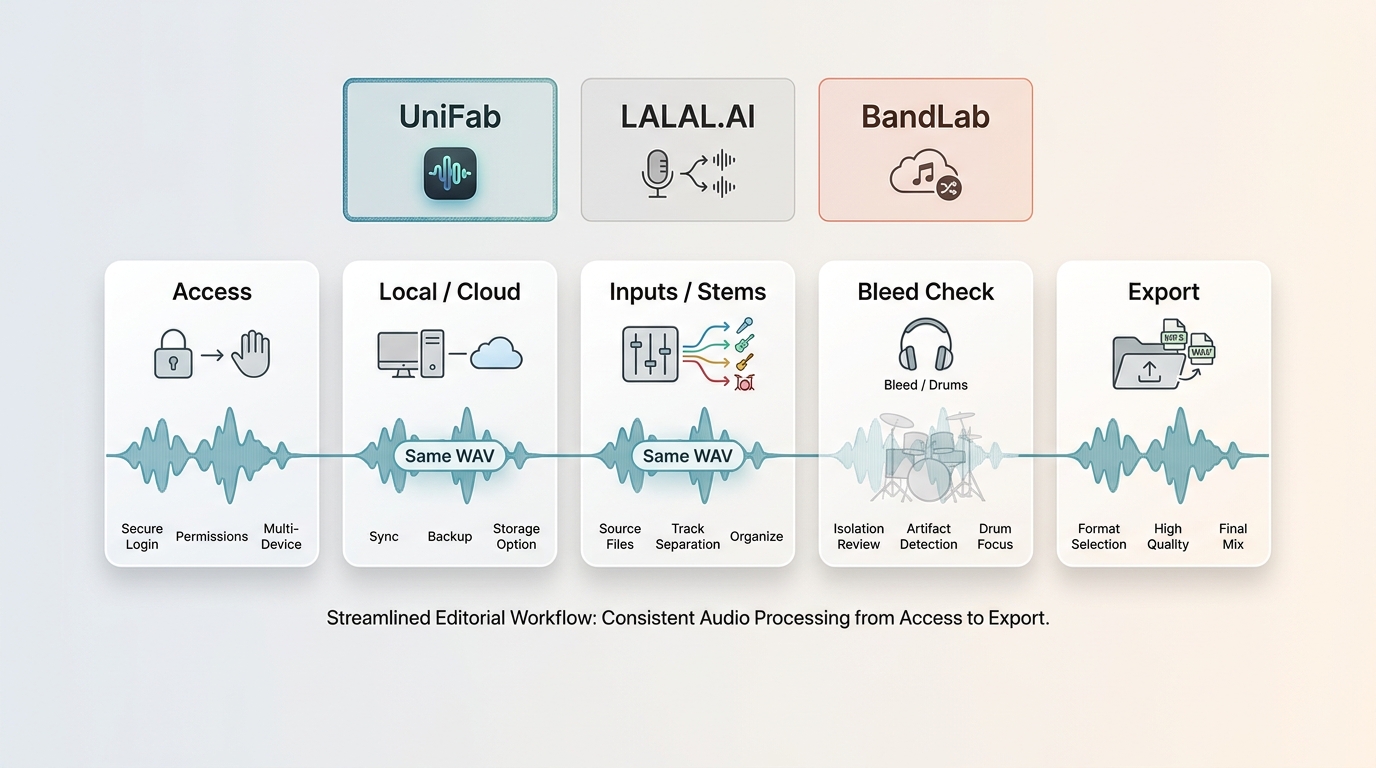
A practical spot-check is to use the same short WAV excerpt on each candidate, listen to both the vocal and instrumental stems on headphones, and compare the chorus, reverb tail, and drum transients. That repeatable check is more informative than a star score without a shared protocol. For best vocal remover, verify this point on the actual source before processing the complete file.
10 Vocal Removers Compared at a Glance
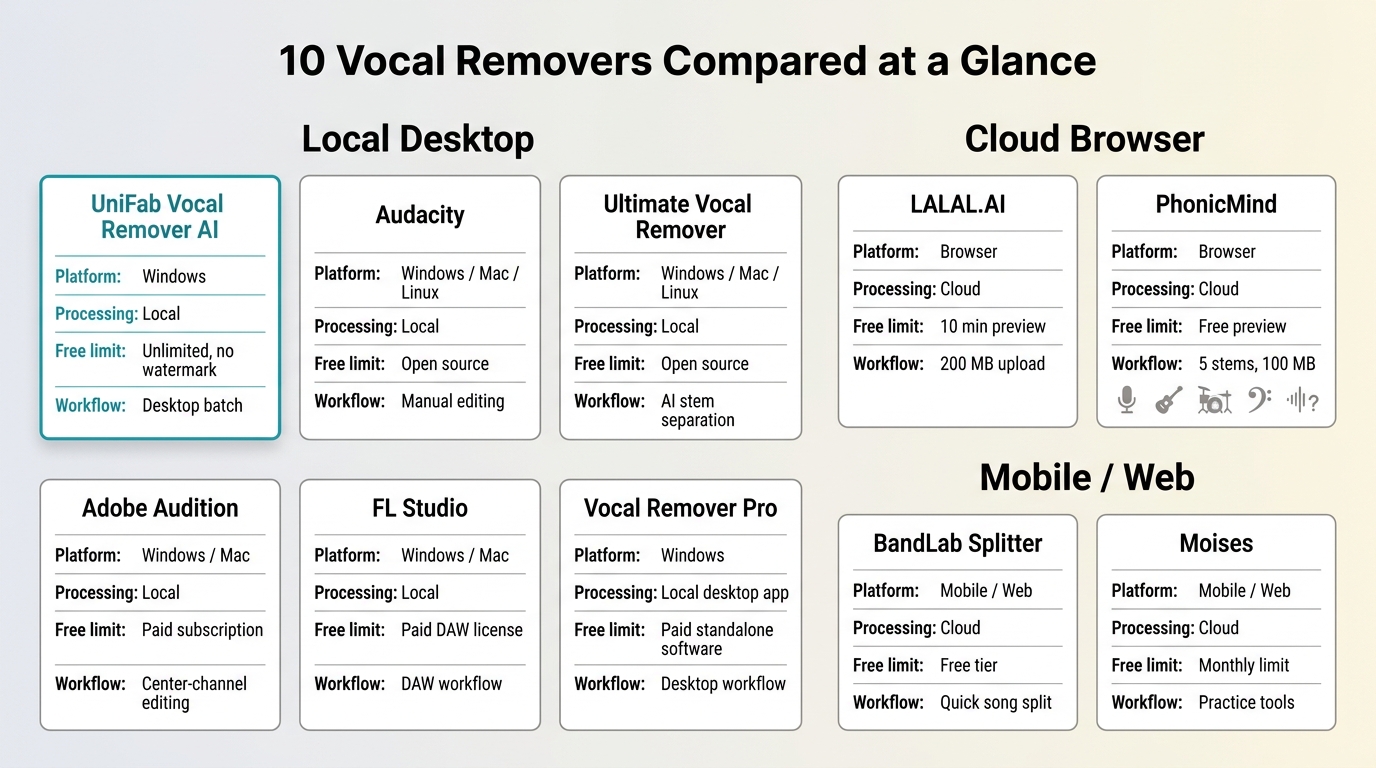
The best AI vocal remover tools 2026 differ most in usable free access, processing location, and artifact risk. The table uses concrete limits where they are publicly stated and keeps uncertain commercial details out of the ranking. For best vocal remover, verify this point on the actual source before processing the complete file.
| Tool | Platform and OS | Processing | Free access and exact limits | Account | Audio input | Video input | Output stems and formats | File or usage limit | Quality caveat | Best fit | Not ideal for |
| UniFab Vocal Remover AI | Windows and Mac | Local desktop workflow | No-cost use, no watermark, unlimited use | Not required for core local workflow | Common audio files | Yes | Vocal and instrumental outputs; MP4 and MKV video workflow | No usage quota stated | Dense mixes can still leave bleed | Local audio and video batches | Phone-only work |
| Audacity | Windows, Mac, Linux | Local | No-cost, open source | No | Common audio formats | No direct video workflow | Edited audio; optional separation depends on setup | Hardware-dependent | Center-channel reduction can remove other centered sounds | Editing plus occasional separation | Fast one-click stems |
| Ultimate Vocal Remover | Desktop | Local | No-cost, community-developed | No | Audio files | Not a primary video workflow | Model-dependent vocal and instrumental stems | Hardware-dependent | Model choice can produce fuzzy or uneven stems | Technical users willing to compare models | Minimal setup |
| Adobe Audition | Windows, Mac | Local | $22.99 per month on an annual, billed-monthly US single-app plan | Adobe account | Professional audio formats | Video-linked editing workflow | Manually edited audio | Plan and hardware dependent | Results depend heavily on operator skill | Experienced spectral editors | Automatic stem extraction |
| FL Studio | Windows, Mac | Local | Paid DAW license | License account | DAW-supported audio | Not a primary video workflow | Native downloadable stem separation inside the DAW | Hardware-dependent | Busy mixes may need further editing | Producers already using the DAW | Occasional one-file removal |
| Vocal Remover Pro | Windows | Local desktop app | Paid standalone software | License activation | MP3, OGG, AC3, M4A | URL-oriented source workflow | Vocal-reduced audio | No verified public quota included | Complex tracks can retain artifacts | Lightweight Windows use | Detailed multi-stem work |
| LALAL.AI | Browser | Cloud upload | Starter includes 10 Relaxed Queue minutes; previews cannot be downloaded as full results | Needed for plan management | MP3, OGG, WAV, FLAC, AIFF, AAC, M4A | AVI, MP4, MKV, MOV, M4V | Multiple paired stems; MP3, OGG, AAC, AIFF, WAV, FLAC | Starter uploads up to 200 MB | Separation varies with layered vocals and reverb | Occasional browser multi-stem jobs | Predictable unrestricted volume |
| PhonicMind | Browser | Online upload | Free preview without signup; full export is separate | No signup for preview | MP3, AAC, WMA, FLAC, WAV, AIFF | No verified direct video input listed | Vocals, instrumental, drums, bass, other; stem MP4 option | Up to 100 MB per upload | Dense arrangements can lose instrument detail | Quick browser previews and stem splits | Sensitive audio or large files |
| BandLab Splitter | Android, iOS, web | App and web service | Core stem separation is available at no cost; some expanded Splitter features require Membership | BandLab account | Imported audio | Not positioned as a direct video remover | Vocals, drums, bass, and other stems; members can access up to seven stems | No numeric basic Splitter quota stated | Mobile results still depend on the source mix | Verified Android app and remix workflow | Offline private processing |
| Moises | Android, iOS, web, desktop | Account-based service | Limited monthly uploads; exact allowance is shown in the account plan | Yes | Imported songs | Not a primary direct-video workflow | Vocal and instrument stems with practice tools | Monthly free-plan limit | Export access and separation vary by plan and mix | Practice, chords, and tempo work | Unrestricted high-volume exports |
Time-sensitive prices and service limits are current as of July 2026.
Desktop Picks: Local Processing and Control
AI vocal remover software is the better fit when privacy, repeat batches, or large files matter. The best free AI vocal remover 2026 for one reader may still be the wrong choice for another if the operating system, setup effort, or model workflow does not match. For best vocal remover, verify this point on the actual source before processing the complete file.
UniFab Vocal Remover AI: Local Batch Processing
UniFab Vocal Remover AI is a local desktop option for Windows and Mac that processes audio and video in batches, separates vocal and instrumental outputs, and provides no-cost use without watermarks or a usage quota.
It is useful when an AI vocal remover instrumental is needed from content the reader is authorized to process, where permitted by applicable law and platform terms. Video support also avoids a separate remove-audio-from-video step for compatible projects.
- Local audio and video processing
- Batch workflow for multiple files
- Vocal and instrumental outputs without a watermark
- MP4 and MKV video workflow
The tradeoff is that complex arrangements can still leave vocal residue or soften nearby instruments. It suits Windows and Mac users who want local batch control, but it is not a phone-first option. For best vocal remover, verify this point on the actual source before processing the complete file.
How to use UniFab Vocal Remover AI
UniFab Vocal Remover AI
- Completely Free – Unlock all features with no hidden costs.
- No Watermarks – Enjoy clean, professional results without any branding.
- AI Technology – Leverage advanced AI for fast and accurate vocal removal.
- User-Friendly – Effortless interface for both beginners and professionals.
UniFab Vocal Remover AI
UniFab Vocal Remover AI
- Completely Free – Unlock all features with no hidden costs.
- No Watermarks – Enjoy clean, professional results without any branding.
- AI Technology – Leverage advanced AI for fast and accurate vocal removal.
- User-Friendly – Effortless interface for both beginners and professionals.
UniFab Vocal Remover AI
- Open UniFab and choose Vocal Remover from the tool list.
- Add an authorized audio or video file to the workspace.
- Select the desired vocal, instrumental, or paired output and choose the destination folder.
- Start processing, then listen to the most layered section before using the export in a larger project.
Audacity: Editing Plus Basic Separation
Audacity combines general audio editing with classic center-channel reduction and optional AI-assisted separation through supported OpenVINO setups. Availability depends on the operating system and plugin configuration. For best vocal remover, verify this point on the actual source before processing the complete file.
Its weakness is consistency: center-channel methods can also reduce drums or bass placed near the middle, while optional AI workflows require more setup than a dedicated remover. It fits readers who also need trimming, recording, and effects; it is less suitable for quick multi-stem exports. For best vocal remover, verify this point on the actual source before processing the complete file.
Ultimate Vocal Remover is another prominent no-cost desktop option for technical users. Its model selection can be valuable for difficult tracks, but there is no universal best model, and the setup curve is steeper than a single-button app. For best vocal remover, verify this point on the actual source before processing the complete file.
Professional-Grade Vocal Remover Software
Professional software offers more control, but control does not guarantee automatic separation. These options make sense when the vocal-removal task is part of a broader editing or production workflow. For best vocal remover, verify this point on the actual source before processing the complete file.
Adobe Audition: Manual Spectral Control
Adobe Audition uses spectral editing and center-channel tools rather than a one-click AI stem workflow. The US single-app plan is $22.99 per month with an annual commitment billed monthly.
The advantage is precise manual control over troublesome frequencies; the drawback is time and expertise. It suits experienced editors who already need Audition, but readers seeking an automatic AI voice remover should choose a dedicated separator.
FL Studio: Native DAW Stem Separation
FL Studio includes a downloadable native Stem separation feature for separating vocals and instruments inside the DAW. This replaces the older assumption that the workflow depends on phase inversion or an external plugin.
The integrated workflow is convenient for producers already arranging and mixing in FL Studio, though difficult source material can still need cleanup. It is excessive for someone who removes vocals only occasionally.
Vocal Remover Pro: Lightweight Windows Workflow
Vocal Remover Pro is a focused Windows application for common audio formats and a URL-oriented source workflow. Its smaller feature set can feel easier than opening a full DAW.
The limitation is separation quality on layered tracks, where residual vocals or instrumental damage can be audible. It fits lightweight, occasional use; it is not ideal for detailed stem control.
Browser Tools: Convenience and Upload Tradeoffs
A browser-based vocal remover alternative is convenient for occasional files because there is no desktop installation. The tradeoff is that the source must be uploaded, and free access often means a preview or a small credit allowance rather than a full unrestricted export.
Readers who want a longer category list can use the existing online vocal remover comparison; this section stays focused on two representative cloud workflows.
LALAL.AI: Multi-Stem Cloud Processing
LALAL.AI is a browser-based AI vocal isolator with paired stem options for vocals, instruments, drums, bass, guitars, piano, and other parts. Its Starter access includes 10 Relaxed Queue minutes, a 200 MB upload ceiling, and previews without full-result downloads.
Credit-based access works for occasional multi-stem jobs, but frequent users may prefer a workflow with a more predictable volume allowance. Dense harmonies and long reverb tails can still create bleed or soft edges.
PhonicMind: Browser-Based Stem Splitting
PhonicMind is an online AI vocal separator that accepts common audio formats, offers a free preview without signup, and handles files up to 100 MB. It can produce vocals, instrumental, drums, bass, and other stem groups.
It suits a quick browser preview or remix preparation, but uploading is a poor fit for confidential material, and busy arrangements may lose detail. Readers focused specifically on voice extraction can compare the adjacent AI vocal isolator options.
Best Vocal Remover Mobile Apps
The best AI vocal remover apps 2026 should be compared by operating system, free allowance, stem count, export access, and whether the workflow is cloud-based. Apps for removing vocals are convenient, but mobile access does not erase file limits or source-mix artifacts.
BandLab Splitter: Verified Android Stem Separation
BandLab, published by BandLab Technologies, provides a verifiable Android app with Splitter for vocals, drums, bass, and other stems. Core splitting is available at no cost, while Membership adds options such as lead and backing vocal separation and up to seven stems.
This is a practical entry among the best Android vocal removal apps 2026 for people who also want a music-creation environment. It is less suitable for private offline processing, and results still vary when vocals overlap heavily with guitars or effects. An extracted voice stem can also support an acapella extraction workflow.
Moises: Mobile Practice and Stem Tools
Moises combines limited free monthly uploads with vocal and instrument separation, chord detection, and tempo controls across Android, iOS, web, and desktop access. Exact allowance and export options depend on the account plan.
It fits musicians who value practice tools alongside separation. It is not ideal for unrestricted high-volume exports, and complex mixes can still produce uneven stems.
Choose by Workflow, Quality, and Limits
The best AI vocal remover is a workflow decision, not a universal ranking. Start with where the file can be processed, then compare instrument preservation, usable export limits, and the amount of setup you are willing to accept.
Match the Tool to Your Workflow
Choose local AI vocal remover software for unreleased music, client material, large batches, or repeated work. Choose browser tools for occasional files when upload convenience matters more than local control. Choose mobile apps when practice and quick sharing are central to the task.
Match the Tool to Your Use Case
- Karaoke or an AI vocal remover instrumental: prioritize a clean instrumental and listen for missing drums in the chorus.
- Remixing: use a multi-stem tool that separates vocals, bass, and drums rather than a two-stem remover.
- Editing: Audacity or Adobe Audition makes more sense when separation is one step inside a larger edit.
- Production: FL Studio keeps native stem separation inside the DAW.
If the goal is simply to remove vocals from songs, a dedicated method guide is more useful than adding a long tutorial to this comparison.
Balance Quality Against Artifacts
No model wins on every mix. Compare the loudest chorus, a quiet verse, and a reverb-heavy ending; these sections expose vocal bleed, fuzzy tails, and instrument loss faster than listening only to the intro.
Compare Privacy and File Limits
A slightly less convenient local tool can be the better choice for unreleased or client audio because the workflow avoids a browser upload. Browser services are often easier for occasional files, but upload size, credits, and export access must fit the project.
Compare Free and Paid Limits
The phrase best free AI vocal remover 2026 should mean more than a free preview. A useful free workflow provides enough processing for the source, allows the resulting stem to be downloaded, and does not add an unwanted watermark.
Best Picks for Different Workflows
There is no single winner across platform, privacy, source format, and artifact tolerance. The strongest vocal remover alternative changes with the job.
- Local audio and video batches: UniFab is a strong fit for Windows and Mac users who want no-cost local processing and batch support; it is not designed as a mobile-first editor.
- Browser multi-stem work: LALAL.AI or PhonicMind suits occasional uploads; neither is ideal for confidential files or readers who want unrestricted volume.
- Technical no-cost desktop control: Ultimate Vocal Remover rewards model experimentation; it is not a low-setup choice.
- General editing: Audacity combines editing and separation options; its classic reduction method can damage other centered sounds.
- Mobile practice: Moises adds chords and tempo tools, while BandLab connects splitting to a broader creation workflow; both depend on account-based services.
- Experienced production: Adobe Audition offers manual spectral control and FL Studio offers native DAW stems; both are excessive for an occasional karaoke file.
For adjacent research, best AI vocal isolation tools 2026 focus more narrowly on preserving the voice stem, while this guide remains centered on choosing a remover and comparing its limits.
Frequently Asked Questions
What is the best way to use best vocal remover?
Start with the source quality, target platform, privacy requirement, and final export settings. For best vocal remover, use a short representative clip first, compare the result at 100% view, and keep the original file so you can revise the workflow without generation loss. This also applies to best AI vocal remover.
Is best vocal remover free?
Some best vocal remover workflows are free, while others limit file size, duration, resolution, credits, watermarks, or export formats. Verify the current plan on the provider's official page because free allowances can change. This also applies to vocal remover.
Does best vocal remover reduce quality?
best vocal remover can reduce quality when it adds unnecessary recompression, aggressive enhancement, or incorrect output settings. Match resolution, frame rate, codec, and bitrate to the source and delivery platform, then inspect motion, edges, audio sync, and fine detail. This also applies to music stem separator.
Which formats or devices support best vocal remover?
Support depends on the chosen application and workflow. Check operating system, input and output formats, hardware acceleration, browser upload limits, and whether the destination platform accepts the selected settings before processing a full project. This also applies to best AI vocal remover.
How long does best vocal remover take?
Processing time varies with duration, resolution, codec, AI model, hardware, and export settings. A short test provides the most reliable estimate; online tools also add upload and download time, while local tools depend more heavily on CPU and GPU performance. This also applies to vocal remover.
Can beginners use best vocal remover?
Yes. Beginners can use best vocal remover by following a conservative workflow: duplicate the source, choose an appropriate preset, process a short sample, compare before and after, and only then export the complete file. This also applies to music stem separator.
What should I check before choosing a tool for best vocal remover?
Compare source fit, output quality, privacy, platform support, batch capability, watermark policy, free limits, price, and control. Do not choose a best vocal remover tool only because it advertises the highest resolution, frame rate, or AI label. This also applies to best AI vocal remover.
Is desktop or online processing better for best vocal remover?
Online processing is convenient for short, non-sensitive files, but it can impose upload, retention, watermark, credit, and resolution limits. Desktop processing is usually better for private, long, high-resolution, or batch best vocal remover work. This also applies to vocal remover.
What are the main limitations of best vocal remover?
The main limits are source quality, missing detail, motion artifacts, incompatible formats, hardware demand, upload constraints, and generation loss. best vocal remover cannot always reconstruct information that was never captured, so results should be described realistically. This also applies to music stem separator.
How does best vocal remover compare with manual editing?
Automated best vocal remover is faster and easier to repeat, while manual editing gives more local control and may avoid overprocessing. A practical workflow uses automation for the first pass and manual review for difficult scenes, transitions, faces, text, and audio sync. This also applies to best AI vocal remover.