For clean exported stems, start with a model-driven offline or browser service; for local video, use a desktop workflow; for live karaoke, accept more bleed in exchange for low latency; and for mobile edits, prioritize simple mixing controls. No single vocal isolator wins on every song because arrangement, reverb, compression, and model choice change the result.
The practical takeaway is to choose by source type, privacy needs, output format, and tolerance for artifacts, then test a short representative passage before committing a full project.
What Vocal Isolators Actually Separate
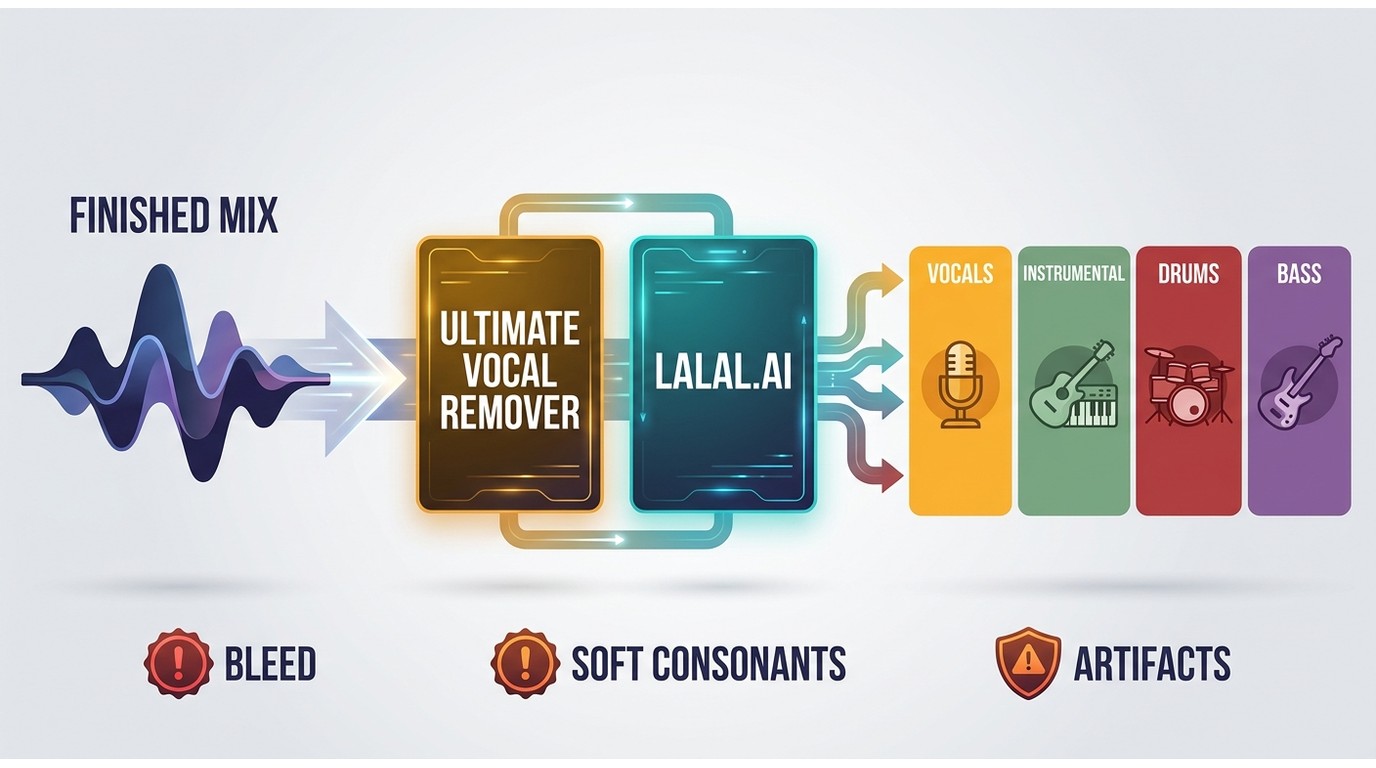
AI vocal isolation estimates separate sources from a finished mix rather than recovering the original studio tracks. An audio isolator may produce vocals and accompaniment, while a multi-stem system can also estimate drums, bass, piano, or other parts.
Modern systems recognize patterns associated with voice and instruments. Older center-channel methods reduce material shared by the left and right channels, so they can also weaken kick, bass, snare, or lead instruments placed near the center. An acapella isolator and an instrumental isolator describe desired outputs, not a guarantee of artifact-free recovery.
My editorial rule is simple: judge the stem against its intended use. A light trace of accompaniment may be acceptable for practice, while a remix vocal needs intact consonants, stable ambience, and fewer scratchy edges.
Best Vocal Isolators by Use Case
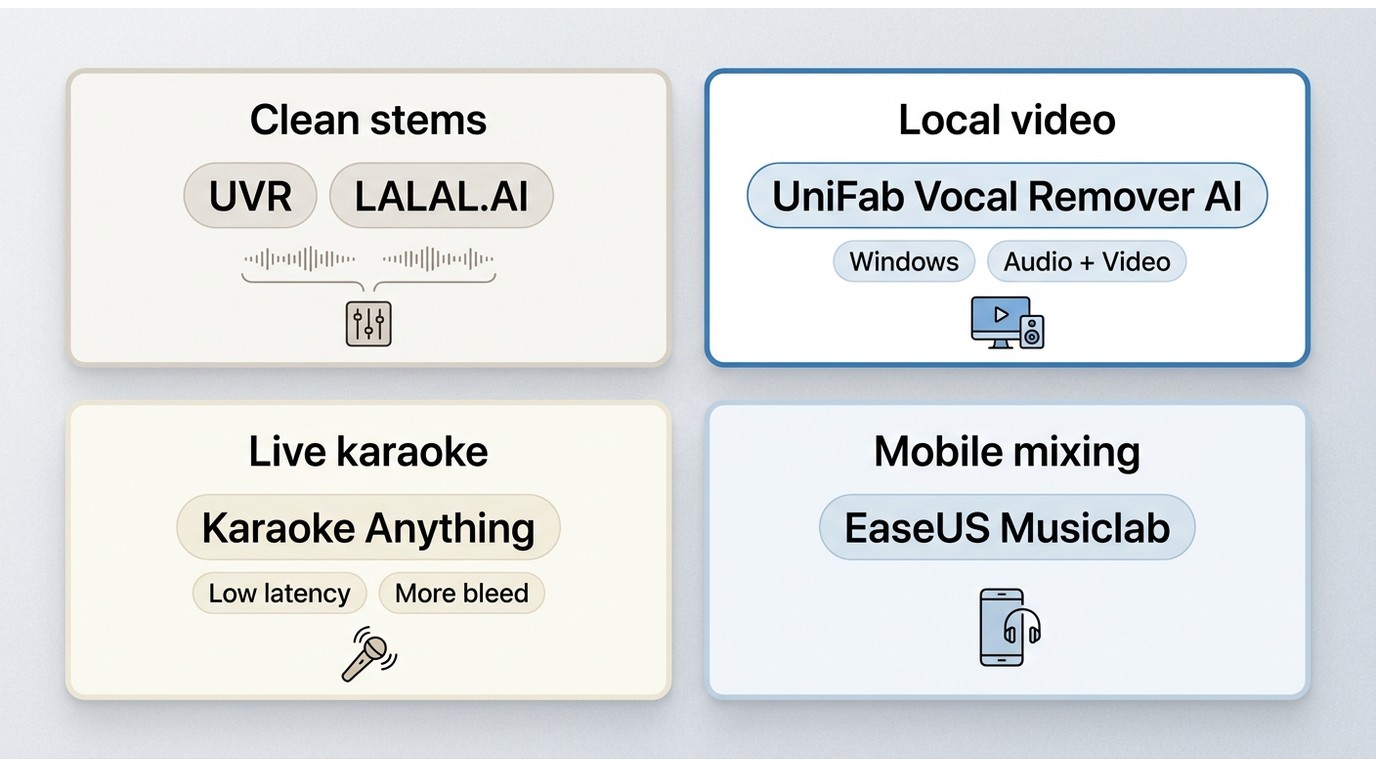
The best vocal isolation software depends on the job. A music isolator optimized for exported files serves a different need from a low-latency karaoke effect or a mobile editor.
Best for Clean Exported Stems
Ultimate Vocal Remover offers local model choice without a service fee, while LALAL.AI provides a guided browser workflow with multiple separation targets. UVR suits readers willing to compare models; LALAL.AI suits readers who prefer simpler controls and cloud processing.
I would not name either a universal winner. A dense chorus may favor one model, while a dry studio vocal may separate more cleanly with another.
Best for Local Video Workflows
UniFab Vocal Remover AI is the clearest fit here because it accepts audio and video files, processes them locally on Windows, supports batch work, and exports vocal and instrumental audio as MP3, M4A, or WAV.
It is suitable for Windows users handling audio or video they are authorized to process, where permitted by applicable terms and law. It is less suitable for macOS or Linux users, or anyone who wants a large library of selectable separation models.
Best for Live Karaoke
Live modes prioritize immediate playback, not the cleanest reconstructed stems. They can be useful when low latency matters more than export quality, but dense mixes usually reveal more vocal bleed and missing instruments than offline processing.
The pictured Karaoke Anything interface represents an older center-channel approach, not a current clean-stem recommendation. For a performance setup, audition the exact song and keep the original mix ready as a fallback.
15 Vocal Isolators Compared
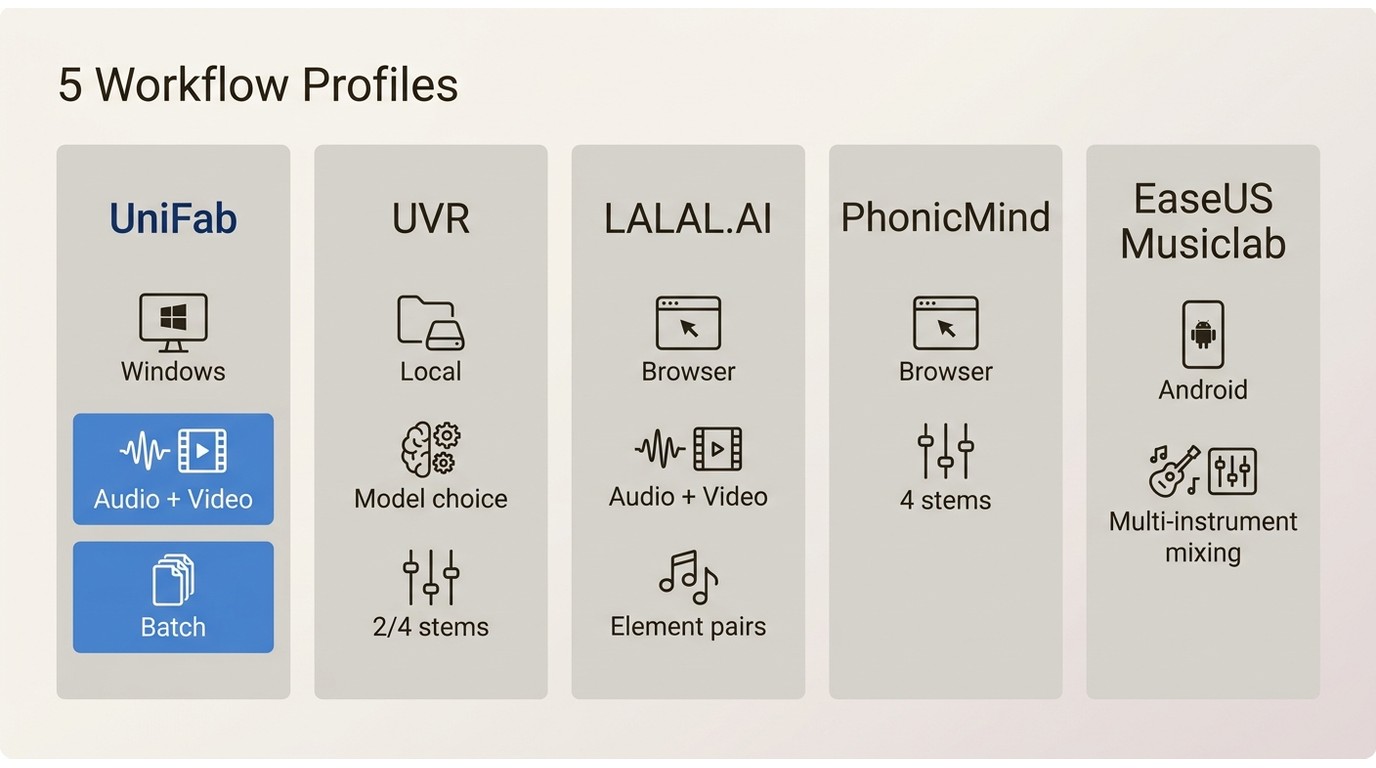
This matrix compares platform, processing location, inputs, outputs, control, and practical limits. Prices and access models are stated as of July 2026; a dash has been avoided, and fields use the narrowest supportable description rather than implying undocumented capability.
| Tool | Best use case | Platform | Processing | Access model | Audio input | Video input | Output | Stems | Batch | Control | Real-time | Main limitation |
| UniFab Vocal Remover AI | Local audio and video jobs | Windows | Local | $0 | Audio files | Video files | MP3, M4A, WAV | Vocal + instrumental | Yes | AI separation mode | No live mode stated | No macOS or Linux build; no model library |
| Ultimate Vocal Remover | Free model experimentation | Windows, macOS, Linux | Local | Free, open source | WAV; other audio through FFmpeg | No | Stem files selected by model | 2 or 4 by model | File workflow | VR, MDX-Net, MDX23C, Demucs | No | Setup and processing demand more hardware knowledge |
| Audacity | Manual editing and general audio work | Windows, macOS, Linux | Local desktop | Free, open source | Common audio files | No direct video workflow | WAV, MP3, FLAC, OGG | Vocal reduction or AI plug-in stems | Macros for repeat tasks | Spectral and effect controls | Effect preview | Manual reduction can damage centered instruments |
| WavePad | Editing many audio files | Windows, macOS, iOS, Android, Chromebook | Installed app | Free noncommercial edition; paid edition | 50+ audio formats | Can edit audio from video | Audio files | Vocal reduction/extraction | Yes | Effects, EQ, filters, plug-ins | No live separation stated | Some features require the paid edition |
| Adobe Audition | Detailed manual post-production | Windows, macOS | Local desktop | Subscription | Professional audio workflow | Video soundtrack workflow | Common audio exports | Center-channel extraction | Batch tools | Frequency and center-channel controls | Preview while adjusting | Not an automatic multi-model stem separator |
| LALAL.AI | Browser quality and element choices | Web, desktop, mobile, VST | Cloud on web; local VST | Free previews; subscription or minute packs | MP3, OGG, WAV, FLAC, AIFF, AAC, M4A | AVI, MP4, MKV, MOV, M4V | MP3, OGG, AAC, AIFF, WAV, FLAC | Pairs by element; 4 for lead/back mode | API or enterprise bulk | Network, de-echo, noise level | No | Free access does not include full-result downloads |
| Vocal Remover Pro | Simple karaoke backing track | Windows desktop or web | Local desktop or cloud web | Free web access; desktop purchase | MP3 desktop; MP3, M4A, OGG, AAC, AC3 web | No | Karaoke track | 1 processed backing track | No | Automatic | No | Web output is positioned below desktop quality |
| Media.io Vocal Remover | Quick browser preview | Web | Cloud workflow | Credit-based access after sign-in | Common audio files | No verified video input | Vocal or instrumental download | 2 described | No published batch option | Automatic | No | Formats and free limits are not published clearly |
| PhonicMind | Four-stem browser export | Web | Online service | Free preview; paid export | MP3, AAC, WMA, FLAC, WAV, AIFF | No | Instrumental, acapella, .stem.MP4 | 4: vocals, drums, bass, other | No published batch option | Automatic separation | No | 100 MB upload cap |
| VocalRemover.org | Fast two-stem browser mix | Web | Online service | Free access | Audio upload | No | Vocal and music tracks | 2 | No | Vocal/music balance | No | Limited control on dense or reverberant mixes |
| Vocal Remover, Cut Song Maker | Android karaoke plus editing | Android | Mobile app | Ads and in-app purchases | Device audio | No verified video input | Karaoke and edited audio | Vocal reduction | No verified batch mode | Cut and song-making tools | No | Current export details are sparse |
| AI Vocal Remover and Karaoke | Simple Android vocal/instrument split | Android | Mobile app | Ads and in-app purchases | MP3 | No | Vocal and instrumental files | 2 | No | Automatic | No | No published format or duration limits |
| SplitHit | Mobile karaoke practice | Android | Mobile app | Ads and in-app purchases | MP3 | No | Karaoke version | Vocal reduction | No | Mobile playback workflow | Playback-focused | Current listing does not document multi-stem exports |
| EaseUS Musiclab | Android multi-instrument mixing | Android | Mobile/cloud-assisted app | Free install with in-app purchases | MP3, WAV, M4A; device or cloud sources | Video input listed | Individual stems or adjusted mix | Voice, drums, guitar, bass, piano, strings and more | No published batch option | Mute, boost, per-track volume | Interactive mixing after processing | Export formats and premium limits are not stated |
| Audio Editor — Music Editor | General mobile trimming and mixing | Android | Mobile app | Ads and in-app purchases | MP3 | No | Edited audio | No verified stem separation | No | Trim, cut, mix, voice edit | No | Use it as an editor, not a quality benchmark |
The matrix shows the core trade-off: local tools protect unreleased material and avoid upload time, browser services reduce setup, and mobile apps favor convenience. For a dedicated browser ranking, use UniFab’s online vocal-remover comparison; this article keeps online products as decision rows rather than a second ranked list.
The Notta image above shows an earlier browser vocal-remover page. Notta is not ranked here because a current official product page with stable format, access, and deletion-policy details was not established.
Isolation Quality Tests and Results
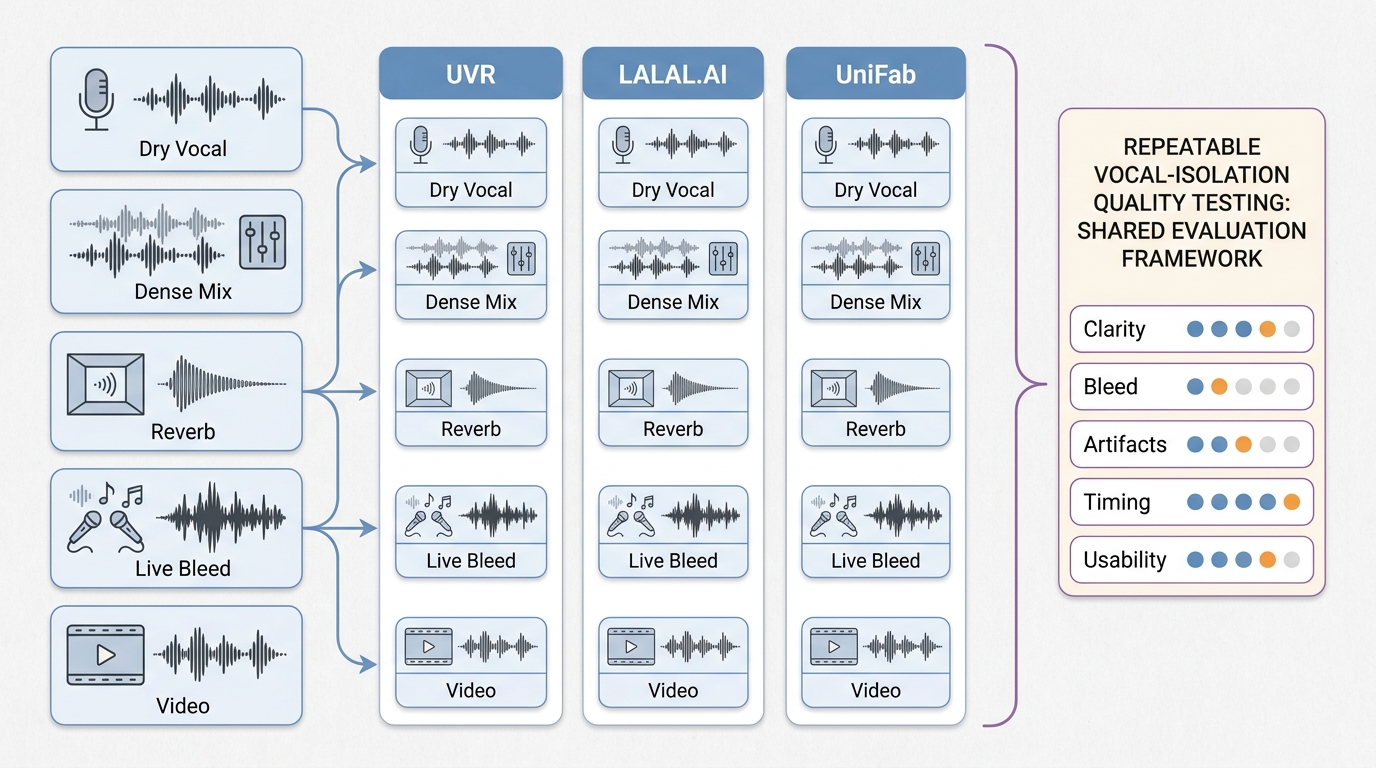
Because separation changes with the source, a fair AI voice isolator comparison uses the same clips and scoring rules for every tool. Without matched output files, the honest approach is to publish the protocol rather than invent a winner or numeric score.
Test Tracks and Scoring Criteria
Use five short, rights-cleared samples: a dry studio vocal, a dense mix with overlapping guitars or synths, a reverberant vocal, a live recording with microphone bleed, and a video-container sample. Keep source files, start and end points, and loudness consistent.
- Process the identical excerpt with each candidate using its default vocal setting.
- Export the vocal and accompaniment stems in the highest documented format available.
- Level-match outputs before listening so louder results do not seem cleaner by default.
- Score vocal retention, instrumental bleed, transient damage, ambience stability, and workflow friction.
- Repeat the most difficult excerpt with one alternate model or setting when the tool provides meaningful control.
For reproducibility, document the computer or phone model, operating-system version, source format, and selected model. Those details explain processing behavior without pretending that one machine’s result applies to every user.
Artifacts We Listen For
Listen first to word openings and endings. Missing first consonants make lyrics feel clipped; weakened sibilants and plosives make words less intelligible. Next, check for drum or guitar bleed, pulsing reverb, phasey ambience, and scratchy textures around sustained notes.
- Karaoke: residual lead vocal is usually more distracting than slight tonal change in the backing track.
- Remixing: damaged consonants, unstable reverb, and rhythmic bleed matter most because later compression can expose them.
- Live-recording cleanup: preserve natural ambience; aggressive separation can sound less believable than controlled bleed.
My priority order is intelligibility first, rhythmic bleed second, then texture. A technically “drier” vocal is not better if the words lose their attacks.
Desktop Vocal Isolation Software
Desktop audio isolation software is strongest when files are large, private, or numerous. The main choice is between guided separation, model-level control, and manual editing.
1. UniFab Vocal Remover AI — Local Video Workflow
UniFab Vocal Remover AI is a local Windows AI vocal isolator for audio and video files. It separates vocals from instrumentals, supports batch processing, and exports MP3, M4A, or WAV stems.
Good fit: Windows editors who want files to stay on the computer and need a direct video-to-stems path. Less suitable: macOS or Linux workflows, real-time performance, or users who want detailed model selection.
The useful distinction is workflow, not a universal quality claim: local processing avoids uploading confidential or unreleased material, while batch handling reduces repetitive setup.
Totally free and 100% safe!
- Step 1Open UniFab and Choose 'Vocal Remover'
- Step 2Load Your Media File
Click the "Add Video" button to choose the music or video from which you want to remove vocals.
- Step 3Click 'Start' Button to Initiate the Process
Make any desired edits to the loaded file, then click the start button. The best AI vocal isolator will complete the task at lightning speed.
Readers who need a longer procedural walkthrough can follow the guide on how to isolate vocals from a song.
2. Ultimate Vocal Remover — Model-Level Control
Ultimate Vocal Remover is a free, open-source desktop benchmark for Windows, macOS, and Linux. It supports VR Architecture, MDX-Net, MDX23C, and Demucs model families, so model choice can be matched to the source rather than hidden behind one automatic mode.
Good fit: users who want local privacy and are willing to compare models. Less suitable: readers who want the shortest setup or have limited memory and graphics hardware.
Start with a general vocal model, compare a Demucs-style option on dense arrangements, and keep the cleaner output rather than assuming the largest model is automatically better. A capable GPU mainly reduces waiting time and makes heavier models practical; the source and model still determine quality.
3. Audacity — Manual Editing Alternative
Audacity remains a useful free audio isolator for manual editing, spectral inspection, and common audio exports. Its traditional vocal reduction is not equivalent to modern AI separation, although optional AI plug-ins can extend the workflow.
Good fit: repair work, manual cleanup, and users who already need an editor. Less suitable: one-click clean stems from dense, reverberant, or mono mixes.
I treat Audacity as the place to inspect and repair a result, not as the automatic quality leader in this list.
4. WavePad — Broad Audio Editing Toolkit
WavePad combines vocal reduction or extraction with editing, conversion, effects, and large batch operations across desktop and mobile platforms.
Good fit: users processing many audio files who also need trimming, conversion, filters, or plug-ins. Less suitable: anyone choosing primarily by transparent multi-stem reconstruction.
Its practical advantage is breadth. The compromise is that the product page does not document a model library or a fixed stem architecture for detailed quality comparison.
5. Adobe Audition — Professional Manual Control
Adobe Audition provides center-channel and spectral controls inside a broader post-production environment. It is designed for detailed manual decisions rather than automatic multi-model source separation.
Good fit: editors already working in Adobe audio post-production who need previewable adjustments and repair tools. Less suitable: a quick free vocal isolator or automatic four-stem export.
The reason to choose Audition is control around the separation task, not a promise that center-channel extraction will outperform dedicated AI models.
Mobile Vocal Isolator Apps
Mobile AI voice isolator apps work well for practice, quick previews, and simple mixes. Their store listings often disclose fewer export and quality details than desktop products, so use a short sample before committing a long file.
11. Vocal Remover, Cut Song Maker
This Android app combines vocal reduction with song-cutting features. It is a practical choice for casual karaoke edits, but its current public listing does not establish a detailed stem architecture or export specification.
Choose it for convenience, not for model-level quality control or a documented batch production workflow.
12. AI Vocal Remover and Karaoke
AI Vocal Remover & Karaoke by TarrySoft accepts MP3 songs on Android and separates vocals from instrumentals. The app includes ads and in-app purchases.
It suits a simple two-stem mobile task. It is less suitable when the project requires video input, published duration limits, or clearly specified export formats.
13. SplitHit — Mobile Stem Mixing
SplitHit Vocal Remover is an Android app currently presented around MP3-to-karaoke use. Treat it as a playback and practice option rather than assuming the older multi-stem claims still apply.
The fit is immediate mobile practice; the limitation is that the current store summary does not document separate drum, bass, or guitar exports.
14. EaseUS Musiclab — Current Android Pick
EaseUS Musiclab is a current Android music isolator that accepts audio or video from the device and supported cloud sources. It can separate voice, drums, guitar, bass, piano, strings, and other parts, then adjust each track’s level.
Good fit: Android users who want multi-instrument practice or a custom mix. Less suitable: users who need a published batch mode, fixed export specification, or iOS parity.
The app was updated May 11, 2026 and lists more than one million Google Play downloads. Those signals establish current availability, not guaranteed separation quality on every recording.
15. Audio Editor — General Mobile Editing
Audio Editor & Music Editor on Android focuses on trimming, MP3 cutting, voice editing, and song mixing. Its current listing does not establish vocal separation, so it belongs here as a general editing fallback rather than an instrumental isolator benchmark.
The older image below shows Voloco, a mobile recording studio, not the current recommendation for vocal isolation.
Choosing the Right Vocal Isolator
Choose an AI vocal isolator by the compromise you can accept: waiting time, cloud upload, weaker live quality, limited formats, or less control.
Quality Versus Real-Time Speed
Offline and queued cloud processing can spend more time reconstructing stems. A vocal isolator plugin or live mode must keep latency low, so it may leave more bleed or soften transients on dense mixes.
For a performance, immediate playback can be the right choice. For remixing or archive work, export quality is usually worth the wait.
Local Versus Cloud Processing
Local processing keeps confidential or unreleased audio on the computer and avoids upload time, but it uses local CPU, memory, and GPU resources. Cloud services reduce installation and hardware demands, but require an upload and may meter downloads or processing minutes.
I favor local processing for unreleased sessions and batches. I favor a browser service for a short, nonconfidential file when setup time matters more than keeping the workflow offline.
Video Inputs, Stems, and Exports
Check the complete path before choosing: whether MP4, MKV, or MOV input is accepted; whether the service is audio-only; whether separate WAV or MP3 stems can be downloaded; and whether several files can run as a batch.
An audio-only service can still work after a separate extraction step, but that adds conversion and file management. For video editors, direct container input is often more useful than a longer list of instrument models.
Acapella extraction, vocal removal, and broader vocal separation are related outcomes with separate buying questions. Use the dedicated UniFab guides when one of those tasks, rather than cross-tool isolation quality, is the primary goal.
Vocal Isolation Questions Answered: FAQ
These answers cover the Edge cases that most often change a purchase or workflow decision.
Do Live Recordings Separate Cleanly?
Sometimes, but microphone bleed and room reflections give the model overlapping information. Test a short chorus and listen for clipped consonants, drum leakage, and unstable reverb before processing the full performance. For cleanup, a slightly imperfect natural stem may sound better than aggressive separation with obvious pumping.
Are Plugins Better for Real-Time Use?
A vocal isolator plugin is better when low latency and immediate monitoring are the priority. Offline or server processing has more time to reconstruct the stem and generally offers a better chance of cleaner export. Choose the plugin for performance; choose offline processing for remix, restoration, or publication.
Does a GPU Improve Isolation Quality?
A stronger GPU mainly improves speed and makes larger AI vocal isolation models practical. It does not repair a poor source or make every model equally accurate. Quality still depends on the model, arrangement, reverb, and compression, although faster processing makes model comparison less time-consuming.
Can Isolated Stems Be Used Commercially?
Separation does not create new copyright or commercial-use rights. Use stems commercially only when you own the audio, have permission or a suitable license, or the material is in the public domain. The same rule applies whether the audio isolator runs locally, in a browser, or on a phone.
Final Recommendation
Pick by workflow, then verify with a short sample. For local Windows audio and video, UniFab Vocal Remover AI offers local batch separation but no macOS, Linux, or model library. For free model control, UVR is stronger but requires more setup and hardware awareness.
For browser access, LALAL.AI offers broad format and separation choices, with download limits tied to access level. For live use, choose a plugin or low-latency tool and accept that the exported stem may contain more bleed. On Android, EaseUS Musiclab provides the clearest current multi-instrument mixing path, while its export and batch details remain limited.
No tool avoids every compromise. The reliable decision is the one that matches your platform, privacy needs, source complexity, latency target, and required output.