Creators can add captions on TikTok with automatic captions, timed manual text, or a reviewed subtitle-file workflow that is embedded in the finished video. Viewers can show or hide supported native captions when TikTok provides that control, but subtitles burned into the video remain visible.
For a quick single-language post, TikTok auto captions are the sensible default. External subtitle preparation makes more sense when translation, a reusable file, or tighter review of names and timing matters.
Why TikTok Captions Matter
Captions on TikTok make spoken content easier to follow when sound is unavailable, dialogue is difficult to hear, or a viewer needs text support. Closed captions on TikTok also give creators a chance to review names, jargon, and phrasing before publication.
- Accessibility: Text gives more people a practical way to follow the message.
- Comprehension: Captions help when audio competes with noise or fast speech.
- Editorial control: Reviewing the transcript catches errors that automatic recognition may miss.
My editorial rule is simple: captions should clarify the video without competing with the subject or the interface.
Add Captions with UniFab
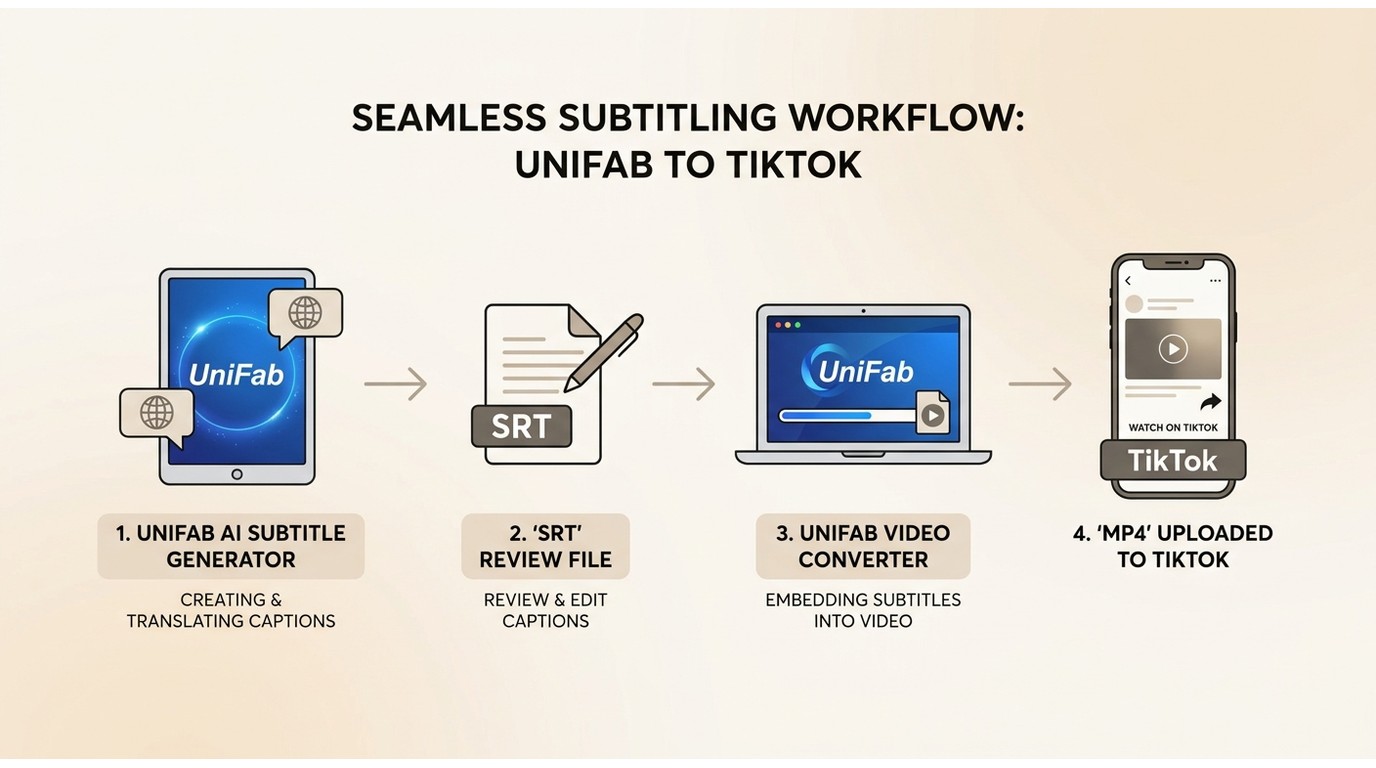
A desktop TikTok subtitle generator fits when you need translated captions, an editable subtitle file, or a review step before the text becomes part of the video. It adds preparation compared with TikTok's built-in route, so it is not the shortest path for a simple one-language clip.
When UniFab Fits the Workflow
UniFab AI Subtitle Generator is designed to generate captions and translations, then export the result as an SRT file. It is suited to multilingual posts and reusable subtitle files; it is less suitable when TikTok auto captions can handle a short clip adequately.
Verified Subtitle Features
To generate captions on TikTok outside the app, focus on the module's documented subtitle functions rather than a long feature checklist.
- Subtitle generation and translation in 30+ languages
- Up to 98% stated accuracy, with human review still needed for names and timing
- SRT export for editing and reuse in a separate video workflow
For a deeper explanation of creating and editing this file type, use the SRT file generator guide; this TikTok guide stays focused on publishing the finished captioned video.
Generate, Review, and Burn In Subtitles
To add subtitles on TikTok with this route, prepare the subtitle file first, review it, and then embed the reviewed text in the video before upload. TikTok should receive the finished MP4, not an assumed direct SRT publishing workflow.
- Import an authorized source video into UniFab AI Subtitle Generator and choose the source and target languages needed for the post.
- Generate the subtitles, then review names, punctuation, timing, and line breaks against the source audio.
- Export the reviewed captions as an SRT file.
- Open the video and SRT in an editor such as UniFab Video Converter, set readable styling and placement, and embed the subtitles in the video.
- Export the finished MP4, preview it on a phone, and upload that video to TikTok.
For broader translation workflows beyond TikTok, the online video translator guide covers the next step without turning this page into a tool comparison.
What We Found in Testing
Judge a TikTok subtitle generator by visible outputs: correct names, natural line breaks, synchronized cues, and a clean SRT export. An accuracy claim is less useful than checking the generated text against the source audio before it is embedded.
The practical trade-off is the extra editing stage. UniFab prepares and exports subtitle text, while styling and burn-in happen in the video editor. I would choose this route for translation or reusable captions, not for a one-off clip that TikTok can caption well in-app.
Add Captions in the TikTok App
The TikTok app offers two direct ways to add captions on TikTok: automatic captions for spoken dialogue and timed manual text for short, deliberate overlays. Control names and placement can vary by account or app version as of July 2026.
Use TikTok Auto Captions
TikTok auto captions are the fastest way to generate captions on TikTok for a straightforward, single-language post. They are useful for speed, but creators should still review automatic TikTok subtitles for names, slang, punctuation, and awkward line breaks.
- Open TikTok, tap the create control, and record a video or upload a prepared clip.
- In the editing tools, select the caption or accessibility option available for the account and let TikTok process the spoken audio.
- Read the generated text while the video plays. Correct recognition errors and split long lines where the editor allows.
- Choose a readable style and move the caption block away from key visual details.
- Preview the full video, save the edit, and continue to publication.
Native captions are sufficient when the language is clear and the post does not need a reusable subtitle file. If repeated corrections, translation, or consistent cross-platform text becomes the main task, switch to the reviewed subtitle-file method.
Add Captions Manually
Manual text is the practical way to put subtitles on TikTok when a short clip needs emphasis, commentary, or carefully timed phrases. It offers direct placement control, but it is not an efficient transcription method for long dialogue or frequent posting.
- Record or upload the video, then open the text tool in the TikTok editor.
- Enter a short caption and choose a readable font, color, and alignment.
- Select the text layer, open its duration control, and set when it appears and disappears.
- Repeat for the remaining lines, preview the timing, and save the edit.
Keep this method focused on TikTok caption timing. For animated titles or broader text-overlay editing across devices, use the guide to adding text to video.
Position Captions in the Safe Zone
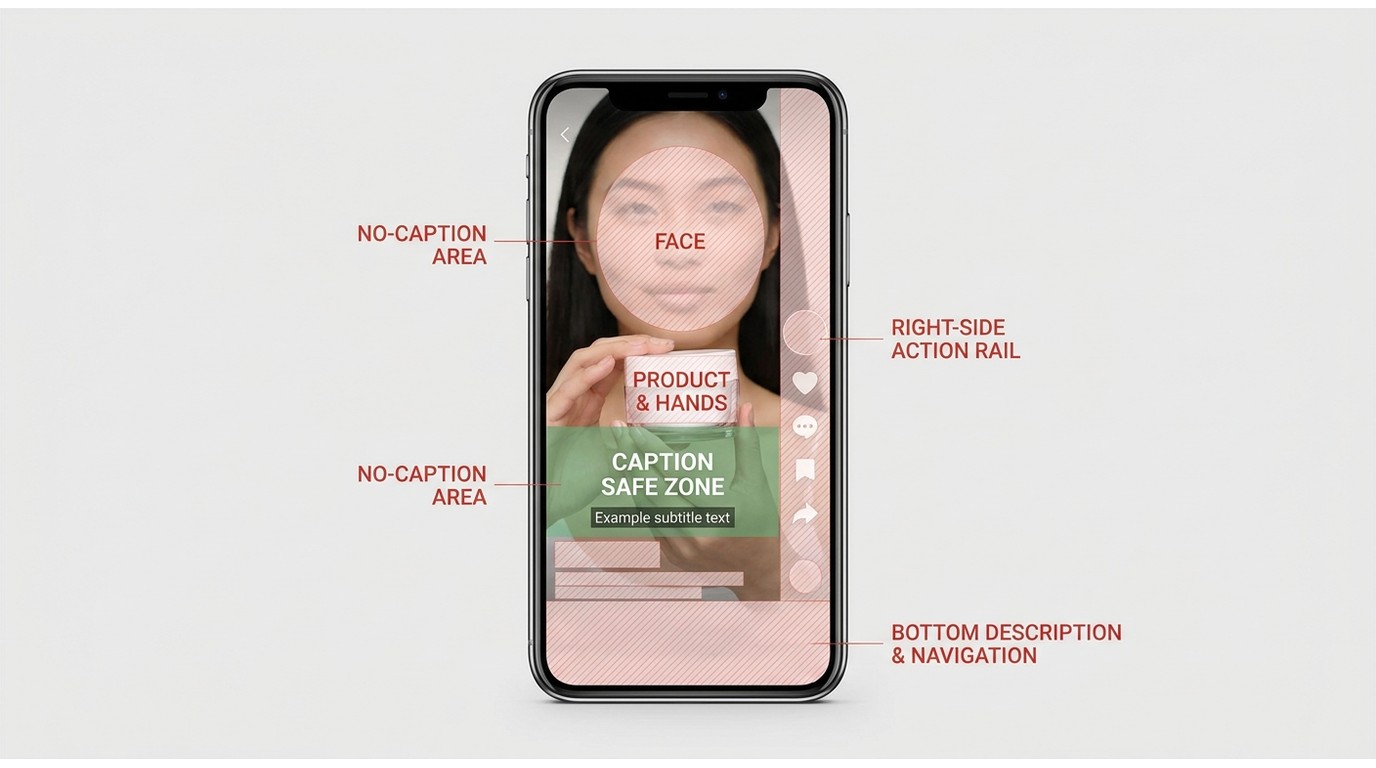
Good caption placement keeps text readable without hiding the speaker, product detail, or TikTok controls. Treat the safe zone as a visual check rather than a fixed pixel measurement.
- Keep text clear of the right-side action rail.
- Leave room above the lower description and navigation controls.
- Avoid covering faces, hands, demonstrations, or important on-screen labels.
- Use strong contrast and short lines that can be read at phone size.
- Preview the final composition on a phone before publication.
The safest editorial choice is a consistent position that follows the subject without jumping around the frame.
Fix TikTok Caption Problems
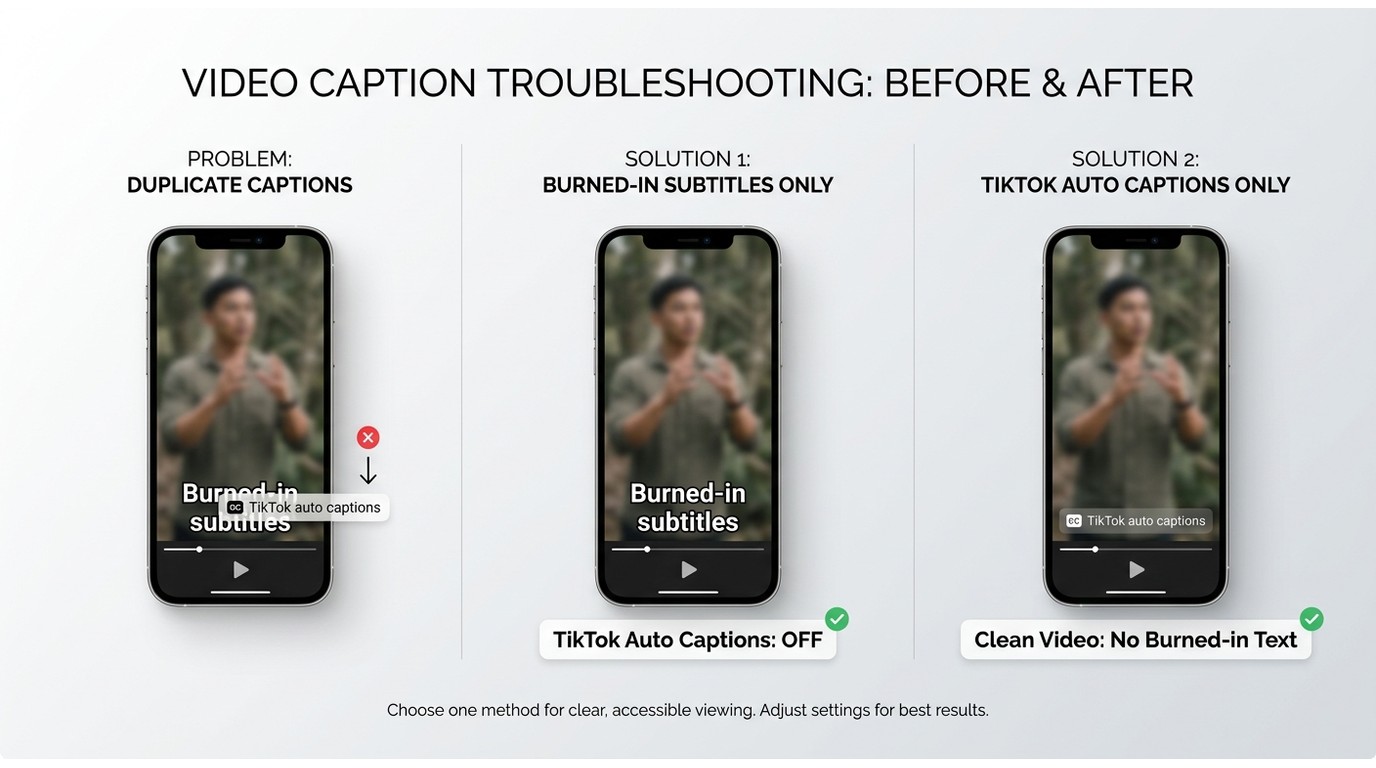
Most TikTok caption problems can be narrowed to a missing control, a failed generation or save step, poor text layout, or two caption layers appearing together. Preserve the source video and project before retrying or reposting.
Restore a Missing Captions Control
If you cannot enable subtitles on TikTok because the control is missing, update the app, restart it, and reopen the editing flow with a short test clip. The caption tool can differ by account, region, device, or app version, so look for the feature by label rather than relying on one fixed icon position.
Viewers trying to turn on TikTok captions should open the video's available caption or accessibility controls. If no native-caption option appears, the creator may not have published a supported caption layer.
Fix Overlap, Line Breaks, and Saving
When captions overlap or split sentences badly, shorten each line, review the cue boundaries, and preview the entire clip instead of checking a single frame. If generation or saving fails, restart the edit and retry with a shorter export while keeping the original project intact.
- Text covers the subject: move the caption block into the safe zone and check the opening and closing frames.
- Every line stays on screen: reopen duration settings and assign each manual text layer a separate time range.
- Sentences break awkwardly: edit at phrase boundaries and avoid packing too many words into one line.
- The edit does not save: restart TikTok, confirm available device storage, and retry from the preserved source.
Avoid Duplicate Caption Layers
Duplicate captions usually mean the video already contains burned-in subtitles while TikTok auto captions are also enabled. Choose one visible layer for the published post: keep the embedded version and turn off native generation, or export a clean video and use TikTok's native captions.
My preference is native captions for simple posts because supported viewer controls remain available. Embedded subtitles make more sense when exact styling, translation, or consistent rendering is essential.
Compare the Three Caption Methods
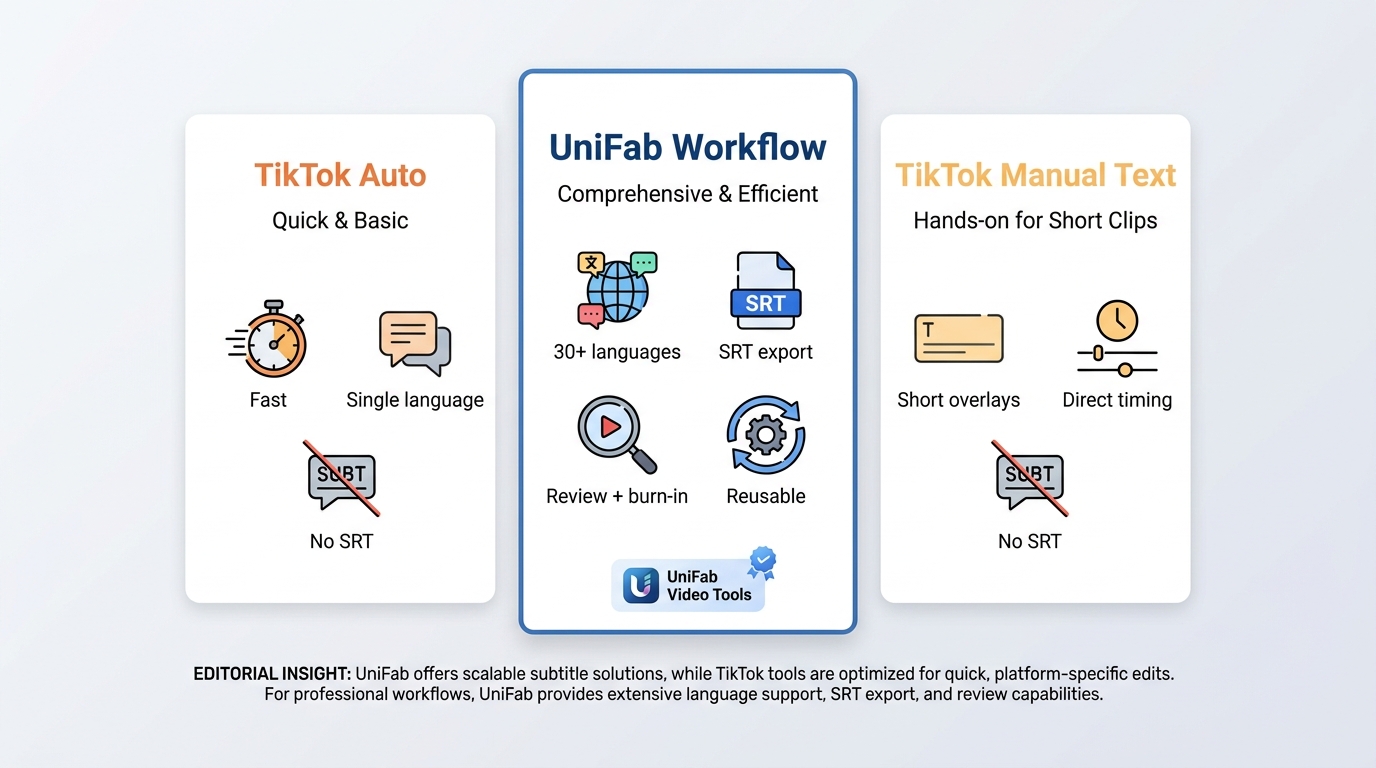
The right method depends on speed, language needs, and how much control the final text requires. TikTok auto captions minimize setup, manual text handles short expressive overlays, and the UniFab subtitle-file workflow adds review and reuse at the cost of another editing step.
| Method | Best fit | Setup speed | Transcription accuracy | Editing and styling control | Translation support | Reusable subtitle file | Publishing workflow | Common failure mode |
| TikTok auto captions | Quick single-language posts | Fast, inside the app | Requires review for names and phrasing | Uses the native options available in the app | Limited compared with a prepared translation workflow | No standard exported SRT workflow | Generate, review, and publish in TikTok | Recognition errors or a missing caption control |
| TikTok manual text | Short emphasis and supplementary text | Fast for a few lines, slow for full dialogue | Depends on the creator's transcription | Direct timing, position, and basic styling in TikTok | Text can be entered manually in another language | No | Add timed text layers, preview, and publish | Overlapping layers or incorrect duration |
| UniFab subtitle-file workflow | Translation, review, and reusable captions | Longer because it includes file review and video editing | Up to 98% stated accuracy, followed by manual review | Subtitle text is prepared in UniFab; visual styling and burn-in happen in the editor | Generation and translation in 30+ languages | Yes, SRT export | Generate SRT, review, embed in video, export MP4, and upload | Skipping review or assuming TikTok accepts the subtitle file directly |
The practical upshot is that no method wins every scenario. Choose the shortest workflow that still gives the post the language coverage and visual control it needs.
Choose the Right Caption Method
Choose TikTok auto captions for speed, manual text for short expressive overlays, and a reviewed subtitle-file workflow for translation, reuse, or stricter quality control. Accuracy percentages matter less than the final review of names, timing, line breaks, and placement.
- Use TikTok auto captions when the post is in one language and needs a quick native workflow.
- Use manual text when a short clip needs selected phrases, emphasis, or commentary rather than full transcription.
- Use the UniFab workflow when captions need translation, SRT reuse, or a separate review before the text is embedded.
For most creators, starting with the native option and moving to external preparation only when a clear need appears keeps the workflow efficient.
Final Wrap Up
There are three dependable ways to add subtitles on TikTok: native auto captions, timed manual text, and a reviewed subtitle-file workflow embedded in the finished video. The first is quickest, the second suits short creative overlays, and the third provides more control for multilingual or reusable captions.
Whichever method you choose, review the words, timing, line breaks, contrast, and screen position before publishing. For general subtitle workflows beyond TikTok, continue with the guide on how to add subtitles to a video.
TikTok Caption FAQs
Can I edit captions after a TikTok is published?
It depends on the caption type and the controls available to the account. Post text and supported native creator-caption options may have different editing limits by app version. Subtitles burned into the video image require editing the source video and uploading a revised post.
Can I upload an SRT or VTT file directly to TikTok?
The dependable publishing route is to review the subtitle file, embed the captions in a video editor, export the finished MP4, and upload that video. Do not plan the workflow around a direct SRT or VTT upload unless the account's current TikTok interface explicitly provides it.
Can viewers hide every type of TikTok caption?
No. Viewers may be able to show or hide supported native closed captions on TikTok when the control is available. Burned-in subtitles are part of the video image, so viewers cannot toggle that text off.
Which caption method works best for multilingual TikTok videos?
A reviewed subtitle-file workflow is usually the better fit for translated or consistently styled captions because it supports language review before publication. TikTok auto captions remain the faster choice for a simple single-language post, while UniFab is useful for translation and SRT export but adds a separate editing step.