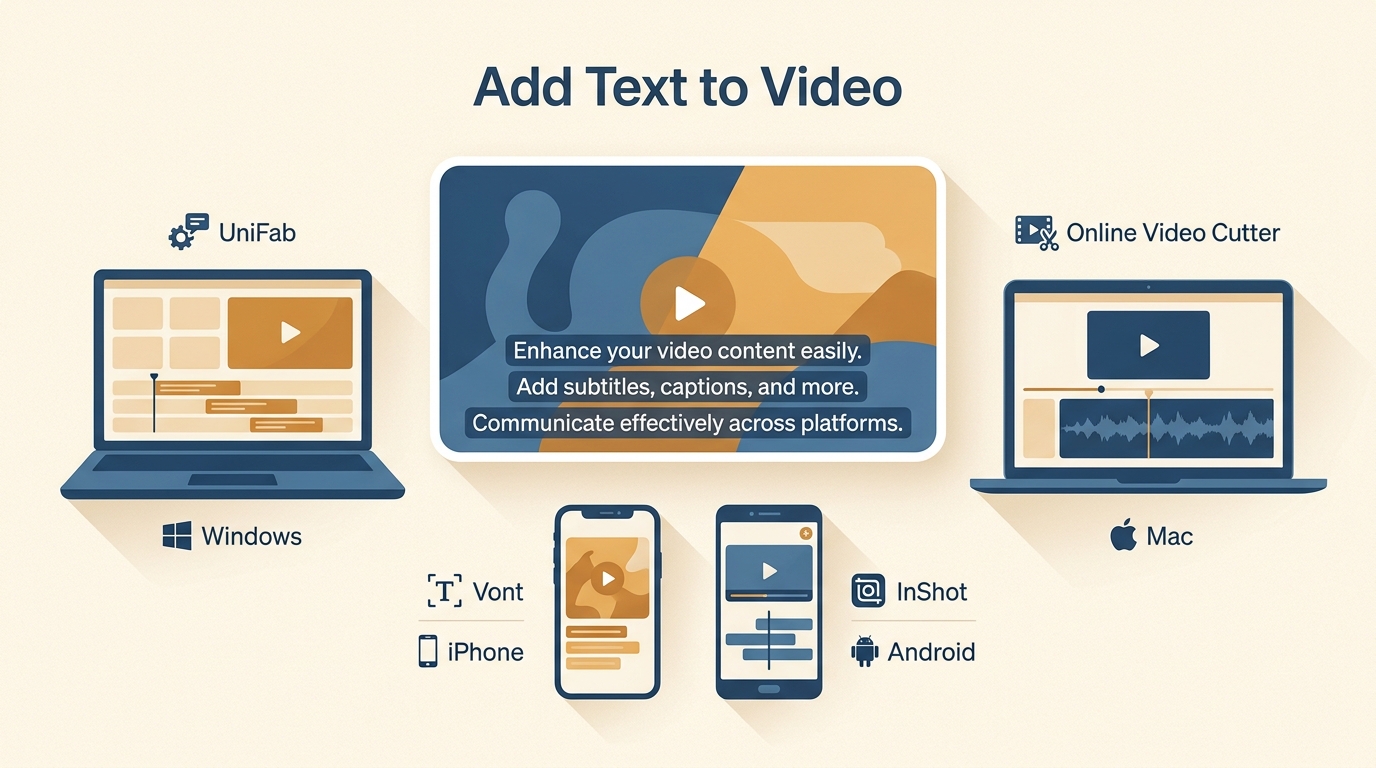
To add text to video, import the clip, create a text layer or captions, adjust the style and timing, and export the finished file. The controls vary by device, but that shared workflow makes it easier to choose a tool without learning the whole process again.
Why Text Helps Viewers Follow a Video
Clear on-screen text helps viewers understand a video without sound, notice key points, follow instructions, and identify speakers. A video text editor can also support consistent branding, translation, and more usable captions when the wording and timing are reviewed.
The two linked clips below are useful visual references for comparing different presentation styles, but their view totals do not prove that text alone caused an engagement difference.
| Reference | What to observe |
| Podcast video with on-screen text | Placement, emphasis, and how text competes with faces and graphics |
| Podcast video without added text | How much context remains clear when the viewer watches without sound |
Text Overlays, Subtitles, and Captions Compared
Choose the text type before choosing the app. Decorative overlays, dialogue subtitles, and accessibility captions solve different problems even when they appear in the same part of the frame.
| Text type | Main purpose | Speech transcription | Typical output |
| Text overlay | Titles, labels, calls to action, and emphasis | No | Editable layer while working, then burned into the exported video |
| Subtitle | Spoken dialogue, often translated | Yes | SRT sidecar file, soft subtitle track, or burned-in text |
| Closed caption | Dialogue plus useful sound cues for accessibility | Yes | Toggleable caption track or platform caption file |
If detailed subtitle-file workflows are the main goal, use the guide to add subtitles to a video. This page stays focused on choosing and placing text.
Add Text in Four Simple Steps
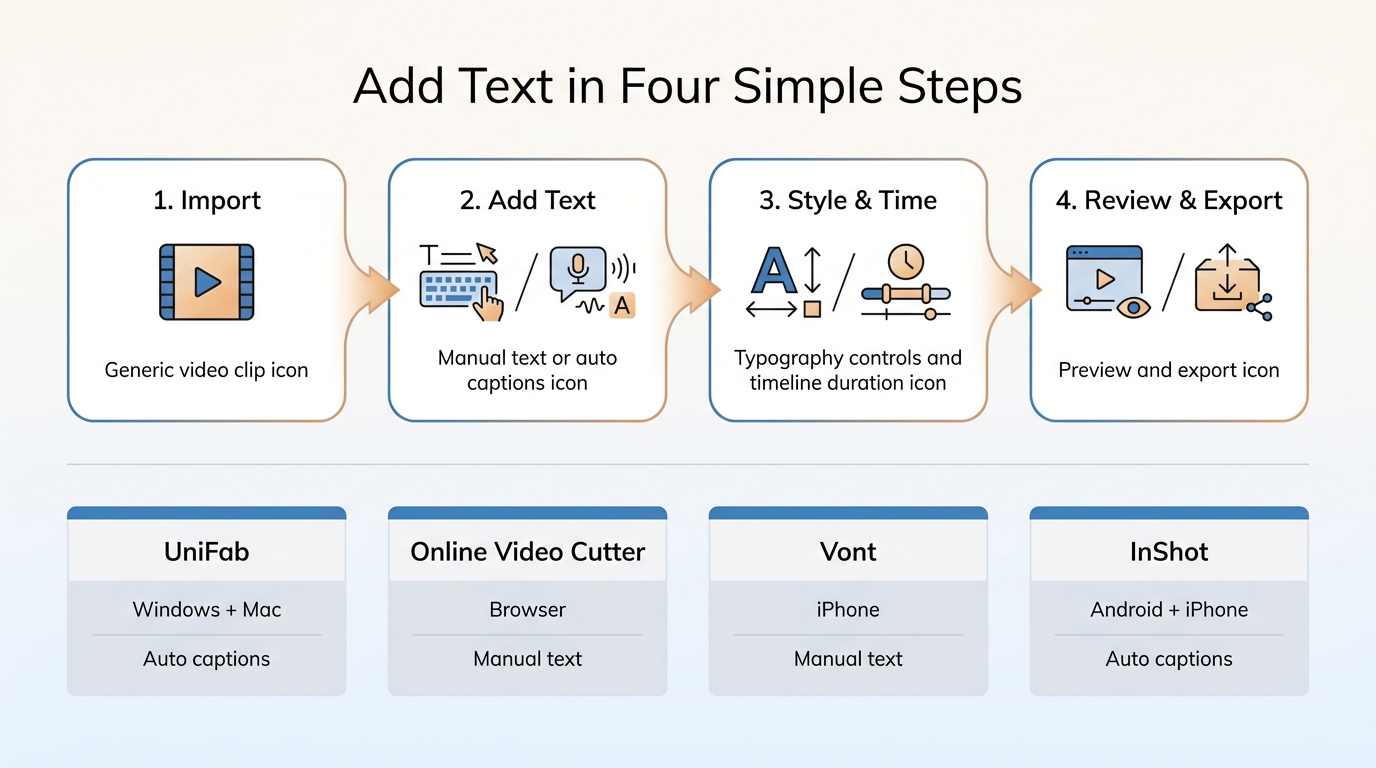
The basic process is the same whether you add words to video manually or add text automatically from speech. Start with the output you need, because a separate SRT file and visible text baked into the picture are not interchangeable.
- Import or upload the video. Use the original file when possible so the editor has enough detail for a clean export.
- Add text or generate captions. Type a title, label, or callout, or let a caption tool transcribe the spoken audio.
- Set appearance and timing. Adjust font, color, position, line breaks, and each text block's start and end points.
- Review and export. Check names, punctuation, safe-zone placement, and synchronization before saving the video or subtitle file.
The editorial priority is readability. Effects can support a message, but they should not make the viewer work harder to read it.
1. Add Text to a Video on Windows & Mac
For Windows and Mac, an AI video editor text workflow is most useful when a project contains substantial spoken dialogue. UniFab focuses on time-aligned subtitles rather than freely positioned animated titles.
UniFab AI Subtitle Generator
UniFab AI Subtitle Generator turns speech into editable, time-aligned subtitles and saves them as an SRT file. It fits long-form or multilingual speech projects where manual transcription and timing would be repetitive.
Suitable for: automatic captions, editable subtitle timing, batch-oriented desktop work, and projects that need a separate caption file.
Less suitable for: decorative titles, rotating labels, or motion graphics that must be positioned freely around the frame.
For personal media you are authorized to edit, generate the captions first, review wording and timing, and then use UniFab Video Converter when the text needs to appear directly in the exported MP4 or MKV video. UniFab supports Windows and Mac workflows, output up to 4K, and batch processing.
30-day Free Trial for full features, without watermark!
After launching the UniFab program on our system, we navigated to the main interface and accessed the “Subtitle Generator.”
Next, we uploaded our newly created YouTube short video file to create subtitles based on the audio of the uploaded video. Alternatively, you can also upload any ready-to-use external SRT file with text to translate it to your desired language.
We have selected English from the available 30 languages. Click the “Start” option, and the tool automatically creates an SRT file with text in the language we have chosen. Here, we have used the UniFab Video Converter to add the newly created SRT file with text to our required video.
Translation belongs in a separate workflow: readers primarily converting spoken content between languages can continue with the dedicated online video translator resource. A broader comparison of automatic caption options also belongs in the free subtitle generator roundup.
2. Add Text to Video Online
A browser-based free video text editor is convenient for a quick manual overlay because it works without installing desktop video text software. The tradeoff is that uploads, previews, account rules, and export limits depend on the service and connection.
Online Video Cutter
Online Video Cutter provides a direct video text editor for titles, labels, and short captions. It offers manual styling and animation controls, but it does not replace automatic transcription for dialogue-heavy projects.
Suitable for: quick browser edits, short labels, and projects where installing software is inconvenient.
Less suitable for: long spoken videos, unstable connections, or projects that need automatic captions and a reusable SRT file.
- Upload the source clip from the device or a supported cloud location.
- Select Add Text, type the copy, and adjust font, color, size, and animation.
- Place the text on the frame and set its start and end points on the timeline.
- Preview the full clip, paying attention to text near player controls and screen edges.
- Choose the export settings and save the rendered video.
If the goal is to add text without watermark, inspect the export conditions before doing a long edit. Browser tools may change resolution, file-size, signup, or watermark limits across their free access levels.
3. Add Text to Video on iPhone
Vont is a current video text app for iPhone users who want typography controls and manual placement. Apple stopped offering Clips to new users on October 10, 2025, so it is no longer the right default recommendation for a new installation.
Vont for iPhone Text Overlays
Vont is designed to add words to video with control over font, size, color, stroke, shadow, position, and rotation. It is a practical fit for titles, labels, and stylized short-form text rather than automatic speech transcription.
Suitable for: typography-led social clips, manually timed callouts, and users who want more font control on iPhone.
Less suitable for: long dialogue, automatic captions, or a workflow centered on editable subtitle files.
- Open the video in Vont and create a new text layer.
- Type the wording, choose a readable font treatment, and position it inside the safe area.
- Set the text duration and repeat for any additional callouts.
- Preview the clip and export after checking that the text remains readable on a phone screen.
The following archived Apple Clips images are retained as interface context, not as a recommendation for new users.
4. Add Text to Videos for Android
InShot combines manual overlays with AI auto captions in a mobile video text app. Captions in InShot still need a human review for wording, timing, and line breaks before the final export.
InShot
InShot supports text overlays, timeline placement, font and color controls, animation presets, and automatic captions. It works well for short mobile edits where visual text and basic video changes happen in one project.
Suitable for: reels, shorts, quick explainers, and creators who want overlays and captions in the same mobile editor.
Less suitable for: long multilingual projects where desktop review, reusable subtitle files, and batch handling matter more than mobile effects.
- Open InShot, choose Video, and import the clip.
- Select Text for a manual overlay, or use auto captions for spoken dialogue.
- Edit the wording, drag the text into position, and adjust the timeline handles.
- Preview every caption change, then export with the required resolution and watermark setting.
Compare Four Video Text Tools
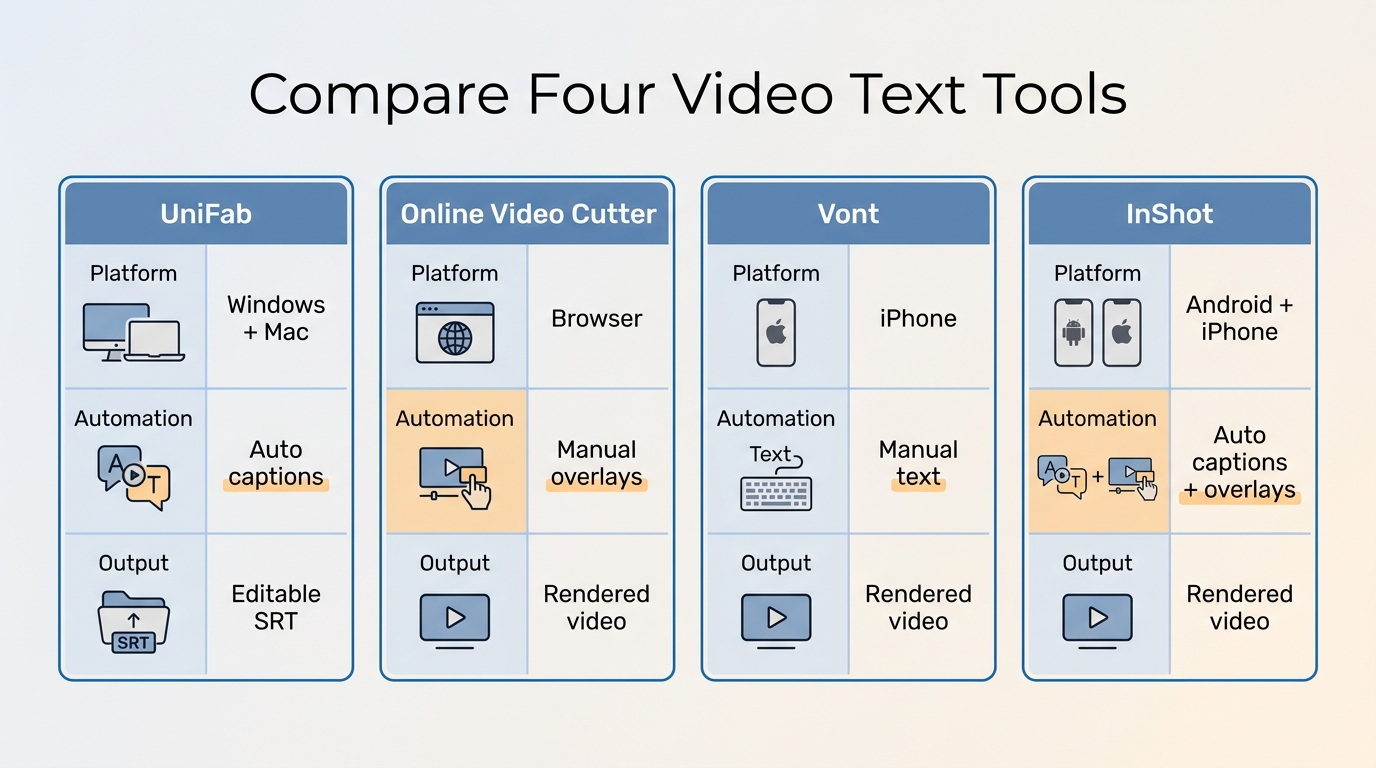
The useful comparison is operational: current availability, automation, styling, watermark conditions, output type, and the kind of project each tool handles comfortably. Ratings are omitted because store and review figures change faster than the workflows.
| Tool | Current availability | Platform | Manual text overlays | Automatic captions | Text styling and rotation | Watermark on free export | Signup requirement | Export resolution or file limit | Saved output type | Best fit | Not ideal for |
| UniFab AI Subtitle Generator | Available | Windows, Mac | No decorative overlay editor | Yes | Subtitle editing rather than free rotation | Not applicable to SRT output | Desktop product access required | Video workflow supports up to 4K | SRT; MP4 or MKV after the separate burn-in step | Long-form or multilingual spoken video | Animated titles and freely placed graphics |
| Online Video Cutter | Available | Modern browser | Yes | No in this text-overlay workflow | Manual styling and animation controls | Depends on current export conditions | Basic use may not require signup | Service limits depend on the current access level | Rendered video | Quick browser overlays | Long transcription and reusable caption files |
| Vont | Available in the US App Store | iPhone | Yes | No | Font, color, stroke, shadow, position, and rotation | Depends on current app export conditions | App installation required | Depends on device and current app conditions | Rendered video | Typography-led iPhone edits | Automatic captions and long dialogue |
| InShot | Available | Android, iPhone | Yes | Yes | Manual styling plus presets | May apply under free access | App installation required | Export options depend on device and app access | Rendered video | Short mobile edits with effects | Long multilingual desktop caption projects |
The practical takeaway is that no row wins every category. Choose the output and level of control first, then pick the editor that matches it.
Make On-Screen Text Easier to Read
Readable text depends more on contrast, placement, pacing, and restraint than on elaborate effects. A good video text editor should make those basics easy to check before export.
- Social clips: use short phrases, fast visual hierarchy, and safe-zone placement that avoids app controls. For platform-specific placement, see the guide to subtitles and captions on TikTok.
- Marketing ads: keep the message focused on one action, use restrained animation, and leave enough screen time for a first read.
- School and tutorial videos: label the exact object or step being discussed, keep terminology consistent, and time each callout to the demonstration.
- Brand content: use a consistent font, color system, capitalization style, and position instead of changing the design from scene to scene.
- Accessibility: use strong contrast, readable line lengths, and accurate captions. Include meaningful sound cues when the text functions as closed captions.
Readability should take priority over effects. If an animation delays recognition or a label covers the subject, the design is working against the message.
Choose the Right Text Workflow
The central choice is automation versus visual control. Manual overlays offer precise placement and styling, while auto captions reduce transcription and timing work but still require editorial review.
- Choose manual overlays for titles, lower thirds, labels, and marketing calls to action.
- Choose auto captions for spoken content when speed matters and corrections can be reviewed before export.
- Choose an SRT sidecar when a platform or viewer should be able to toggle, restyle, or translate the subtitle track. Readers focused on file creation can use the dedicated SRT generator guide.
- Choose soft subtitles when the subtitle track should travel inside a compatible media container but remain selectable.
- Choose burned-in text when the words must remain visible in every player. This makes the text part of the picture, so later wording changes require another export.
Watermark and free-access rules can shift between versions and devices. Confirm the export result with a short sample before committing a long project, especially when a free video text editor is central to the workflow.
The Best Method Depends on Your Project
Use an online or mobile editor for visual text that needs manual placement, and use UniFab when the main job is generating and editing time-aligned subtitles on Windows or Mac. Keep the separate burn-in step in mind, and review every AI-generated name, line break, and timestamp before delivery.
That decision path is more reliable than choosing by feature count: match the tool to the text type, output format, editing length, and device.
Questions About Adding Text to Video
Can I add text to an MP4 without a watermark?
Yes, but it depends on the editor and its current export conditions. Check the comparison table for watermark, signup, and output differences, then export a short sample before editing the full MP4.
Can I edit AI-generated captions before exporting them?
Yes. Review names, accents, punctuation, line breaks, and synchronization before saving the subtitle file or rendering visible captions into the video.
Should I save captions as an SRT file or burn them into the video?
Use SRT when viewers or platforms should control the subtitle track. Use burned-in text when the words must be visible everywhere; the full tradeoff is summarized in the workflow section above.
Can ChatGPT add text directly to a video?
ChatGPT can help draft titles, captions, and scripts, but a video text app or editor is still needed to position the words, set timing, review the result, and export the finished video.