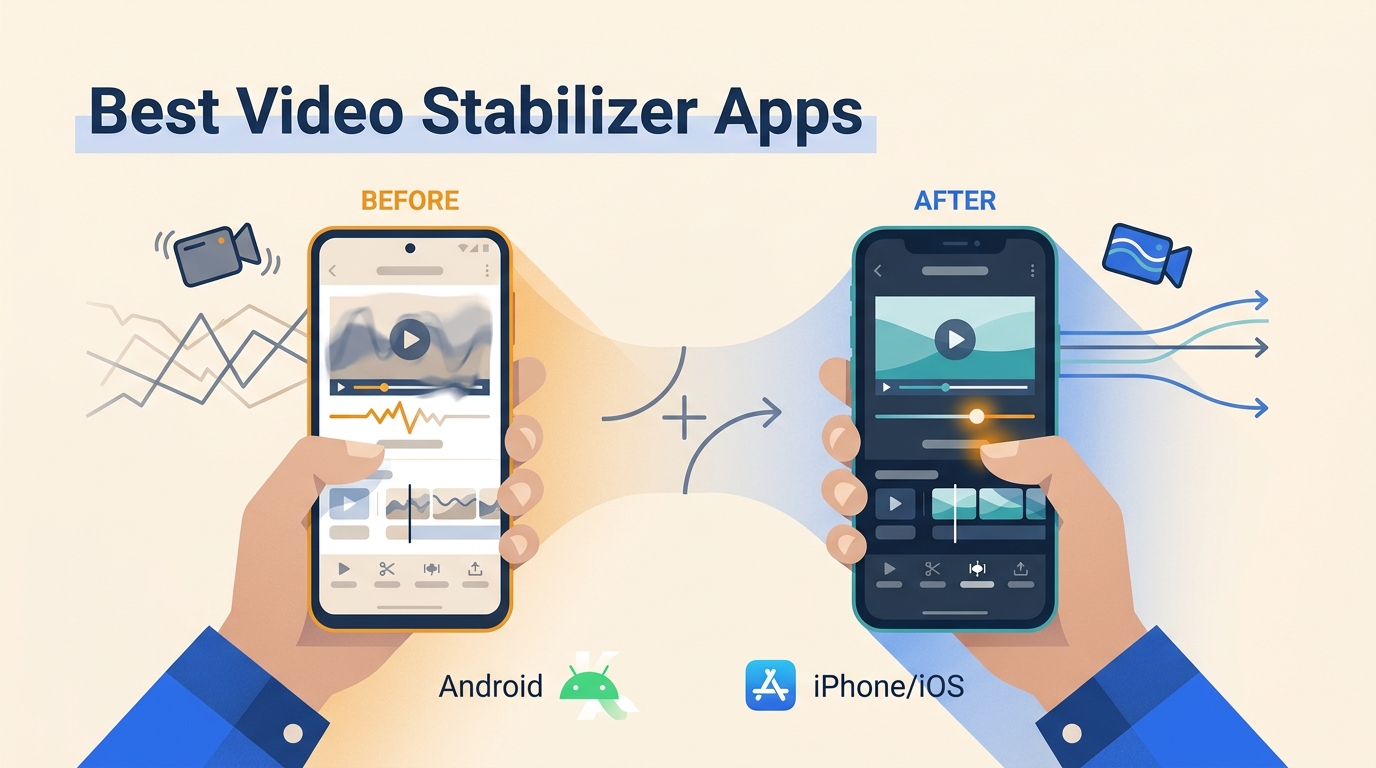
A video stabilizer app can smooth light handheld shake after recording, but it cannot recreate detail lost to motion blur or rescue every severe jolt. Phone apps fit quick social edits; long clips, repeated exports, 4K projects, or strong wobble are clearer signals to move to desktop processing.
This is a documentation-based comparison of current US product pages and store listings, not a claim that all ten apps were tested on one shared clip. That distinction matters because app names, included tools, watermark rules, and export limits change across platforms and releases. For video stabilizer app, verify this point on the actual source before processing the complete file.
Why Video Stabilization Helps
Quick answer: video stabilizer app should be chosen or configured by matching the source, viewing device or platform, quality target, privacy needs, and export limits. Test a representative clip, compare the result at full size, and avoid settings that add artifacts or unnecessary recompression. The latest GSC comparison shows that the optimization priority is impressions fell substantially while average position stayed broadly stable.
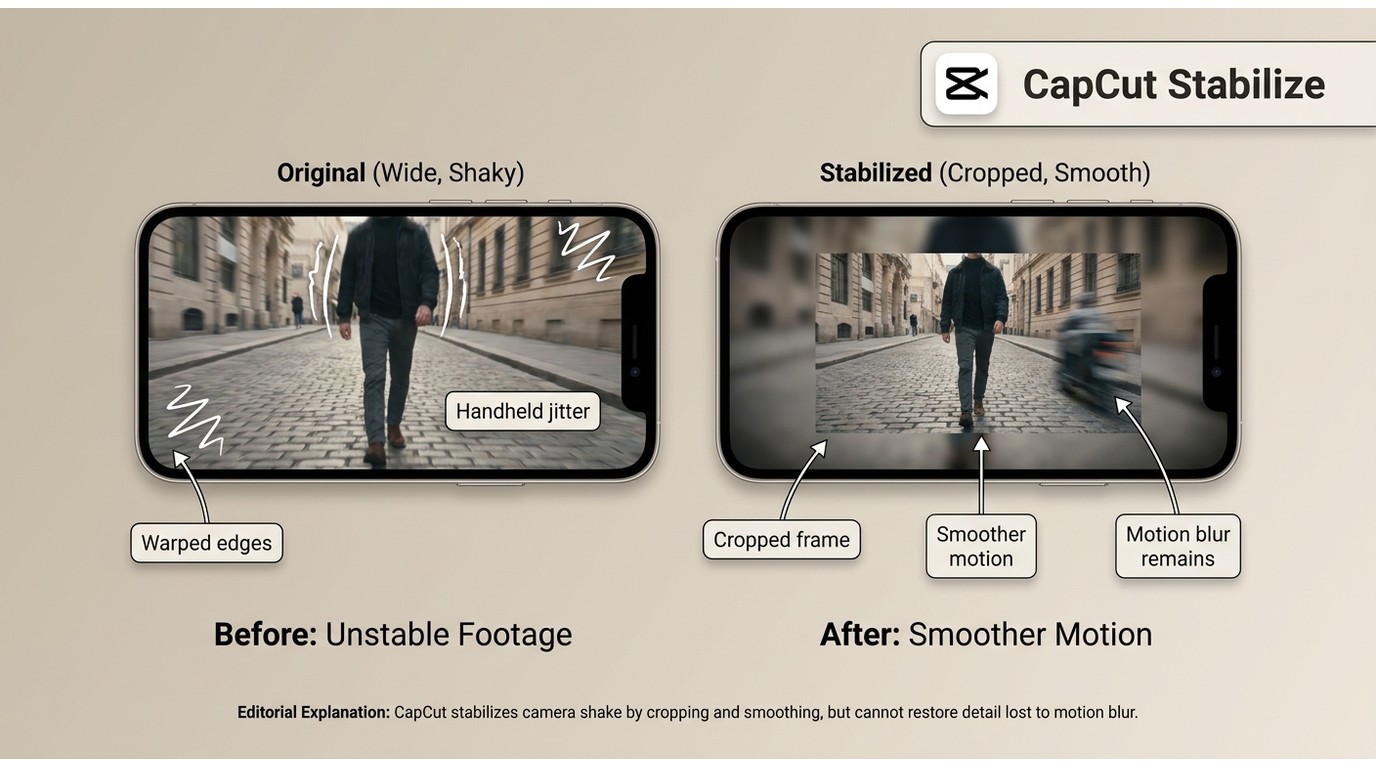
Mobile video stabilization reframes existing footage to reduce visible shake, while a camera stabilizer app or built-in optical system reduces motion during capture. Post-processing can improve watchability, but stronger correction usually means more crop and a greater risk of warped edges. For video stabilizer app, verify this point on the actual source before processing the complete file.
- Light handheld jitter: A phone editor is usually enough for a short clip and a fast social export.
- Walking or action footage: Preview the edges carefully because rolling-shutter wobble and aggressive crop become more visible.
- Blurred frames: Stabilization can smooth movement, but it does not restore detail that was never captured sharply.
- Repeated or long projects: Desktop processing becomes more practical when the phone overheats, storage runs low, or exports repeatedly fail.
The editorial rule is simple: fix mild shake in the app where the edit already lives, but do not trade half the frame for artificial smoothness. Better capture technique, a wider original frame, or desktop control is often the more credible answer for severe motion. For video stabilizer app, verify this point on the actual source before processing the complete file.
10 Best Video Stabilizer Apps in 2026
The ten video stabilization apps below are not equally verified. Current US listings clearly document stabilization for CapCut, InShot, GoPro Quik in supported GoPro workflows, and LumaFusion; several other listings confirm strong editing features but do not currently name stabilization. For video stabilizer app, verify this point on the actual source before processing the complete file.
1. CapCut
Platform: Android and iPhone/iPad.
Best for: short social edits in an editor that currently names stabilization.
Not ideal for: anyone who needs a guaranteed free entitlement or a documented manual-strength slider. For video stabilizer app, verify this point on the actual source before processing the complete file.
CapCut lists stabilization and export up to 4K at 60 fps on its current US iPhone listing. The app is a free download with in-app purchases, but the listing does not specify whether stabilization is included on every platform, whether stabilized exports carry a watermark, or how much strength control is available. For video stabilizer app, verify this point on the actual source before processing the complete file.
Use the app page for availability, then follow the focused CapCut Stabilizer guide for the workflow instead of treating a web-editor feature page as proof of identical mobile behavior.
2. PowerDirector
Platform: Android and iPhone/iPad.
Best for: multitrack editing and cross-device cloud projects.
Not ideal for: buyers who need current US listing proof of a mobile stabilizer, its control range, or its watermark policy. For video stabilizer app, verify this point on the actual source before processing the complete file.
The current US iPhone listing documents HDR export, keyframes, masks, speed tools, and cloud projects, but it does not name video stabilization or a maximum export resolution. PowerDirector is a free download with in-app purchases; exact free export limits and watermark behavior are not stated there. For video stabilizer app, verify this point on the actual source before processing the complete file.
That makes PowerDirector a capable editor whose stabilization status should be checked inside the current build before choosing it for this single task. A broader PowerDirector review is more useful if the rest of its editing toolkit matters too.
3. Google Photos
Platform: Android and iPhone/iPad, with stabilization treated here as Android-focused.
Best for: checking whether an existing Android Photos build offers a simple edit.
Not ideal for: manual strength control or a feature guaranteed across Android and iPhone. For video stabilizer app, verify this point on the actual source before processing the complete file.
Google's current store and help pages document editing, saving copies, sharing, backup, and 15 GB of account storage, but they do not currently describe a stabilization control. The listing also gives no watermark rule, strength setting, or maximum export quality for stabilization. For video stabilizer app, verify this point on the actual source before processing the complete file.
Do not infer iPhone stabilization from the fact that Google Photos is available on iOS. If the Stabilize control appears in the Android editor, save a copy and compare it with the original; if it is absent, choose an app whose current listing explicitly names the feature. For video stabilizer app, verify this point on the actual source before processing the complete file.
4. InShot
Platform: Android and iPhone/iPad.
Best for: social-first editing with a currently documented stabilizer.
Not ideal for: users who need published details about stabilization strength, crop behavior, or offline processing. For video stabilizer app, verify this point on the actual source before processing the complete file.
InShot's current US iPhone listing names a video stabilizer and export up to 4K at 60 fps. The app is a free download with in-app purchases, while InShot Pro hides the watermark and ads; the listing does not say whether stabilization itself requires Pro. For video stabilizer app, verify this point on the actual source before processing the complete file.
For quick vertical or square edits, the attraction is keeping stabilization, trimming, captions, and export in one project. The missing detail is control: no official strength levels or crop safeguards are described, so preview the whole frame rather than judging a single paused shot. For video stabilizer app, verify this point on the actual source before processing the complete file.
5. KineMaster
Platform: Android and iPhone/iPad.
Best for: layered mobile editing with 4K export.
Not ideal for: readers choosing solely on verified stabilization, because the current US iPhone listing does not name that feature. For video stabilizer app, verify this point on the actual source before processing the complete file.
KineMaster documents multitrack editing, keyframes, project files, KineCloud backup for Premium, and export up to 4K at 60 fps. Free output carries a watermark, and Premium hides it. Stabilization strength, availability, and stabilized-export behavior are not stated in the current listing.
The practical fit is an editor-first workflow, not a dedicated stabilization purchase. Confirm the tool inside the current Android or iPhone build before importing a large project, especially if the watermark rule or cloud handoff affects delivery.
6. VN Video Editor
Platform: Android and iPhone/iPad.
Best for: watermark-free editing and export up to 4K at 60 fps.
Not ideal for: anyone specifically seeking verified VN Video Editor stabilization in the current official listings.
VN's US iPhone listing says the editor is free with no watermark and supports 4K at 60 fps, draft saving, and project transfer through AirDrop or iCloud. Neither the iPhone nor Android listing currently names stabilization or a manual-strength control.
VN remains useful when stabilization without watermark is the deciding requirement only if the current build actually exposes that tool. Otherwise, its verified value is as a watermark-free editor for footage already stabilized during capture or processed elsewhere.
7. Filmora Mobile
Platform: Android and iPhone/iPad.
Best for: a broad mobile editor with keyframes, tracking, masks, and cloud options.
Not ideal for: a stabilization decision based on current US listing evidence.
Filmora Mobile is a free download with in-app purchases. Its current iPhone listing says Pro hides the watermark and logo roll, but it does not name stabilization, a strength control, or a maximum video export resolution. Filmora Cloud is listed without detailed stabilization storage behavior.
Choose it for the surrounding edit only after confirming the stabilizer in the installed release. The current listing supports an editor comparison, but it is not enough to promise a specific free limit, stabilization result, or export ceiling.
8. Video Stabilizer: Smooth Video
Platform: no current US App Store identity confirmed under the cited app ID.
Best for: no recommendation until the exact listing is restored or verified.
Not ideal for: anyone considering an unofficial mirror or assuming the old Android-only description is current.
The previously cited US App Store ID returns no result, so current platform support, free restriction, watermark, strength controls, export quality, and local-processing behavior cannot be responsibly assigned to this exact app. This is a concrete availability failure, not a blank specification.
Skip look-alike downloads with similar names. A valid replacement needs a live US listing, a named developer, a current privacy page, and explicit stabilization and export details before it belongs in a purchasing shortlist.
9. GoPro Quik
Platform: Android and iPhone/iPad.
Best for: supported GoPro and 360 footage.
Not ideal for: assuming every phone clip receives the same post-processing stabilization tools.
Quik documents adjustable 360 stabilization, horizon controls, and stabilization updates for supported GoPro footage. The app is a free download; single-media filters and speed adjustments are free, while automatic edits, Beat Sync, themes, and specified cloud features require a subscription. No watermark policy or maximum export resolution is stated.
This is the most defensible action-footage pick when the camera and media type match GoPro's documented workflow. For unrelated phone footage, confirm compatibility first rather than generalizing HyperSmooth behavior to every imported file.
10. LumaFusion
Platform: iPhone and iPad, with an Android version sold separately.
Best for: control-focused mobile editing and high-resolution workflows on supported devices.
Not ideal for: a free video stabilizer app or speed-ramped clips that must be stabilized in place.
LumaFusion's US listing names its Lock & Load stabilizer and costs $29.99 upfront on iPhone/iPad. No watermark is stated. It can export up to 5K, 6K, or 8K on newer Apple devices, while stabilization-specific strength controls are not described in the listing.
The key documented limitation is specific: stabilization does not work with speed-ramped clips. LumaTouch advises stabilizing and exporting in a separate project before applying the speed ramp, which adds a generation and an extra project step.
Compare 10 Video Stabilizer Apps
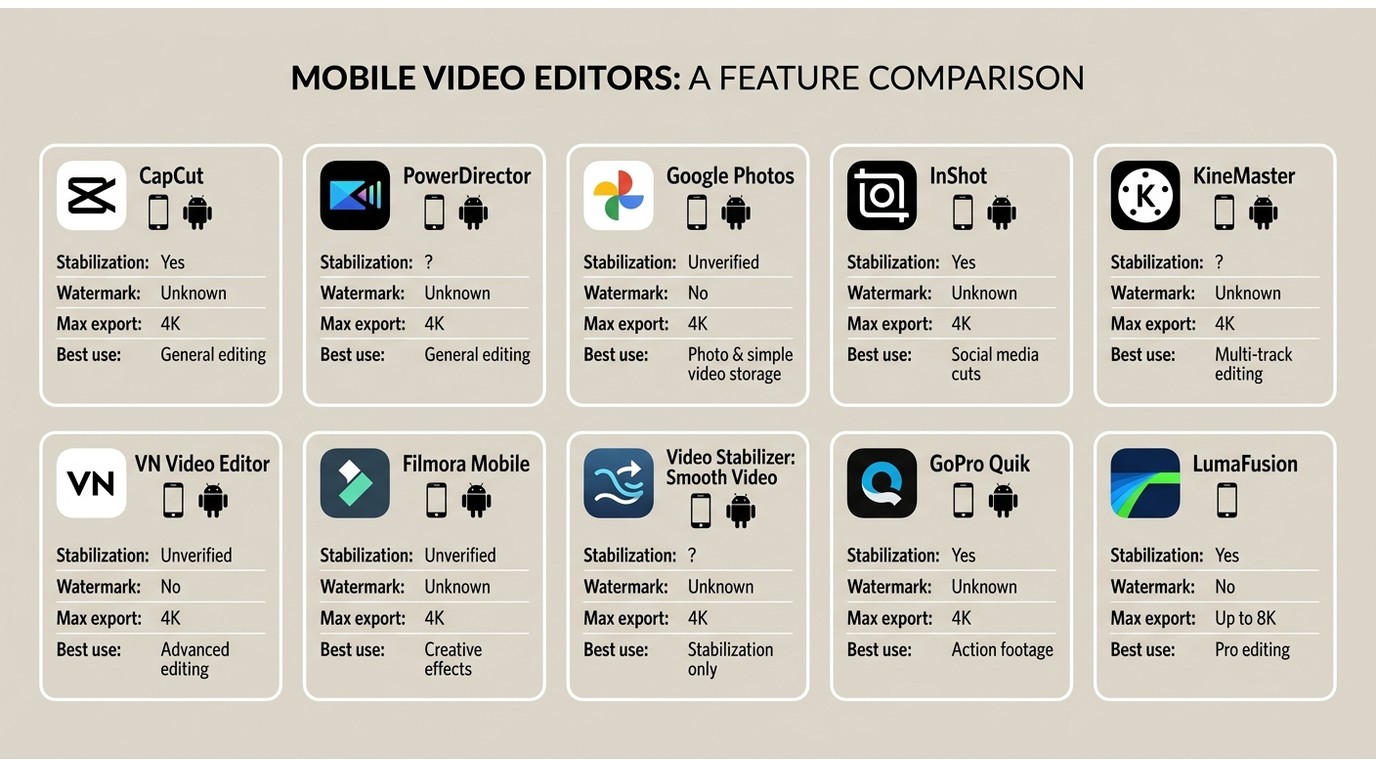
This matrix separates confirmed current facts from old assumptions. Availability and plan details checked in July 2026. “Not listed” means the current official US page does not publish that value; it should not be read as a hidden promise.
| App | Platform and stabilization availability | Best use case | Verified free-tier limit | Watermark on stabilized export | Manual stabilization strength | Maximum verified export quality | Offline, cloud, and saved-file behavior | Main limitation or artifact risk |
| CapCut | Android; iPhone/iPad. Stabilization named on current iPhone listing. | Short social edits | Free download; stabilization entitlement not specified | Not listed | Not listed | 4K, 60 fps | Cloud/local project behavior not specified for stabilization | Crop and Edge behavior not published |
| PowerDirector | Android; iPhone/iPad. The present US iPhone page omits a stabilizer. | Multitrack and cloud projects | Free download; exact export limit not listed | Not listed | Not listed | HDR export named; resolution ceiling not listed | Cloud projects support cross-device continuation | Stabilizer availability needs in-app confirmation |
| Google Photos | Android and iPhone/iPad; stabilization treated as Android-focused but absent from current listing text | Checking an existing Android editor | 15 GB account storage shared with Gmail and Drive | Not listed | No current documented control | Not listed | Cloud backup; edited shared items can be saved or saved as a copy | Feature presence can differ by platform and release |
| InShot | Android; iPhone/iPad. Stabilizer named. | Social-first phone edits | Free download; stabilizer tier not specified | Pro hides watermark and ads | Not listed | 4K, 60 fps | Stabilization processing location not listed | No published crop or strength details |
| KineMaster | Android; iPhone/iPad. The present US iPhone page omits a stabilizer. | Layered mobile projects | Free output carries watermark | Premium hides watermark | Not listed | 4K, 60 fps | .kine project files; KineCloud backup with Premium | Feature availability needs in-app confirmation |
| VN Video Editor | Android; iPhone/iPad. Current listings do not name stabilization. | Watermark-free editing | Free with no watermark | No watermark claimed by listing | Not listed | 4K, 60 fps | Local drafts; AirDrop/iCloud project transfer on Apple devices | Stabilization itself is not currently documented |
| Filmora Mobile | Android; iPhone/iPad. The present US iPhone page omits a stabilizer. | General mobile editing | Free download; exact export limit not listed | Pro hides watermark and logo roll | Not listed | Not listed | Filmora Cloud offered; stabilization behavior not detailed | No current listing proof for stabilizer or export ceiling |
| Video Stabilizer: Smooth Video | Cited US App Store ID unavailable | No current recommendation | No live listing | No live listing | No live listing | No live listing | No live listing | Identity and availability cannot be confirmed |
| GoPro Quik | Android; iPhone/iPad. Stabilization documented for supported GoPro/360 workflows. | GoPro and 360 action footage | Single-media filters and speed adjustments are free | Not listed | Adjustable for 360 stabilization | Not listed | Local and cloud media; subscription storage for supported files | Do not generalize support to every imported phone clip |
| LumaFusion | iPhone/iPad; Android sold separately. Lock & Load stabilizer named. | Control-focused mobile projects | No free tier; $29.99 upfront on iPhone/iPad | No watermark stated | Not listed | Up to 5K, 6K, or 8K on newer Apple devices | Photos, USB-C, Frame.io, and cloud-storage workflows | Does not stabilize speed-ramped clips in place |
The practical upshot is narrower than a generic ranking: InShot and CapCut have the clearest mainstream phone-listing support, LumaFusion offers the clearest editor-grade Apple workflow, and Quik is strongest when its supported GoPro media path matches the source. For a broader catalog, see the free video stabilizer tool guide.
Choose the Right Video Stabilizer App
The best video stabilizer app is the one that confirms the feature on your platform, exports at the quality you need, and leaves enough frame area after correction. Start with the source footage and delivery target, not the longest feature list.
Check Platform and Free-Tier Limits
A free download does not guarantee free stabilization, watermark-free export, or unrestricted resolution. Check the current Android or iPhone listing for the exact app identity, then confirm the stabilizer appears before building a full edit around it.
- Need a confirmed iPhone stabilizer: Start with CapCut, InShot, or LumaFusion, then compare entitlement and export details in the installed release.
- Need an Android video stabilizer: Verify the current Android listing and in-app tool; do not rely on an iPhone description or an old tutorial.
- Need no watermark: VN verifies watermark-free editing, but its current listing does not verify stabilization. KineMaster and Filmora tie watermark-free output to Premium or Pro.
- Need 4K: InShot, KineMaster, and VN publish 4K at 60 fps; CapCut's iPhone listing does too. A 4K video stabilizer still needs enough device storage and processing headroom.
Stabilize and Export on Your Phone
A conservative mobile workflow protects video export quality by checking crop, distortion, and the saved file before the original is changed. Controls and output paths differ by Android, iPhone, and app version.
- Duplicate or back up the original clip before editing.
- Import the clip and confirm that the current app build exposes stabilization.
- Choose the lowest effective strength when the app provides a strength control.
- Preview the full clip, watching faces, straight lines, corners, and fast pans for warping or excess crop.
- Export to MP4 when that format is supported, using a resolution and frame rate the current listing confirms.
- Find the saved file, play it outside the editor, and compare framing, sharpness, audio sync, and motion with the original.
Readers who need a fuller recording-to-post-production sequence can use the how to stabilize a video guide; this comparison stays focused on choosing among apps.
Fix Wobble, Crop, and Export Problems
Most failed results come from asking stabilization to correct motion the source did not capture cleanly. Adjust one variable at a time, export a short section, and stop increasing strength when Edge artifacts become more distracting than the original shake.
- Jelly or rolling wobble: Lower stabilization strength and avoid combining strong stabilization with speed changes.
- Bent edges or pulsing corners: Reduce correction, add a modest manual crop, or select a steadier section of the clip.
- Excessive crop: Use a lower mode or accept some natural motion to preserve composition.
- Soft output: Match the source resolution and avoid repeated exports between apps.
- Low-light blur: Stabilization cannot restore sharp detail from long-exposure motion; choose shorter, clearer segments.
- Over-smoothed movement: Back off the setting so intentional pans still feel intentional.
- Severe walking shake: Try a desktop tool or reshoot with steadier capture if the frame repeatedly lurches beyond the crop margin.
- Failed save: Check available storage, Photos or file permissions, network access for cloud tools, supported format, resolution, and frame rate.
When Desktop Stabilization Makes Sense
Desktop stabilization makes sense for long clips, repeated files, severe shake, 4K delivery, failed mobile exports, or projects that need more control. It is an alternative when phone constraints interfere with the result, not the universal answer to every shaky clip.
A wider comparison of video stabilization software belongs on the desktop-software guide. Here, the decision threshold is whether mobile convenience still outweighs crop, storage, heat, queue, and export limitations.
Where UniFab Fits
UniFab Video Stabilizer AI fits Windows or Mac users who prioritize local processing, batch work, and a 4K desktop workflow. It is less suitable for anyone who needs an on-phone edit, an instant social export, or a tool that runs without desktop hardware.
UniFab Video Stabilizer AI uses the Statys model for shaky handheld footage, supports MP4 and MKV output up to 4K, includes GPU acceleration, and can queue multiple files. Processing stays on the computer rather than requiring a cloud upload.
Annual and lifetime licensing are available. The relevant value here is not a suite-wide feature count: it is the combination of local-file control, batch processing, and a desktop workspace when mobile exports become the bottleneck.
Stabilize a Video with UniFab
The documented UniFab workflow is short: open the Stabilizer module, add the shaky file, choose a stabilization mode, run the analysis, and export the result. Keep the original until the finished file has been reviewed at full size.
- Open UniFab and select the Stabilizer module.
- Add the shaky video from local storage.
- Choose Mild, Moderate, or Strong stabilization based on the source motion.
- Start processing so the software can analyze the frames and motion pattern.
- Export the stabilized result, then compare its framing and Edge behavior with the original.
Final Picks by Use Case
There is no universal winner. The better choice depends on whether the current listing verifies stabilization, whether the source is ordinary phone footage or supported action-camera media, and whether the delivery needs a quick mobile post or a controlled desktop export.
- Quick Android check: Look for stabilization in the current Google Photos build, but switch to a clearly documented app if the control is absent.
- Confirmed mainstream iPhone options: Compare CapCut and InShot for a quick edit, while checking the installed release for entitlement and watermark details.
- Control-focused mobile editor: LumaFusion is the clearest current listing, with an upfront purchase and a documented stabilizer, but speed-ramped clips require an extra workflow.
- Supported action footage: GoPro Quik is the logical fit for documented GoPro and 360 stabilization paths.
- Desktop fallback: UniFab suits Windows or Mac users handling long, severe, repeated, or 4K stabilization jobs locally.
The restrained next step is to test one representative clip before committing a whole project. Check the frame edges, compare the saved file with the original, and choose the least aggressive correction that makes the motion easier to watch.
Reference links retained from the original article: online video stabilizer guide
Frequently Asked Questions
What is the best way to use video stabilizer app?
Start with the source quality, target platform, privacy requirement, and final export settings. For video stabilizer app, use a short representative clip first, compare the result at 100% view, and keep the original file so you can revise the workflow without generation loss. This also applies to video stabilization app.
Is video stabilizer app free?
Some video stabilizer app workflows are free, while others limit file size, duration, resolution, credits, watermarks, or export formats. Verify the current plan on the provider's official page because free allowances can change. This also applies to stabilize shaky video.
Does video stabilizer app reduce quality?
video stabilizer app can reduce quality when it adds unnecessary recompression, aggressive enhancement, or incorrect output settings. Match resolution, frame rate, codec, and bitrate to the source and delivery platform, then inspect motion, edges, audio sync, and fine detail. This also applies to best video stabilizer.
Which formats or devices support video stabilizer app?
Support depends on the chosen application and workflow. Check operating system, input and output formats, hardware acceleration, browser upload limits, and whether the destination platform accepts the selected settings before processing a full project. This also applies to video stabilization app.
How long does video stabilizer app take?
Processing time varies with duration, resolution, codec, AI model, hardware, and export settings. A short test provides the most reliable estimate; online tools also add upload and download time, while local tools depend more heavily on CPU and GPU performance. This also applies to stabilize shaky video.
Can beginners use video stabilizer app?
Yes. Beginners can use video stabilizer app by following a conservative workflow: duplicate the source, choose an appropriate preset, process a short sample, compare before and after, and only then export the complete file. This also applies to best video stabilizer.
What should I check before choosing a tool for video stabilizer app?
Compare source fit, output quality, privacy, platform support, batch capability, watermark policy, free limits, price, and control. Do not choose a video stabilizer app tool only because it advertises the highest resolution, frame rate, or AI label. This also applies to video stabilization app.
Is desktop or online processing better for video stabilizer app?
Online processing is convenient for short, non-sensitive files, but it can impose upload, retention, watermark, credit, and resolution limits. Desktop processing is usually better for private, long, high-resolution, or batch video stabilizer app work. This also applies to stabilize shaky video.
What are the main limitations of video stabilizer app?
The main limits are source quality, missing detail, motion artifacts, incompatible formats, hardware demand, upload constraints, and generation loss. video stabilizer app cannot always reconstruct information that was never captured, so results should be described realistically. This also applies to best video stabilizer.
How does video stabilizer app compare with manual editing?
Automated video stabilizer app is faster and easier to repeat, while manual editing gives more local control and may avoid overprocessing. A practical workflow uses automation for the first pass and manual review for difficult scenes, transitions, faces, text, and audio sync. This also applies to video stabilization app.