A useful PowerDirector 2026 review has to answer three buyer questions: which license makes sense, whether the editor stays reliable on your projects, and how PowerDirector AI credits affect the real cost. The short answer is that PowerDirector remains approachable for solo editing, but the right plan and platform matter.
This CyberLink PowerDirector review separates official features from user-reported problems, compares the Windows and Mac experience, explains export choices, and shows where the software fits against Adobe Premiere and a dedicated enhancement workflow.
What Is CyberLink PowerDirector?
CyberLink PowerDirector is a timeline-based CyberLink video editor aimed mainly at beginners, hobbyists, and solo creators who want fast access to effects, titles, audio tools, and assisted editing without starting in a studio-oriented interface.
The desktop software combines a conventional multitrack timeline with guided modes and task-focused tools. It covers cutting, compositing, motion tracking, chroma key work, audio cleanup, screen capture, effects, and common delivery formats. Its strength is breadth and accessibility rather than the deepest color, collaboration, or finishing workflow in each category.
My editorial view is straightforward: PowerDirector is easiest to recommend when one person needs to move from raw clips to a finished social, instructional, or YouTube video without managing a large production system. Buyers with specialized finishing requirements should judge it by the exact workflow they need, not the length of its feature list.
PowerDirector Versions and Pricing
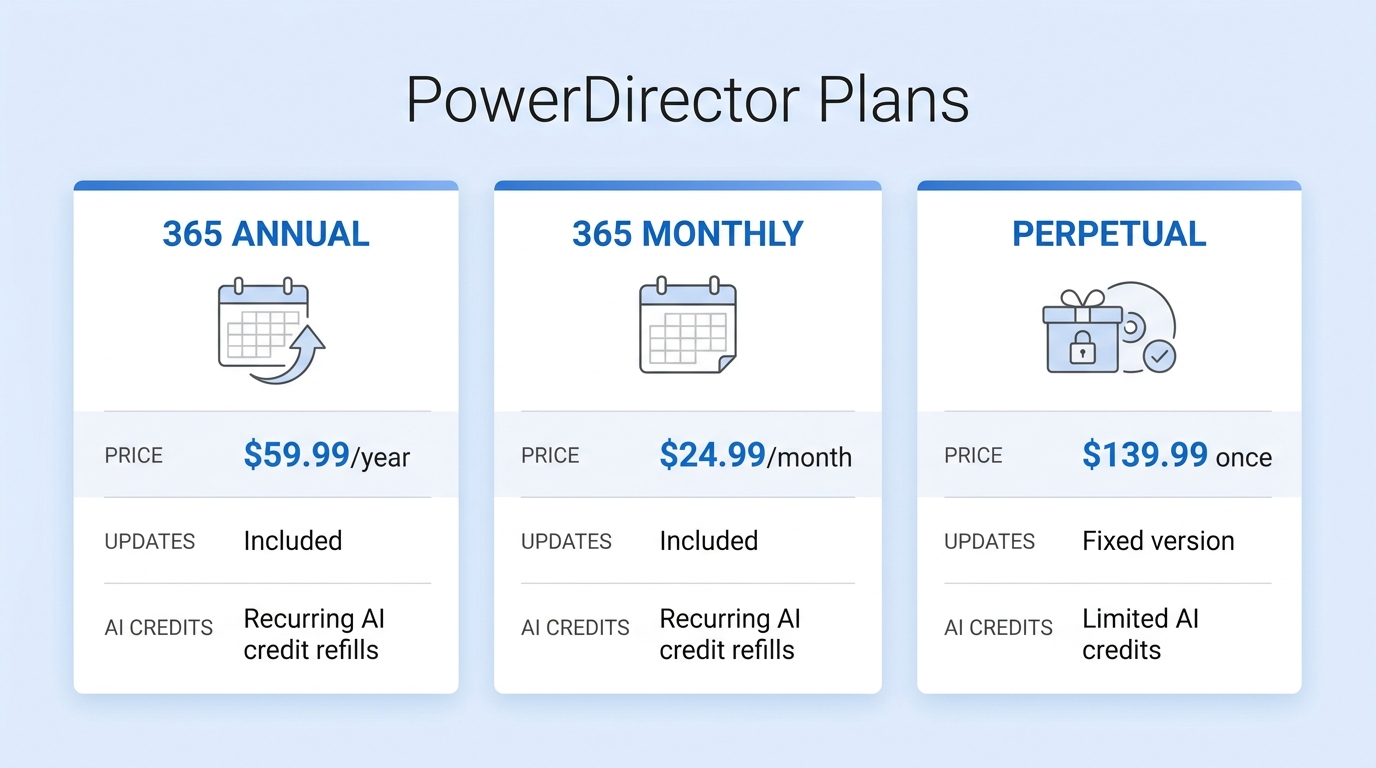
PowerDirector price comparisons come down to three practical paths: an annual PowerDirector 365 plan, a monthly 365 plan, or the perpetual PowerDirector 2026 edition commonly associated with PowerDirector Ultimate. The PowerDirector 365 cost depends sharply on billing cadence.
Subscription vs Perpetual License
A PowerDirector 365 review should distinguish access from ownership. The subscription receives ongoing feature updates, downloadable content, and recurring AI-credit allocations while active. The perpetual license covers the purchased edition and does not include future major-version upgrades.
- Annual subscription: suited to people who edit regularly and want updates, stock content, and recurring AI access at a lower monthly equivalent.
- Monthly subscription: suited to a short production period or a buyer who wants limited commitment, though continued use costs more than annual billing.
- Perpetual edition: suited to editors who prefer a fixed version and can work without ongoing feature drops, subscription content, or recurring AI-credit refills.
Current US Pricing
As of July 2026, CyberLink's US listing shows PowerDirector 365 at $59.99 per year or $24.99 per month, while the perpetual PowerDirector 2026 edition is $139.99.
| Buying path | Listed US price | Update model | Editorial fit |
| PowerDirector 365 annual | $59.99 per year | Ongoing updates while subscribed | Regular solo editors who expect to use new tools and content |
| PowerDirector 365 monthly | $24.99 per month | Ongoing updates while subscribed | Short projects or temporary access |
| PowerDirector 2026 perpetual | $139.99 | Licensed 2026 edition | Editors who prefer a fixed release and infrequent AI use |
AI Credit Costs
PowerDirector AI credits can turn frequent generative or cloud-assisted tasks into a usage decision, not just a feature decision. Subscription plans receive refills, while the perpetual edition has more limited credit access.
Credit use depends on the tool and current build, so a universal per-operation estimate would be misleading. The practical question is whether AI music, image generation, assisted effects, or similar tasks are occasional conveniences or a routine part of every project.
Best for frequent AI use: a subscription that refreshes credits and stays current.
Not ideal for heavy AI use: a fixed edition if the included allocation would become a recurring constraint.
Which Version Fits You?
The annual plan has the clearest value for regular editors, monthly access fits a defined production window, and the perpetual edition makes more sense when a stable toolset matters more than continuous additions.
- Choose annual billing if you publish throughout the year and use stock assets or AI tools often enough to benefit from refills.
- Choose monthly billing if the software is needed for a short campaign, class, or contract rather than an ongoing channel.
- Choose the perpetual edition if your projects rely on standard timeline editing and you accept staying on the licensed major version.
System Requirements
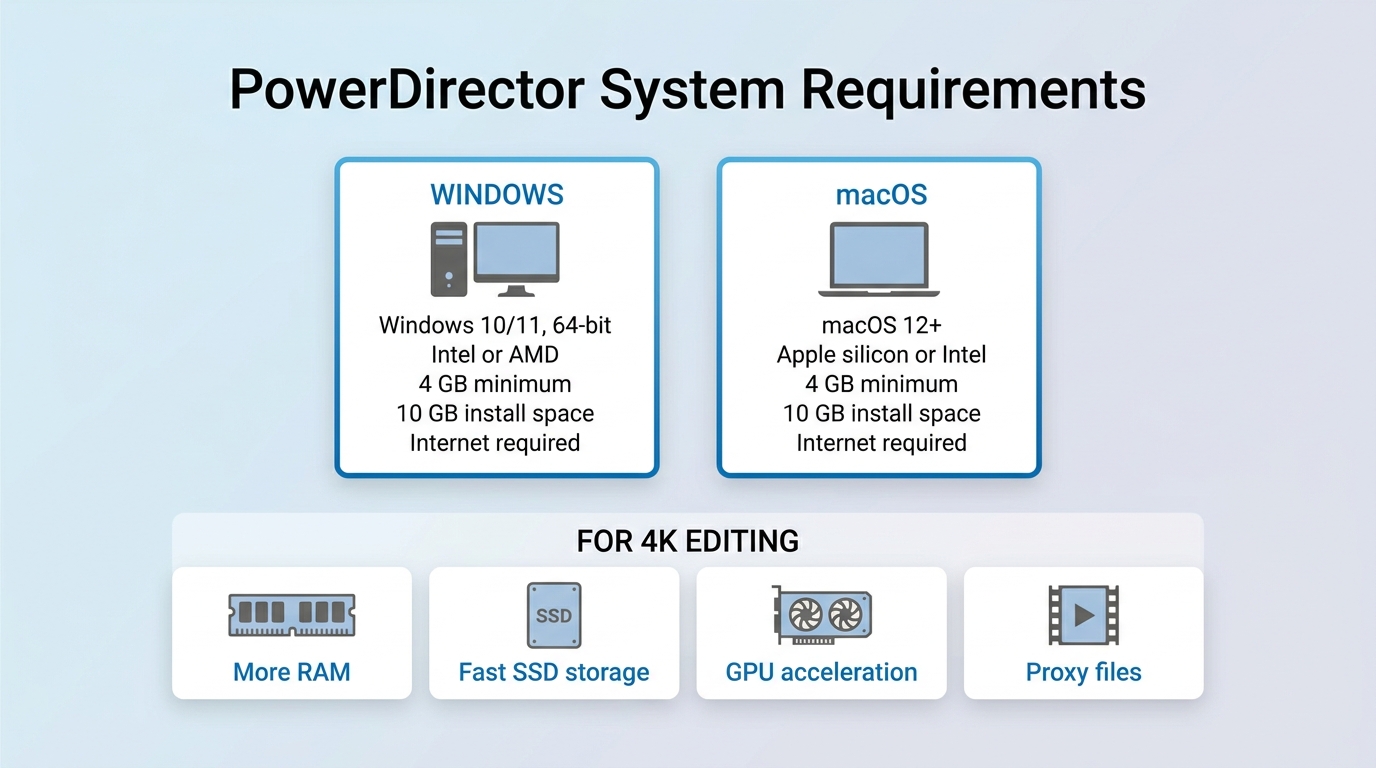
PowerDirector system requirements are modest for basic editing, but smooth preview and export behavior depend heavily on footage, effects, resolution, storage speed, GPU support, and the software build.
| Requirement | Windows | Mac |
| Operating system | Windows 11 or Windows 10, 64-bit | macOS 12 or later |
| Processor | Compatible Intel or AMD processor | Apple silicon or compatible Intel processor |
| Memory | 4 GB minimum; more is practical for demanding projects | 4 GB minimum; more is practical for demanding projects |
| Storage | At least 10 GB for installation, plus project media space | At least 10 GB for installation, plus project media space |
| Internet | Needed for activation and connected AI features | Needed for activation and connected AI features |
For long-form 4K work, prioritize memory headroom, fast media storage, and supported hardware acceleration. Proxy files can make a bigger day-to-day difference than a headline render claim because they improve the editing stage where most time is spent.
User Interface and Workflow
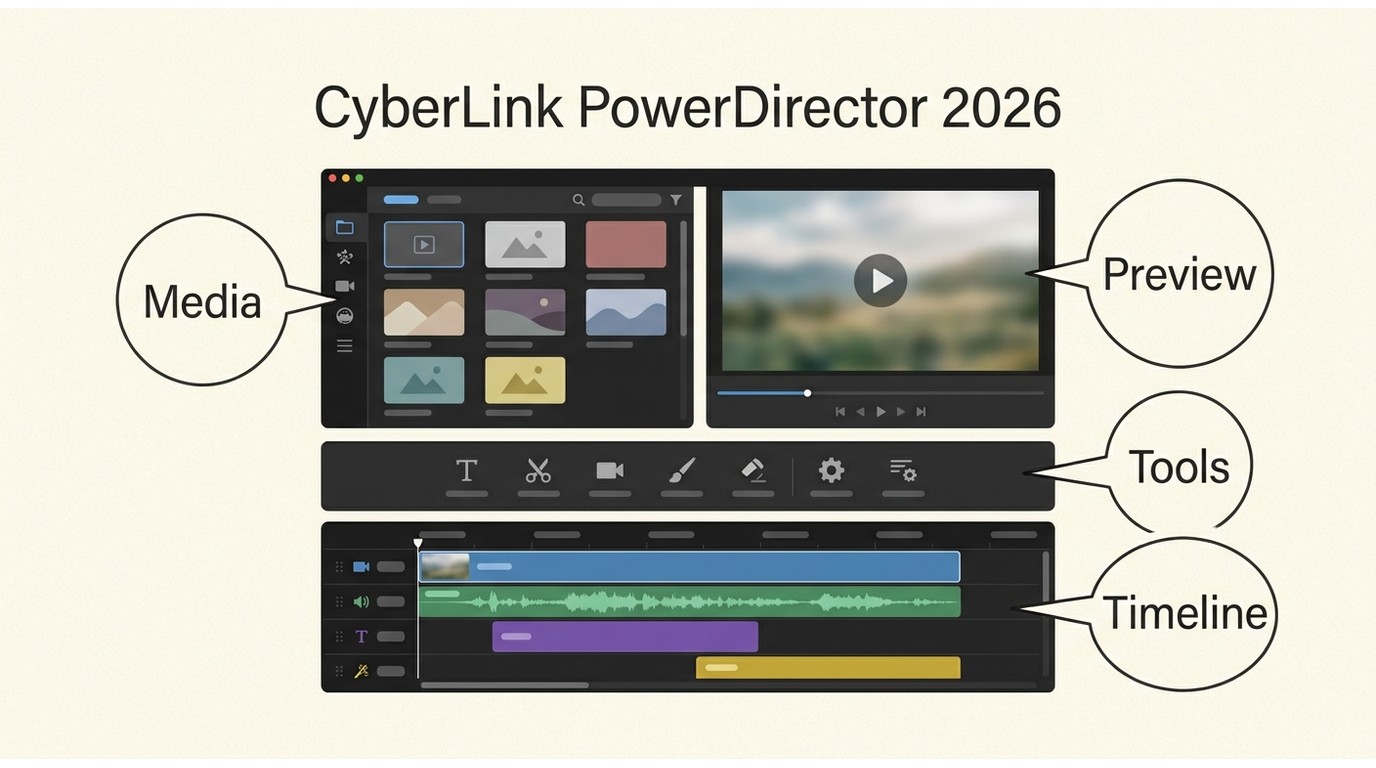
PowerDirector for beginners works because it offers guided entry points without removing the full timeline. The 2026 interface organizes common tasks more clearly, although preferences and project-performance controls still require some exploration.
The launcher can open a focused task such as trimming, merging, recording, or creating a slideshow. The full editor then provides the familiar media library, preview monitor, tool panels, and multitrack timeline. Storyboard and automated modes reduce setup for quick edits, while the main timeline supports layered video, audio, titles, and effects.
The useful distinction is not whether the interface looks simple, but how quickly it exposes the controls needed for a real project. PowerDirector keeps routine cuts and templates close at hand; deeper proxy, keyframe, and export decisions sit one level further in.
Key PowerDirector Features
This PowerDirector 2026 review groups features by the jobs that affect a buying decision. The CyberLink video editor covers a wide range, but not every tool has the same depth or cost model.
Video Effects and Transitions
PowerDirector provides a large visual toolkit for titles, transitions, overlays, masks, blending, keyframes, and object-based effects. It is most useful when speed and variety matter more than building every element from scratch.
Editors can adjust duration and intensity rather than accepting templates unchanged. Masking and compositing controls support more deliberate work, although complex Edge cleanup still takes manual attention.
AI Tools
AI tools can shorten repetitive tasks, but their value depends on both output quality and credit use. The 2026 toolset includes assisted music, speech cleanup, wind-noise reduction, image generation, image animation, object work, and sky adjustments.
These features are better treated as first-pass helpers than automatic final decisions. Speech cleanup may reduce manual audio work, while generated music or imagery still needs an editorial check for tone, timing, and visual consistency.
Content and Editing Tools
Titles, templates, stock assets, stickers, vertical previews, and task-oriented editing controls support quick production. Subscription access is more content-rich, while the perpetual edition is a better match for people who already maintain their own media library.
Format behavior can change between builds. A July 2026 user report described a WebM audio regression after an update, which is a useful warning about build-specific compatibility rather than evidence that all WebM workflows fail. The current official specification should remain the baseline for planned inputs and outputs.
Fix and Enhance Footage
PowerDirector handles common correction tasks inside the edit: stabilization, lens and fisheye correction, color adjustments, LUTs, split toning, pan and zoom, and general noise cleanup.
These controls are suitable for making footage consistent enough for an edit. They are less specialized than a dedicated restoration or enhancement pipeline when the source is severely noisy, low resolution, interlaced, or intended for HDR delivery.
Audio Editing
PowerDirector covers the audio work most solo video projects need, including dialogue cleanup, noise reduction, vocal separation, ducking, timing adjustments, voice effects, and generated narration options.
Automatic ducking and music fitting can save keyframing time, but speech clarity should still be checked against the full mix. My editorial preference is to use automation for setup, then listen through transitions and dialogue overlaps before export.
360° Video Editing
PowerDirector includes 360° editing tools for importing spatial footage, adjusting the viewing direction, stabilizing movement, placing titles, and reframing a spherical source into a conventional view.
This is a useful specialty feature for creators who already own a 360° camera. It should not drive the purchase for a standard two-dimensional workflow, and availability should be considered alongside the Windows and Mac differences discussed below.
Multicam Editing
Multicam tools synchronize clips and let an editor switch between angles during playback before refining the cuts on the timeline. The workflow is well suited to interviews, demonstrations, performances, and event coverage.
Audio synchronization works best when each camera captures a clear shared reference. For difficult recordings, a manual sync point or dedicated timecode workflow remains more dependable than expecting automatic alignment to solve every mismatch.
Motion Tracking and Chroma Key
Motion tracking attaches text, graphics, blur, or effects to a moving subject, while chroma key controls remove a selected background color. Both tools are accessible enough for quick social and instructional edits.
Clean contrast and controlled lighting matter more than the number of sliders. Fast motion, occlusion, fine hair, and uneven green-screen illumination still create Edge work that needs manual review.
Plugins and Performance
PowerDirector supports screen capture, connected plugins, and hardware-assisted processing, but performance cannot be reduced to one render-time number. Project complexity, codec, effects, media location, preview settings, GPU, and build can all change the result.
A fixed ten-minute 4K render claim has been omitted because no reproducible setup accompanied it. User reports include both smooth operation and cases of lag, freezes, or export failures. For a typical buyer, stable editing and a successful final export on representative footage matter more than a single benchmark.
Export Formats and MP4 Output
PowerDirector MP4 export supports H.264 AVC and H.265 HEVC, alongside listed outputs such as MKV, MPEG-2, WMV, XAVC S, and relevant audio formats. Unsupported AV1 and broad 8K export claims should not guide a purchase.
| Output choice | Practical use | Editorial guidance |
| MP4 with H.264 AVC | YouTube, general sharing, and broad device support | Choose compatibility first |
| MP4 with H.265 HEVC | Efficient 4K delivery when the destination supports HEVC | Choose smaller files or higher efficiency |
| MKV, MPEG-2, WMV, or XAVC S | Workflow-specific delivery and archiving needs | Match the receiving app or device |
- Open the Produce or Export workspace after the timeline is locked.
- Select MP4, then choose H.264 for wider compatibility or PowerDirector H.265 export for a compatible high-efficiency workflow.
- Set resolution and quality for the destination, export a short sample, and inspect motion, audio sync, text, and color before rendering the full project.
What's New in PowerDirector 2026
The 2026 edition focuses on a reorganized interface, quicker task entry, and more assisted media tools rather than changing the basic identity of the editor.
- A redesigned tools panel reduces reliance on the older room-based navigation.
- The launcher opens common editing tasks without requiring a full project setup first.
- AI-assisted music, speech enhancement, wind-noise cleanup, image generation, and image-to-video tools broaden the quick-production workflow.
- Sky adjustment and related assisted effects receive refinements intended to reduce manual setup.
The interface changes are the most broadly relevant improvement because they affect nearly every project. The AI additions matter mainly to editors who will use them often enough to justify the credit model.
PowerDirector on Mac vs Windows
PowerDirector Mac vs Windows is not a simple performance comparison: feature availability and implementation can differ, making Windows the safer choice for buyers who require the broadest set of PowerDirector workflows.
Windows has historically received a wider selection of specialty tools and plugins. Mac buyers should map must-have tasks such as screen recording, live streaming, 360° work, multicam behavior, and specific AI features against the current Mac edition before choosing a plan.
A buyer report about missing screen-recording or live-streaming expectations is a valid pain signal, but it does not prove that every Mac build has the same limitation. The practical takeaway is to assess named workflows rather than assume feature parity from the product name alone.
- Windows is the safer fit for: buyers who want the broadest feature coverage and access to more plugins.
- Mac is a reasonable fit for: editors whose required timeline, effect, and export tools are present in the current Mac release.
PowerDirector Pros and Cons
PowerDirector's advantages are accessibility, range, and fast solo production. Its drawbacks center on AI-credit economics, build-to-build reliability reports, platform differences, and less depth in professional collaboration and finishing.
Pros
- Guided modes and a conventional timeline support both first projects and more layered edits.
- Effects, templates, titles, audio tools, screen capture, and export options cover many solo-creator needs in one app.
- Annual, monthly, and perpetual buying paths suit different project schedules.
- H.264 and H.265 MP4 output provides practical delivery choices for common platforms.
- Assisted tools can reduce setup time for speech, music, images, and routine corrections.
Cons
- Frequent credit-based AI use can change the total cost and make a fixed license less attractive.
- Users report lag, freezes, export failures, update regressions, removed behavior, and uneven support experiences, though these reports are not universal.
- Mac and Windows editions can differ in feature availability and workflow details.
- Color finishing, team collaboration, codec depth, and plugin breadth do not match every professional production requirement.
- Export and performance settings may feel dense after the otherwise approachable interface.
Who Should Use PowerDirector?
PowerDirector for beginners and independent creators makes sense when quick solo production is more important than shared project systems, deep finishing, or a large post-production pipeline.
Best Fit
- Beginners who want guided entry points plus room to grow into a multitrack timeline.
- YouTube, social, education, and small-business creators producing frequent videos without a dedicated post team.
- Windows users who need a broad mixture of effects, capture, audio, and delivery tools.
- Editors who value templates and assisted setup but still want manual timeline control.
Not the Best Fit
- Production teams that depend on shared projects, formal review systems, and deep Creative Cloud integration.
- Colorists and finishing specialists who need a more extensive grading environment.
- Mac buyers whose required features are not available in the current Mac implementation.
- Heavy AI users who do not want their workflow tied to recurring credits.
- Editors who need dedicated restoration or upscaling rather than cuts, titles, transitions, and general correction.
For that last use case, a dedicated video quality enhancer is a more focused category than a timeline editor.
PowerDirector vs Adobe Premiere
PowerDirector vs Adobe Premiere is a workflow choice, not a universal ranking. PowerDirector favors faster learning and solo production; Premiere favors collaboration, deeper post-production control, and integration with a wider professional ecosystem.
| Decision factor | PowerDirector | Adobe Premiere |
| Audience | Beginners to intermediate solo creators | Professional editors and production teams |
| Learning curve | Guided and task-focused entry | More concepts and workspace configuration |
| AI tools | Built into a credit-aware creator workflow | Integrated across Adobe's editing ecosystem |
| Collaboration | Primarily solo-project oriented | Stronger shared and team workflows |
| Color and codec depth | Suitable for common creator delivery | Better suited to demanding professional pipelines |
| Platform fit | Broadest feature set on Windows | Professional Windows and Mac workflows |
| Pricing model | Subscription or perpetual edition | Subscription |
Choose PowerDirector for approachable solo editing and rapid turnaround. Choose Premiere Pro when collaboration, codec handling, color workflow, and a connected professional toolchain outweigh the steeper setup.
What PowerDirector Users Report
PowerDirector user reviews show a mixed but useful pattern: people often praise accessibility and effects, while recurring complaints involve lag, freezes, export failures, support, updates, feature changes, and AI-credit value.
Recurring Strengths
- New editors can reach a usable timeline quickly.
- Templates and effects help solo creators finish routine projects faster.
- The combination of capture, editing, audio, and delivery tools reduces app switching.
- Users with supported hardware often describe acceptable performance on ordinary creator projects.
Recurring Problems
- Some users report lag or freezes after updates or on effect-heavy timelines.
- Export failures can appear with specific media, settings, plugins, or builds.
- Feature removals and format regressions can disrupt an established workflow.
- Support outcomes and objections to AI-credit usage vary widely by case.
These reports should not be converted into a percentage or universal verdict. My editorial recommendation is to use representative source clips, effects, and an actual delivery preset during the evaluation period; a simple sample project may not expose the bottleneck that matters to your work.
UniFab for Post-Production Enhancement
UniFab All-In-One is a complementary local-processing option for footage enhancement after the timeline edit. It does not replace PowerDirector's cuts, titles, transitions, or project assembly.
Where UniFab Adds Value
The focused use case is restoration or enhancement after creative editing: upscale low-resolution footage up to 16K, convert SDR material to HDR10, or prepare 5.1 or 7.1 audio where the selected module and source support it.
UniFab All-In-One processes media locally, which suits large files and workflows that should stay on the editing computer. It is less suitable when the project needs only basic cuts, titles, and transitions.
Best Alternative: UniFab All-In-One
- All-in-One AI tools for your video enhancement needs.
- Designed for fast and efficient video enhancement.
- Enjoy a 30-day free trial with full feature access—no watermark!
- Flexible pricing: You can purchase each function individually.
UniFab All-In-One
Best Alternative: UniFab All-In-One
- All-in-One AI tools for your video enhancement needs.
- Designed for fast and efficient video enhancement.
- Enjoy a 30-day free trial with full feature access—no watermark!
- Flexible pricing: You can purchase each function individually.
UniFab All-In-One for Mac
The practical limitations are equally important: UniFab is not a full timeline editor, AI enhancement can require substantial hardware resources and processing time, and output still needs visual and audio review.
An AI Video Upscaler can address resolution and detail after the edit is complete, while PowerDirector remains responsible for pacing, narrative, titles, and assembly.
PowerDirector vs UniFab
The comparison works only when each app is judged by its primary job. PowerDirector and Premiere are timeline editors; UniFab is an enhancement processor used before or after an edit.
| Candidate | Primary job | Timeline editing | Learning curve | AI credit model | Video enhancement depth | Platform fit | Pricing model | Best fit | Not ideal for |
| CyberLink PowerDirector 365 | Solo video creation | Full timeline | Approachable | Recurring allocation | General correction | Windows; Mac with feature differences | Annual or monthly subscription | Frequent creator projects | Deep team post-production |
| CyberLink PowerDirector 2026 | Fixed-version solo editing | Full timeline | Approachable | Limited fixed-edition access | General correction | Windows; Mac with feature differences | Perpetual edition | Standard editing without constant upgrades | Frequent credit-based AI work |
| Adobe Premiere | Professional editing and finishing | Full timeline | Steeper | Adobe ecosystem model | Deep manual post workflow | Windows and Mac | Subscription | Teams and demanding pipelines | Buyers seeking a guided start |
| UniFab All-In-One | Video and audio enhancement | No full timeline | Task focused | Module-based AI processing | Dedicated upscaling, HDR, audio, and cleanup | Windows and Mac | Lifetime-license options | Enhancement after editing | Cuts, titles, transitions, and collaboration |
A Practical Two-App Workflow
The cleanest division of labor is to finish creative decisions in PowerDirector, then send a locked export to UniFab only when the footage needs dedicated enhancement.
Best Alternative: UniFab All-In-One
- All-in-One AI tools for your video enhancement needs.
- Designed for fast and efficient video enhancement.
- Enjoy a 30-day free trial with full feature access—no watermark!
- Flexible pricing: You can purchase each function individually.
UniFab All-In-One
Best Alternative: UniFab All-In-One
- All-in-One AI tools for your video enhancement needs.
- Designed for fast and efficient video enhancement.
- Enjoy a 30-day free trial with full feature access—no watermark!
- Flexible pricing: You can purchase each function individually.
UniFab All-In-One for Mac
- Edit the story in PowerDirector: trim clips, arrange the timeline, mix audio, add titles, and approve the final duration.
- Export a master at the intended delivery resolution and bitrate, then process that file in the relevant UniFab module for upscaling, HDR conversion, audio upmixing, or denoising.
- Review the enhanced result for artifacts, color, sync, and delivery compatibility before publishing.
PowerDirector FAQs
These answers cover the buying and delivery questions that most often determine whether PowerDirector fits a project.
Is PowerDirector 365 worth the annual price?
It is worth considering for editors who work throughout the year and benefit from updates, stock content, and recurring AI credits. Occasional editors should compare that convenience with the perpetual edition or a single month of access.
Can PowerDirector export MP4 files for YouTube?
Yes. PowerDirector can export MP4 using H.264 AVC or H.265 HEVC. H.264 is the safer compatibility choice for YouTube and general sharing; H.265 is useful when efficient 4K delivery matters and the destination supports it.
Does the lifetime PowerDirector edition include future upgrades?
The perpetual license covers the purchased major edition rather than future major releases. It also differs from 365 in ongoing content access and AI-credit refills, so the better option depends on how often the editor needs new features.
Why can PowerDirector feel slow on some computers?
Slowdowns can come from high-resolution media, demanding codecs, stacked effects, slow storage, limited memory, unsupported acceleration, or a build-specific regression. Proxies, updated drivers, simplified previews, and a short sample export help isolate the cause.
Final Verdict
PowerDirector remains a sensible choice for beginner and intermediate solo creators who want an approachable timeline, broad creative tools, and flexible licensing, especially on Windows.
The annual plan has the strongest fit for regular editing and recurring AI use; monthly access is a project-based option; the perpetual edition suits buyers comfortable with a fixed release. The deciding risks are update stability, credit-based AI costs, Mac feature differences, and how the app behaves with your actual media and export settings.
My final position is conditional rather than promotional: choose PowerDirector for fast solo production, choose Premiere for deeper collaborative post-production, and add UniFab only when a finished edit needs dedicated restoration or enhancement.