
Amazon Prime HDR: Current Dolby Vision Requirements
If your Prime Video HDR badge isn’t producing the expected picture, missing Ultra isn’t necessarily the cause: eligible US titles can play in Dolby Vision without it. HDR means high dynamic range; the title, playback app and display must support the format.
In the United States, as of November 2026, Prime Video separates Dolby Vision availability from Ultra’s resolution and audio benefits:
- Dolby Vision is available without Ultra on eligible titles and compatible devices
- Ultra adds 4K UHD and Dolby Atmos for eligible Prime subscription titles; without Ultra, those titles are limited to HD resolution. Purchased, rented and add-on subscription titles have separate exceptions
- HDR content availability varies by title — each title must display specific badges (HDR, HDR10+, or Dolby Vision) to confirm format support
- An HDR-capable PC monitor alone does not establish Prime Video HDR support; the specific app or playback device must support the format too
- Functional HDR requires a compatible TV or streaming device with HDR enabled in system settings
I recommend checking the title and playback route before choosing an upgrade. Follow the setup steps below, then inspect the TV’s active signal during playback to confirm which HDR format is actually reaching the screen.
Does Amazon Prime Video Support HDR and Dolby Vision?
Yes. Prime Video supports HDR and Dolby Vision on eligible titles and compatible playback routes, and Dolby Vision does not require Ultra. A title’s format badge identifies an available format, not necessarily the signal your device is playing.
Dolby Vision Requirements
Dolby Vision does not require Ultra. Check the title and playback conditions below:
- Compatible Prime Video app: The app on your playback device must support Dolby Vision
- Compatible device — Your TV or streaming device must support Dolby Vision
- Title badge — The specific title must carry the Dolby Vision badge
- Internet speed — Minimum 25 Mbps sustained connection
HDR10 / HDR10+ Availability
Devices to check for HDR playback include:
The available HDR format follows the specific title and Prime Video app’s support on your playback device and display; a 4K label describes resolution, not HDR compatibility, and supported devices and availability may change, so check Amazon’s official device-support information for your exact setup.
- Most 4K HDR televisions from Samsung, LG, Sony, TCL, and Hisense
- Fire TV Stick 4K and Fire TV Stick 4K Max
- Apple TV 4K
- Select Roku devices
- Xbox Series X/S and PlayStation 5
- iPhone 12 and newer (Dolby Vision support)
Amazon Prime HDR Movies: Dolby Vision and Dolby Atmos
Titles to search for include Tom Clancy's Jack Ryan (S1), Suspiria, Bosch (S2), Carnival Row, The Marvelous Mrs. Maisel, Reacher, and The Lord of the Rings: Rings of Power. Check the specific United States title page, season, and edition for Dolby Vision and Dolby Atmos badges; a series-level badge does not establish both formats for every episode.
Enable HDR or Dolby Vision on Prime Video
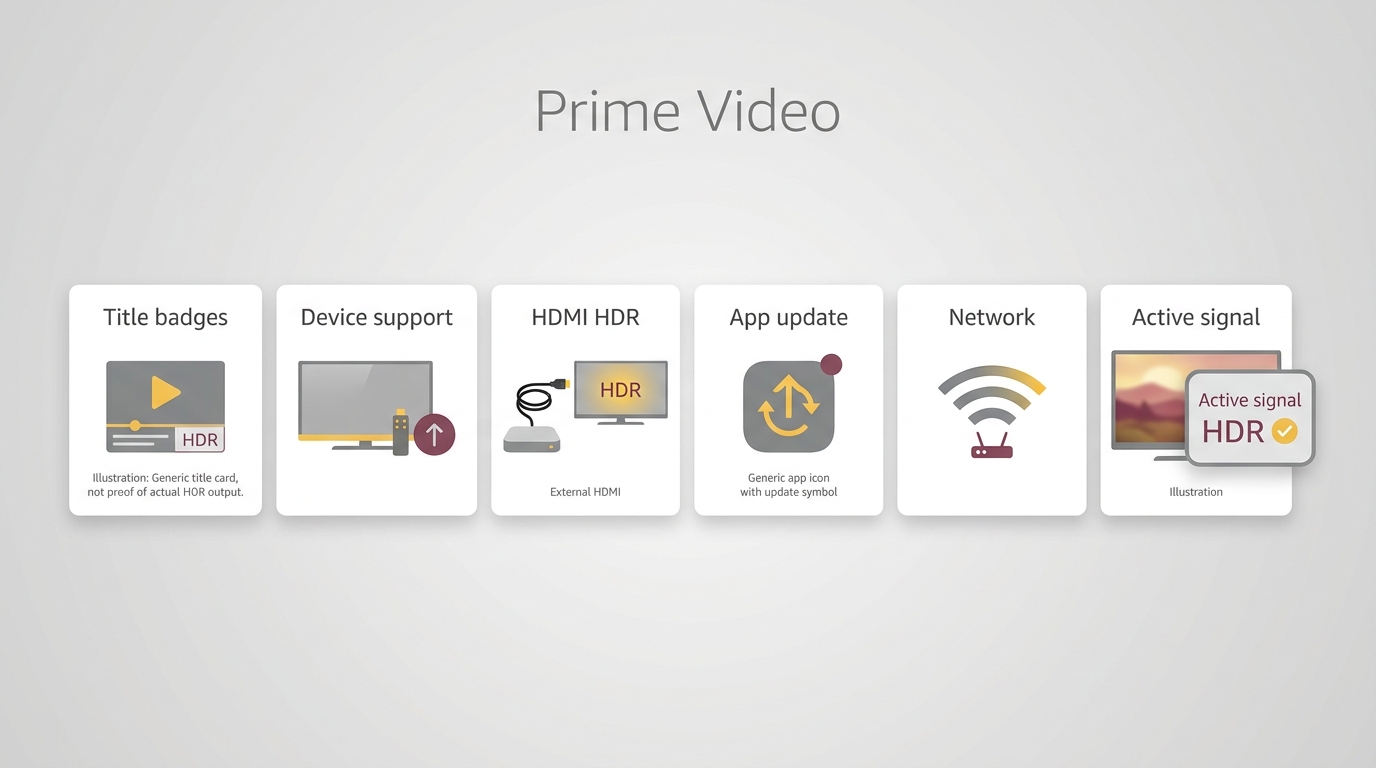
If you have compatible hardware and the right subscription, follow these steps to ensure HDR is active:
Step 1: Confirm the Content Supports HDR
Before troubleshooting your setup, verify that the title you want to watch actually supports HDR. Look for labels such as HDR, HDR10+, Dolby Vision, or 4K Ultra HD HDR on the title's detail page.
Step 2: Check Your Device Compatibility
Your display and the specific Prime Video app or playback device must support the HDR format you want to watch. An HDR-capable screen alone does not confirm that the app supports HDR playback. For an external streaming device, also check the display manufacturer's HDMI port and cable requirements.
Step 3: Enable HDR in Your TV or Device Settings
This step is frequently overlooked. HDR must be explicitly enabled on many televisions. Menu names and paths vary by model; these examples apply to external devices connected through HDMI:
- Samsung TVs: Settings > General > External Device Manager > enable HDMI UHD Color for the HDMI port you are using
- LG TVs: Settings > General > HDMI Settings > enable HDMI Deep Color for the relevant port
- Sony TVs: Settings > Watching TV > External Inputs > enable Enhanced Format for HDMI
Step 4: Update the Prime Video App
Outdated Prime Video app versions frequently fail to trigger HDR playback modes. Ensure your app is updated to the latest version available for your device.
Step 5: Ensure Adequate Internet Speed
- HDR10 / HDR10+: Minimum 15 Mbps
- 4K HDR or Dolby Vision: Minimum 25 Mbps
Run a speed test to verify your connection meets these thresholds. Use a wired ethernet connection when possible for the most reliable streaming experience.
Step 6: Verify HDR Is Actually Active
Prime Video does not always display "Dolby Vision" or "HDR" prominently in the app during playback. The most reliable way to confirm HDR is active is to check your television's pop-up notification — most TVs briefly display the active HDR format when it engages.
If a Dolby Vision badge produces HDR10 or SDR (standard dynamic range), inspect your TV's signal information during playback, compare another eligible Prime Video title, then try another HDR app through the same playback device and display. If Dolby Vision appears only in the device's menus, check the movie's actual output separately. A subscription upgrade does not fix an incompatible app or a title-specific playback problem.
Amazon Prime Video HDR on PC: Current Limitations
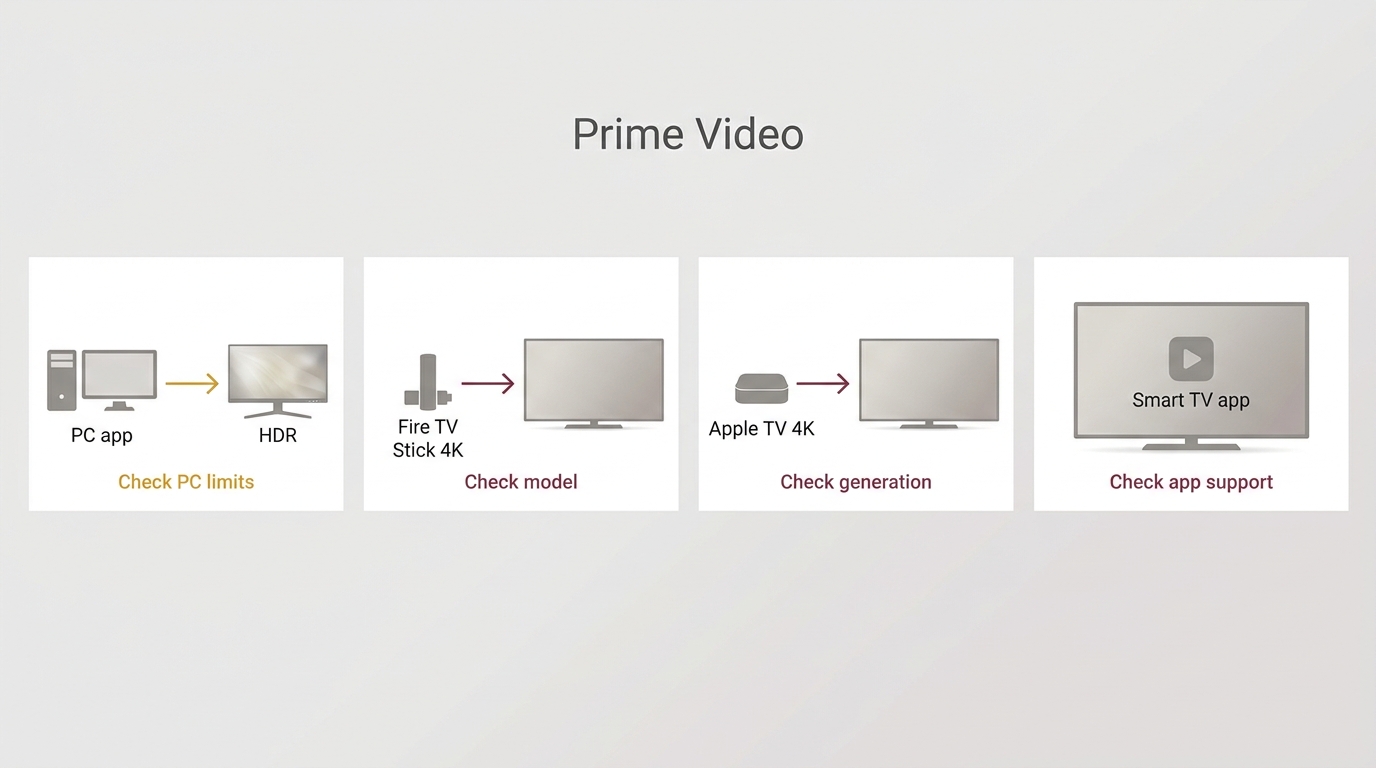
An HDR-capable PC monitor alone is not enough for Prime Video HDR playback. The specific Prime Video app or playback device must also support the format.
For streaming, use a compatible Prime Video app on your TV or connect a compatible streaming device to an HDR-capable display. Check the active signal during the movie rather than relying on the monitor's HDR setting.
Workarounds for PC Users
- Use a streaming device — Connect a Fire TV Stick 4K, Apple TV 4K, or Chromecast with Google TV to your HDR monitor via HDMI
- Use your TV directly — Stream through your smart TV's built-in Prime Video app
- Offline viewing and separate local files: Prime Video offline downloads are managed through supported Prime Video apps. Converting a separate, accessible SDR video file is a different workflow and does not alter Prime Video streaming playback.
How to Find 4K HDR Titles on Prime Video
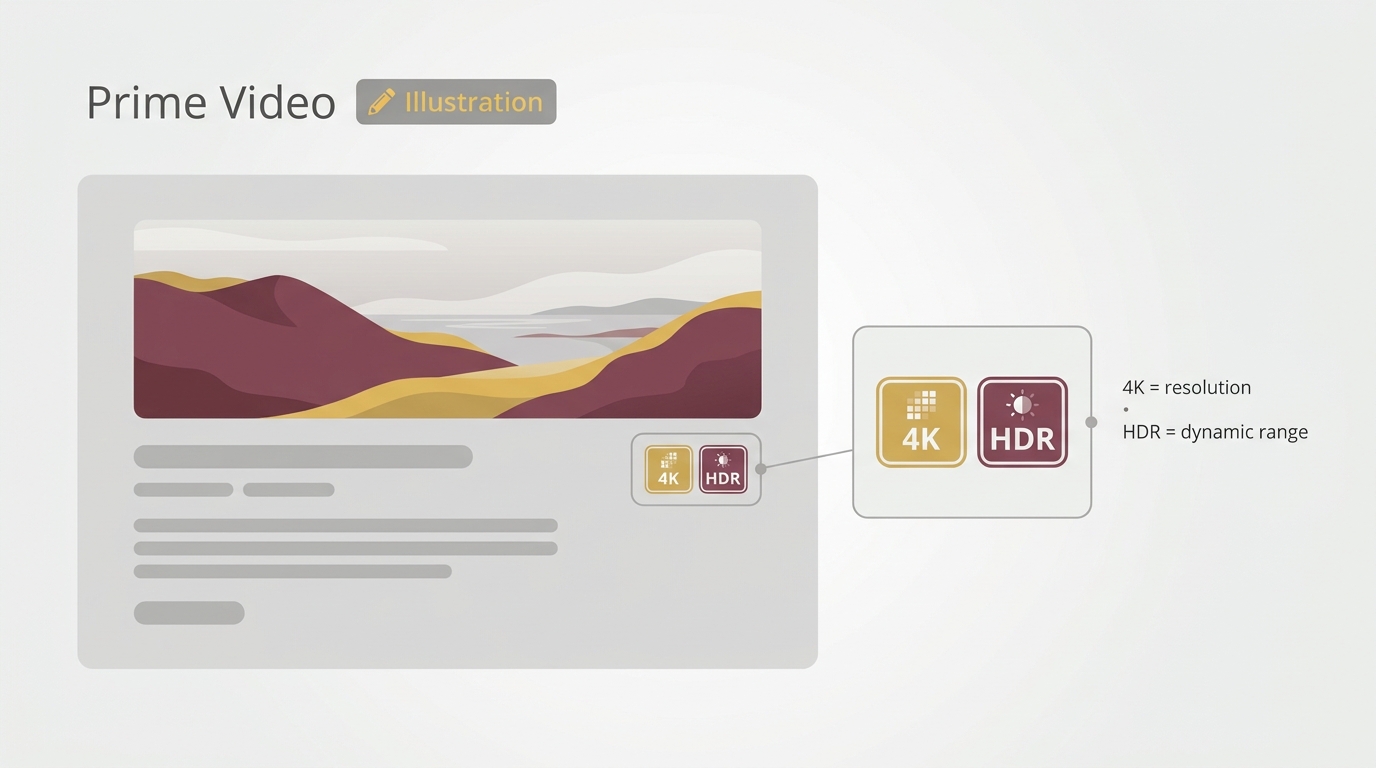
Finding HDR content on Prime Video is not always intuitive. Here are the most reliable methods:
- Browse curated rows — Look for rows labeled "4K Ultra HD," "4K HDR," or "HDR10+" on the Prime Video home page
- Search directly — Search for "4K HDR" in the Prime Video search bar (results may include non-HDR titles mixed in)
- Check title pages — Open any title's detail page and look for format badges: 4K, HDR, HDR10+, or Dolby Vision
- Use external databases — Use sites such as JustWatch.com to discover titles, then inspect the specific US title page for format badges
A 4K label describes resolution, not an HDR format, and a series-level badge does not guarantee the same format for every season or episode. Confirm the active format using your TV's signal information during playback.
SDR-to-HDR Conversion with UniFab for Local Video Files
For a separate, compatible SDR video file that you can access locally, HDR Upconverter AI offers an optional SDR-to-HDR10 conversion workflow with local processing for content you’re authorized to access, where permitted by platform terms and applicable law. An HDR-compatible display is required to view the output in HDR; conversion does not add HDR capability to an SDR display or change Prime Video streaming entitlements. The linked product page explains supported output workflows.
HDR Upconverter AI converts compatible SDR files to HDR10 or supported Dolby Vision output, with adjustments to color depth and contrast. The input must be a separate, accessible file in a supported format, not an app-managed Prime Video download. An HDR video download that already contains HDR does not need SDR-to-HDR conversion. I recommend a compatible Prime Video playback route for streaming; this local-file workflow is for readers who separately have SDR footage to convert.
Key Features
- SDR to HDR Conversion: Convert compatible SDR files to HDR10 or supported Dolby Vision output
- Frame-by-Frame Analysis — AI analyzes and optimizes brightness, contrast, and color saturation for each individual frame
- Color Space Options — Choose between DCI-P3 and Rec.2020 color spaces for optimal display compatibility
- Multiple Quality Modes — Fast, FHD, QHD, and 4K UHD processing options to match your hardware
- GPU-accelerated processing: HDR Upconverter AI supports GPU-accelerated SDR-to-HDR processing with output up to 4K; processing speed is affected by the selected workflow and hardware.
- Video Trimming — Built-in trimming tool for selecting specific segments
How to Use UniFab HDR Upconverter AI
Start with a compatible, accessible SDR file and select a supported HDR output workflow for your HDR-capable display.
30-day Free Trial for Full Features, No Watermark!
Install and launch UniFab. Select the HDR Upconverter module from the left panel. Click "Add" to import your video file.
Configure output settings. Choose HDR format, set Quality to "High" for best results. Adjust other parameters as needed.
Click "Start" to begin the AI conversion process. UniFab completes the processing rapidly using GPU acceleration.
Process authorized content for personal use only.
For a separate resolution-improvement task, UniFab's AI Video Enhancer addresses upscaling rather than Prime Video playback.
When choosing an HDR video enhancer for local footage, distinguish resolution improvement from SDR-to-HDR conversion.
If you plan on uploading HDR video to YouTube, confirm that the exported file retains its HDR format and review playback on an HDR-compatible display.
Final Thoughts
Amazon Prime Video offers an impressive library of HDR and Dolby Vision content, but accessing it requires navigating subscription tiers, device compatibility requirements, and platform-specific limitations. Eligible US titles can stream in Dolby Vision without Ultra on compatible devices; Ultra adds 4K UHD and Dolby Atmos for eligible Prime subscription titles.
I recommend checking the title and compatible Prime Video playback route before upgrading, then confirming the TV’s active signal during playback. For readers with a separate, accessible SDR file, HDR Upconverter AI offers optional SDR-to-HDR10 conversion for an HDR-capable display, without changing Prime Video streaming entitlements.
Frequently Asked Questions
Is HDR the same as 4K on Prime Video?
No. HDR describes brightness and color range; 4K describes resolution. Eligible Prime Video titles can play in Dolby Vision at HD resolution without Ultra. Ultra adds 4K UHD for eligible Prime subscription titles; purchased, rented, and add-on subscription titles have separate entitlement exceptions.
Can I choose HDR10+ instead of Dolby Vision on Prime Video?
There is no universal Prime Video switch for choosing between these formats. Available output follows the title’s formats and support in the specific playback app and display. Use your device’s supported video-output controls, then check the TV’s signal information during playback to see which format is active.
Why does Prime Video HDR look too dark on my TV?
Check the active HDR picture mode, room lighting, and your TV’s picture controls, then compare another HDR title using the same playback setup. Use a compatible Prime Video app and the display manufacturer’s picture settings. A dark picture alone does not mean you need a subscription upgrade.
Why does my Apple TV menu show Dolby Vision but Prime playback does not?
The Apple TV menu’s output format and a movie’s playback format are separate. A Dolby Vision menu does not confirm that Prime Video is playing the title in Dolby Vision. Check your TV’s signal information while the movie is playing, then compare another Dolby Vision title using the same Apple TV and Prime Video app.
Does Dolby Atmos on Prime Video also mean Dolby Vision is active?
No. Dolby Atmos is an audio format, while Dolby Vision is an HDR video format. An Atmos badge does not confirm Dolby Vision playback, or vice versa. For eligible US Prime subscription titles, Ultra adds Dolby Atmos and 4K UHD; Dolby Vision can be available without Ultra on compatible devices.