![10 Best 1080p to 4K Upscalers of 2026 [Windows, Mac & Online]](https://artifact.dvdfab.me/2026/08/27/4oBcI3_xuUKywSNNK2A3JX1U3UrVXX7-/feature_cover.jpg)
Upscaling 1080p to 4K increases the frame size, but it cannot restore every detail that the original camera never captured. The right 1080p to 4K upscaler depends on your source, hardware, privacy needs, and workflow: browser tools suit short clips, while desktop, cloud, and NLE options serve different projects.
Quick takeaway: Choose by source quality and workflow rather than a universal winner, then preview a representative clip before exporting the full file.
Quick Verdict: Choosing a 1080p to 4K Upscaler
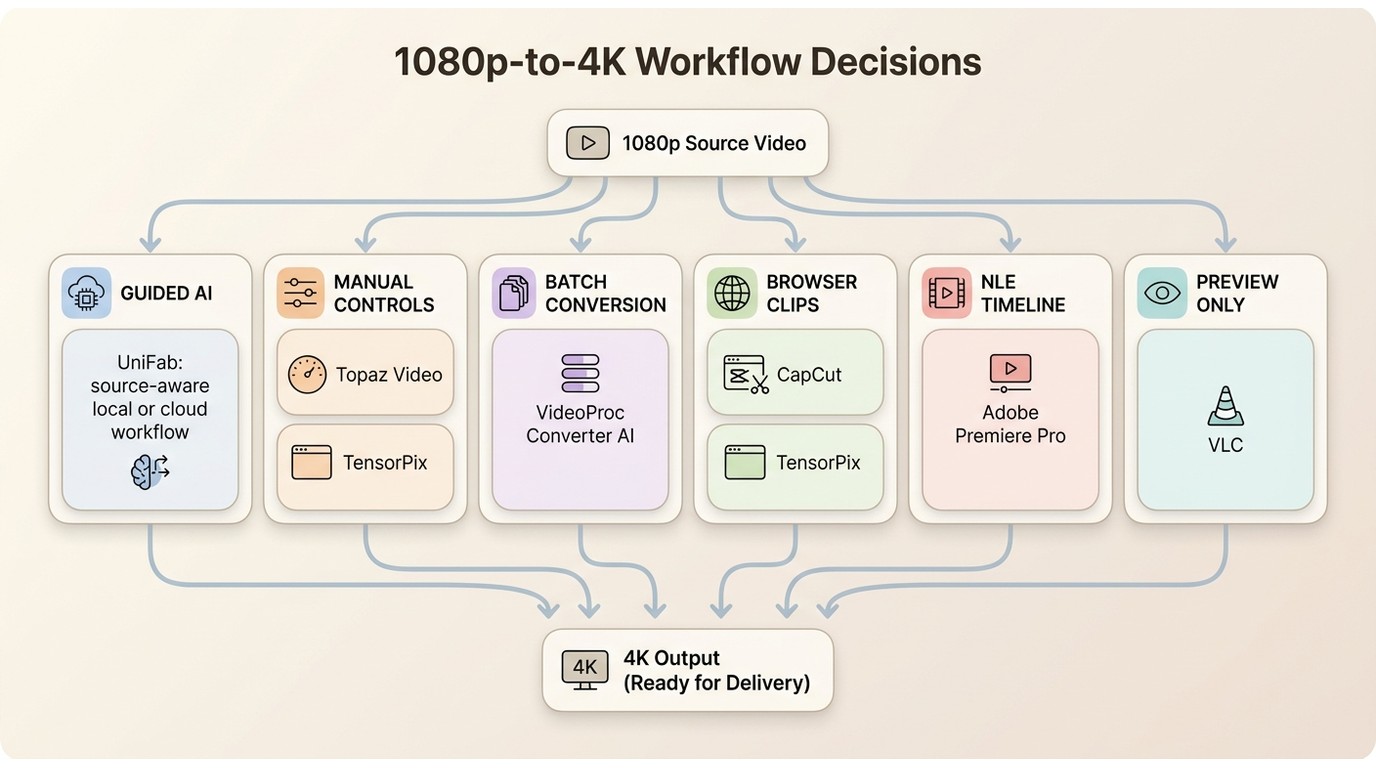
- Guided desktop or cloud processing: UniFab Video Upscaler AI suits users who want source-aware model routing and a local or FabCloud workflow; it is not ideal for deep manual parameter tuning.
- Manual model control: Topaz Video suits specialists who want detailed recovery controls, provided their hardware and recurring subscription budget fit the project.
- Batch conversion: VideoProc Converter AI fits lightweight format and batch workflows; it is less suited to demanding restoration control.
- Short browser projects: TensorPix or CapCut can reduce installation overhead, but uploads, account limits, credits, and export conditions vary.
- Timeline finishing: Adobe Premiere Pro fits projects already being edited in an NLE, rather than dedicated restoration work.
- Basic playback and scaling: VLC is useful for previewing and applying filters, but it does not reconstruct missing 4K detail with AI.
UniFab 1080p to 4K upscaler
- Best overall 1080p to 4K upscaling solution
- Balanced quality, speed, and usability
- Ideal for most everyday video upscaling
- Reliable AI upscaling with minimal effort
UniFab Video Upscaler AI
UniFab 1080p to 4K upscaler
- Best overall 1080p to 4K upscaling solution
- Balanced quality, speed, and usability
- Ideal for most everyday video upscaling
- Reliable AI upscaling with minimal effort
UniFab Video Upscaler AI for Mac
What Is a 1080p to 4K Upscaler?
A 1080p to 4K upscaler is a tool that increases video resolution from 1920×1080 Full HD video resolution to 3840×2160 (Ultra HD). Modern upscalers use AI-based reconstruction rather than simple interpolation, predicting missing pixels frame by frame to improve sharpness, textures, and perceived detail. If you also handle mixed sources, our roundup of the best 4K video upscaler tools compares desktop and online options side by side.
Native 4K Still Holds More Real Detail
Clean, well-encoded 1080p usually has more to gain than heavily compressed footage. Aggressive processing can invent texture in faces, reflections, hair, or fine patterns, sometimes creating halos or a waxy look. Native 4K remains preferable when a reshoot is possible because it begins with more captured scene detail.
AI-powered 1080p to 4K upscalers can help by:
- Rebuilding edges instead of stretching pixels
- Reducing some noise and compression artifacts
- Improving perceived clarity in faces, text, and motion
How Does AI-Based 1080p to 4K Upscaler Work?
Unlike traditional upscaling that simply enlarges pixels, AI upscalers analyze the content of the video, identifying patterns, textures, and details that should be present at higher resolution. These algorithms use learned visual patterns to predict additional pixels and may improve perceived sharpness, edges, and texture, helping ensure that the final 4K output retains sharpness, clarity, and natural-looking textures when the source and model support it. Results depend on the source and model, and aggressive processing can produce invented detail, waxy faces, halos, flicker, or other temporal inconsistencies.
The process works like this:
- Analysis of original video: The AI examines the 1080p video to understand structures, shapes, and textures, identifying edges, faces, and important visual features.
- Pixel prediction: Neural networks predict the additional pixels required to scale to 4K, filling gaps using what similar imagery looked like in training data.
- Smoothing and refining: The AI applies smoothing and anti-aliasing so the upscaled video looks natural — without pixelation or artifacts on larger screens.
- Output at 4K resolution: The final result preserves original detail at 8.29 million pixels.
A Four-Step Workflow at a Glance
- Import a source file you are authorized to process, where permitted by applicable terms and law; MP4 is a common path.
- Choose 3840×2160 and a model suited to the footage.
- Preview a representative segment with faces and motion before processing the full file.
- Export the new file, then inspect it at full size for flicker, halos, and unnatural texture.
MOV or WEBM import and export availability depends on the tool. A 4K TV can scale 1080p during playback, but that display processing does not create a downloadable 4K file. For a concise guide to upscale 1080p to 4K, see the step-by-step workflow; the existing guide on how to upscale video to 4K covers the broader task.
How We Tested These 1080p to 4K Upscalers
Review process:
- Compare the processing route: local desktop, cloud, browser, or edit timeline.
- Use 1920×1080 source clips with faces, fast motion, low light, and visible compression.
- Assess output quality, workflow controls, hardware demands, formats, and current pricing.
- Judge each tool by the project it fits, rather than by a universal ranking.
Test setup:
- Source resolution: 1920×1080
- Output resolution: 3840×2160 (4K UHD)
- Video types tested: talking-head footage (face and skin detail), fast-motion scenes (sports, handheld), low-light and compressed footage (noise and artifacts)
Evaluation criteria:
- Detail recovery and Edge clarity
- Face rendering without waxy texture
- Noise reduction without over-sharpening
- Motion consistency without ghosting or flicker
- Halos and invented texture around fine detail
- Batch processing, format support, and hardware demands
Render time varies substantially by model, GPU, source condition, and output settings. A short preview is the practical way to judge both quality and processing demands before committing to a full batch. One community benchmark illustrates the spread: the same 72-second 1080p-to-4K clip ran at 2.6 FPS on an RTX 3090 system, 2.5 FPS on an M4 Pro, and 1.4 FPS on an RTX 3070 laptop.
Comparison Table: Best 1080p to 4K Upscalers (Desktop & Online)
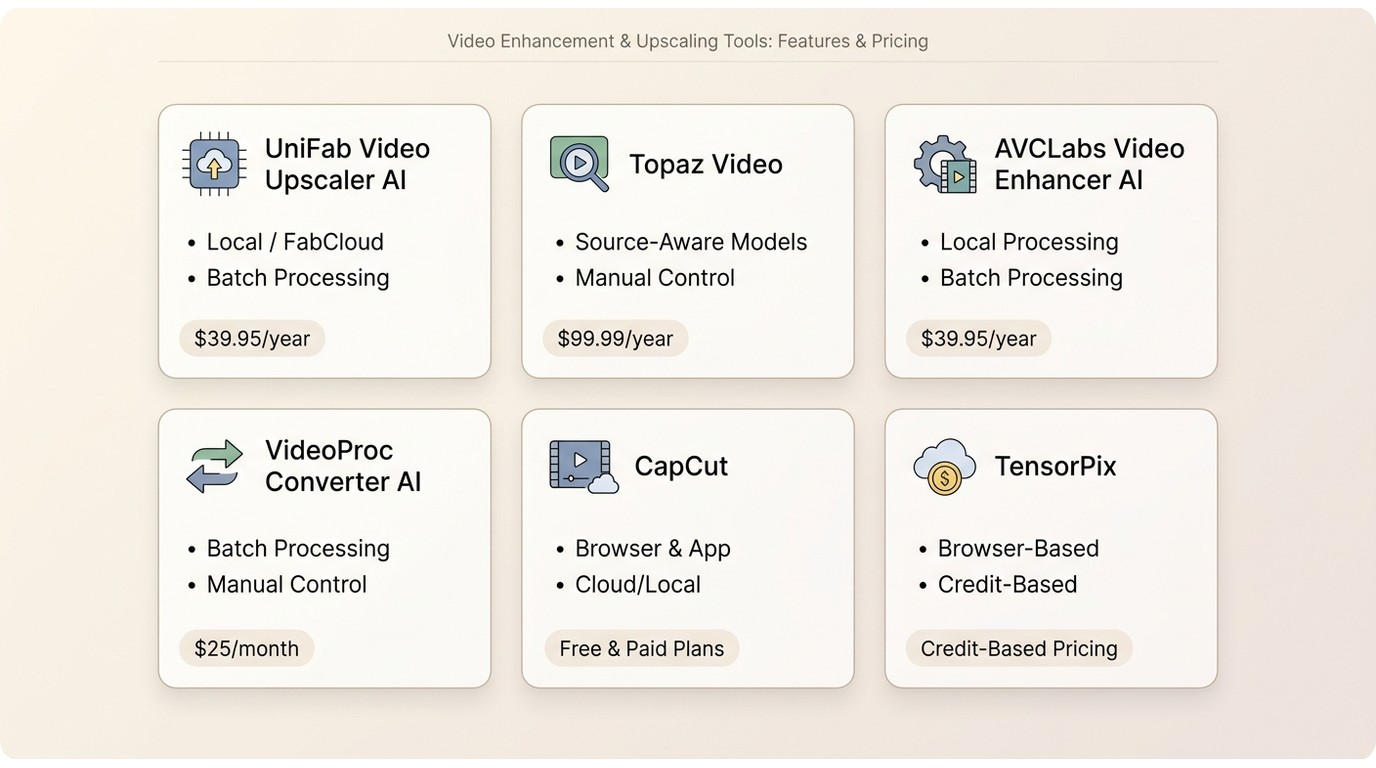
| Tool | Processing and hardware | Formats and export | Best fit and main limit | Current price |
| UniFab Video Upscaler AI | Desktop + FabCloud; guided AI | MOV, MP4, AVI and more; MP4/MKV output | Model routing; not deep manual tuning | 3 watermark-free attempts; $99.99/year; $129.99 lifetime |
| Topaz Video | Desktop; manual controls; hardware-intensive | Desktop formats vary | Recovery control; recurring subscription | $25/month billed annually |
| AVCLabs Video Enhancer AI | Desktop; multi-frame AI | Desktop formats vary | Restoration and colorization; slower processing | $39.95/month |
| VideoProc Converter AI | Desktop; batch; GPU acceleration | 370+ input / 420+ output formats | Broad conversion; fewer restoration controls | $39.95/year; lifetime around $65.95 |
| CapCut | Web/app; automated processing | Formats vary by account | Short social clips; account limits vary | Free access advertised |
| TensorPix | Web; cloud upload | Browser formats vary | Short batches; credit limits apply | Credit-based pricing varies |
Prices shown as of August 2026.
Best 1080p to 4K upscaler
- Flexible customization with four distinct AI models.
- User-friendly interface suitable for beginners and pros alike.
- Faster processing with support for modern GPUs.
- 30-day full-feature free trial allowing risk-free evaluation.
- Competitive pricing compared to high-end rivals like Topaz Video AI.
UniFab Video Upscaler AI
Best 1080p to 4K upscaler
- Flexible customization with four distinct AI models.
- User-friendly interface suitable for beginners and pros alike.
- Faster processing with support for modern GPUs.
- 30-day full-feature free trial allowing risk-free evaluation.
- Competitive pricing compared to high-end rivals like Topaz Video AI.
UniFab Video Upscaler AI for Mac
Desktop 1080p to 4K Upscalers
Desktop applications can process authorized footage locally, while some services also offer cloud processing for users without a dedicated GPU. Local processing keeps files on your device and suits repeat batches; cloud processing can reduce hardware dependence but requires uploading footage. The right route depends on privacy needs, clip length, and available hardware.
UniFab Video Upscaler AI
UniFab Video Upscaler AI offers local processing and FabCloud processing for content you are authorized to process, where permitted by applicable terms and law. Its Equinox model is intended for general video, Vellum for texture-focused material, Kairo for anime and stylized footage, and Titanus for film-oriented sources. Output support up to 16K provides headroom, though a higher output setting does not by itself improve a 1080p-to-4K result.
For compressed or aging footage, its model choices can help address noise, jagged edges, blur, and compression artifacts. Previewing a face-and-motion segment first helps avoid over-sharpening or synthetic texture.
Supported OS: Windows & Mac Price: $99.99/year; $129.99 lifetime. Three watermark-free processing attempts are available for standard features.
It is most relevant for:
- General footage that benefits from guided model selection
- Anime or stylized clips that need a dedicated model option
- Users choosing between local processing and FabCloud
UniFab is a practical fit for guided model routing and users who may need a cloud route without a dedicated local GPU. It is not the natural fit for readers who want deep manual parameter tuning.
AVCLabs Video Enhancer AI
AVCLabs Video Enhancer AI is suited to restoration-focused projects that use multi-frame enhancement, super-resolution, or colorization to improve older and lower-quality footage. While offering colorization for black-and-white video, it provides multiple video-enhancing functions such as frame interpolation, upscaling, and enhancement.
Supported OS: Windows & Mac Price: $39.95/month
Pros
- AI single- or multi-frame enhancement
- Multi-frame enhancement for restoration-focused projects
- Removes noise, blur, and compression artifacts
- Frame interpolation for slow-motion exploration
Cons
- Comparatively expensive
- Slow video upscaling
Topaz Video
In this 1080p to 4K comparison, Topaz Video suits users who want manual model controls for detail recovery, artifact reduction, frame-rate changes, and slow-motion work. For cinematic projects, its detailed controls can help users adjust recovery, artifact reduction, frame-rate changes, and slow-motion processing when the source and settings support those goals. Its desktop workflow can require substantial hardware, and its current licensing uses a recurring subscription.
Supported OS: Windows & Mac Price: $25 per month billed annually.
Pros
- Fixes compression artifacts during upscale
- Preserves minute details by removing digital noise
- Multiple models for blur, noise, haze, shake
- Instant automatic face recognition
Cons
- Heavy on system resources
- Subscription cost and demanding hardware
Adobe Premiere Pro
For projects already being edited in an NLE, Adobe Premiere Pro keeps scaling and finishing inside the timeline. Its tools suit editors who need to upscale video in Premiere Pro alongside color, trims, and delivery work, but they are not a substitute for a dedicated AI restoration workflow.
Supported OS: Windows & Mac Price: US$22.99/month for the annual single-app plan billed monthly.
Pros
- AI features: audio ducking, color matching, speech enhancement
- Auto transcript generation with text adding & clip trimming
- Three-point editing with ripple, roll, slip, slide
- Hundreds of built-in transitions, effects, templates
Cons
- Requires a powerful system
- Steep learning curve
VideoProc Converter AI
VideoProc Converter AI fits users who need conversion, compression, editing, recording, stabilization, sharpening, and denoising in one desktop workflow. It is more relevant to broad format and batch work than to projects requiring deep restoration controls.
Supported OS: Windows & Mac Price: $39.95/year for Premium 365; an official lifetime option is around $65.95.
Pros
- Handles all types of videos (quality/format/file size)
- 370 input & 420 output formats
- Batch upscaling 1080p (or lower) to 4K
- Lossless compression to reduce upscaled file size
Cons
- Limited night mode/landscape/portrait modes
VLC Media Player
VLC Media Player is free, open-source media-player software with playback scaling, filter controls, color adjustment, and preview tools. It can display 1080p video at a 4K output size or help with basic preprocessing, but it does not reconstruct missing scene detail with AI. Cache settings affect playback behavior, not the underlying video quality.
Supported OS: Windows, Mac, Linux Price: Free
Pros
- Increase number of threads for upscaling
- Essential Effects filter for brightness/contrast/saturation
- Video Effects filters with color adjustment, crop settings
- Adjust output settings for quality
Cons
- Some formats need additional codecs
- Poor-quality video creates playback issues
Online 1080p to 4K Upscalers
Online 1080p to 4K upscalers are convenient for short clips because they run in a browser, but they require uploading footage. A video quality enhancer 1080p online free can suit a short, non-sensitive clip, while local processing is often the more practical route for sensitive, long, or repeated projects. In my view, browser convenience is not worth the upload trade-off for sensitive footage or long batches.
| Tool | Accepted formats | Watermark | Account or credit limits | Clip, export, and privacy notes |
| TensorPix | Browser formats vary | Plan-dependent | Credits and plans apply | Short batches; cloud upload and download |
| CapCut | Formats vary by account | Access rules vary | Account-level limits vary | Short social clips; browser/app workflow |
| HitPaw | Web formats vary | Watermark on free version | Advanced features are paid | Plan and channel conditions vary |
| Media.io | MP4, MOV, AVI, and more | Plan-dependent | Minute-based plans | Short clips; limited minutes for batches |
Browser tools commonly accept MP4, while MOV or WEBM support, watermark rules, account sign-in, credits, clip limits, download behavior, and privacy terms vary by service. A 1080p to 4K converter online free can be useful for a one-off clip, but export conditions and upload terms should be considered before processing the full file.
TensorPix
TensorPix is a browser-based option for users who want to process short clips without installing desktop software. It can suit cloud batches, although its current credit limits and plan options should be considered before larger jobs.
Supported OS: Web Price: Plans vary by credits and billing option.
Pros
- Fixes low resolution, compression artifacts, blur
- Batch upscaling on smartphone or tablet
- Multiple AI filters (decompressor, film cleaner, deinterlacer, color restorer)
- Instant download
Cons
- No video editing during upscale
- Cannot handle very low-quality footage
CapCut 4K Upscaler Online
CapCut AI Video Upscaler provides browser and app access for quick short-form projects, with sharpening and deblurring tools. It can be useful for stylized social clips, though stronger processing can produce an artificial look and account-level limits vary.
Supported OS: Web Price: Free access is advertised; features and limits vary by account.
Pros
- Professional appeal while removing blur
- Handles videos with various resolutions, contexts, formats
- Gives new life to historical footage
- Smooth, fully automated workflow
Cons
- Output quality often unnatural with strong AI look
- Limited track-adding option
- Some features (background removal, body effect) glitchy
HitPaw Online AI Video Upscaler
HitPaw Online AI Video Upscaler is an easy-to-use 1080p to 4K upscaler online — for beginners through professionals, including anime fans, social media users, film lovers, and content creators. It upscales any poor-quality, old, or damaged video to 4K while restoring details and color. Batch processing supported.
Supported OS: Web Price: US$22.39 monthly promotion; US$124.99 annual Microsoft Store plan, with availability varying by channel.
Pros
- AI face model for automatic face detection & enhancement
- Instant background noise removal
- Anime upscaling to 4K with professional appeal
- Colorization for vintage/historical/B&W footage
Cons
- Free version exports with watermark
- Most advanced features paid
Media.io 1080p to 4K Tool Online
Media.io is an online option for simple AI-assisted upscaling with a browser workflow and a desktop version. Its minute-based plans make more sense for a few short clips than for large recurring batches.
Supported OS: Web Price: $17.90/month for 5 minutes; pay-as-you-go from $19.90 for 3 minutes. The included minutes make it less suitable for large recurring batches.
Pros
- Adds missing details
- Zoom function for clear viewing
- Multiple format support (MP4, MOV, AVI, etc.)
- 2× or 4× upscaling speed control
Cons
- No dedicated video editing
- Denoising, sharpening, shake stabilization not supported
Best Upscalers for Different Source Videos
| Source or project | Processing route | Useful fit | Main caveat |
| Short social or AI-generated clips | Browser or guided AI preview | CapCut, TensorPix, or a desktop AI tool | Stylized or synthetic detail may look artificial |
| Archives and compressed footage | Local or cloud AI with denoise and preview | AVCLabs or UniFab; try Equinox or Vellum by source | Missing detail cannot be fully recovered |
| Anime and stylized footage | Dedicated model with conservative preview | UniFab Kairo or a suitable specialist workflow | Overprocessing can damage line and pixel structure |
| Professional finishing | NLE timeline or manual desktop controls | Premiere Pro or Topaz Video | Timeline scaling and AI restoration are different tasks |
Source type matters more than a generic best-overall label: the right choice changes with artifact risk, available hardware or cloud access, editing needs, and batch size. For more detail on how the AI Video Enhancer processes individual frames, see the related overview.
Final Verdict: Match the Tool to the Job
A 1080p to 4K upscaler enlarges the output frame and may improve perceived clarity, but the suitable route depends on the project. Browser tools fit short, non-sensitive clips; dedicated desktop or FabCloud AI tools fit repeated restoration and batches; an NLE fits projects already being edited; and basic scalers are mainly for playback or preprocessing. UniFab is a practical fit for guided local or FabCloud processing, while readers who need deep manual controls, one-off browser work, or timeline editing may prefer another route. To explore a higher-resolution workflow, see our guide on how to upscale 4K to 8K.
1080p to 4K Upscaling FAQs
Does 1080p Upscaled to 4K Look Good?
It can look cleaner and sharper when the 1080p source is well encoded, but it will not match native 4K capture. Clean footage usually offers more useful detail than heavily compressed or stylized footage, and aggressive processing can introduce waxy faces, halos, flicker, or invented texture.
Can lossless scaling upscale from 1080p to 4K?
Lossless scaling can technically scale 1080p to 4K, but it does not add new visual detail. For meaningful quality improvement, AI-based upscalers are far more effective than lossless or interpolation-only scaling methods.
Is a 4K Upscaler Worth Buying?
It can be worthwhile for recurring archive restoration, client work, or large batches where a new exported file matters. For one short, non-sensitive clip, a browser tool may be more practical. A TV's built-in scaling changes playback only, so it does not replace an exported 4K file.
Is 4K really 4 times 1080p?
Yes, in pixel count: 1080p is 1920×1080 (about 2.07 million pixels), while UHD 4K is 3840×2160 (about 8.29 million pixels). Four times the pixels does not guarantee four times the visible detail because the source still sets the quality ceiling.
Can I Upscale an MP4 Online Without a Watermark?
Some browser tools advertise free or free-start access, but watermark, signup, credit, duration, format, download, and privacy conditions vary. A short, non-sensitive clip is the safest fit for comparing these services; longer or sensitive footage is better suited to a workflow with clearer local or cloud handling.
What hardware do I need to upscale 1080p to 4K with AI?
A modern dedicated GPU (NVIDIA RTX 30-series or higher / Apple Silicon M2+) gives a smooth experience for AI upscaling at 1080p→4K. Integrated GPUs work but are noticeably slower. For very large libraries, a workstation card or cloud render makes more sense.
Should I upscale 1080p to 4K or shoot 4K natively?
Always shoot native 4K if you can — AI upscaling cannot recreate detail that wasn't captured. Reach for a 1080p to 4K upscaler when reshooting isn't possible: archival footage, legacy YouTube uploads, downloaded source material, or stock you don't own the originals for.