To remove motion blur from video, first identify whether the problem is exposure streaking, camera shake, missed focus, compression softness, or noise. Mild blur can often be reduced; severe lost detail cannot be restored reliably. This guide compares four practical desktop and online routes.
Why Motion Blur Appears
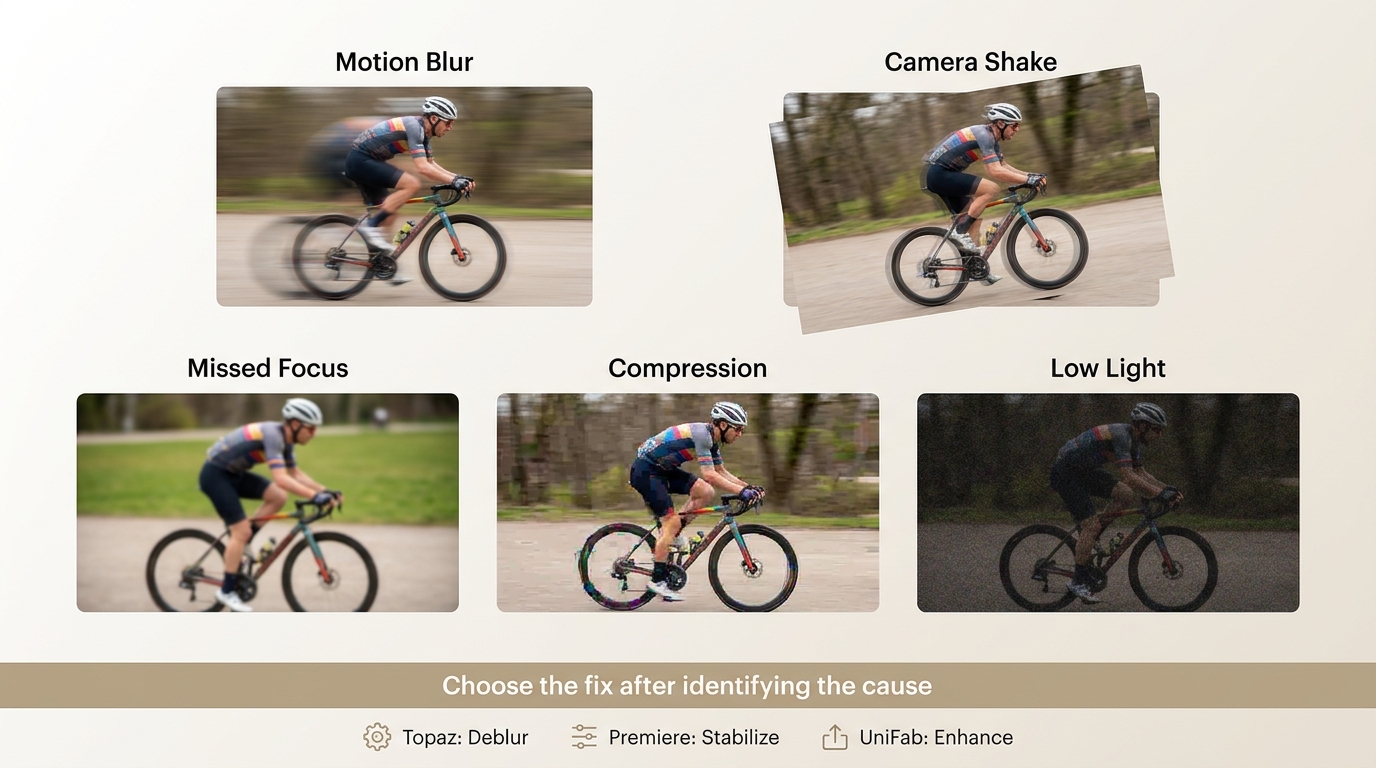
Motion blur records movement as a streak within a frame, but several look-alike problems need different fixes. Diagnosing the symptom before applying a strong filter is the most reliable way to avoid sharpening noise or stabilizing footage that was simply out of focus.
| What you see | Likely cause | First response |
| Directional streaks on a moving subject | Slow shutter speed or fast subject motion | Use a motion blur remover conservatively, then inspect moving edges frame by frame. |
| The whole image shifts between otherwise readable frames | Camera shake | Stabilize first; deblur only if individual frames also contain streaks. |
| Edges remain uniformly soft even when nothing moves | Missed focus | Try modest sharpening or upscaling; reshoot important footage when facial or text detail is absent. |
| Blocky or smeared detail around motion | Compression softness | Use denoise or upscale tools before judging whether deblurring is still needed. |
| Grain and colored speckles in dark areas | Low-light noise | Denoise before sharpening so the filter does not amplify noise. |
Slow shutter speed is the most common source of exposure-time blur. A low frame rate can make motion look less continuous, but increasing frame rate does not recreate detail that the shutter failed to capture. My editorial rule is simple: match the fix to the symptom before increasing strength.
What Blur Removal Can Recover
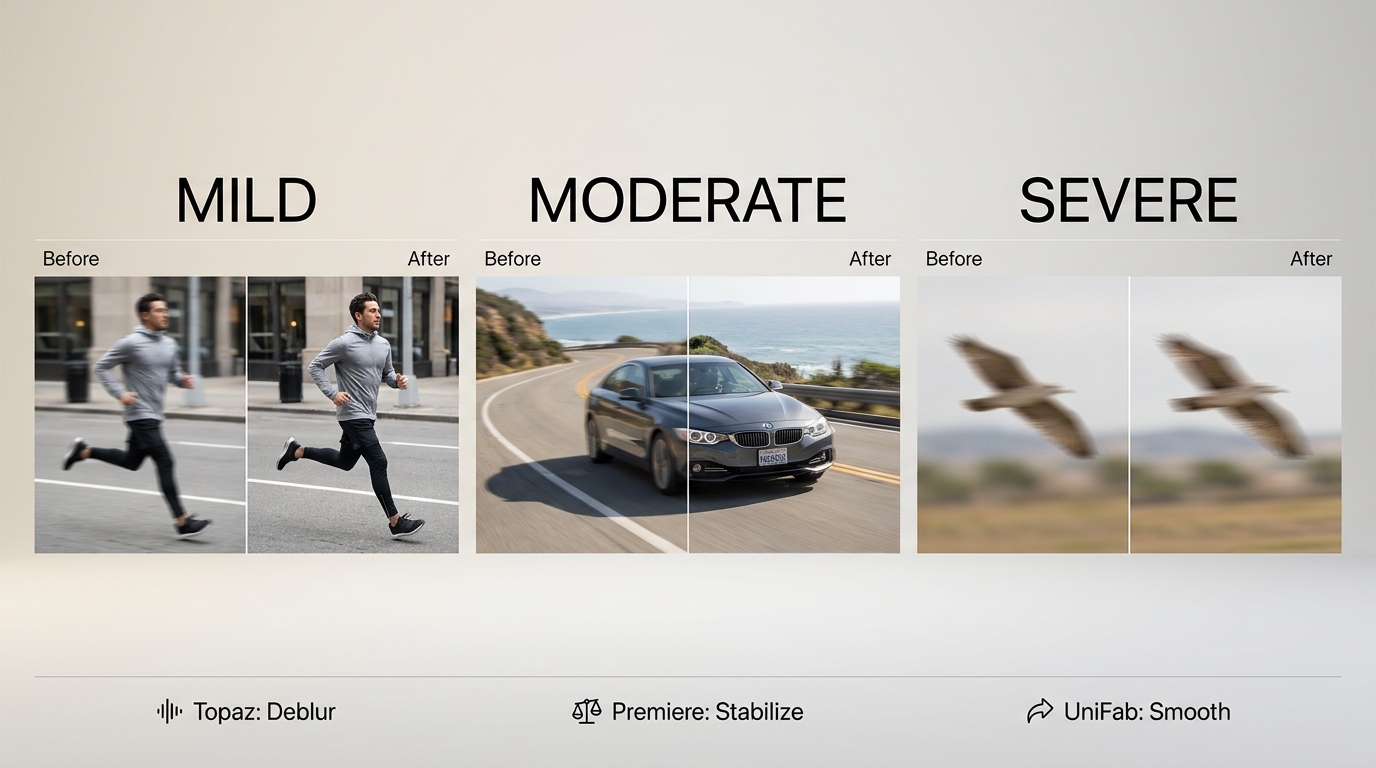
Motion blur reduction is most convincing on mild or moderate streaking with visible Edge information. Severe smears may improve in perceived clarity, but AI can estimate unstable texture instead of recovering the original detail.
- Mild blur: Reduce motion blur with restrained deblur or interpolation, then compare moving edges at normal playback speed.
- Moderate blur: Combine stabilization, denoise, and deblur in separate passes. Mask the effect if faces, text, or thin lines begin to shimmer.
- Severe blur: Accept the shot for atmosphere, crop around the damaged area, use a brief cutaway, or reshoot when the missing information is essential.
A useful result is not the sharpest paused frame. It is a clip that remains stable through motion without doubled outlines, crawling texture, or flicker. For critical footage, that temporal consistency matters more than an aggressive before-and-after still.
4 Motion Blur Removers Compared
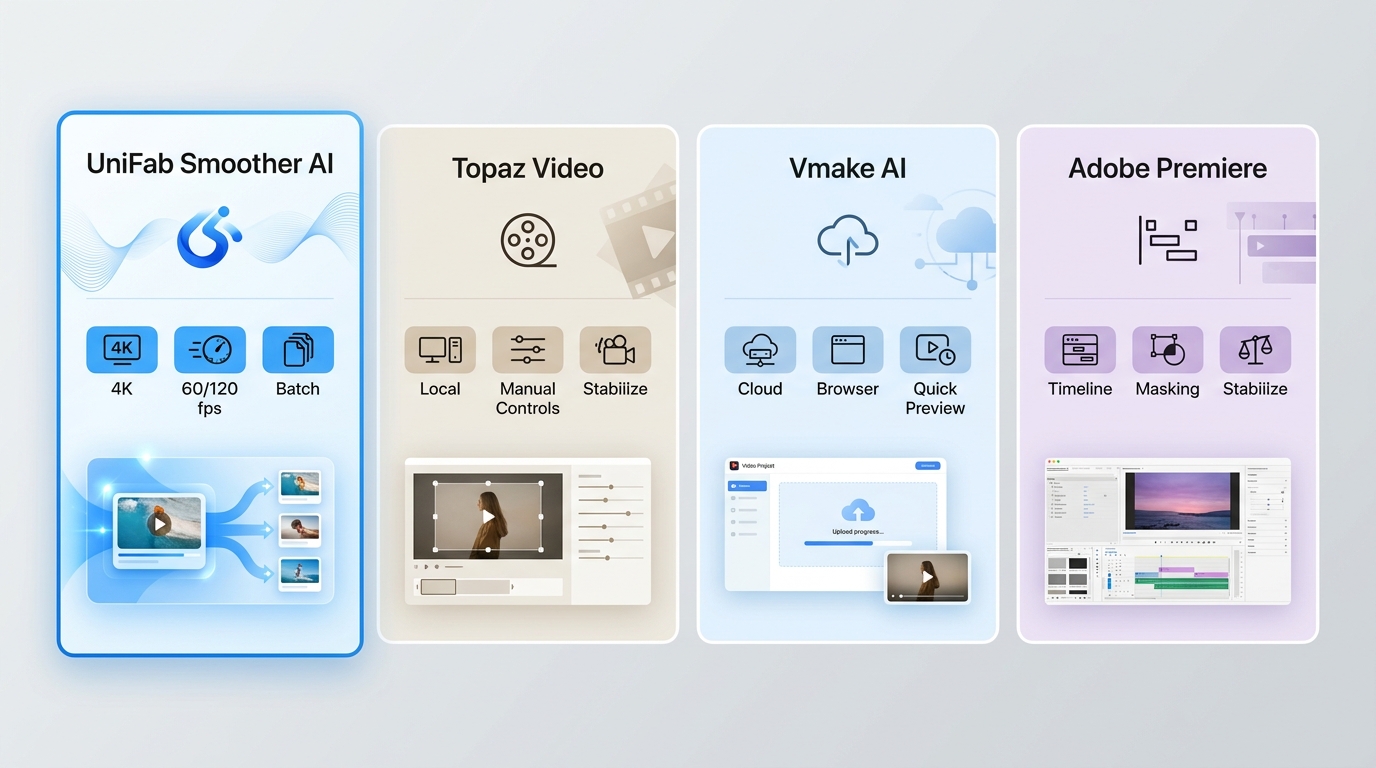
This comparison uses verified capabilities and practical limits rather than product ratings or unsupported benchmark claims. For a reproducible check, preview the same mild streak, severe streak, camera-shake, and low-light clips in each applicable tool before committing a full project.
| Tool | Good fit | Less suitable for | Blur cases to preview | Shared evaluation method | Verified capability | Likely failure signs | Processing factors | Output | No-cost access | Watermark | Upload or duration limits | Processing location | Access | Current price |
| UniFab Smoother AI | Windows or Mac batch work that needs frame interpolation and motion compensation | Editors who need manual, model-level restoration controls | Judder, moderate motion smear, fast pans, and low-frame-rate footage | Compare the same source and target frame rate; inspect outlines and repeating patterns during playback | 24 or 30 fps to 60 or 120 fps, batch processing, GPU acceleration, up to 4K | Doubled edges or flicker on occlusion, severe streaking, or complex motion | Source resolution, target frame rate, GPU, and queue size | MP4 or MKV, up to 4K | No no-cost access claim is used in this article | No watermark policy claim is used in this article | No upload limit for local files; project length affects processing time | Local desktop processing | Windows and Mac | $69.99/year or $89.99 one-time |
| Topaz Video | Detailed model selection, stabilization, and motion-deblur control | Quick work on modest hardware or a simple automatic queue | Camera shake, directional streaking, difficult edges, and restoration work | Preview identical ranges with stabilization and Motion Deblur adjusted separately | Dedicated stabilization and Motion Deblur controls in a desktop workflow | Long processing, cropping from stabilization, halos, or inconsistent detail | Selected model, stabilization method, source resolution, and hardware | Desktop export settings vary by project | Not stated in this comparison | Not stated in this comparison | Local files; no browser upload limit | Local desktop processing | Windows and Mac | As of July 2026: $59/month, $299/year, or $39/month with a 12-month commitment |
| Vmake AI | A quick way to unblur video online from a browser or phone | Private, long, high-resolution, or parameter-sensitive projects | Mild softness, short social clips, and quick browser previews | Upload the same short excerpt and compare the preview before export | Browser-based automatic enhancement with no desktop installation | Over-sharpening, generalized enhancement instead of targeted deblur, or plan-limited output | Upload size, service queue, clip length, and selected export | Export options depend on the current service plan | Credits and preview access depend on the current plan | Watermark rules depend on the current plan | Upload and duration limits depend on the current plan | Cloud processing requires an upload | Desktop and mobile browsers | Plan-dependent |
| Adobe Premiere | Editors who want motion blur reduction inside an existing edit and color workflow | One-click AI motion deblur or automatic batch restoration | Camera shake, moderate softness, and clips needing masked corrections | Analyze the same segment with Warp Stabilizer, then add sharpening only if needed | Warp Stabilizer, manual sharpening, masks, and timeline integration | Warping, cropping, sharpened noise, or limited recovery of exposure streaks | Clip length, effect stack, sequence settings, and hardware | Controlled by sequence and export settings | Available through the chosen Adobe plan | No separate blur-removal watermark policy | Local files; project length affects analysis and export | Local desktop processing | Windows and Mac | Subscription plan-dependent |
The practical takeaway is to compare motion, not marketing claims. Use the same short ranges, keep settings documented, and judge playback at normal speed. Processing time varies with source resolution, output frame rate, selected effects, hardware, and queue conditions.
1. UniFab Smoother AI
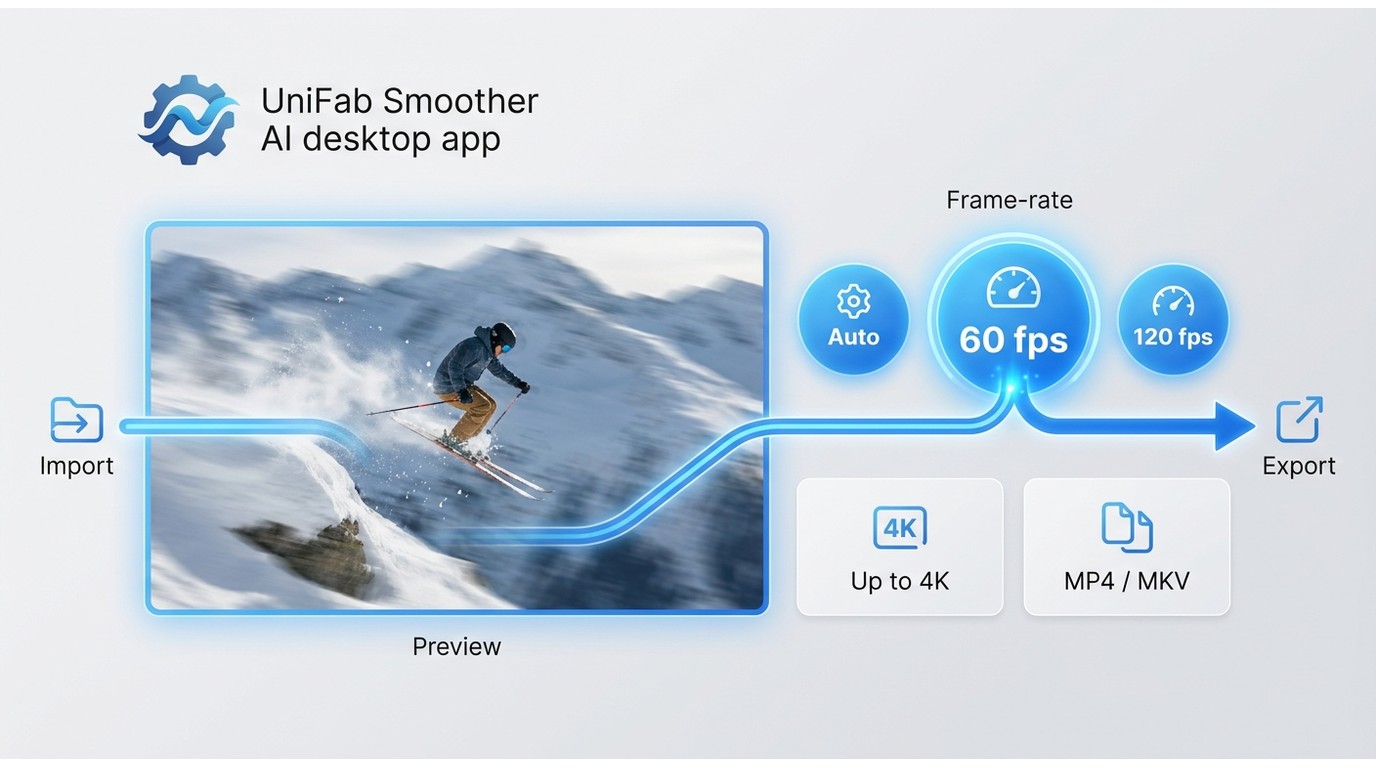
UniFab Smoother AI is an AI motion blur remover for Windows and Mac that combines frame interpolation, motion compensation, GPU acceleration, and batch processing. It supports MP4 and MKV output up to 4K and can convert 24 or 30 fps footage to 60 or 120 fps.
Good fit: creators processing multiple sports, drone, gameplay, or handheld clips that need smoother motion with a guided desktop workflow. Less suitable for: severe exposure streaking or projects that require manual masks and model-by-model restoration controls.
- Select the target frame rate instead of assuming the highest value will suit every source.
- Use 2X or 4X slow motion only when the source motion and delivery plan call for it.
- Queue related clips in a batch, then review difficult motion individually before final export.
Frame interpolation supports motion blur reduction by filling temporal gaps; it does not replace dedicated sharpening or restore missing texture. For a broader comparison of this technique, see the AI frame interpolation software guide.
Remove Motion Blur with UniFab
To remove motion blur from video with UniFab, keep the workflow simple: import, choose the motion setting, preview difficult edges, and export only after the clip remains stable in motion.
{DOWNLOAD_STEP_GUIDE_1}
If the source also needs denoise or enlargement, use a separate pass rather than forcing Smoother AI to solve an unrelated defect. The UniFab AI Video Upscaler covers that adjacent workflow.
The strongest reason to choose this route is predictable batch organization with local processing. The limit is equally important: badly smeared facial detail or occluded edges may still require masking, a different restoration tool, or a reshoot.
2. Topaz Video
Topaz Video is video deblurring software for editors who prefer detailed controls over a largely automatic workflow. Its stabilization and Motion Deblur tools can be adjusted separately, which is useful when camera movement and within-frame streaking appear together.
Good fit: restoration work where the editor will compare settings and tolerate longer processing.
Less suitable for: quick browser access, lightweight hardware, or users who want minimal configuration. A longer overview is available in the Topaz Video AI review.
Remove Motion Blur with Topaz
AI motion deblur in Topaz works best when stabilization and deblur are treated as separate decisions. Preview a short range before export because a stronger setting can trade blur for halos, cropped framing, or unstable texture.
- Import the clip and isolate a range that includes the most difficult motion.
- Enable Stabilization when the frame itself shifts. Compare auto-crop and full-frame behavior before choosing a method.
- Open Motion Deblur, start with the default model, and preview moving edges instead of judging one paused frame.
- Export a short sample and check it at normal speed before processing the full clip.
Auto-crop can reduce exposed borders after stabilization, but it also changes framing. Keep an eye on faces and objects near the Edge of the shot.
My recommendation is to reserve Topaz for clips where its additional control can change the decision. For a large set of routine clips, the setup and preview cycle may outweigh that benefit.
3. Vmake AI Online
Vmake AI offers a browser route for readers who want to unblur video online without installing desktop software. That convenience comes with cloud uploads and plan-dependent credits, watermarks, duration limits, export options, and file-handling terms.
Good fit: short, low-stakes clips and mobile access when a quick preview matters most.
Less suitable for: confidential footage, long files, repeat batch work, or projects requiring precise control. The Vmake AI review covers the service in more depth.
Remove Motion Blur with Vmake
To use this online video blur remover AI workflow, upload a short representative clip first, inspect the processed preview, and check the current export conditions before committing a larger file.
- Open Vmake in a browser and upload the motion-blurred clip.
- Let the automatic enhancement process the file, then compare faces, text, and thin edges against the source.
- Review the available resolution, format, watermark, credit, and retention terms shown for the selected plan.
- Export only if the preview improves motion without creating an over-sharpened or unstable look.
A free video blur remover can be useful for evaluation, but “free” does not automatically mean unrestricted export or no watermark. The sensible browser workflow is to test a short non-sensitive excerpt before uploading a full project.
4. Adobe Premiere
Adobe Premiere handles motion blur reduction as part of an editing workflow rather than through a dedicated AI motion deblur button. Warp Stabilizer addresses camera movement, while masks and restrained sharpening can improve selected areas without changing the entire frame.
Good fit: editors already finishing color, sound, and delivery in Premiere.
Less suitable for: severe within-frame streaking or anyone seeking an automatic motion blur remover outside a full editor.
- Apply Warp Stabilizer when the image shifts from frame to frame.
- Check the crop and warping around straight lines, faces, and frame edges.
- Add modest sharpening only after stabilization, and mask it away from noise or already crisp areas.
- Compare the processed range at normal speed before rendering the sequence.
Premiere is the practical choice when the fix must stay editable inside the timeline. It is not a substitute for missing captured detail, but its masks and effect order make localized corrections easier to control.
AI and Traditional Deblur Methods
An AI motion blur remover estimates plausible detail from neighboring frames, while traditional tools stabilize, sharpen, and mask information already present. AI can be faster to start; traditional controls are often easier to constrain when a face, title, or object needs selective treatment.
| Method | Strength | Main risk | Good fit |
| AI estimation and interpolation | Automates motion analysis and can improve perceived continuity | Invented texture, doubled edges, or temporal flicker | Batch fixes and clips with moderate, predictable motion |
| Stabilization and sharpening | Offers direct control over crop, masks, strength, and effect order | Warping, halos, amplified noise, and limited recovery of exposure streaks | Timeline-based edits and localized corrections |
The clearest quality check is not a single still. Scrub backward and forward, then watch at normal speed. If texture changes from frame to frame, the apparent sharpness is not a stable recovery.
Choosing the Right Motion Blur Remover
Choose a motion blur remover by blur type, severity, source importance, processing location, batch volume, hardware, output needs, budget, and tolerance for artifacts. The right video deblurring software is the one that improves the specific defect without damaging stable detail.
- Identify the defect. Stabilize camera shake, denoise low-light grain, and reserve deblur for within-frame streaking.
- Set a recovery threshold. Mild blur is a good software candidate; severe missing detail may need a mask, cutaway, or reshoot.
- Choose processing location. Local desktop tools suit private or repeated work; cloud tools suit quick access to short, non-sensitive clips.
- Match the workflow. UniFab suits guided desktop batches, Topaz suits detailed restoration controls, Vmake suits browser convenience, and Premiere suits an existing NLE timeline.
- Preview failure points. Check faces, text, crossing subjects, thin lines, and repeating patterns before processing the full file.
I would not pick a tool from a feature count alone. A short representative preview tells you more about fit than a long list of claims, especially when motion changes direction or subjects overlap.
Preventing Motion Blur While Filming
Prevention starts with shutter speed, support, and light. A faster shutter directly reduces exposure-time motion blur, while frame rate mainly changes how frequently motion is sampled and what playback or slow-motion options remain available.
- Use a faster shutter for sports, fast pans, or rapidly moving subjects.
- Add light rather than relying on a long exposure in dim scenes.
- Use a tripod, monopod, gimbal, or in-camera stabilization to reduce shake.
- Keep focus on the intended subject so missed focus is not mistaken for motion blur.
- Choose frame rate for motion sampling and delivery needs, not as a substitute for shutter control.
The practical priority is shutter first, then support and light. Higher frame rates can make motion sampling smoother and support slow motion, but they do not directly shorten the exposure unless the camera settings change with them.
Final Verdict
The right video blur remover AI workflow depends on the source. UniFab fits straightforward Windows and Mac batches, Topaz fits detailed control, Vmake fits quick browser access, and Premiere fits editors who want the correction inside an existing timeline.
UniFab is less suitable when severe streaking requires masks or model-level experimentation. Topaz asks for more setup, Vmake requires an upload and may impose plan limits, and Premiere is not a dedicated deblur engine. Whichever route you choose, preview motion and accept that some shots are more reliable to crop, mask, or reshoot.
Motion Blur Removal FAQs
Can Severe Motion Blur Be Fully Fixed?
No tool can guarantee a full fix when detail was never captured. Mild and moderate blur can often be reduced, but severe streaking may produce guessed texture, doubled edges, or flicker. For an important face, label, or action, masking the affected area, using a cutaway, or reshooting is usually more reliable.
Can I Unblur Video Online for Free?
You may find a free video blur remover with browser previews or limited credits, but no-cost access does not guarantee full-resolution export, no watermark, unlimited duration, or private local processing. Upload a short non-sensitive excerpt first and review the plan's export, retention, credit, and watermark terms before using a full file.
Which Option Fits Desktop or Mobile Use?
Desktop tools suit repeated jobs, local files, batch queues, and controlled exports. Browser tools are easier on a phone or shared computer, but they require an upload and may limit duration or output. If you need to remove video blur from confidential or long footage, a local desktop workflow is the safer fit.
What Causes Flicker After AI Deblurring?
Flicker appears when AI motion deblur estimates different texture or Edge positions in consecutive frames. It is common around crossing subjects, hair, text, fences, and repeating patterns. Lower the effect, preview the difficult range, or use a masked frame-sequence workflow only when the additional editing time is justified.