
AI can remove or replace a video background without a green screen, but a transparent video background also requires an output format that preserves alpha. Many tools labeled free impose trial, duration, resolution, credit, export, or watermark limits. For how to remove background from video free, verify this point on the actual source before processing the complete file.
The practical choice depends less on a one-click label than on where the footage is processed, how long it is, and whether the final video needs transparency or an ordinary replacement background. For how to remove background from video free, verify this point on the actual source before processing the complete file.
How AI Video Background Removal Works
Quick answer: how to remove background from video free should be chosen or configured by matching the source, viewing device or platform, quality target, privacy needs, and export limits. Test a representative clip, compare the result at full size, and avoid settings that add artifacts or unnecessary recompression. The latest GSC comparison shows that the optimization priority is the page is not in a material click decline in this comparison window; optimization focuses on protecting gains and expanding high-intent query coverage.
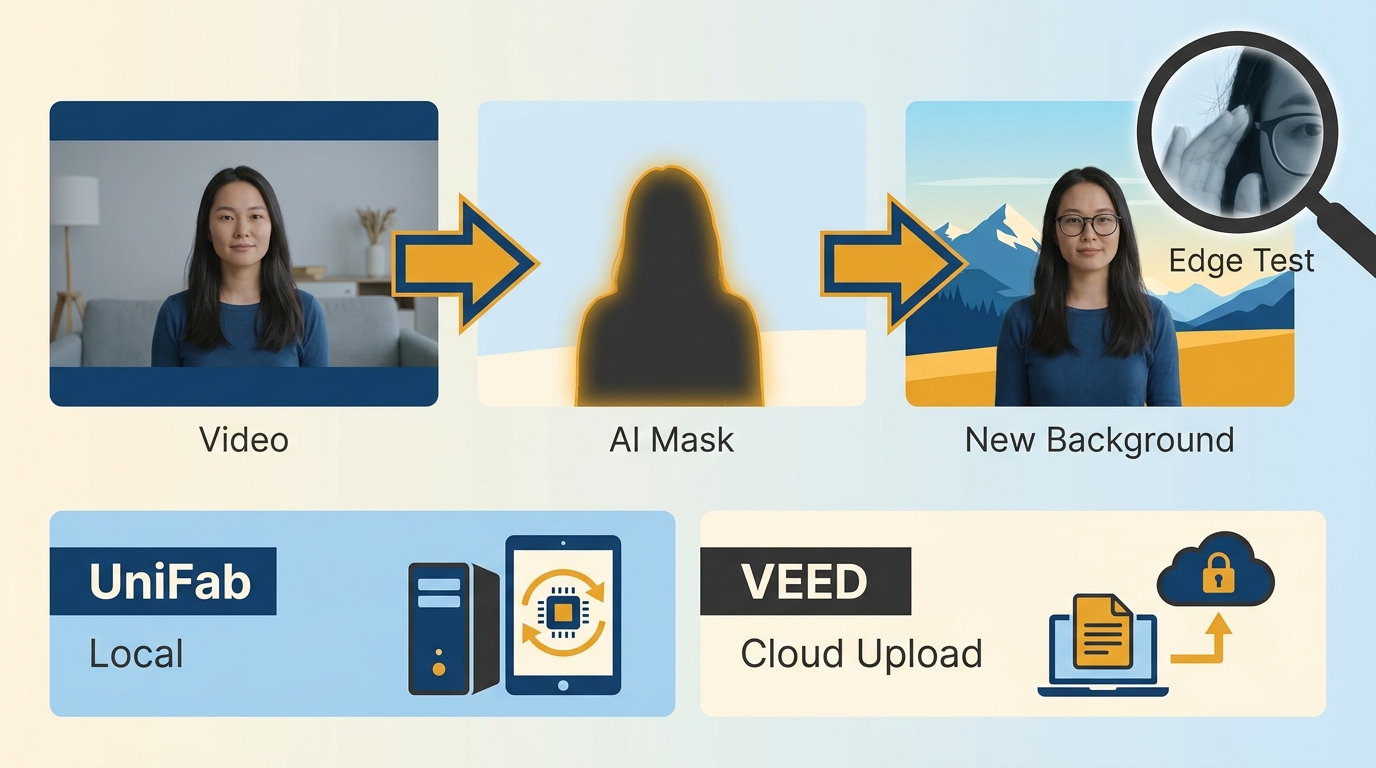
An AI video background remover identifies the main subject in each frame and builds a moving mask that separates the foreground from the scene behind it. Local video background removal runs on the computer, while cloud tools normally upload footage for remote processing. For how to remove background from video free, verify this point on the actual source before processing the complete file.
- Local processing: Better suited to sensitive footage because the source file does not need a cloud upload. Speed depends on the computer's CPU, GPU, memory, and the software model.
- Cloud processing: Convenient on lightweight devices, but upload time, retention policies, credits, file-size caps, and compression can affect the workflow.
Background removal Edge quality is not determined by local or cloud processing alone. The model, source footage, motion, lighting, hardware, mask controls, and export settings all matter. For how to remove background from video free, verify this point on the actual source before processing the complete file.
Before processing a full project, preview a difficult five-to-ten-second sample containing hair, separated fingers, fast movement, changing light, white halos, and semi-transparent details such as glasses. That short stress test is more useful than judging a tool from a static demo frame. For how to remove background from video free, verify this point on the actual source before processing the complete file.
Best Free Desktop Video Background Removers
A free video background remover for desktop is usually the better fit for long footage, private files, or repeated work. An offline video background remover avoids browser uploads, although local rendering may put more pressure on modest hardware. For how to remove background from video free, verify this point on the actual source before processing the complete file.
1. UniFab: Best for Private, Long Videos
UniFab Video Background Remover AI is a Windows workflow for authorized footage that benefits from local processing. It currently advertises free use, no watermark, unlimited use, and no video-length limit.
Best Free Video Background Remover Method
- Free Video Background Remover with AI
- Hair-Level Precision with Advanced AI Video Matting
- One-Click Background Change for a Fresh Video Look
UniFab Video Background Remover AI
Best Free Video Background Remover Method
- Free Video Background Remover with AI
- Hair-Level Precision with Advanced AI Video Matting
- One-Click Background Change for a Fresh Video Look
UniFab Video Background Remover AI
How to remove a video background with UniFab
- Download and install UniFab from the UniFab website.
- Open Video Background Remover AI from the tool list.
- Add the source video to the workspace.
- Select the replacement background color needed for the project.
- Preview the detected subject, paying close attention to hair, hands, and moving edges.
- Start processing and review the exported file.
Suitable for: privacy-sensitive or long Windows projects that need a local video background removal workflow and a video remover with no watermark. For how to remove background from video free, verify this point on the actual source before processing the complete file.
Less suitable for: Mac users and laptops that struggle with sustained video processing. UniFab's documented workflow supports the recommendation, but it does not justify claiming better Edge quality than every competing model. For how to remove background from video free, verify this point on the actual source before processing the complete file.
2. DaVinci Resolve: Best for Manual Control
DaVinci Resolve has a free edition, but Magic Mask is a DaVinci Resolve Studio feature. Free users can still build a video background remover workflow with manual masks, rotoscoping, or chroma-key tools when the footage supports them. For how to remove background from video free, verify this point on the actual source before processing the complete file.
- Import the clip and place it on the timeline.
- Choose a manual mask, rotoscoping, or chroma-key workflow appropriate for the shot.
- Track or refine the mask across the clip.
- Add the replacement layer and inspect edges at full size.
- Export in a format that matches the delivery requirement.
Suitable for: editors who want detailed control and are willing to refine difficult frames.
Less suitable for: a quick automatic cutout or a computer with modest graphics hardware.
3. Filmora: Best for Simple Paid Editing
Filmora's AI Portrait Cutout offers a beginner-friendly AI video background remover inside a broader editor, but access and watermark-free exporting depend on current trial or paid-plan terms. For how to remove background from video free, verify this point on the actual source before processing the complete file.
Suitable for: beginners already editing in Filmora who want background replacement, titles, and timeline tools in one interface. For how to remove background from video free, verify this point on the actual source before processing the complete file.
Less suitable for: readers who need unlimited, watermark-free exports without moving beyond free access.
Best Free Online Video Background Removers
An online video background remover is convenient for a short, non-sensitive clip, but browser tools normally require an upload unless the provider explicitly documents on-device processing. Privacy, retention, duration, credits, file size, compression, and export rules differ by service.
4. Cutout.Pro: Best for Short Previews
Unscreen has closed, so it should not be treated as an active option. Cutout.Pro is a current online alternative for users who want to remove a video background free for a short preview, with fuller use governed by its credit and plan boundaries.
Suitable for: occasional online work and testing a short clip before choosing a longer workflow.
Less suitable for: long footage, recurring free work, or sensitive files that should not be uploaded.
5. VEED: Best for One Quick Edit
VEED currently allows one free use of its background remover before Pro access is required. Its browser editor can keep the picture, audio, captions, and layout work in one project, making it a practical video remover with sound for a single quick edit.
Suitable for: one short browser project that also needs captions or simple social-media editing.
Less suitable for: recurring free use or private footage that should remain on the local computer.
6. Canva: Best for Pro Templates
Canva's editor has free features, but its video background remover is a Canva Pro feature. The distinction matters because access to the editor does not make this specific cutout tool an unrestricted free option.
Suitable for: existing Canva Pro users creating presentation, marketing, or social assets from templates.
Less suitable for: anyone seeking a genuinely free standalone video background remover.
Mobile Options for Quick Clips
Mobile apps can remove a video background free when the clip is short and the project will be finished on the same device. Access, watermarks, and transparent export behavior can change by platform, app version, and output format.
7. CapCut: Check Platform-Specific Access
CapCut includes automatic cutout tools on supported mobile workflows, but free access and export behavior are not uniform across all platforms and formats. A reported black-background export is best treated as a format test case, not a defect that affects every project.
Suitable for: quick social clips when the cutout and final export can be checked before publishing.
Less suitable for: workflows that require predictable alpha output or identical terms across devices.
8. BgRem: A Focused Mobile Option
BgRem is listed in mobile app stores and should not be described as Android-only. Store versions may not have identical features, so the available cutout, export, credit, and watermark options should be assessed on the device being used.
Suitable for: a focused mobile trial on a short clip.
Less suitable for: assuming feature parity between store versions or committing a long project before checking the export.
9. Video Background Eraser: Use Cautiously
Video Background Eraser remains listed in the US App Store, but its visible latest update is from June 2024. That age makes a short compatibility and export test more responsible than a strong claim about current quality.
Suitable for: an iOS user who wants to try a focused cutout app on a disposable sample.
Less suitable for: projects that depend on actively documented long-term support.
For a deeper comparison of phone-based choices, see the dedicated guide to free video background remover apps.
Free Tool Limits and Best Uses
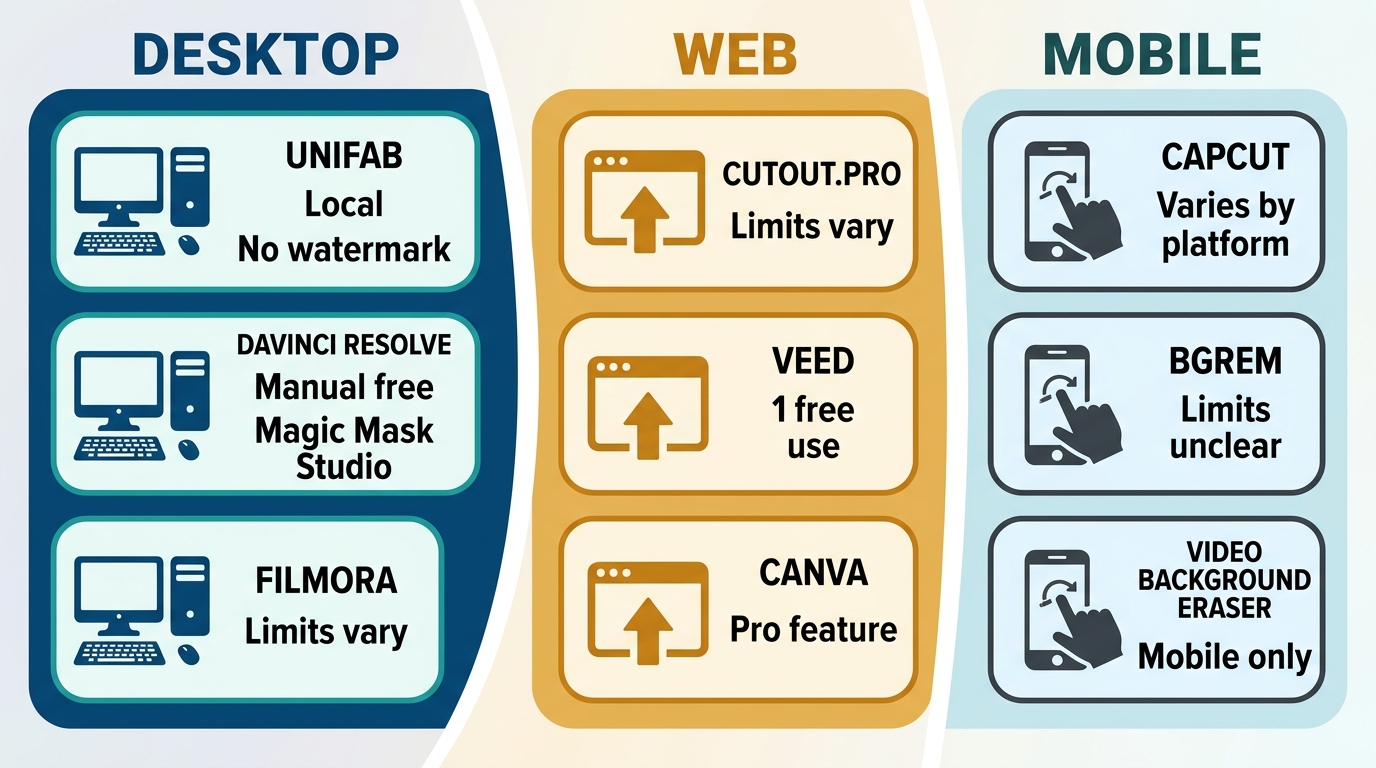
Free remover limits are often more important than the tool's headline feature. Compare the account, watermark, duration, resolution, credits, upload, output, audio, and processing location before starting a full project.
Free-Tier Limits by Tool
The matrix below summarizes documented positioning and clearly marks details that are not stated. Terms shown are as of July 2026.
| Tool | Platform | Processing location | Account required | Free access type | Watermark | Maximum duration | Maximum resolution | Credits or use cap | Upload or file-size cap | Alpha-capable output | Audio retention | Best fit | Not ideal for |
| UniFab | Windows | Local | Not stated | Free use advertised | No watermark advertised | No length limit advertised | Not stated | Unlimited use advertised | No cloud upload | Not stated | Not stated | Private or long Windows footage | Mac or underpowered laptops |
| DaVinci Resolve | Windows, Mac, Linux | Local | Not stated | Free editor; Magic Mask requires Studio | Not stated | Not stated | Not stated | No credit model stated | No cloud upload for local work | Available through suitable export workflows | Retained in normal editing workflows | Manual control | Fast automatic cutouts |
| Filmora | Windows, Mac | Local | Not stated | Trial or paid feature | Depends on trial or plan | Not stated | Not stated | Not stated | No cloud upload for local work | Not stated | Retained in editor workflow | Beginners already using Filmora | Unlimited free exports |
| Cutout.Pro | Browser | Cloud | Depends on workflow | Limited preview or credits | Not stated | Not stated | Not stated | Credit boundaries apply | Not stated | Not stated | Not stated | Short previews | Long or sensitive footage |
| VEED | Browser | Cloud | Not stated | One free background-removal use | Not stated | Not stated | Not stated | One free use | Not stated | Not stated | Can be retained in the editor | One edit with captions and audio | Recurring free work |
| Canva | Browser and apps | Cloud | Yes for Pro access | Canva Pro feature | Depends on export workflow | Not stated | Not stated | Plan access required | Not stated | Not stated | Retained in normal video projects | Pro template projects | Free standalone removal |
| CapCut | iOS, Android, other supported versions | Varies by platform | Varies | Varies by platform and version | Varies by export | Not stated | Varies by workflow | Varies | Varies | Varies by format | Usually retained in standard projects; test export | Quick mobile clips | Predictable cross-platform terms |
| BgRem | Mobile store versions | Not stated | Not stated | Free tier listed | Not stated | Not stated | Not stated | Not stated | Not stated | Not stated | Not stated | Focused mobile trial | Assumed parity across stores |
| Video Background Eraser | iOS | Not stated | Not stated | Free listing with in-app terms | Not stated | Not stated | Not stated | Not stated | Not stated | Listed transparent-background workflow | Not stated | Quick iOS trial | Long-term supported workflows |
The practical takeaway is that a video remover with no watermark is not automatically the right option if it cannot handle the project's duration, privacy, Edge quality, audio, or delivery format.
Choose by Project Type
- Talking-head or private footage: Prefer a local tool when the source should not be uploaded.
- Short social clip: A browser or mobile tool may be faster if its free-use and export limits fit the clip.
- Long video: Check duration, hardware load, render time, and preview quality before processing the full file.
- Transparent overlay: Choose the alpha-capable delivery format first, then select a tool that can produce it.
- 4K project: Test resolution support, render time, motion edges, and final compression together rather than treating 4K as a checkbox.
A slower local tool can be the more sensible choice for private or long footage, while a browser tool can suit a short, non-sensitive social clip. The right answer changes with the task, not with the loudest free label.
Transparent Video Formats Explained
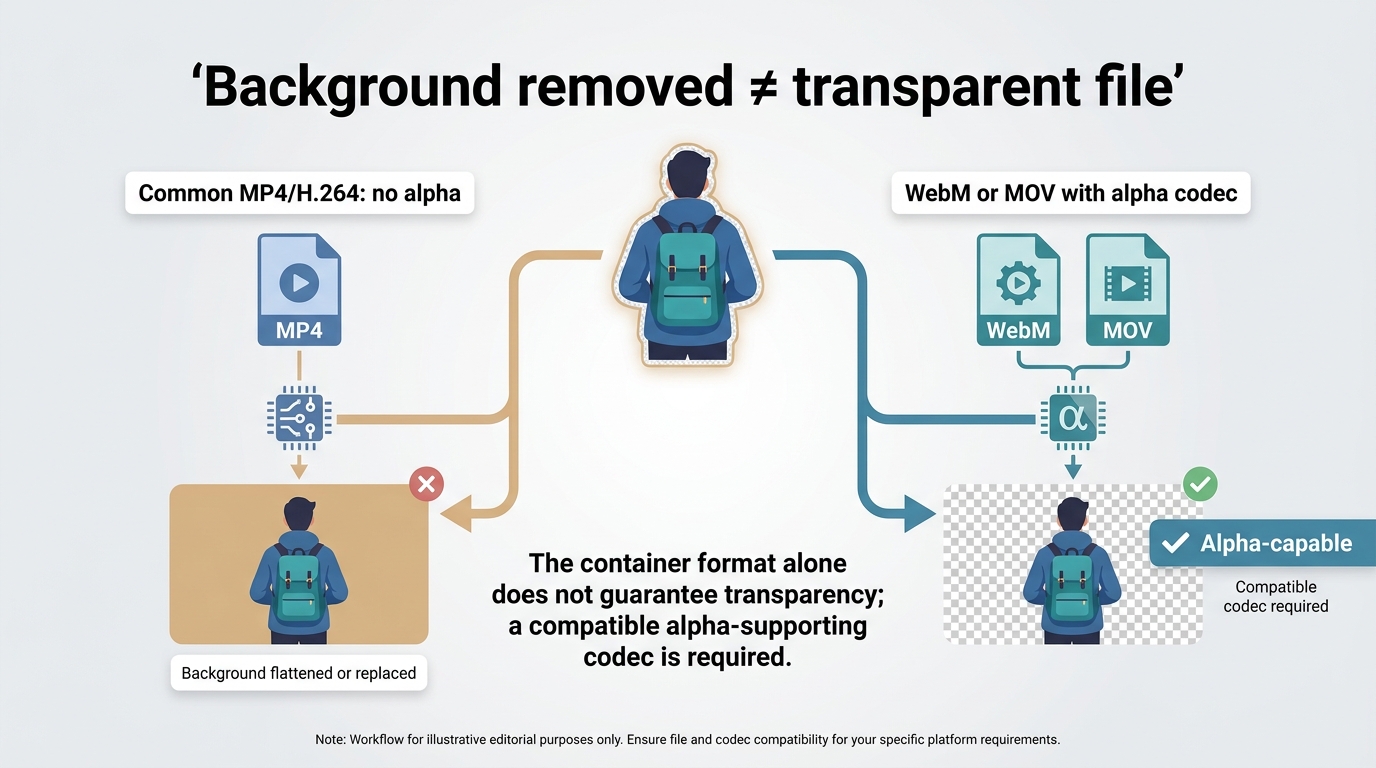
An MP4 background remover can remove or replace the visible background of an MP4 source, but standard MP4 delivery does not preserve video alpha transparency. Removing a background and exporting a transparent file are separate decisions.
Why Transparent MP4 Does Not Work
If you remove the background from MP4 footage and export to a standard MP4 again, transparent areas are normally filled with black or another background because the delivery format does not carry the required alpha channel.
Choosing the delivery format before choosing the tool prevents the most common failed-export workflow: a clean preview followed by a file that displays a black rectangle in the target app.
Formats That Preserve Alpha
For video alpha transparency, use an alpha-capable WebM workflow, MOV with a codec such as ProRes 4444, or a PNG image sequence. If broad MP4 compatibility matters more than transparency, place a solid color, image, or video behind the subject before export.
The full process is covered in the guide to making a video background transparent.
Tips for Cleaner Background Removal
Cleaner results begin with a short stress test, not a full render. Hair, hands, motion blur, changing light, halos, and semi-transparent details reveal mask weaknesses quickly.
Test Hair, Hands, Motion, and Lighting
- Select a five-to-ten-second sample containing the hardest movement and Edge detail in the project.
- Preview hair strands, fingers, glasses, fabric edges, and fast turns frame by frame.
- Look for white or dark halos, missing foreground pixels, flicker, and background fragments.
- Repeat the preview after changing the Edge or mask settings available in the tool.
- Confirm that the chosen resolution, audio, and output format survive the final export.
This repeatable sample says more about background removal Edge quality than a clean talking-head frame with flat lighting.
Record and Export for Cleaner Edges
- Use even lighting: Strong moving shadows can merge with the subject and make the mask unstable.
- Create visual separation: Avoid clothing that closely matches the background.
- Limit avoidable motion blur: A faster shutter or steadier movement gives the model clearer edges to follow.
- Start with the source file: Repeatedly compressed clips can lose the fine detail needed around hair and fingers.
- Use a physical green screen when practical: A uniform background can simplify difficult compositing. For that workflow, compare dedicated green screen editing software.
After the cutout, AI tools can help with improving video quality, but enhancement cannot reliably restore Edge detail that was discarded by a poor mask. Fix the separation first, then refine the picture.
Frequently Asked Questions
What is the best way to use how to remove background from video free?
Start with the source quality, target platform, privacy requirement, and final export settings. For how to remove background from video free, use a short representative clip first, compare the result at 100% view, and keep the original file so you can revise the workflow without generation loss. This also applies to remove video background free.
Is how to remove background from video free free?
Some how to remove background from video free workflows are free, while others limit file size, duration, resolution, credits, watermarks, or export formats. Verify the current plan on the provider's official page because free allowances can change. This also applies to video background remover.
Does how to remove background from video free reduce quality?
how to remove background from video free can reduce quality when it adds unnecessary recompression, aggressive enhancement, or incorrect output settings. Match resolution, frame rate, codec, and bitrate to the source and delivery platform, then inspect motion, edges, audio sync, and fine detail. This also applies to remove background without green screen.
Which formats or devices support how to remove background from video free?
Support depends on the chosen application and workflow. Check operating system, input and output formats, hardware acceleration, browser upload limits, and whether the destination platform accepts the selected settings before processing a full project. This also applies to remove video background free.
How long does how to remove background from video free take?
Processing time varies with duration, resolution, codec, AI model, hardware, and export settings. A short test provides the most reliable estimate; online tools also add upload and download time, while local tools depend more heavily on CPU and GPU performance. This also applies to video background remover.
Can beginners use how to remove background from video free?
Yes. Beginners can use how to remove background from video free by following a conservative workflow: duplicate the source, choose an appropriate preset, process a short sample, compare before and after, and only then export the complete file. This also applies to remove background without green screen.
What should I check before choosing a tool for how to remove background from video free?
Compare source fit, output quality, privacy, platform support, batch capability, watermark policy, free limits, price, and control. Do not choose a how to remove background from video free tool only because it advertises the highest resolution, frame rate, or AI label. This also applies to remove video background free.
Is desktop or online processing better for how to remove background from video free?
Online processing is convenient for short, non-sensitive files, but it can impose upload, retention, watermark, credit, and resolution limits. Desktop processing is usually better for private, long, high-resolution, or batch how to remove background from video free work. This also applies to video background remover.
What are the main limitations of how to remove background from video free?
The main limits are source quality, missing detail, motion artifacts, incompatible formats, hardware demand, upload constraints, and generation loss. how to remove background from video free cannot always reconstruct information that was never captured, so results should be described realistically. This also applies to remove background without green screen.
How does how to remove background from video free compare with manual editing?
Automated how to remove background from video free is faster and easier to repeat, while manual editing gives more local control and may avoid overprocessing. A practical workflow uses automation for the first pass and manual review for difficult scenes, transitions, faces, text, and audio sync. This also applies to remove video background free.