Clipchamp remains a practical editor for quick social videos, but the Clipchamp free plan stops at 1080p, finished videos export as MP4 at 30 fps, and editable projects rely on OneDrive. This Clipchamp review 2026 explains those limits before weighing Premium 4K, reliability, and a specialized local background option.
How to Choose the Right Clipchamp Review Workflow in 2026
Use the same decision criteria across tools: source type, expected output, supported formats, local versus uploaded processing, free limits, hardware requirements, and the risk of visible artifacts. The related intents Clipchamp review, is Clipchamp good, Clipchamp alternatives should be evaluated as distinct needs rather than interchangeable labels.
What Is Clipchamp?
Quick answer: Clipchamp review should be chosen or configured by matching the source, viewing device or platform, quality target, privacy needs, and export limits. Test a representative clip, compare the result at full size, and avoid settings that add artifacts or unnecessary recompression. The latest GSC comparison shows that the optimization priority is the page is not in a material click decline in this comparison window; optimization focuses on protecting gains and expanding high-intent query coverage.
Clipchamp is Microsoft's browser-focused video editor for straightforward timeline projects, templates, recording, captions, and social content. Its current workflow ties editable projects to OneDrive, which matters as much as its editing features when choosing it.
Clipchamp can be opened in a supported desktop browser or through its Windows app. It combines media imports, a multitrack timeline, stock assets, text, transitions, recording tools, and AI-assisted features in an interface designed to reduce the setup required for a first edit.
The important 2026 change is project storage. Editable Clipchamp projects depend on OneDrive, while a locally saved project file is better treated as an archive than as a normal local project that can be reopened and edited independently. This is convenient inside Microsoft 365, but it adds friction for anyone who expects a local-only editing library.
Key Features of Clipchamp Video Editor
Clipchamp AI features support fast assembly rather than deep finishing control. The useful set includes automatic captions, text-to-speech, silence removal, templates, screen recording, resizing, stock media, and the Clipchamp green screen effect.
- Timeline editing: trim, split, crop, rotate, resize, layer clips, and add transitions without learning a professional editing layout.
- Recording: capture a screen, webcam, or voice track directly within the project workflow.
- Audio and captions: adjust track volume, create voiceovers, generate captions, and reduce silent sections.
- Templates and stock: start from social-video layouts and replace the included media with your own clips.
- Color-key effects: use green, blue, or red backgrounds for conventional chroma-key compositing.
The editorial takeaway is simple: Clipchamp covers common creator tasks in one approachable workspace, but its strength is speed of assembly, not granular control over encoding, complex effects, or repeatable batch jobs.
Clipchamp System Requirements
Clipchamp works best on a current desktop with a supported Chromium-based browser and a stable connection to Microsoft services. Clipchamp for Mac runs through a supported browser rather than a native macOS timeline app.
| Platform | Practical requirement |
| Windows | Windows app or a current supported desktop browser |
| Mac | Current Google Chrome or Microsoft Edge; no native macOS editor |
| Chromebook | Current ChromeOS and Chrome browser |
| Other browsers | Safari and Firefox are not the intended editing path |
| Storage | A Microsoft account and sufficient OneDrive capacity for editable projects |
Clipchamp Free vs Premium Plans
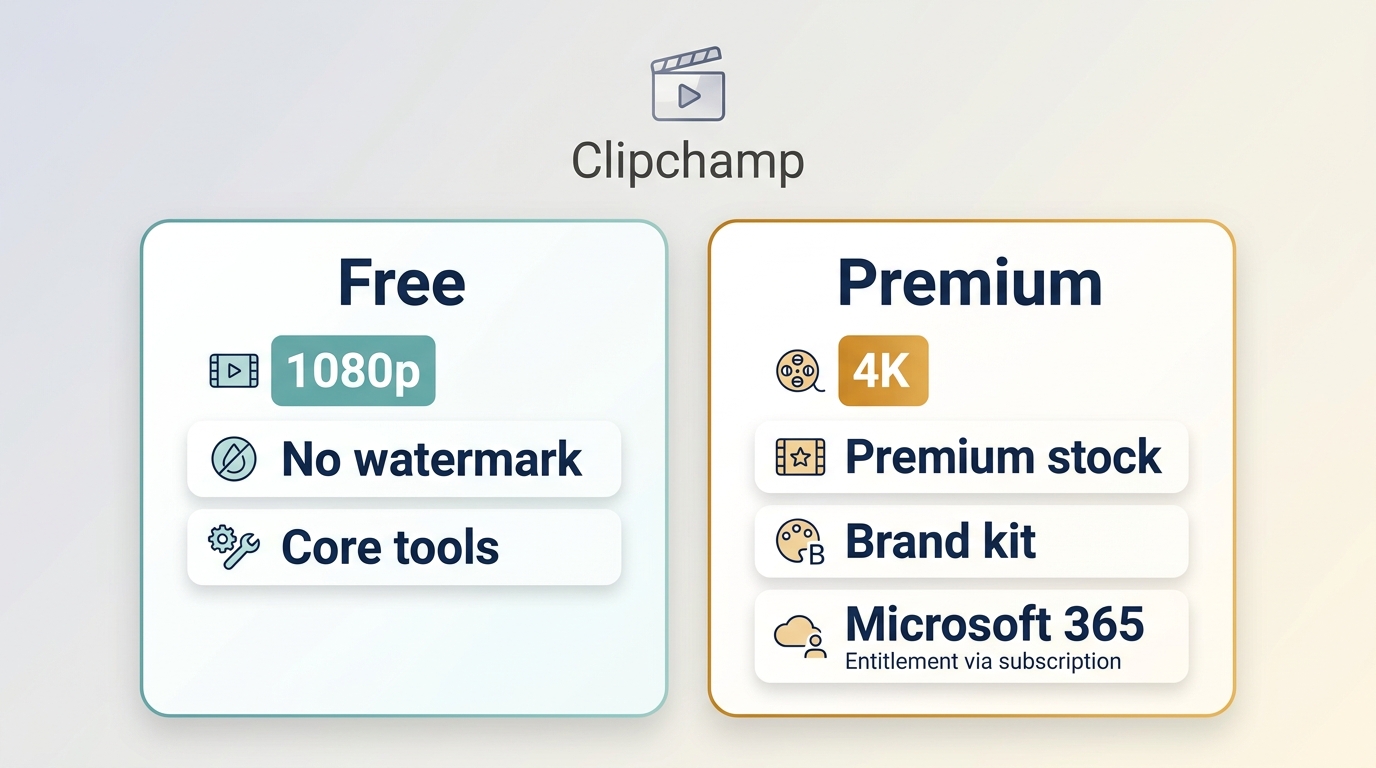
Clipchamp pricing is easiest to understand by export tier: the Clipchamp free plan supports watermark-free output up to 1080p, while Clipchamp Premium adds 4K export and paid creative assets and brand tools.
| Plan | Verified position | Best fit |
| Free | Watermark-free exports up to 1080p, core editing tools, and a selection of stock assets | Short social videos, presentations, and occasional edits |
| Premium | Clipchamp 4K export, premium stock, additional filters and effects, and brand-kit features | Creators who need 4K delivery or Microsoft 365 creative benefits |
As of July 2026, the official US pricing page presents a free plan and Premium access through Microsoft 365, while Microsoft support also describes standalone Premium availability without displaying a current standalone US dollar price on that page.
For most buyers, the decision is not whether basic editing is usable for free. It is whether 4K delivery, premium assets, and Microsoft 365 integration justify moving beyond the free tier.
Clipchamp Export Formats and Quality Limits
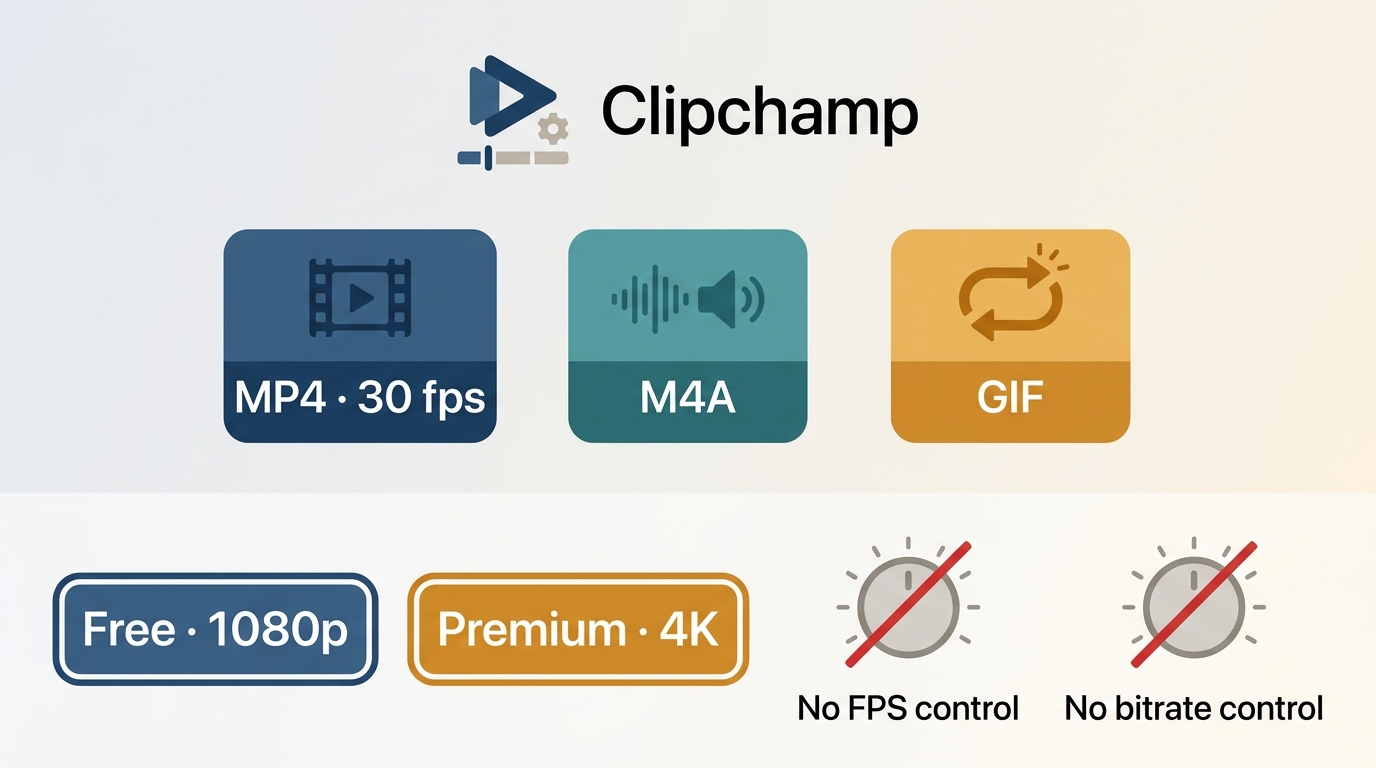
The Clipchamp export format is deliberately simple: completed videos are MP4 files at 30 fps. Audio-only output uses M4A, short animations can use GIF, and the editor does not expose manual frame-rate or bitrate controls.
| Export question | Clipchamp behavior |
| Finished video | MP4 at 30 fps |
| Audio-only export | M4A |
| Short animation | GIF where the GIF export option is available |
| Free maximum resolution | 1080p with Clipchamp no watermark on the finished export |
| 4K output | Clipchamp 4K export requires Premium |
| 4K source guidance | Microsoft recommends source video with a bitrate of 70 Mbps or less |
| Frame-rate selection | No user-selectable export frame rate in the cited export workflow |
| Bitrate selection | No user-selectable export bitrate control |
These fixed settings make Clipchamp video quality predictable for common web delivery, but they also explain why output files can feel large and why a source clip's original frame rate is not preserved as a selectable export setting. Creators who must deliver a specific frame rate, codec, container, or bitrate need a more configurable desktop editor.
Clipchamp and OneDrive: What Stays Local?
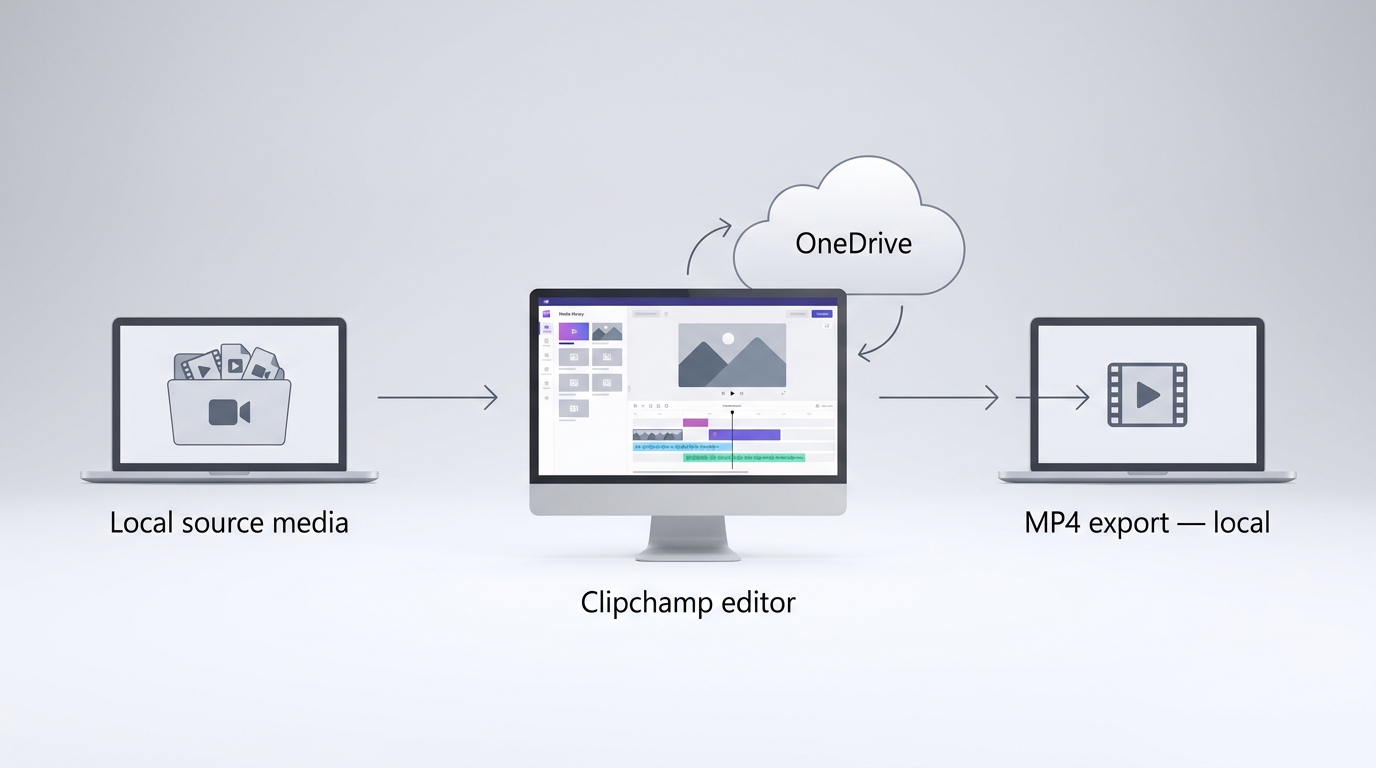
The Clipchamp OneDrive requirement applies to editable project storage. Source media may begin on a local drive, and exported videos can be saved locally, but the project workflow itself depends on Microsoft's cloud storage.
This distinction prevents a common misunderstanding: a local project archive is not equivalent to a fully editable local project library. OneDrive capacity can therefore become part of the editing decision, especially when projects contain several high-resolution source files.
- Convenient for: Microsoft 365 users who already organize files in OneDrive and want access tied to one Microsoft account.
- Less suitable for: teams that require local-only editable projects, tightly controlled storage locations, or a workflow separated from cloud accounts.
From an editorial standpoint, this is Clipchamp's most consequential tradeoff. The cloud dependency may be invisible during a quick edit, but it becomes central when storage policy, project portability, or confidential footage governs the workflow.
Clipchamp Green Screen in Five Steps
Clipchamp green screen editing uses a conventional color-key effect: place the keyed clip above the replacement background, select the effect, adjust the threshold, and export the composite.
- Start a project. Open Clipchamp in a supported browser or the Windows app, sign in, and create a new video.
- Add the keyed clip. Open the content library, search for a green-screen clip or import your own, and place it on the upper timeline track.
- Add the replacement background. Import the background video or image and place it on the track below the keyed clip.
- Apply the effect. Select the upper clip, open Effects, choose Green Screen, and adjust the threshold until the subject Edge looks clean.
- Review and export. Check the full sequence for Edge artifacts, choose an available resolution, and export the finished video.
This workflow is a good fit when footage was recorded against an even color. For ordinary footage without a prepared screen, automatic subject isolation is a different task and may be faster in a dedicated background tool.
Clipchamp Review: Pros and Cons
This Clipchamp review 2026 finds a capable beginner editor with meaningful free features, balanced by fixed export controls, OneDrive dependence, and uneven reliability on heavier projects.
Pros of Clipchamp
- The Clipchamp free plan exports up to 1080p without adding a Clipchamp watermark.
- The timeline, templates, stock library, recording, captions, and Clipchamp AI features are organized for quick onboarding.
- Microsoft account and Microsoft 365 integration can simplify access for people already using that ecosystem.
- The green-screen workflow is clear enough for a first color-key project.
Best for: beginners, short social projects, classroom or presentation videos, and Microsoft 365 users who accept OneDrive-based project storage.
Cons of Clipchamp
- Editable projects depend on OneDrive rather than a normal local-only project folder.
- Finished video output is MP4 at 30 fps, without user-selectable frame-rate or bitrate controls.
- 4K export is reserved for Premium.
- Large, mixed, or complex projects can face slow media preparation or a Clipchamp export failure.
- Clipchamp for Mac depends on a supported browser and does not provide a native macOS editor.
Not ideal for: local-only or confidential workflows, batch-heavy production, complex multitrack editing, and jobs that require exact delivery specifications.
Clipchamp Performance and Export Reliability
Clipchamp performance varies with source media, project complexity, available storage, browser state, and hardware. Export stalls and slow preparation are credible user-reported problems, but they do not mean that Clipchamp is discontinued.
A useful performance report should identify the source duration, codec, resolution, computer, media-preparation time, export time, and the point of any failure. Without that information, a fast or slow result cannot be compared fairly across projects.
Current reliability signals include reports of exports stopping before completion, media taking a long time to prepare, and a temporary grey-screen or availability incident in June 2026. Clipchamp remains active, so those incidents should be read as reliability warnings rather than evidence that the service ended.
The safest editorial judgment is to test a representative project before committing to a deadline. A short template video and a layered 4K timeline place very different demands on the same editor, and there is no reliable universal duration limit that predicts success.
The public Clipchamp customer review page can provide qualitative examples, but this review does not publish an unverified current score.
Who Should Use Clipchamp
Clipchamp suits people who value a short learning curve more than detailed output control.
- Beginners creating short social, presentation, or instructional videos
- Microsoft 365 users comfortable with OneDrive project storage
- Creators who need watermark-free 1080p output from a free editor
- Occasional editors who want templates, captions, recording, and stock assets in one interface
Who Should Look Elsewhere
A Clipchamp alternative makes more sense when storage policy or production control is non-negotiable.
- Editors who require local-only editable projects
- Teams handling confidential media under strict storage rules
- Batch workflows processing many files with repeatable settings
- Projects requiring a selectable frame rate, bitrate, codec, or container
- Complex multitrack productions with demanding effects and finishing needs
UniFab for Local Background Removal
UniFab Video Background Remover is a specialized Clipchamp alternative for local background removal or replacement. It is not a replacement for Clipchamp's complete timeline, templates, recording, or browser collaboration workflow.
For footage that was not recorded against a solid green screen, the local tool automatically separates the subject and lets the user make the background transparent, replace it with another visual, or create a solid-color background for later editing. The narrow fit is the point: use it for background processing, then continue the broader edit in a timeline editor.
UniFab Video Background Remover is most relevant when media should be processed on the computer instead of being attached to a cloud project.
Clipchamp vs UniFab by Workflow
This is a workflow comparison, not a claim of feature parity. Clipchamp is a general timeline editor; UniFab Video Background Remover AI is a focused background-processing tool.
| Product | Platform | Project storage | Full timeline editing | Green-screen keying | Automatic background removal | Batch processing | Export resolution | Privacy fit | Best use |
| Clipchamp | Web and Windows app | Editable projects rely on OneDrive | Yes | Yes | Available within its editing feature set | Not designed as a batch processor | Free up to 1080p; Premium up to 4K | Fits Microsoft cloud workflows | Short, straightforward timeline projects |
| UniFab Video Background Remover AI | Desktop software | Local file workflow | No | Can create a solid-color background for later keying | Yes | Supports processing multiple videos | Supports output up to 4K | Fits local background-processing needs | Background removal or replacement before further editing |
The practical upshot is that Clipchamp should be chosen for editing a complete short video, while UniFab fits the narrower stage where a background must be isolated locally. Users who need multitrack editing, templates, and collaboration still need a full editor.
Removing a Video Background with UniFab
The local workflow has four steps: import the video, let the tool identify the subject, choose a transparent or replacement background, and export the processed result for the next editing stage.
100% free, fully featured, and watermark-free.
- Step 1
Launch UniFab program, select “Background Remover” from the left-hand panel> and import the video by clicking on the “+” Icon.
- Step 2
Choose your preferred background color from green, blue, black, or white> select the output file size > and choose the output format and codec from the right side.
- Step 3
You can also personalize the video with three other options, like Trim, crop, and audio, shown under your selected video for more detailed customization.
- Step 4
After finishing all of your required customization, select “OK” at the right below > click on “Start,” and you will see the video background removing process will be started.
This option is best treated as a preparation tool. It does not supply Clipchamp's full timeline, stock library, captions, templates, or recording workspace.
Conclusion
Clipchamp is worth considering for simple projects, watermark-free 1080p exports, and Microsoft 365 workflows. Its OneDrive dependence, fixed MP4 30 fps output, Premium 4K tier, and reliability limits make it less suitable for demanding production.
The decision framework is clear: choose Clipchamp for approachable timeline editing and quick social output; choose a more configurable desktop editor for exact delivery controls or complex projects; use UniFab only when the specific need is local automatic background removal or replacement.
Frequently Asked Questions
What is the best way to use Clipchamp review?
Start with the source quality, target platform, privacy requirement, and final export settings. For Clipchamp review, use a short representative clip first, compare the result at 100% view, and keep the original file so you can revise the workflow without generation loss. This also applies to Clipchamp review.
Is Clipchamp review free?
Some Clipchamp review workflows are free, while others limit file size, duration, resolution, credits, watermarks, or export formats. Verify the current plan on the provider's official page because free allowances can change. This also applies to is Clipchamp good.
Does Clipchamp review reduce quality?
Clipchamp review can reduce quality when it adds unnecessary recompression, aggressive enhancement, or incorrect output settings. Match resolution, frame rate, codec, and bitrate to the source and delivery platform, then inspect motion, edges, audio sync, and fine detail. This also applies to Clipchamp alternatives.
Which formats or devices support Clipchamp review?
Support depends on the chosen application and workflow. Check operating system, input and output formats, hardware acceleration, browser upload limits, and whether the destination platform accepts the selected settings before processing a full project. This also applies to Clipchamp review.
How long does Clipchamp review take?
Processing time varies with duration, resolution, codec, AI model, hardware, and export settings. A short test provides the most reliable estimate; online tools also add upload and download time, while local tools depend more heavily on CPU and GPU performance. This also applies to is Clipchamp good.
Can beginners use Clipchamp review?
Yes. Beginners can use Clipchamp review by following a conservative workflow: duplicate the source, choose an appropriate preset, process a short sample, compare before and after, and only then export the complete file. This also applies to Clipchamp alternatives.
What should I check before choosing a tool for Clipchamp review?
Compare source fit, output quality, privacy, platform support, batch capability, watermark policy, free limits, price, and control. Do not choose a Clipchamp review tool only because it advertises the highest resolution, frame rate, or AI label. This also applies to Clipchamp review.
Is desktop or online processing better for Clipchamp review?
Online processing is convenient for short, non-sensitive files, but it can impose upload, retention, watermark, credit, and resolution limits. Desktop processing is usually better for private, long, high-resolution, or batch Clipchamp review work. This also applies to is Clipchamp good.
What are the main limitations of Clipchamp review?
The main limits are source quality, missing detail, motion artifacts, incompatible formats, hardware demand, upload constraints, and generation loss. Clipchamp review cannot always reconstruct information that was never captured, so results should be described realistically. This also applies to Clipchamp alternatives.
How does Clipchamp review compare with manual editing?
Automated Clipchamp review is faster and easier to repeat, while manual editing gives more local control and may avoid overprocessing. A practical workflow uses automation for the first pass and manual review for difficult scenes, transitions, faces, text, and audio sync. This also applies to Clipchamp review.