A free video enhancer app can improve blur, noise, color, or scale, but free access often comes with credit, clip-length, resolution, ad, or watermark limits. The practical choice depends first on whether you edit on iPhone, Android, a browser, or a Windows or Mac desktop.
Before starting, have a local video you are authorized to edit, a compatible device or browser with upload access, and enough storage for the exported file.
Quick Answer: Free Video Enhancer Apps
The best free video enhancer app is the one whose device support, free allowance, and export rules match your clip. Mobile apps suit quick edits, a web tool avoids installation, and desktop software gives longer projects more local control.
Start with the matrix below, then follow the workflow for your device. If you want a broader category overview, this guide to free AI video enhancer tools explains the main tool types without assuming one universal winner.
Choose by Device, Problem, and Limits
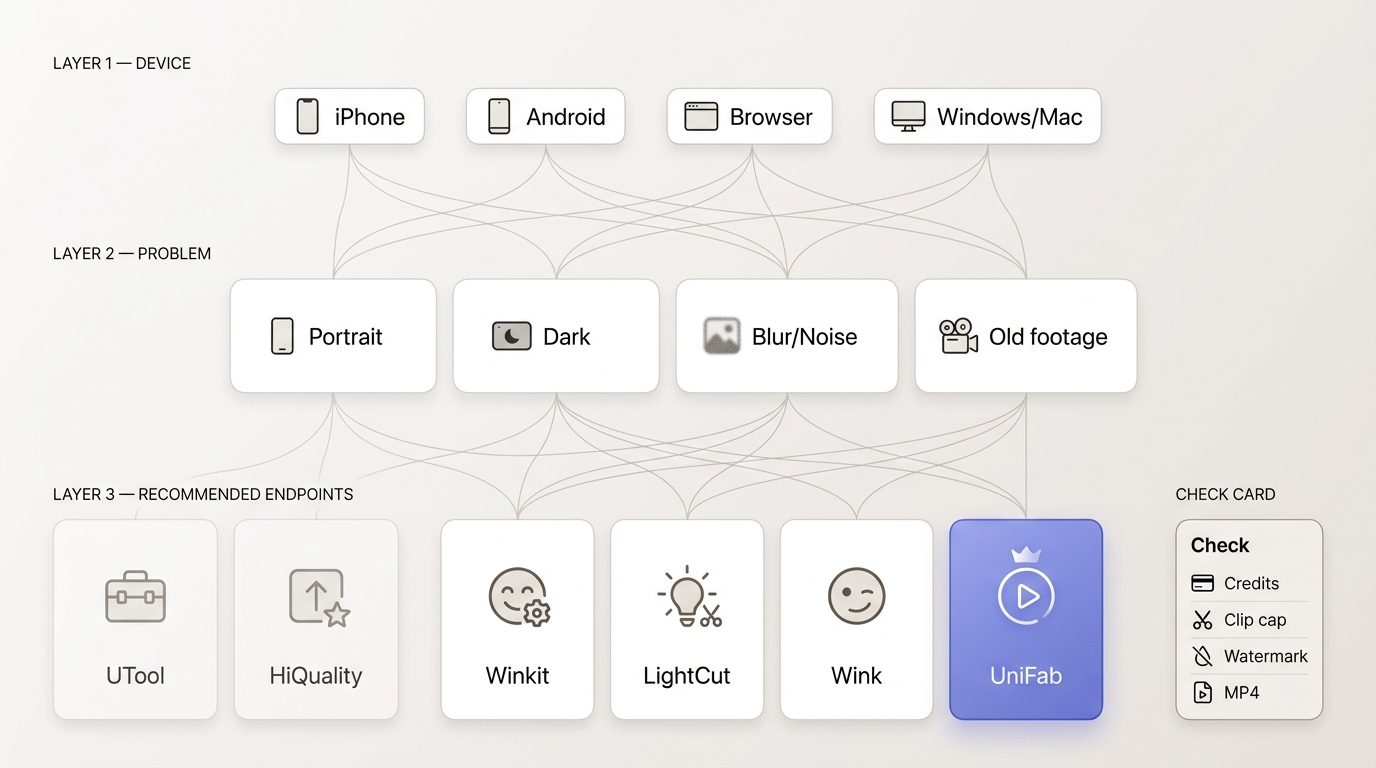
Choose a video enhancer app by access, footage problem, and export boundary before comparing headline resolution. That order prevents a promising preview from becoming an unusable final file.
Match the App to Your Footage
A mobile video enhancer is convenient for a blurry video, dark video, shaky video, or short social clip, while old footage and heavy compression may benefit from desktop processing. A video quality enhancer may reduce noise or balance color without increasing resolution; upscaling is a separate decision.
- Device access: Confirm iOS, Android, browser, Windows, or Mac support.
- Problem fit: Match the tool to blur, dark scenes, shake, compression, faces, or old footage.
- Free boundary: Check credits, clip length, ads, resolution, and whether an in-app purchase appears before export.
- File handling: Confirm accepted input, downloadable output, save location, and whether an MP4 export is available.
- Visual quality: Inspect faces, fine edges, flicker between frames, and preserved texture instead of judging one paused frame.
Natural motion matters more than maximum sharpness: an oversharpened frame may look impressive when paused yet show halos, waxy faces, or flicker during playback.
What “Free” Includes
A free tier can be limited by credits, clip length, ads, resolution, watermark placement, or export access. Preview is not the same as a downloadable file, so open the export screen before committing a long clip.
For a fair check, use the same short local sample on the same device or browser, request the same output resolution where each tool allows it, and record processing time, save location, watermark result, facial detail, flicker, and natural texture. For ordinary users, a clean export with stable motion is more useful than the sharpest single frame.
Five Free Video Enhancer Apps
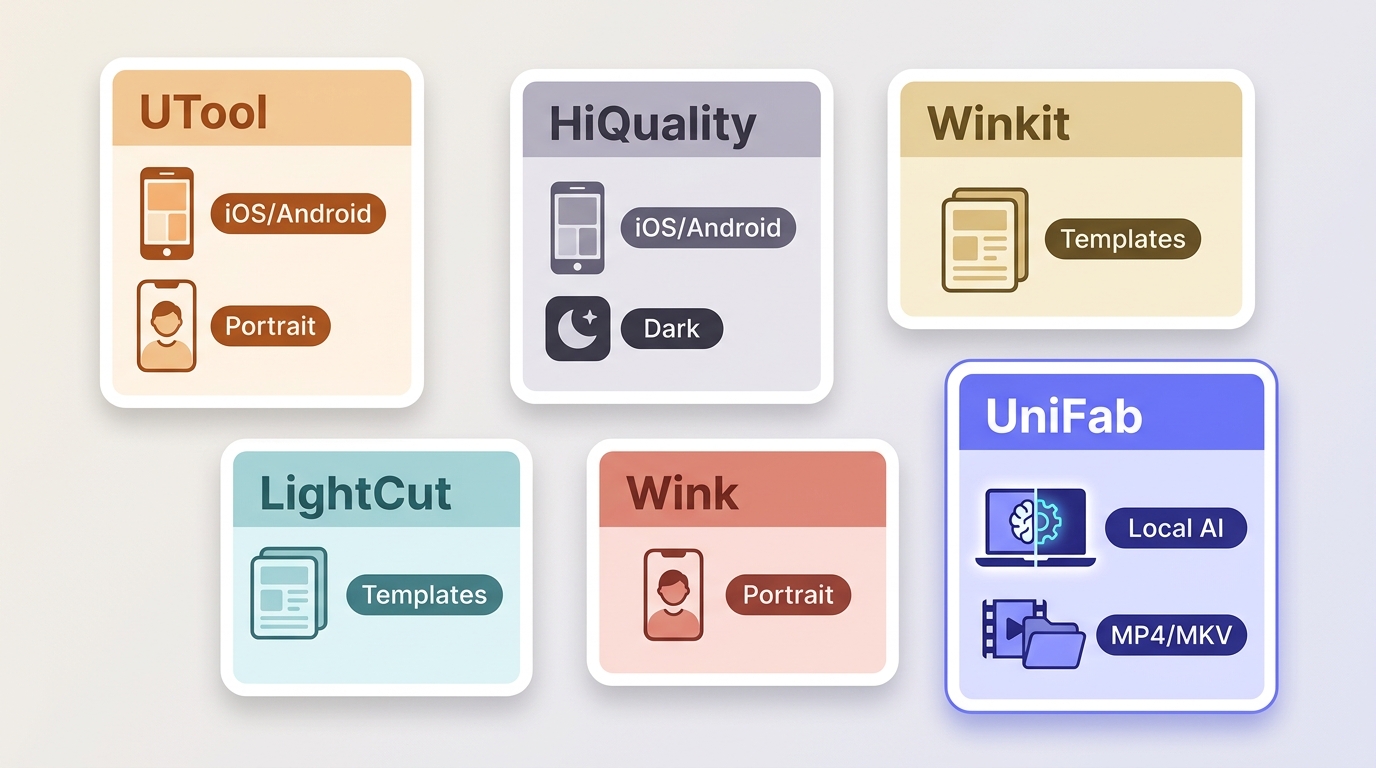
5 Free Video Enhancer Apps in 2026: Mobile, Web, and Desktop Picks. These five mobile apps cover quick enhancement on iOS and Android; the sixth matrix row adds a desktop path for larger files and local processing. Free terms can change, so the most useful comparison pairs known facts with the exact check to make before export.
| Tool and access | Verified free limit | Import and save | Best use | Watermark or export check |
| UTool, iOS/Android | Ads may appear; credits and clip cap not stated | Phone import; in-app export | Quick touch-ups | Review credits, clip cap, and final export |
| HiQuality, iOS/Android | Not stated | Phone import; in-app export | Blur and noise reduction | Test a short clip and inspect final export |
| Winkit, iOS/Android | Credits and duration not stated | Phone import; in-app export | Portrait and social clips | Check resolution and watermark before export |
| LightCut, iOS/Android | Allowance not stated | Phone import; in-app export | Fast template edits | Check the allowance and export screen |
| Wink, iOS/Android | Clip-length limit not stated | Phone import; in-app export | Short-form effects | Test the intended clip length and inspect export |
| UniFab, Windows/Mac | Three standard uses; no watermark | 9 listed inputs; MP4/MKV export | Local upscaling | Saved to chosen folder |
App allowances and export screens are described as of August 2026.
Use one repeatable mobile or browser workflow:
- Import a local clip from the phone, or upload it to the browser tool.
- Choose the enhancement that matches the actual problem, such as noise reduction, stabilization, color adjustment, or upscaling.
- Preview moving sections with faces and fine detail; a preview confirms appearance, not download availability.
- Export or download the file, open it from the saved location, and check resolution, audio, watermark, and motion consistency.
UTool: iOS and Android App
UTool is a free video enhancement app for iOS and Android that combines quick AI enhancement with basic editing. It fits short mobile clips that need a fast cleanup more than detailed restoration.
- Platform: iOS and Android.
- Problem fit: Quick clarity, color, and social-video edits.
- Free allowance: Review the current credit and clip-length allowance before importing a long file; ads may interrupt the workflow.
- Input, output, and save: Import from the phone library and use the app export screen to save the result.
- Watermark: Inspect the exported file before sharing it.
- Processing note: Use a short representative section first, especially when faces or fine text are present.
Best for: quick edits on either major mobile platform. Not ideal for: long clips that need predictable batch control.
Quick AI video fixes.
It has a simple and good UI design.
Provides good stability in-app.
The free version includes ads.
Export quality may be capped.
HiQuality: Repair and Noise Reduction
HiQuality focuses on blur cleanup, old-footage improvement, and noise reduction on iOS and Android. It is more relevant when the source looks soft or noisy than when the main goal is a complex edit.
- Platform: iOS and Android.
- Problem fit: Blur, visible noise, and older low-detail clips.
- Free allowance: Start with a short clip before committing to a longer export.
- Input, output, and save: Import from the phone and complete saving through the app export flow.
- Watermark: Review the final file rather than relying on the preview.
- Processing note: Watch skin texture and edges for smoothing that removes useful detail.
Best for: noise reduction and gentle repair. Not ideal for: projects that require a clearly documented batch workflow.
Can reduce video noise effectively.
It has creative design tools.
Smooth and simple UI.
Occasional stability issues.
Limited editing beyond enhancement.
Winkit: Android and iPhone Enhancer
Winkit is an Android and iPhone video enhancer app aimed at portrait, social, and short-form footage. Its mix of enhancement and styling makes it useful when the edit needs both cleanup and a finished social look.
- Platform: iOS and Android.
- Problem fit: Portrait cleanup, filters, and short social clips.
- Free allowance: Review available credits and the clip-duration limit on the export screen before processing.
- Input, output, and save: Import from the phone and save through the app export flow.
- Watermark: Check the exported file at the chosen resolution.
- Processing note: Compare facial detail in motion, since portrait enhancement can look different from a paused preview.
Best for: short portrait-led edits. Not ideal for: restrained restoration where filters are unnecessary.
For users focused on resolution, a dedicated free video upscaler app may be a better fit.
Creative filters and edits.
Beginner-friendly interface.
Offers good user experience.
Exporting may take some time.
The free version has watermarks.
LightCut: Quick Mobile Edits
LightCut is a mobile video enhancer and editor for iOS and Android, with one-tap edits and templates for quick assembly. It suits users who need speed and structure more than fine restoration controls.
- Platform: iOS and Android.
- Problem fit: Brightness, color, clarity, and template-led edits.
- Free allowance: Check the current allowance before selecting a long template or importing several clips.
- Input, output, and save: Import from the phone and save through the app export screen.
- Watermark: Inspect the completed file before publishing.
- Processing note: Preview transitions and motion, not just the opening frame.
Best for: fast mobile stories and template edits. Not ideal for: detailed control over restoration strength.
Great for mobile users wanting easy, fast video quality boosts.
Supports both editing and AI enhancement in one app.
Free to download with regular updates.
Some export limits in the free version.
Lacks some advanced professional editing tools.
Wink: Short-Form Video Tools
Wink combines enhancement, effects, filters, and editing on iOS and Android. Among apps like Wink, the important distinction is whether the final clip remains natural after facial cleanup and motion effects are applied.
- Platform: iOS and Android.
- Problem fit: Short-form effects, portrait cleanup, and social edits.
- Free allowance: Test the intended clip length before editing a batch.
- Input, output, and save: Import from the phone and save through the app export flow.
- Watermark: Review the final export at normal playback speed.
- Processing note: Check for flicker around hair, eyes, and moving edges.
Best for: short-form editing with effects. Not ideal for: long footage that needs consistent settings across many files.
User-friendly interface with stylish design.
Wide range of creative features for video enhancement and editing.
Fast processing speeds.
Exporting videos can take some time.
Free version includes watermarks.
Desktop and Web Options
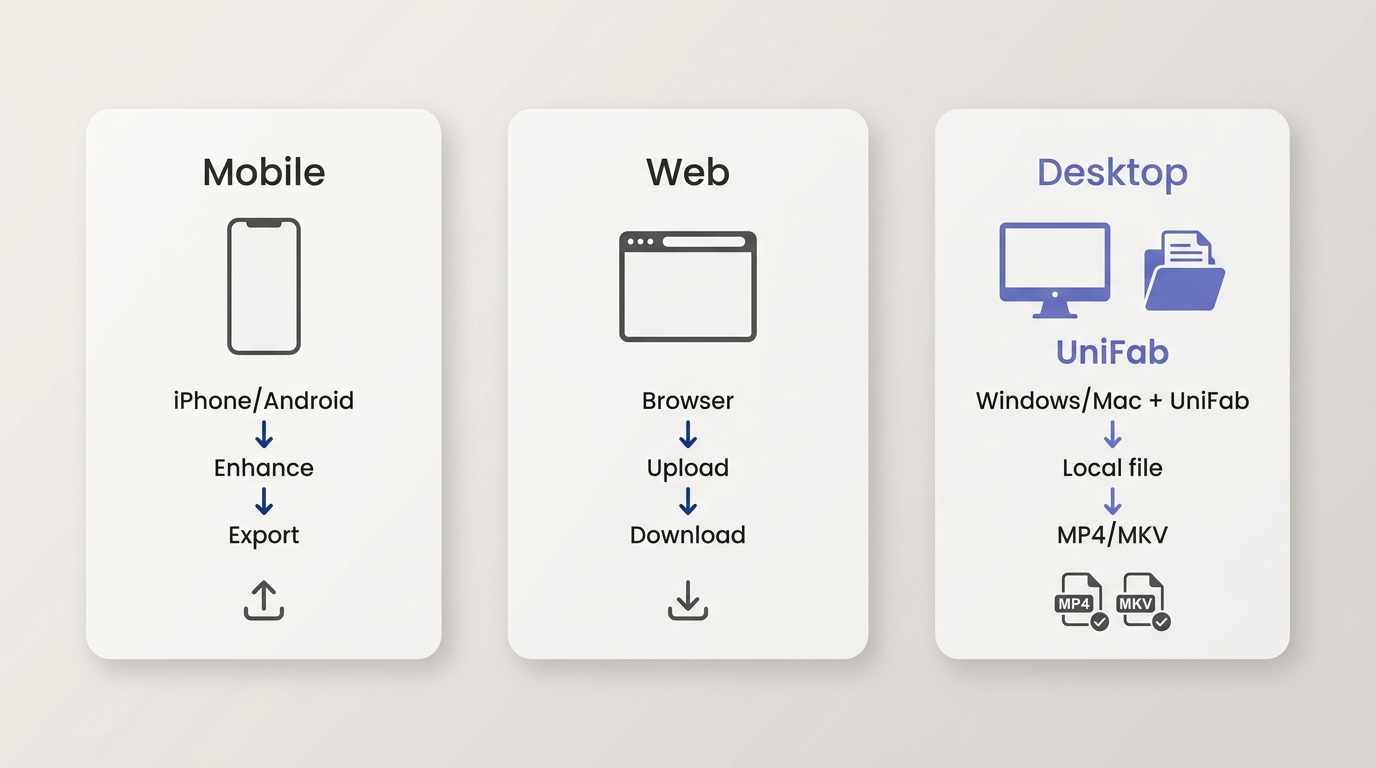
A desktop video enhancer offers local files, chosen save folders, and batch control, while an online video enhancer trades installation for browser upload. The deciding factors are file size, device performance, privacy preference, and whether you need a downloadable export.
Phone, Browser, or Desktop?
Use iOS or Android for a short camera-roll edit, a web video enhancer for a quick browser task, and Windows or Mac software for larger local projects. Browser processing requires an upload; desktop processing keeps the workflow on the computer.
- Phone: quickest for capture-to-share work, but storage, heat, and app limits matter.
- Browser: no installation, but upload time and downloadable-export rules matter; this overview of free online video enhancer options covers that route in more detail.
- Desktop: better suited to longer local files and repeatable settings; a broader free video enhancer software comparison can help if you want more installed choices.
UniFab Video Enhancer
For footage you own or are authorized to process, where permitted by applicable terms and law, UniFab Video Enhancer is a Windows and Mac option that processes local files and saves the result to a chosen folder.
It accepts MOV, MP4, AVI, MPEG, WMV, F4V, MPG, TS, and FLV, exports MP4 or MKV, supports batch processing, and offers three uses of standard features without a watermark. Its Kairo model is designed for animation, while Titanus is rated up to three times faster than the preceding model and output can scale as high as 16K.
Best for: larger local clips, animation upscaling, and users who want a selected output folder. Not ideal for: phone-only or browser-only workflows; high-resolution jobs also need compatible Windows or Mac hardware and substantial storage.
This video demonstrates the use of a free video enhancer app to improve video quality:
The practical advantage is control over local input and output, not a claim that desktop software suits everyone. Mobile apps remain the simpler choice for short social edits.
For a guided local workflow, the steps in enhancing video quality free provide more context:
{{FREE_TRIAL_BTN_1}}
- Install UniFab on a compatible Windows or Mac computer, sign in, and choose Video Upscaler AI.
- Import the local video, choose a model and output resolution that fit the source, then preview a moving section before starting.
- Select the output folder, process the clip, open the saved MP4 or MKV, and inspect motion, audio, resolution, and watermark status.
Conclusion
There is no universal best AI video enhancer. Choose a mobile app for short camera-roll edits, a browser tool when installation is inconvenient, or desktop software when local processing, batch work, and selected output folders matter more.
The strongest decision signal is the exported file: stable motion, natural faces, usable detail, an acceptable watermark result, and a format your next app can open. That is more meaningful than a dramatic preview or a headline resolution alone.
FAQs About Free Video Enhancer Apps
Can I fix a blurry video without paying?
Yes, a free video enhancer app can reduce mild blur or noise, but access may be limited by credits, clip length, ads, resolution, or watermarks. Use a short representative section first, preview faces and motion, then export and open the saved file before processing the full clip.
Can a free app upscale a video to 4K?
Some tools can act as a 4K video enhancer, but the free allowance may restrict output resolution, clip duration, or export. Check the export screen before processing, and remember that upscaling cannot recreate detail that the source never captured; a natural 1080p result may look better.
How do I export an enhanced MP4 without a watermark?
Choose a tool that explicitly supports MP4 export and a no watermark allowance, then confirm both on the export screen. Save a short test file, open it outside the app, and inspect the full frame. UniFab lists three standard uses without a watermark on Windows and Mac.
Which option is easier on an older phone or computer?
A lightweight mobile or browser tool is usually easier for one short clip, while desktop processing can demand more graphics capability, storage, and time. Reduce the target resolution, close other apps, and test a short section first. Move to desktop only when the project needs its extra control.