If your Clideo review search comes down to “is Clideo safe, free, and capable enough?”, the practical answer is that it works well for quick browser edits, but the watermark, cloud workflow, and manual enhancement controls create clear limits. This guide covers pricing, safety, AI, export quality, and the right use case.
The key distinction is simple: Clideo is a convenient online editor, not a substitute for a timeline-based desktop editor or an AI restoration tool.
What Is Clideo?
Clideo is a browser-based video editor for fast, focused tasks such as trimming, merging, resizing, compressing, adding subtitles, and making simple audio or image edits.
Because processing happens through a web interface, the Clideo video editor is easy to open on a computer or mobile device without installing an application. That convenience is its strongest advantage, especially when the source is a disposable social clip rather than a large or confidential project.
Core Editing and AI Features
Clideo AI features include text-to-speech, AI voiceover, and video translation. Those capabilities should not be confused with the controls in its Video Enhancer, which adjust the appearance of footage but do not perform AI upscaling, denoising, or detail reconstruction.
- Quick editing: trim, crop, merge, resize, compress, and add subtitles or music.
- AI-assisted audio and language tools: generate voiceovers from text and translate video content.
- Browser access: complete a small edit without setting up a desktop workspace.
That capability boundary matters. Someone searching for a Clideo upscaler or Clideo video enhancer may expect missing texture to be rebuilt, while Clideo's clearer tool mainly changes how the existing pixels look.
Clideo Video Clearer Explained
Clideo Video Clearer can make flat or poorly exposed footage easier to view, but it does not restore information that the camera never captured.
Readers comparing video clearer tools should separate tonal correction from restoration: the former changes brightness and color; the latter attempts to reduce noise or reconstruct detail.
What Its Manual Controls Can Fix
Brightness, contrast, saturation, hue, and fade can correct a dark, washed-out, or overly vivid appearance. They cannot truly sharpen a blurred subject, remove grain, or increase source resolution.
- Raise brightness carefully when shadow detail is present but hard to see.
- Use contrast to separate tones without crushing highlights or dark areas.
- Reduce saturation when colors look unnatural after another adjustment.
- Preview faces, text, and fine edges before exporting.
The useful editorial test is whether the problem is exposure or missing detail. Clideo can help with the first; an AI enhancement workflow is the better category for the second.
Clideo Free and Pro Limits
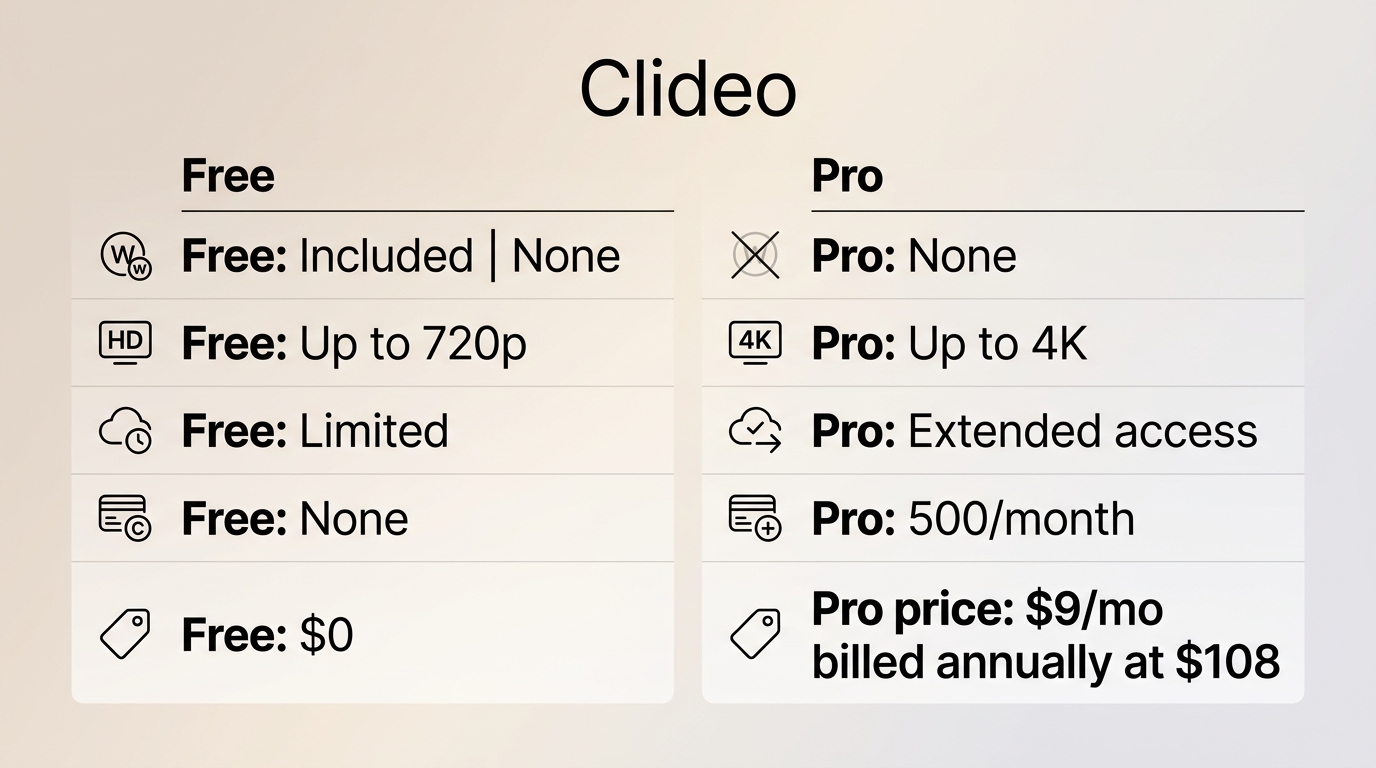
The Clideo free plan provides access to browser tools, but free exports carry a Clideo watermark. Pro is mainly a convenience upgrade for recurring, watermark-free work and higher output limits.
Price, Watermark, Resolution, and Storage
Clideo pricing and project access vary by account state. The clearest current differences are summarized below.
| Account state | Watermark | Upload limit | Export resolution | Project storage | Credits | Price |
| Visitor | Included on free exports | Limited | Up to 720p | Temporary access | Not specified | $0 |
| Registered free | Included on free exports | Limited | Free-tier limit | Projects from the previous 14 days remain accessible | Not specified | $0 |
| Pro | Removed | Higher plan allowance | Up to 4K | Extended project access | 500 per month | $9 per month, billed annually at $108 |
As of July 2026.
The practical point is that “free” describes access, not a clean final export. The watermark and resolution ceiling matter more than the tool count if the clip will be published.
Is Clideo Pro Worth It?
Pro can be worthwhile for frequent browser editing, but it is harder to justify when the main need is a complex timeline, confidential footage, or AI restoration.
Occasional users should compare the cost with the number of watermark-free exports they actually need. For repeated short tasks, the subscription removes friction; for one disposable clip, the free tradeoff may be acceptable.
Is Clideo Safe for Uploaded Videos?
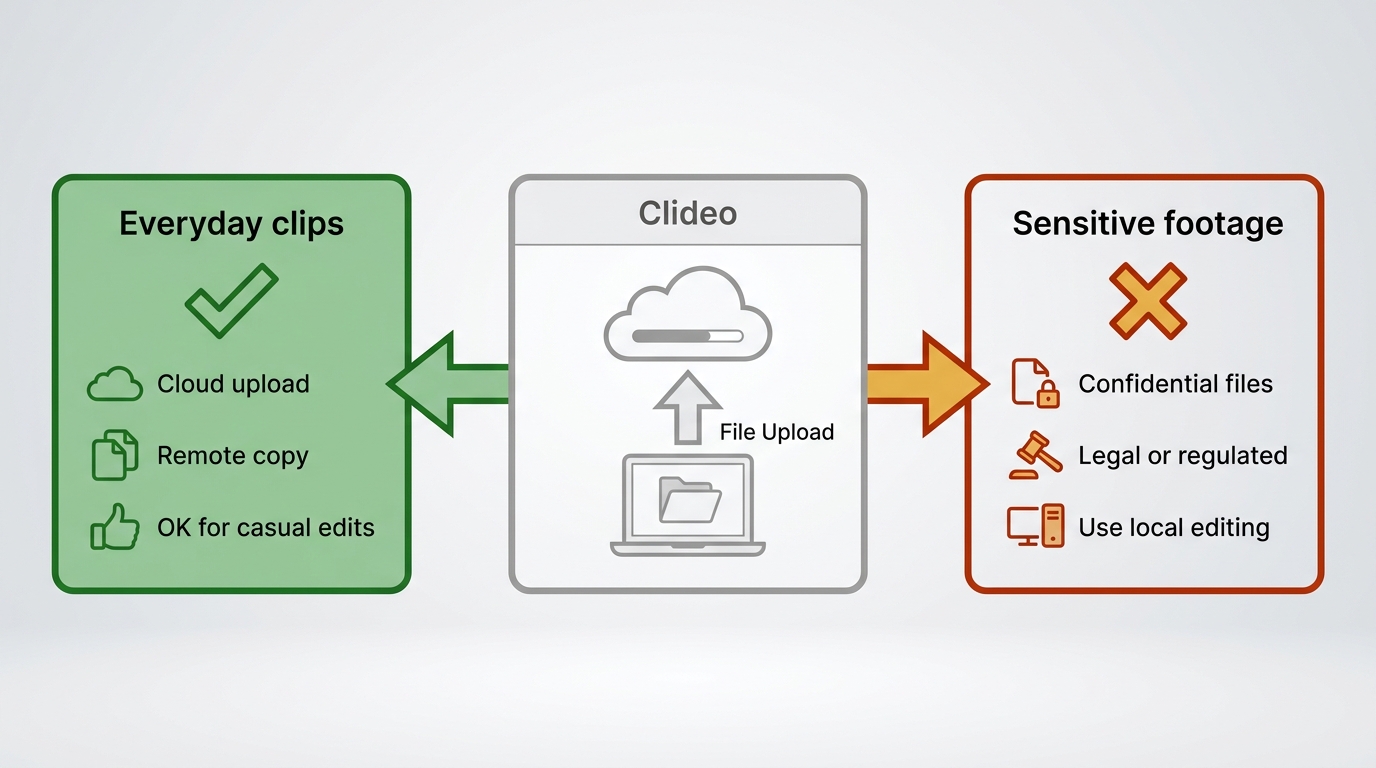
Clideo is a legitimate cloud editor with protected transfers and controlled project access, but uploading a file still means placing a copy on a remote service.
Verified Security and File Access
Clideo's safety documentation describes encrypted transfers and restricted access to uploaded projects. Those protections reduce routine exposure during upload and editing, but they do not turn a cloud workflow into local processing.
- Use a private connection and a unique account password.
- Remove projects when they are no longer needed.
- Check the selected file before upload, especially when filenames are similar.
This is enough for ordinary, non-sensitive edits in many workflows. It is not a reason to upload material that should remain inside a controlled local environment.
Privacy Limits for Sensitive Footage
The main privacy limit is architectural: the source must be uploaded for cloud processing. Project retention also depends on account state, with registered free users able to access projects from the previous 14 days.
Confidential client footage, unreleased commercial material, legal recordings, and other restricted assets are better handled locally. This is the single most important boundary in the “is Clideo safe” decision.
Safety Verdict by Use Case
Clideo is a reasonable fit for everyday clips that do not contain sensitive information. Choose local processing when the consequences of uploading the source outweigh browser convenience.
- Suitable: short social clips, simple classroom media, and non-confidential personal projects.
- Use caution: unreleased client work or content governed by a restrictive handling policy.
- Prefer local processing: confidential or regulated footage.
Clideo Video Clearer in Three Steps
The Clideo video enhancer workflow is straightforward: upload the source, adjust its appearance, then preview and export. The controls should be judged as color and exposure adjustments, not AI repair.
Step 1: Upload the Source Video
Open Clideo Video Clearer, choose the source file from the device or a supported cloud location, and wait for the editor to load.
Step 2: Adjust the Image Controls
Move brightness, contrast, saturation, hue, and fade in small increments. Compare faces, text, shadows, and highlights after each change instead of pushing several sliders at once.
These settings can make footage look cleaner when the issue is exposure or color balance, but they do not reconstruct blurred edges or remove captured noise.
Step 3: Preview and Export
Preview the full clip, confirm audio sync, choose the available export setting, and save the result. Record source and output properties if quality matters.
- Note the source duration, resolution, file size, and bitrate.
- Record the browser, connection context, upload time, and render time.
- Compare the output resolution, bitrate, close-up detail, compression, audio sync, and timeline stability.
This record turns a subjective “looks better” judgment into a repeatable Clideo export quality check.
Clideo User Reviews and a Repeatable Test Method
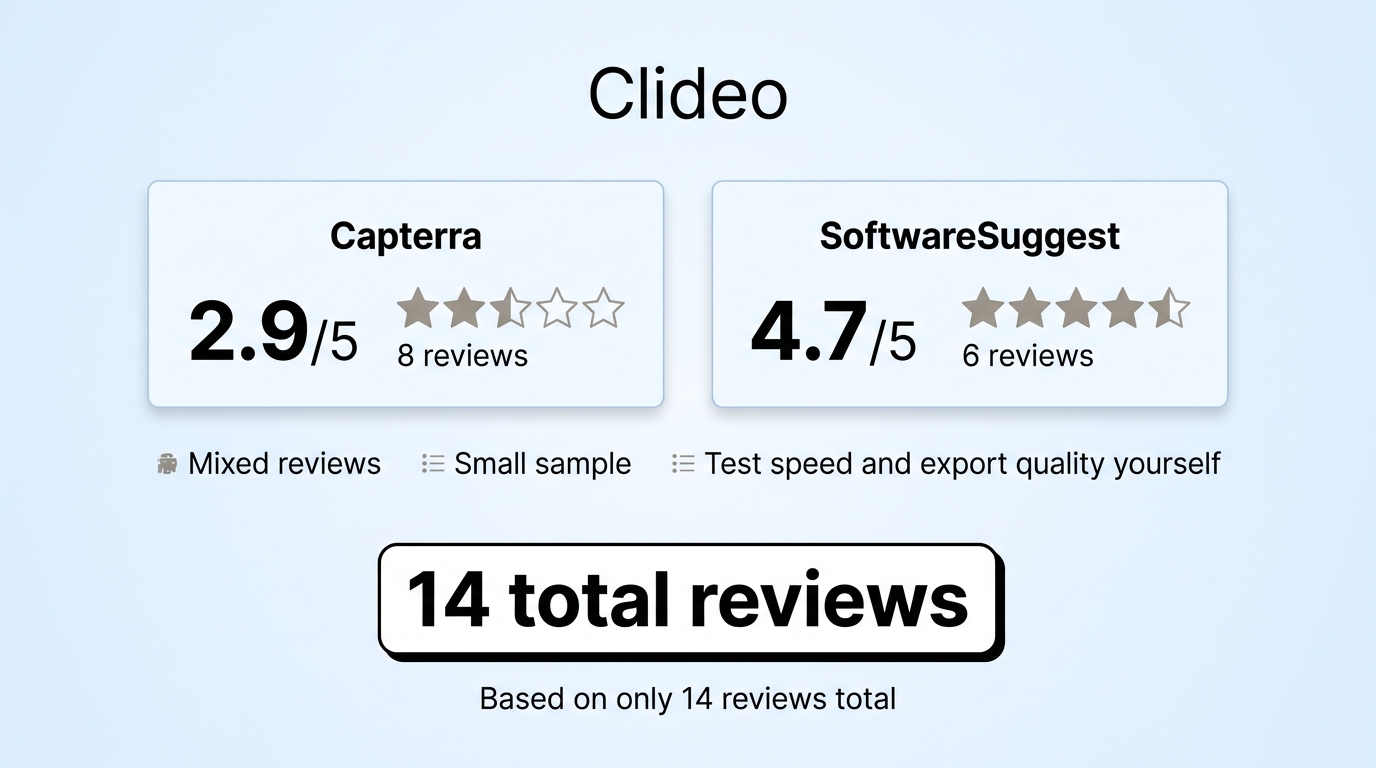
Clideo user reviews are mixed, and the available rating samples are too small to support a universal verdict. Ease of access earns praise, while processing delays, watermarks, and export quality appear in critical feedback.
Current Ratings and Review Counts
The two visible review samples point in different directions, which makes review count as important as the score.
| Platform | Rating | Review count | Review page |
| Capterra | 2.9/5 | 8 | Clideo reviews on Capterra |
| SoftwareSuggest | 4.7/5 | 6 | SoftwareSuggest listing |
A fourteen-review total across these two platforms is a signal, not a representative customer survey. The gap is more useful as a prompt to test speed and output quality than as proof that Clideo is either excellent or poor.
Same-Clip Speed and Quality Test
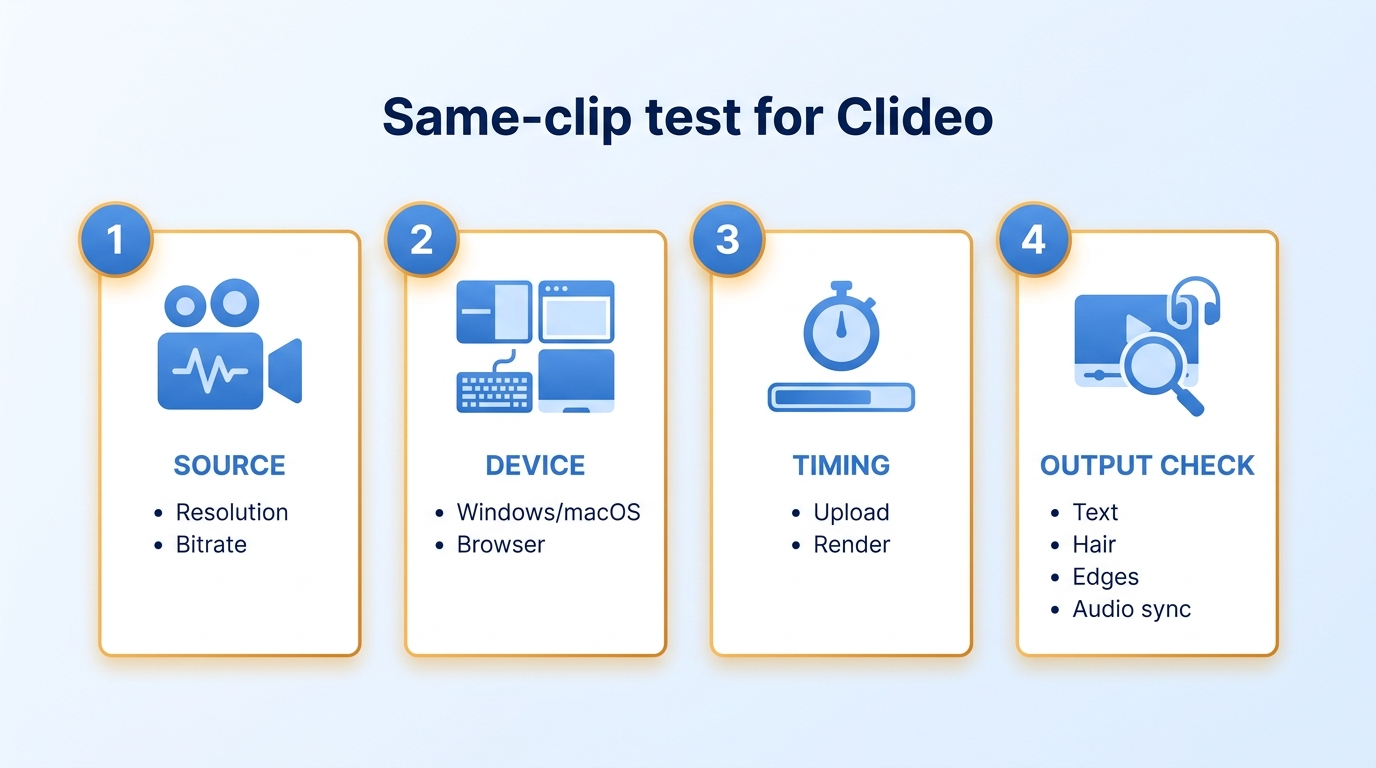
No verified same-source benchmark was available for this revision, so presenting invented render times or visual observations as test results would be misleading. Use the following repeatable method to evaluate Clideo on your own source clip.
| Test field | What to record |
| Source clip | Duration, resolution, codec, file size, and bitrate |
| Environment | Computer model, operating system, browser version, and connection type |
| Timing | Upload time and render time measured separately |
| Output | Resolution, codec, file size, and bitrate |
| Visual check | Fine text, hair, edges, shadow detail, banding, and compression blocks |
| Stability check | Audio sync, timeline behavior, and whether the project saves correctly |
Run the same source through each candidate with equivalent output settings. A single short clip is enough to judge a one-off clearer task; a multi-clip sequence is necessary before trusting the workflow for a larger project.
Clideo Pros, Cons, and Best Fit
The central tradeoff is browser convenience versus control. Clideo removes setup time, while its cloud processing, free watermark, and limited restoration capability become more noticeable as a project grows.
Where Clideo Works Well
- Quick trims, merges, resizing, compression, subtitles, and simple color adjustments.
- Occasional edits on a device where installing software is inconvenient.
- Short projects that do not require a complex timeline or AI restoration.
- Users who value a guided browser interface over granular controls.
Where Clideo Falls Short
- Free exports include branding, which can make a published clip look unfinished.
- Upload and render time depend on the connection and remote processing load.
- Video Clearer does not provide AI denoising, sharpening, or resolution reconstruction.
- Large, repeated, or multi-clip projects expose the limits of a simple browser workflow.
Best For and Not Ideal For
Best for: quick browser-based trims, merges, resizing, subtitles, and disposable one-off clips.
Not ideal for: complex timelines, sensitive footage, repeated large projects, or true AI restoration.
The watermark-versus-subscription decision is practical rather than ideological: pay when clean browser exports save enough time, but switch categories when the task itself demands more control.
When UniFab Is the Better Fit
UniFab is relevant when the goal shifts from simple editing to AI enhancement, higher-resolution output, batch work, or local processing. Clideo remains the simpler choice for a fast trim or merge.
Browser AI Enhancement with FabCloud
UniFab FabCloud AI Video Enhancer is the fair browser-to-browser comparison. It targets AI upscaling, noise reduction, sharpening, and texture recovery, while Clideo Video Clearer targets manual appearance adjustments.
FabCloud fits users who want cloud-based AI enhancement It is less suitable when upload privacy or a long queue makes local processing the better workflow.
Local Processing with UniFab Desktop
UniFab desktop processes video locally on Windows or Mac and supports batch enhancement. Relevant options include denoising, AI upscaling, and SDR-to-HDR10 conversion.
For grain-focused work, UniFab Denoise AI matches the narrower task more closely than a generic “video quality enhancer” label.
For resolution work, UniFab Video Upscaler supports higher-resolution output and offers models including Equinox, Kairo, and Titanus. Readers comparing a broader shortlist can also assess the best free AI video upscaler options by source type and hardware.
Local processing is the stronger fit for sensitive footage and repeated projects, but UniFab is not the simpler option for someone who needs one fast browser trim.
Using UniFab Video Enhancer AI
A local enhancement workflow should stay focused: import the source, choose the model that matches the problem, preview a representative segment, then export with the required resolution and format.
30-day Free Trial with full feature access!
- Step 1
After opening UniFab on your Windows or Mac system, head to 'All Fetures' > select your desired Module. Then click on the “+” sign to upload the low-quality video file for enhancement.
- Step 2
To customize the output video quality further, adjust various parameters such as codec, resolution, quality, format, etc. Finally, select the “Start” option to complete the instant and automatic video-enhancing process.
Clideo vs UniFab: Quick Comparison
This comparison separates browser convenience from AI enhancement and local control, rather than treating the products as interchangeable editors.
| Option | Best use case | Browser or desktop | AI quality enhancement | Free watermark | Output resolution by plan | Batch processing | Processing location | Sensitive-footage fit | Current price structure |
| Clideo | Quick trims, merges, resizing, subtitles, and manual appearance changes | Browser | AI voice and translation tools; Video Clearer uses manual image controls | Included on free exports | Visitor up to 720p; Pro up to 4K | Not a core clearer workflow | Cloud | Better for non-sensitive clips | Free access; Pro is $9 per month billed annually at $108 |
| UniFab FabCloud | Cloud-based AI upscaling, denoising, and more | Desktop and Browser | AI enhancement for detail, noise, and resolution | Depends on the active credit workflow | Up to 4K from supported enhancement jobs | Supported | Cloud | Use for non-confidential uploads | Credit-based access |
| UniFab Video Enhancer AI | Local AI enhancement, batch work, and sensitive footage | Windows and Mac desktop | AI denoising, upscaling, and model-based enhancement | No cloud-export watermark in the desktop workflow | Up to 4K under the verified product specification for this article | Supported | Local | Stronger fit when files should stay on the computer | Commercial desktop licensing; no article-specific price listed |
Choose Clideo for speed and simplicity, FabCloud for cloud-based AI enhancement, and UniFab desktop when local processing or repeated enhancement work matters. A broader video quality enhancer comparison should still begin with the actual defect in the source.
Clideo Review Verdict
Clideo is worth using for short, non-sensitive browser edits when convenience matters more than timeline depth or AI restoration. Its free watermark, cloud workflow, and manual clearer controls are the main constraints.
The balanced decision is not “Clideo or AI” for every task. Use Clideo for quick editing, choose FabCloud for browser-based enhancement, and move to a local desktop workflow when privacy, batch processing, or reconstruction of detail becomes central.
Clideo FAQs
Can I use Clideo without a watermark?
Free exports include a Clideo watermark. A Pro plan removes it, so the value depends on how often you need a clean browser export.
Does Clideo use AI to improve video quality?
Clideo offers AI text-to-speech, voiceover, and video translation. Its Video Clearer uses manual brightness, contrast, saturation, hue, and fade controls rather than AI upscaling, denoising, or sharpening.
Is Clideo suitable for private or sensitive videos?
It can be suitable for ordinary non-sensitive clips, but the source must be uploaded for cloud processing. Keep confidential or restricted footage in a local workflow.
Why can a Clideo export look worse than the source?
Source quality, free-plan limits, compression, output settings, and project complexity can all affect the result. Compare resolution, bitrate, fine detail, audio sync, and compression against the source before publishing.