Choose the Right 4K Conversion Path
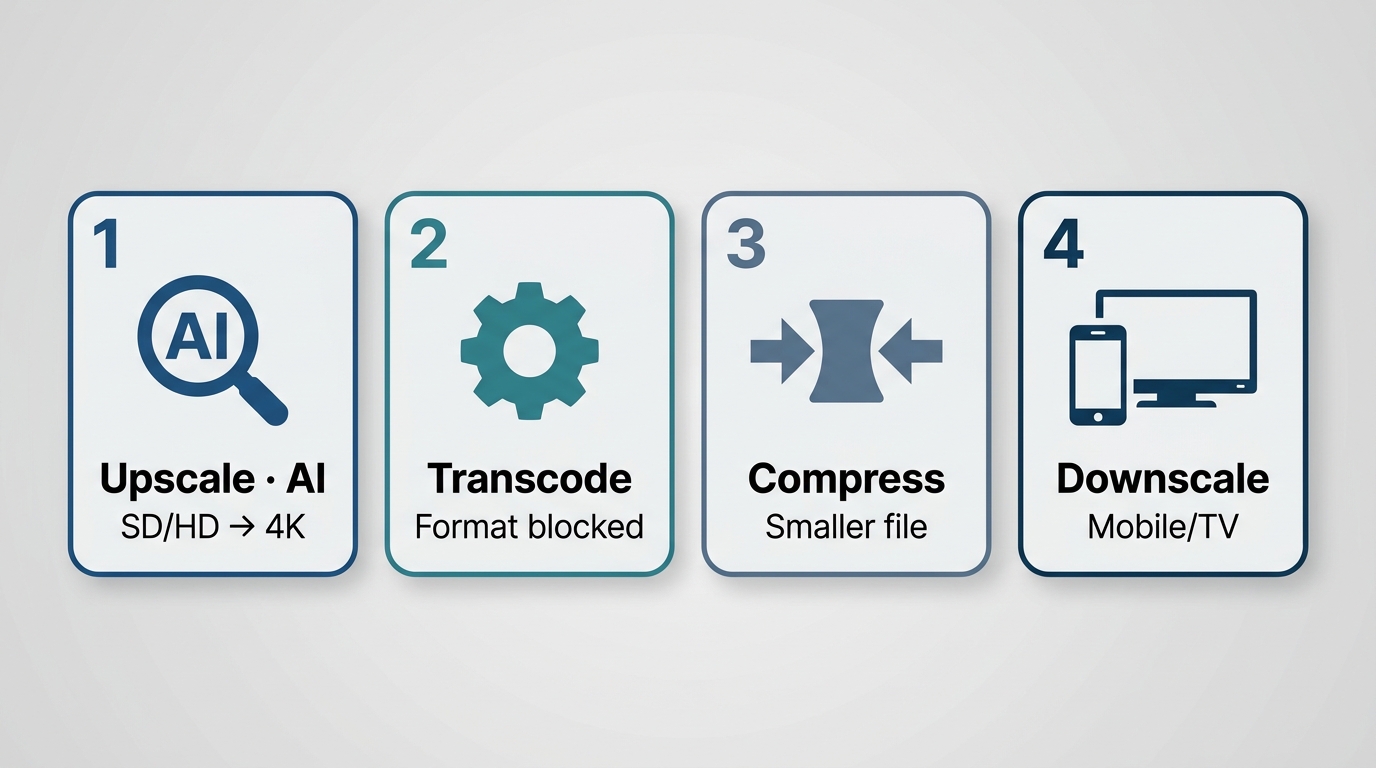
Here's the short answer: after testing eight tools across old family footage, gameplay captures, and mixed-codec edit timelines, picking the wrong task type wastes more time than picking the second-best tool. A "4K video converter" can mean four very different jobs, and the tool that's brilliant at one is usually mediocre at another.
Upscale, Transcode, Compress, or Downscale
Sort your job into one of these before you download anything:
- AI upscaling reconstructs plausible detail with a neural network — the right choice when the source is soft 480p, 720p, or 1080p and you want it to look sharper at native 3840 × 2160 video resolution. Ordinary resizing (bicubic, Lanczos) only smooths what's already there.
- Transcoding changes container or codec (MP4 to MKV, H.264 to HEVC) without touching resolution. Use it when a file won't play or import, not when it looks blurry.
- Compression keeps the resolution and shrinks the bitrate for storage or upload. It doesn't improve quality; it manages size.
- 4K-to-1080p downscaling is the opposite direction — trimming a 4K master for phones, older editors, or slower connections. A careful downscale actually preserves perceived sharpness because the source has detail to spare.
Fast Routes for Common Conversion Goals
- Want believable 4K from soft old footage → desktop AI upscaler.
- Need a quick browser conversion without installing anything → an online converter, accepting file-size and privacy trade-offs.
- File won't play in your editor → transcoder with broad codec support, no AI needed.
- 4K master too heavy for the target device → downscale to 1080p with an efficient codec.
What 4K Upscaling Can Realistically Improve
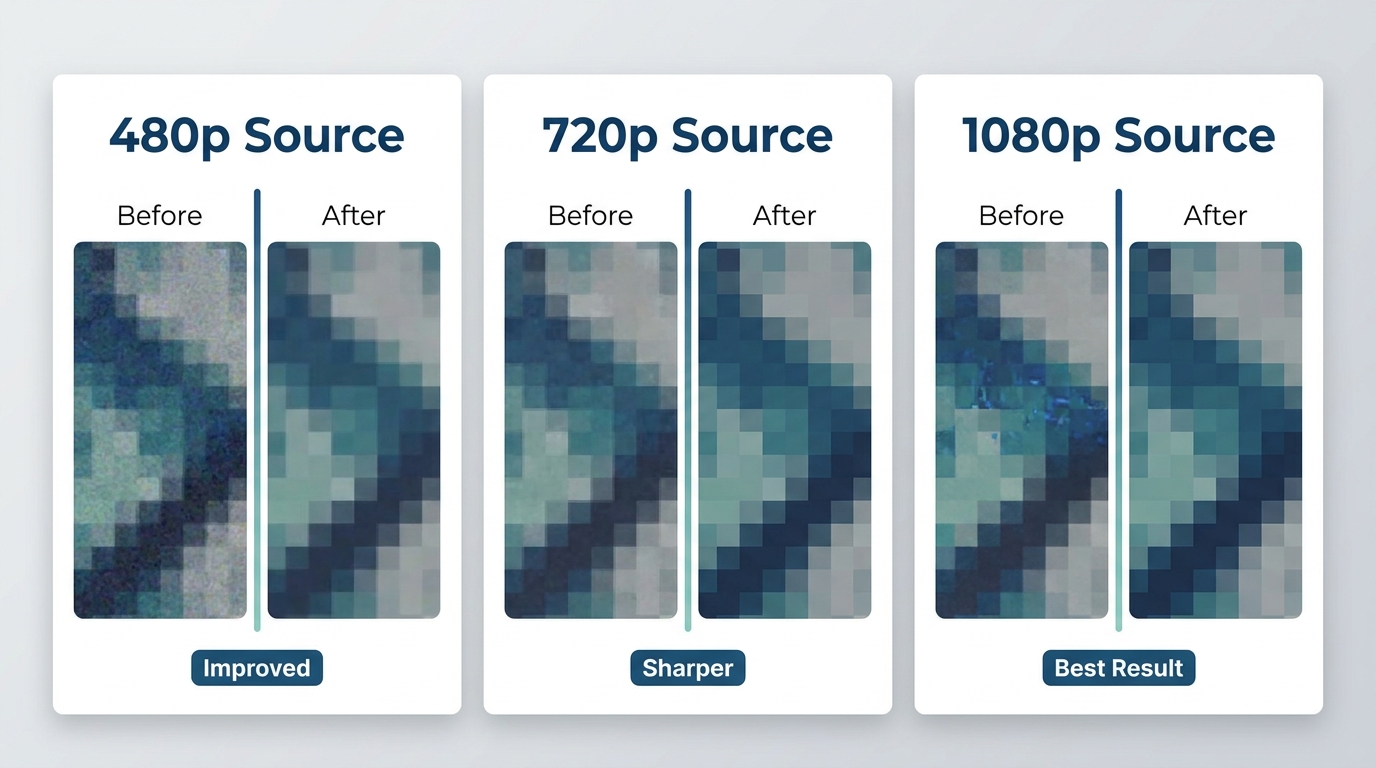
AI upscaling reconstructs plausible detail; it does not recover information the camera never captured. What you'll actually get back depends on the source, the model, and the scene.
480p, 720p, and 1080p Expectations
- Clean 1080p upscales the most convincingly. Text stays legible, edges sharpen, fine texture holds up on a 4K display.
- 720p from a decent camera can look genuinely sharper, but expect some smoothing on skin and background detail.
- 480p, VHS transfers, and heavily compressed clips improve, but don't expect native-4K looks. The AI has less signal to work with, and aggressive settings tend to invent detail rather than restore it.
Face, Motion, and Texture Artifacts
The failure modes I keep seeing across models are consistent: faces in close-ups can drift into a plastic, over-smoothed look; fast motion produces Edge flicker or wobble; fine repeating textures (fabric weave, foliage, grain) sometimes turn into painterly patches. Over-sharpening amplifies all of them.
Before committing to a batch, export a 20–30 second preview covering your hardest scene — a lit close-up, a motion-heavy shot, and one dark or noisy frame. If the preview holds up, the batch will. If a face looks synthetic, switch to a gentler model or lower the enhancement strength; don't push more sharpening on top.
Convert 1080p Video to 4K
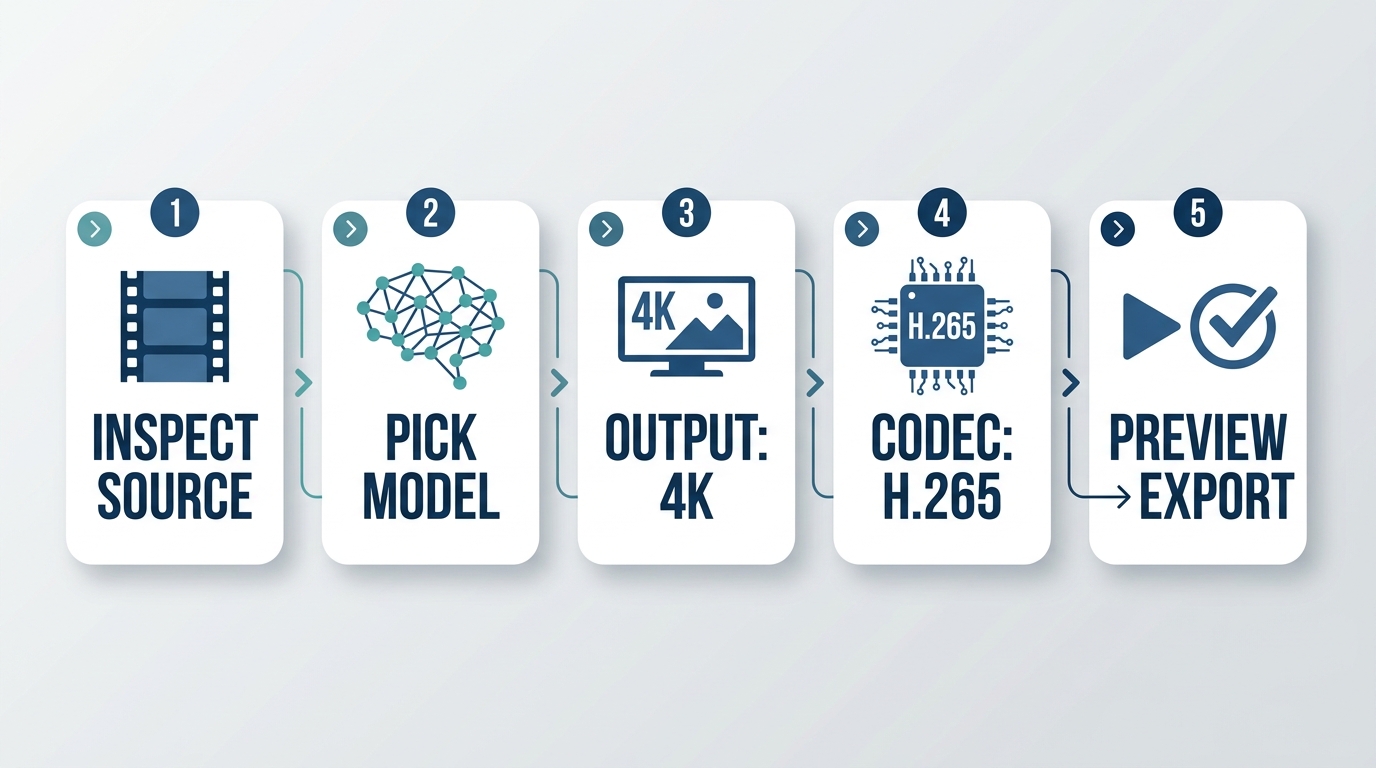
This is the most common task readers land here for, so it earns its own workflow instead of a buried FAQ.
Five-Step Desktop Workflow
- Inspect the source. Play the clip full-screen. Note the softest scene, any compression blocks, and whether faces are close or distant — that scene decides your model.
- Pick a model that matches the content. A general model handles live-action fine; anime or texture-heavy footage does better on a purpose-built model. Gentler beats aggressive on soft sources.
- Set output to 3840 × 2160. Match the frame rate to the source. Don't interpolate frame rate at the same time as resolution unless you specifically want that.
- Choose codec and bitrate. HEVC (H.265) at a moderate bitrate is my default for 4K — smaller files than H.264, wider playback support than AV1. See the recommended 4K bitrate ranges for streaming versus archival targets.
- Preview a 20–30 second segment, then run the full export. If the preview shows plastic faces or Edge wobble, adjust before committing to the full clip. For the deeper option map, see how to upscale video to 4K.
Settings for Detail and File Size
A 4K frame carries roughly four times the pixels of 1080p, so files grow. HEVC or AV1 at a moderate bitrate keeps that growth manageable; H.264 at 4K balloons quickly. If a target device chokes on the output, the fix is usually the codec, not the resolution.
Best Desktop 4K Video Converters
Six desktop options that are still actively maintained and worth considering in 2026. Each entry lists what it's genuinely good at and where I wouldn't reach for it.
UniFab Video Upscaler AI
OS: Windows and Mac
UniFab Video Upscaler AI is a local desktop app for Windows and Mac that runs AI upscaling on your machine — no cloud upload — with output headroom up to 16K and a Titanus model that runs up to 3× faster than the previous generation on supported hardware. Batch queueing lets you line up a folder of clips and walk away.
Processing time varies with source footage, chosen model, GPU, codec, and export settings, so I won't quote a fixed number. In practice, GPU acceleration is the difference between waiting minutes and waiting hours on a long clip.
30-day Free Trial for full features, without watermark!
- Step 1
Launch the UniFab program > click on “Video Upscaler” Mode > Upload the poor-quality video that you wish to upscale to 4K.
- Step 2
Next, customize the output video profile with many parameters, such as resolution, models, and more.
- Step 3
Tab “Start” to begin the video resolution upscaling process to 4K.
Best for: local batch AI upscaling when you don't want footage on someone else's server and you want headroom past 4K.
Not ideal for: a one-off browser conversion on a machine where you can't install software.
HitPaw Univd
OS: Windows and Mac
Now marketed by the vendor as HitPaw Univd, this tool bundles format conversion with AI portrait enhancement and light editing (trimming, cropping, subtitle work) in one interface. Turning AI enhancement on slows processing meaningfully; leaving it off, it behaves like a fast, format-focused converter.
Best for: readers who want format conversion and mild AI portrait cleanup in a single app.
Not ideal for: heavy AI upscaling on soft, low-resolution footage — dedicated upscalers get further on hard sources.
Topaz Video
OS: Windows and Mac
Now branded Topaz Video, this is the tool power users reach for when they want granular control: parameter tweaking, model blending, frame-by-frame preview, and dedicated tools for artifact removal, stabilization, and frame-rate work.
Best for: experienced editors who want per-clip parameter control and don't mind investing time in the interface.
Not ideal for: beginners who want good defaults, or workflows that need a large queue of clips with different settings each.
AVCLabs Video Enhancer AI
OS: Windows and Mac
AVCLabs Video Enhancer AI leans into restoration work: multi-frame analysis that reads temporal information across neighboring frames, AI colorization for black-and-white footage, and dedicated cleanup for scratches and compression damage.
Best for: archival projects — old family reels, black-and-white footage, damaged sources — where restoration matters more than raw resolution.
Not ideal for: tight close-ups where face artifacts show up, or high-volume batch jobs on long clips.
Cutout.Pro AI Video Enhancer
OS: Desktop and web
Cutout.Pro offers both a downloadable app and a browser tool, with motion interpolation, stabilization, and upscaling up to 4K. The web version means uploading footage to their servers, which is a real consideration for anything you'd rather keep off the cloud.
Best for: quick hybrid jobs when a short clip needs a browser turnaround.
Not ideal for: sensitive personal footage, or workflows that need 8K output.
Aiseesoft Video Converter Ultimate
OS: Windows and Mac
Now sold as Aiseesoft Video Converter Ultimate, this one is honest about being a converter first and an enhancer second. Broad format and codec support, basic edits (merge, trim, brightness/contrast), and standard resolution scaling — no serious AI reconstruction.
Best for: fast, no-fuss format conversion and batch transcoding when the source is already clean.
Not ideal for: resurrecting soft, noisy, or low-resolution footage — an AI upscaler will beat it.
Best Online 4K Video Converters
Two browser tools worth using in 2026. The trade-off with anything online is the same: you're uploading footage to a server you don't control, so keep sensitive material on desktop. For the full browser-based workflow, see convert video to 4K online free, or for the specific 1080p-to-4K browser path, 1080p to 4K online.
HDConvert
HDConvert runs 4K conversion in the browser with no install. It's a straightforward resizer rather than an AI reconstructor, so results on soft sources match what basic upscaling can deliver — cleaner than raw stretching, not visibly reconstructed detail.
Best for: a quick browser job on non-sensitive content when you can't install software.
Not ideal for: soft, noisy, or quality-critical footage where AI reconstruction actually matters.
Media.io AI Video Enhancer
Media.io promotes AI-powered enhancement server-side, meaning the neural work happens in their cloud rather than on your GPU. It's a genuine step up from mathematical resizing, but you're still bound by upload time, credit or watermark limits on the free tier, and the privacy trade-off of cloud processing.
Best for: short clips where AI cleanup would help but installing a desktop tool isn't practical.
Not ideal for: long clips, batch jobs, or footage you'd rather not upload.
4K Video Converter Comparison
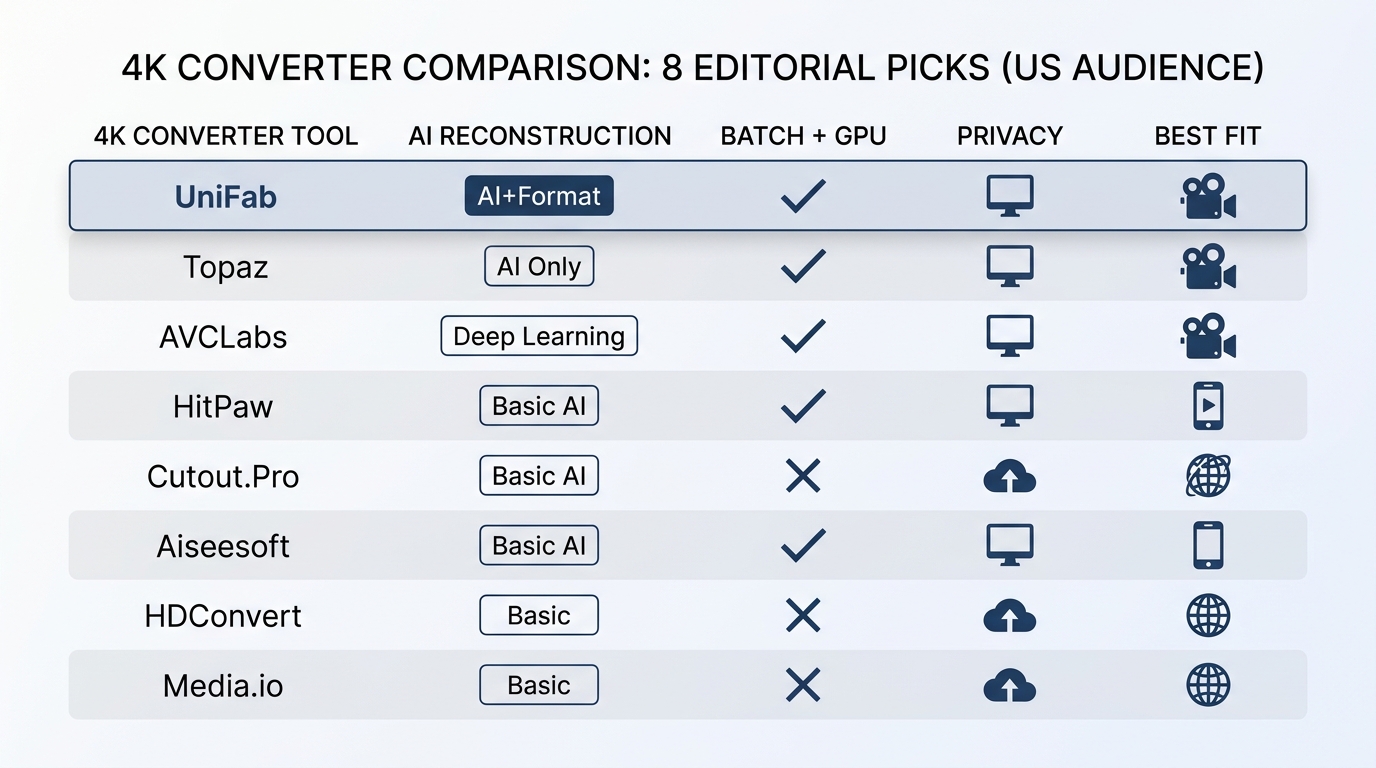
| Tool | Environment | Primary job | AI reconstruction | Batch / GPU | Privacy model | Best fit | Not ideal for |
| UniFab Video Upscaler AI | Windows, Mac | AI upscaling | Yes, up to 16K | Batch queue, GPU-accelerated | Local processing | Batch AI upscaling with headroom past 4K | One-off browser jobs |
| HitPaw Univd | Windows, Mac | Format conversion with light AI | Yes, portrait-focused | Batch, GPU | Local processing | Convert plus mild portrait cleanup | Heavy upscaling on soft sources |
| Topaz Video | Windows, Mac | AI upscaling and restoration | Yes, per-parameter control | Batch, GPU | Local processing | Experienced editors wanting granular control | Beginners; large mixed-setting queues |
| AVCLabs Video Enhancer AI | Windows, Mac | Restoration and colorization | Yes, multi-frame | Batch, GPU | Local processing | Archival and black-and-white footage | Close-up faces; very long clips |
| Cutout.Pro AI Video Enhancer | Desktop and web | Hybrid enhancement | Yes | Single-file focus | Cloud upload on web | Quick hybrid clip jobs | Sensitive footage; 8K output |
| Aiseesoft Video Converter Ultimate | Windows, Mac | Format conversion | No | Batch, GPU | Local processing | Fast transcoding of clean sources | Reviving soft, low-resolution footage |
| HDConvert | Browser | Basic resizing | No | Single-file | Cloud upload | Quick browser conversion | Quality-critical or private footage |
| Media.io AI Video Enhancer | Browser | Cloud AI enhancement | Yes, server-side | Single-file | Cloud upload | Short clips needing AI cleanup without install | Long clips; batch; private footage |
As of August 2026. Licensing tiers and specific limits change; check each tool's official page before buying.
Choose by Format, Codec, and Workflow
Compatibility failures cause more grief than a mediocre 4K badge. Match the tool to the file, not the marketing claim.
Containers, Codecs, and Bitrate
Containers (MP4, MOV, MKV, WebM) are the wrapper; codecs (H.264, HEVC, AV1, ProRes) are how the video is compressed inside. An editor may accept the container but choke on the codec, or vice versa. If your target editor or player is picky, transcode to a widely supported combination — MP4 with H.264 or HEVC clears most walls. For 4K output, HEVC at a moderate bitrate is a solid default; AV1 saves more space but has thinner playback support.
Batch Jobs, Metadata, and GPU Support
"Batch" means different things across tools. Check these separately: can it queue individual files, ingest a whole folder, apply per-file settings, preserve timestamps and location metadata, and carry subtitles or multiple audio tracks through unchanged? GPU acceleration turns a multi-hour job into a manageable one — verify it's actually engaged (some tools default to CPU on unsupported hardware). Before pointing it at an entire archive, run a small validation batch of five to ten clips.
Desktop Privacy and Cloud Convenience
Desktop keeps footage on your machine — the right choice for family archives, work material, and anything you don't want on someone else's server. Online is genuinely convenient for a one-off job on a machine you can't install to, at the cost of upload time, tier limits, and the privacy trade-off. For 8K output beyond what most tools handle, an 8K video enhancer is a specialized desktop path.
Common 4K Conversion Use Cases
Personal Archives and Old Footage
Family VHS transfers, Hi8 tapes, and early digital clips benefit most from AI reconstruction — but only up to a point. Expect meaningful improvement in faces and midground detail; don't expect the tape to become a 4K master. A restoration-oriented tool with colorization or artifact repair usually beats a general upscaler here.
Editing and Playback Compatibility
Mixed-source timelines and 4K TV playback are the same problem in disguise: the destination expects one format, the source arrives in another. Upscaling low-resolution clips to match the timeline avoids export dropouts; transcoding the container or codec fixes playback stutter without touching resolution. Which one you need depends on why it's not working — check the codec first.
Social and Gaming Footage
Gameplay from older consoles (720p or 1080p) upscales cleanly because game graphics have geometric edges the AI can reconstruct with confidence. For social platforms, the counterintuitive part: short-form vertical video usually doesn't need 4K output at all — the destination re-encodes hard, and bitrate control matters more than resolution. If your TikTok upload looks soft, the fix is often codec and bitrate, not upscaling to 4K.
The pattern across all three scenarios: readers waste more time picking the wrong task type than picking a slightly wrong tool. Sort the job first, then the software.
4K Video Converter FAQs
Can I convert 4K video to 1080p without losing much detail?
Yes, a careful downscale actually preserves perceived sharpness because you're throwing away information the destination doesn't need. Use HEVC at a moderate bitrate, keep the original frame rate, and run a short test export before batching a whole folder — the result is smaller, more compatible, and often looks crisper on 1080p screens than the native 4K did.
Why does a 4K conversion sometimes make faces look artificial?
Very soft sources, an aggressive model, motion blur, and over-sharpening all push faces toward that plastic, waxy look. Preview a lit close-up and a motion-heavy shot before the full run. If they look synthetic, switch to a gentler model or reduce enhancement strength — piling on more sharpening makes it worse, not better.
Can I convert a whole folder and keep the original metadata?
Depends on the tool. Batch queueing, folder ingestion, per-file settings, timestamp and location retention, and subtitle or multi-audio pass-through are all separate features — a tool can support one without the others. Run a five-clip sample and inspect the output metadata before pointing it at an entire archive.
Can I turn a 4K MP4 into a web-friendly GIF?
A full-resolution 4K GIF is impractical: the file balloons and browsers stutter. Resize to 480–720 pixels wide, trim to a few seconds, drop the frame rate to 15–24 fps, and consider WebP or a short MP4 loop instead — animation quality holds up and file sizes stay reasonable.
Choose for Your Source, Not the Badge
Pick the workflow first, the tool second. Quality-critical batches of soft or archival footage belong on a local desktop AI upscaler. Quick, non-sensitive browser jobs are fine online. Files that won't play or won't import need a transcoder, not an enhancer. And a 4K master headed for a phone is better served by a clean downscale than pushed as-is.
For local batch AI upscaling with headroom past 4K, UniFab Video Upscaler AI fits — with the honest caveat that it's overkill if all you need is a one-off browser conversion. Match the tool to the source and the destination, and the badge on the box stops mattering.