Searching for an Aiseesoft Video Enhancer review now creates a version problem: old Aiseesoft Video Enhancer screenshots, Aiseesoft Filmai pages, and current Aiseesoft VidHex claims do not describe one unchanged build. That makes stale limits easy to mistake for current behavior.
This review maps the names first, separates current specifications from legacy observations, checks pricing and workflow details, and ends with a practical fit decision. The central conclusion is simple: judge VidHex by its current models and your source footage, not by an old 4K ceiling.
Quick Verdict: Current Strengths and Limits
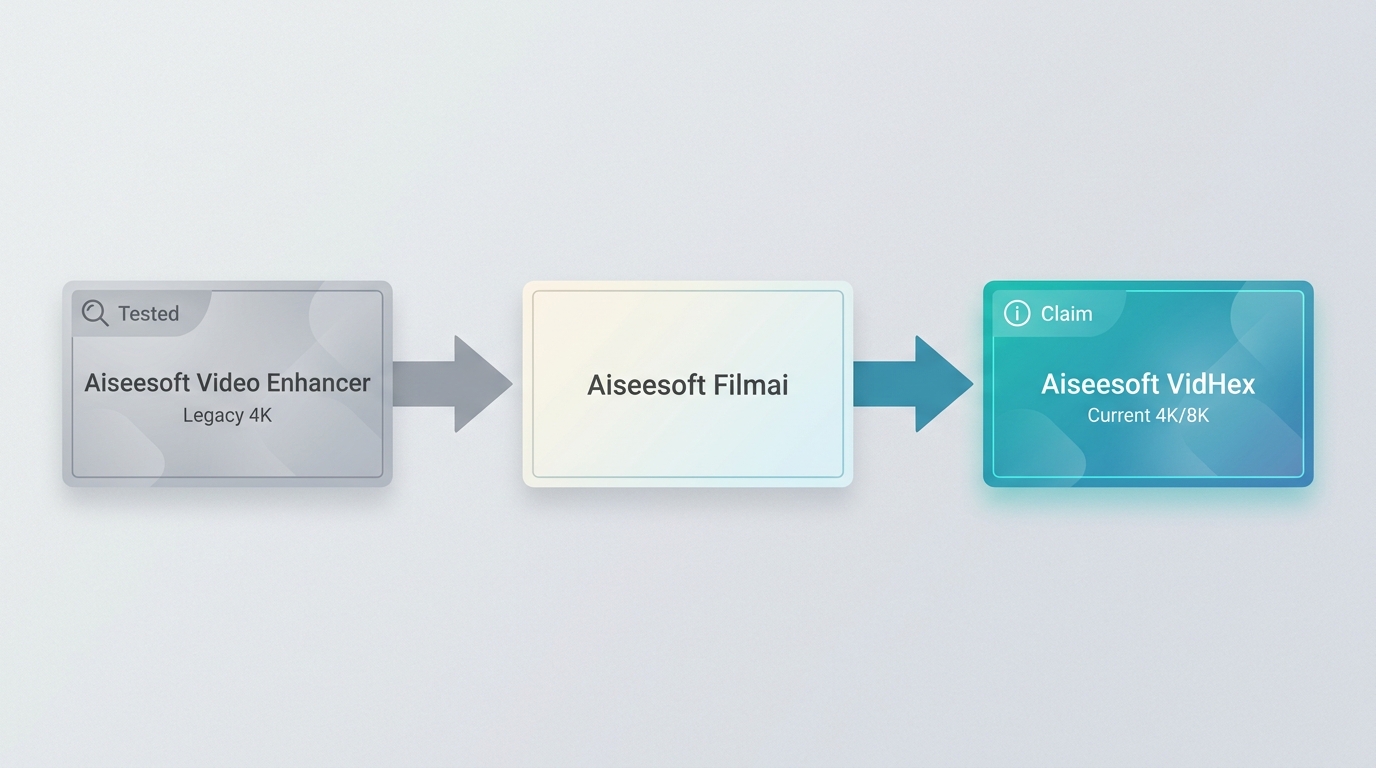
Current VidHex is a broader product than the legacy Aiseesoft Video Enhancer shown in the available tests, but the older results still reveal useful questions about detail, texture, preview access, and workflow.
- Current strengths: official materials advertise 4K and 8K output, general, anime, and face-focused models, SDR-to-HDR conversion, and higher-frame-rate workflows.
- Evidence limit: the comparison images come from an older interface and cannot prove how the current VidHex models perform.
- Buying limit: a three-second unpaid preview may be too brief to reveal temporal artifacts or dialogue synchronization.
Readers comparing a browser-based video enhancer with desktop software should also account for upload time, hardware, and whether a workflow uses local or cloud-assisted processing.
The practical takeaway is to treat Aiseesoft as a plausible fit for guided enhancement, while keeping the legacy observations clearly separated from current product claims.
Aiseesoft Video Enhancer, Filmai, and VidHex Explained
Aiseesoft Video Enhancer, Aiseesoft Filmai, and Aiseesoft VidHex are names from a transitioning product line, not proof that every interface and model remained identical.
- Aiseesoft Video Enhancer: the legacy desktop name visible in the workflow screenshots.
- Aiseesoft Filmai: an intermediate AI-enhancement identity whose official page now presents VidHex.
- Aiseesoft VidHex: the current identity used for the wider model set, pricing, preview, and cloud-credit context.
The title bar identifies the tested software only as Aiseesoft Video Enhancer (Unregistered); it does not display a numeric build. Those observations are therefore labeled as legacy rather than assigned to current VidHex.
Aiseesoft Video Converter Ultimate is a separate converter and editor. Its name may appear in older tutorials, but it should not be treated as the current VidHex enhancement application.
This version map matters more than a rebrand label because it prevents an old interface limitation from becoming a false claim about a current model.
Current Aiseesoft Video Enhancer Features
The current Aiseesoft Video Enhancer feature set is centered on model-based upscaling, cleanup, color work, interpolation, and guided export rather than the four-checkbox legacy interface alone.
Resolution Upscaling and Detail Recovery
Current materials advertise both 4K upscaling and 8K output, along with specialized general, anime, and face models. Resolution and real detail recovery remain separate questions: a larger frame does not by itself prove that texture was reconstructed.
The useful distinction is between output dimensions, Edge clarity, facial texture, and stability from frame to frame. The legacy result below addresses those observations only for the available test images.
Noise Reduction
VidHex presents video denoise and deblurring as current capabilities, but texture preservation depends on the model, source compression, and strength of processing.
Noise cleanup should be judged on flat backgrounds, hair, skin, and moving edges, not on a single still alone. A broader guide to remove grain from video explains why different noise patterns need different treatment.
Brightness and Color Enhancement
This works better than expected. Underexposed clips become more legible without manual tweaking. The auto-optimization is one of Aiseesoft's stronger features.
Current materials also advertise SDR to HDR conversion. That is a separate workflow from simple brightness optimization, so the legacy brightness result does not establish current HDR output quality.
Stabilization
Video stabilization targets camera shake, while upscaling and denoising target image quality. The legacy panel includes a deshaking control, but current results should be assessed for cropping, Edge warping, and motion consistency.
Motion stability matters more than a steadier sample frame because wobbling edges can be more distracting than the original shake.
Basic Editing Tools
Trim, crop, rotate, and related preparation tools reduce the need to switch applications for a simple enhancement job. They are useful for setup, but they do not replace a timeline editor for layered edits or detailed audio work.
For most buyers, these tools are conveniences rather than the reason to choose the product.
Aiseesoft Performance Tests by Version
The available evidence supports a legacy-build assessment, not a universal verdict on every current Aiseesoft Video Enhancer model.
Tested Build and Source Clips
The screenshots identify the software as Aiseesoft Video Enhancer (Unregistered) in a Windows-style interface, but they do not show a numeric version, Windows build, processor, or graphics-card model.
- Upscale input: 360p.MP4, 426×240, 17 seconds, with no audio track shown.
- Upscale setting: 4096×2160 output using the 4K H.264/MPEG-4 AVC MP4 profile shown in the interface.
- Noise-test input: a dark outdoor cabin scene with visible chroma and luminance noise.
- Observable criteria: output dimensions, detail recovery, compression artifacts, residual noise, face texture, temporal consistency, and audio sync.
- Test boundary: the still images support spatial comparisons; they do not document hardware speed, temporal consistency, or audio sync.
These are the reproducible conditions visible in the test record. A numeric build and hardware model remain unknown.
4K Upscaling Results
When upscaling from lower resolutions to 4K, Aiseesoft performs basic scaling well — output has the expected pixel count. But the software struggles to recover fine detail, leaving footage soft or blurry at the higher resolution. The behavior reads as interpolation rather than AI-driven detail reconstruction.
The image supports a softness observation for this legacy run. It does not establish the output of current face or 8K models. Anyone trying to upscale video to 4K should distinguish the requested pixel size from recovered texture and stable detail across motion.
The decisive result here is facial texture: it is easier to notice in normal viewing than the output-resolution label, and it exposes whether enlargement is creating useful detail or merely smoothing the source.
Noise Removal Results
Tested on a video with visible digital noise. After Aiseesoft processing, noise reduction was limited — the output still displayed much of the original imperfection, with negligible enhancement in clarity. Whatever noise was reduced came with a slight loss of fine detail.
The visible criteria are residual grain in the sky and trees, Edge definition around the roof, and texture in the people. Because the asset is a still, it cannot show whether noise flickers between frames or whether processing changes audio timing.
Version-Aware Performance Verdict
The legacy build produced limited detail recovery and modest noise cleanup in the test images, while current VidHex officially claims a much wider model set. Both statements can be true because they describe different evidence.
The appropriate verdict is conditional: the older observations are useful warning signals, but current output must be judged by model and source. No current 8K, face, HDR, or interpolation result is inferred from the legacy stills.
Using Aiseesoft Video Enhancer in Four Steps
The current workflow still follows four practical stages: install VidHex, import a source, choose a model, and set the export format and destination.
- Install the current VidHex package for the correct operating system.
- Import the video and confirm its audio and aspect ratio.
- Select the enhancement model that matches the source problem.
- Choose MP4 or another available format, set the destination, and export.
Download the Current VidHex Build
Use the current VidHex download rather than assuming an old Aiseesoft Video Enhancer installer represents the same interface. Confirm whether the installed application identifies itself as VidHex before following current controls.
Import a Source Video
Import the source and check the displayed dimensions, duration, audio track, and subtitle state. The legacy screenshot shows a 17-second 426×240 MP4 with no audio selected, which is useful context for that test but not a current default.
Choose the Enhancement Model
Match the model to the problem instead of enabling unrelated adjustments. Upscaling addresses resolution, denoise targets visible noise, stabilization addresses shake, and face-focused processing should be reserved for footage where facial detail is central.
Export as MP4 or H.264
Select MP4 and an H.264 profile when those controls are available, then choose the destination folder before export. In the tested legacy build, the Profile field shows 4K H.264/MPEG-4 AVC Video (*.MP4), while Destination and Open Folder controls identify where the saved file goes.
Current VidHex labels may differ from the legacy controls, so the reliable sequence is format, codec if exposed, destination, export, then the app's file-location control.
Preview and Aspect-Ratio Caveats
The current pricing context distinguishes a free three-second preview from access available after purchase. That preview limit should not be confused with a claim that every adjustment requires a complete export.
Likewise, the legacy 16:9 and 4:3 interface evidence is not a current product ceiling. Current materials promote TikTok and Instagram workflows, so vertical or square output should be checked in the installed VidHex build rather than ruled out from old screenshots.
Aiseesoft Free Preview and Current Pricing
As of August 2026, VidHex lists monthly, annual, and perpetual options, each paired with a different initial cloud-credit allowance.
The unpaid evaluation offers a three-second preview. It can reveal obvious framing or color problems, but it is too brief to establish long-sequence consistency by itself.
Current Individual Pricing
| Plan | Price | Included credits | Access |
| 1 month | $31.92 | 100 | Current enhancement tools |
| 1 year | $79.92 | 1,350 | Current enhancement tools |
| Perpetual | $239.92 | 5,000 | License plus initial credits |
Cloud credits are plan-specific resources for accelerated or cloud-assisted work. A perpetual license should not be read as an unlimited promise for every future credit or service benefit.
The sensible pricing judgment is based on expected use: a recurring plan lowers the initial commitment, while the perpetual option places more cost upfront and still requires attention to credit-based features.
Aiseesoft Video Enhancer Pros and Cons
A current Aiseesoft review needs to combine official VidHex capabilities with the limits of the legacy test evidence.
Pros
- Available as a desktop application for Windows and Mac.
- Current materials advertise 4K and 8K output plus general, anime, and face-focused models.
- Includes denoise, color, interpolation, stabilization, and preparation tools in one workflow.
- Offers monthly, annual, and perpetual purchasing options.
Cons
- The three-second unpaid preview gives limited evidence for long-motion consistency.
- Local and cloud-assisted modes make privacy and credit use more nuanced than a single offline claim.
- The hands-on images do not show a numeric build, hardware, or current-model results.
- Output quality remains source- and model-dependent, especially for faces, compression noise, and motion.
Best for: buyers who want guided desktop enhancement and are comfortable selecting among current models.
Not ideal for: buyers who need long-form evidence before purchase or whose decision depends on a result not visible in the short preview.
The balanced judgment is that version clarity is a strength when handled correctly, while limited evaluation time is the main reason to keep comparing.
Official Capabilities vs Observed Test Results
This matrix separates current official capability claims, observations from the tested legacy build, and UniFab fit without treating any one column as universal proof.
| Evaluation area | Current Aiseesoft/VidHex | Tested-build observation | UniFab fit | Status or caveat |
| 4K and 8K output | Both advertised | Legacy 4K looked soft | 4K workflow available | Retest current models |
| SDR-to-HDR | Advertised | Not in legacy assets | HDR10 workflow | Compare source fit |
| Face enhancement | Face model advertised | Soft facial texture | Upscale workflow | Different evidence sets |
| Frame interpolation | Up to 120 fps; 240 fps slow motion | Not tested | Separate workflow | Motion footage needed |
| Preview and export | Three-second free preview | Legacy export controls shown | Desktop workflow | Paid behavior differs |
| Processing and privacy | Local plus cloud context | Hardware undocumented | Local processing | Check selected mode |
Capability and pricing context: the official VidHex pricing page, as of August 2026. A general Trustpilot company page does not isolate this product and is not used as performance evidence.
The practical upshot is that official specifications answer what a current product offers, while the old assets answer only what happened in that documented legacy scenario.
Where Aiseesoft and UniFab Differ
Aiseesoft and UniFab overlap on common enhancement tasks, but their useful differences emerge in workflow fit, evidence, and what the buyer needs beyond basic cleanup.
Shared Enhancement Workflows
Both products address upscaling and denoising. UniFab separates those tasks into an AI Video Upscaler and a Video Denoiser, while VidHex presents a current model-based enhancement line.
Best for Aiseesoft: users who want the current VidHex model choices.
Not ideal for Aiseesoft: anyone relying on legacy stills as proof of current output.
Differences in Output and Workflow
The images suggest different treatment of facial detail and dark-scene noise, but they are not a controlled current-build benchmark. The comparison is useful as a question generator, not as a universal ranking.
Best for UniFab: Windows or Mac users who want a desktop suite with distinct enhancement workflows.
Not ideal for UniFab: browser-first users or anyone who needs only an occasional, single-purpose brightness adjustment.
The tradeoff is evidence versus breadth: Aiseesoft's current claims need current output validation, while UniFab's wider desktop workflow may be more than a narrow one-off job requires.
Additional UniFab Workflows
The relevant UniFab differences are limited to three workflows in this comparison: SDR-to-HDR10 conversion, 5.1 or 7.1 audio upmixing, and local processing for privacy-sensitive footage.
Those capabilities matter only when the project actually requires them. They should not be used to imply that a current VidHex feature is absent when Aiseesoft now advertises a comparable category.
UniFab All-In-One as an Alternative
UniFab All-In-One is a fit-based alternative when the project extends beyond visual cleanup into HDR, surround-audio, or local-processing requirements.
Professional AI Video Enhancer
- 30-day free trial — no watermarks, no feature limits
- Advanced AI enhancement across 22 dedicated modules
- Deeper restoration than Aiseesoft for detail-critical work
- Suited for professional-grade workflows
UniFab All-In-One
Professional AI Video Enhancer
- 30-day free trial — no watermarks, no feature limits
- Advanced AI enhancement across 22 dedicated modules
- Deeper restoration than Aiseesoft for detail-critical work
- Suited for professional-grade workflows
UniFab All-In-One for Mac
Where UniFab May Fit Better
- SDR-to-HDR10: useful when the deliverable specifically requires HDR10 rather than a brighter SDR image.
- 5.1 or 7.1 audio upmixing: relevant when the audio deliverable matters alongside picture enhancement.
- Local processing: useful for privacy-sensitive footage that should stay within a Windows or Mac desktop workflow.
Best for: projects that need at least one of those three workflows. Not ideal for: browser-only work, low-power devices without a desktop workflow, or a one-time basic adjustment where a broader suite adds little value.
The honest reason to choose it is workflow coverage, not a blanket claim that one product wins every shared task.
Choosing Between Aiseesoft and UniFab
The choice should follow the source problem and required deliverable. Buyers still surveying the category can place both tools within the broader video quality enhancer field or compare a best free AI video upscaler shortlist before deciding how much workflow breadth they need.
- Choose Aiseesoft: when current VidHex models, 8K output, and its purchasing options match the project.
- Choose UniFab: when HDR10, surround-audio work, or a local desktop pipeline is central.
- Keep comparing: when neither product's evaluation path shows the motion, texture, or synchronization evidence required for the source.
Use one representative source clip as the decision framework, then check the following once rather than repeating the same advice across the review:
- Confirm preview access and whether it covers the difficult scene.
- Inspect texture retention on faces, hair, fabric, and compressed edges.
- Watch temporal consistency and spoken-dialogue synchronization.
- Record processing time on the hardware that will handle the real project.
- Confirm output format, codec, aspect ratio, and saved-file location.
This checklist is more reliable than comparing feature counts because it ties the recommendation to observable output and the buyer's actual delivery requirements.
Worth Buying? Aiseesoft in 2026
Aiseesoft is worth considering for buyers who want a guided Windows or Mac enhancer and whose current VidHex result passes the decision checklist above.
It is less convincing for buyers who need long-motion proof before paying, depend on a specific cloud-credit policy, or cannot establish texture and synchronization quality within the available preview. The decisive limitation is evaluation confidence, not the stale claim that the product stops at 4K.
The restrained recommendation is to keep Aiseesoft on the shortlist for its current model range, then choose only when its output matches the source. If HDR10, surround audio, or a local desktop workflow is decisive, the UniFab alternative section explains that separate fit without repeating a full feature catalog.
Aiseesoft Video Enhancer FAQs
These answers address installation, Mac support, evaluation, synchronization, and processing mode without repeating the pricing or product-line sections.
Is Aiseesoft Video Enhancer safe to install?
Install the current desktop package from Aiseesoft's official site and review the selected processing mode. Current messaging combines local/private processing with cloud or GPU acceleration and cloud credits, so privacy behavior should be understood mode by mode rather than described as universally offline.
Does Aiseesoft Video Enhancer work on Mac?
Yes, the current product is offered for Mac as well as Windows. Hardware performance and model availability should be assessed on the intended Mac, while a broader AI video enhancer for Mac comparison can clarify device-specific alternatives without changing the VidHex verdict.
What should you test before paying for VidHex?
Use the single representative-clip checklist in the choosing section. It covers preview access, texture, motion, dialogue sync, processing time, output settings, and the saved-file path without duplicating the framework here.
Can enhancement cause audio and video sync problems?
It can occur in video-processing workflows, but the cited concern is an old version-specific signal rather than proof of a universal current defect. Give spoken dialogue and visible mouth movement extra attention within the checklist, especially when frame interpolation is enabled.
Is Aiseesoft Video Enhancer online or desktop software?
VidHex is a Windows and Mac desktop application, with processing behavior that may include local and cloud-assisted features. Readers who need a phone- or browser-oriented option can compare a free video upscaler app, but that device choice is separate from this desktop review.