Organizing TV shows reliably comes down to four things: predictable folders, scanner-compatible names, recoverable TV show metadata, and a staging process that protects the working library. Fix those foundations before changing formats or adding software.
Why Organized TV Libraries Work Better
Well-structured TV show files scan more consistently, remain searchable outside a media server, and are easier to back up. The goal is not cosmetic neatness; it is a library whose identity can be reconstructed after a scanner change or media library migration.
- Fewer identification errors: Series names, years, seasons, and episode numbers give scanners stronger matching signals.
- Clearer recovery: Local artwork and sidecar metadata reduce dependence on a single online provider.
- Safer transfers: Predictable paths make copied files easier to audit, but custom descriptions, specials, artwork, and episode order still need separate protection.
- Better browsing: Correct titles, posters, summaries, subtitles, and audio labels turn a folder archive into a usable TV library.
The practical standard is simple: a person should be able to identify an episode from its path even when the media server database is unavailable.
Essential Tool for Every TV Show Collector!
- Easily batch convert and organize your TV shows.
- Auto generate .nfo files with covers, descriptions, and more.
- 30-day free trial for full features—no watermark included.
TV Show Converter
Essential Tool for Every TV Show Collector!
- Easily batch convert and organize your TV shows.
- Auto generate .nfo files with covers, descriptions, and more.
- 30-day free trial for full features—no watermark included.
TV Show Converter for Mac
Fix Wrong Matches and Missing Episodes
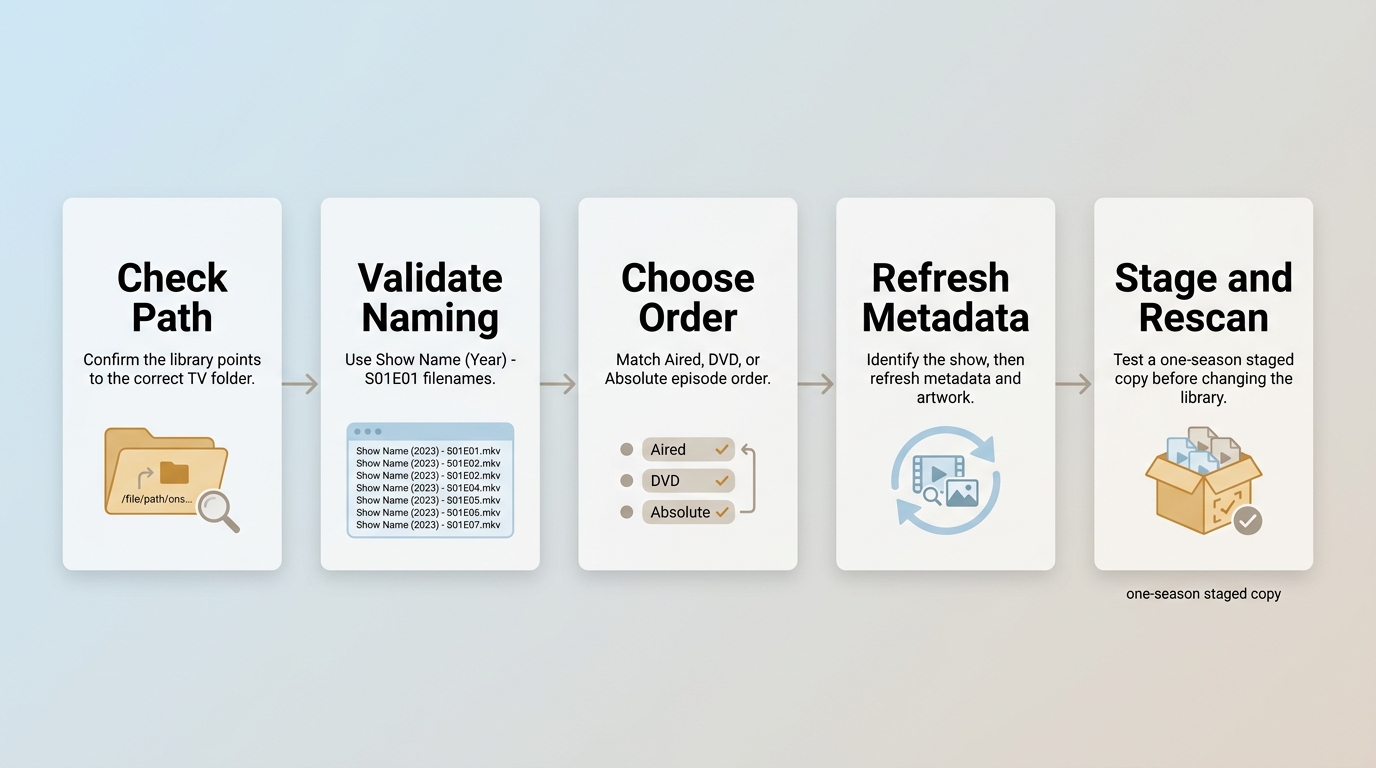
Missing TV shows and a wrong metadata match usually come from a bad library path, ambiguous naming, mismatched episode order, disabled metadata providers, or a cached identification. Diagnose those layers in order instead of renaming the entire collection at once.
- Verify the library path and type. Confirm that the server is scanning the parent TV folder rather than a season folder or an unrelated media library.
- Check the folder and filename pattern. Make sure the show title, release year, season folder, and SxxExx token agree.
- Add a stronger identifier when needed. A release year or supported provider ID can separate remakes and similarly named series.
- Confirm episode ordering. Aired, DVD, absolute, and alternate orders can map the same file number to different episodes.
- Refresh or identify the item. Clear the stale match through the server's normal identify or refresh controls, then choose the intended series and order.
- Check metadata and artwork settings. Confirm that the relevant provider, local metadata reader, and image source are enabled for that library.
- Rescan a staged copy. Test the proposed repair outside the live library before applying it broadly.
For an established collection, renaming everything first is the riskiest approach. A one-season sample reveals whether the scanner, naming rule, or metadata source is actually at fault.
Scan Failures and Missing Episodes
When Jellyfin shows are not showing up, start with filesystem visibility: permissions, supported file extensions, the selected library folder, and whether episodes sit beneath a recognizable series and season path. Then inspect the server scan log for skipped paths or naming conflicts.
A file that appears in the operating system but not in the library often points to path access or library scope. A visible season with gaps points more often to episode naming conventions, unsupported extras placement, or an ordering mismatch.
Wrong Matches and Missing Artwork
A wrong match can persist even after a filename is corrected because the server may retain the earlier identity. Use the platform's identify function, select the intended provider result, confirm the release year and order, then refresh metadata and artwork.
Blank posters do not always mean the episode failed to scan. Check whether local artwork follows the platform's accepted filenames, whether online image providers are active, and whether locked metadata prevents a refresh. The useful editorial distinction is identity first, decoration second: fix the series match before chasing artwork.
Safe Rollback Before Rescanning
A reversible test protects a working library while you diagnose scanner behavior. Use this complete repair workflow for changes that affect names, folders, sidecars, or episode order.
- Copy one representative season, including its artwork and NFO files, into a separate staging location.
- Record the current series match, episode order, custom descriptions, locked fields, and specials placement.
- Apply one naming or metadata change to the copied season, not several changes at once.
- Add the copy to a temporary library that uses the destination scanner and metadata settings.
- Compare episode grouping, titles, artwork, subtitles, audio tracks, and specials with the working library.
- If the result is wrong, discard the staged copy and restore from the untouched source; if it is correct, document the rule before scaling it.
Folder and Filename Rules That Scan Reliably
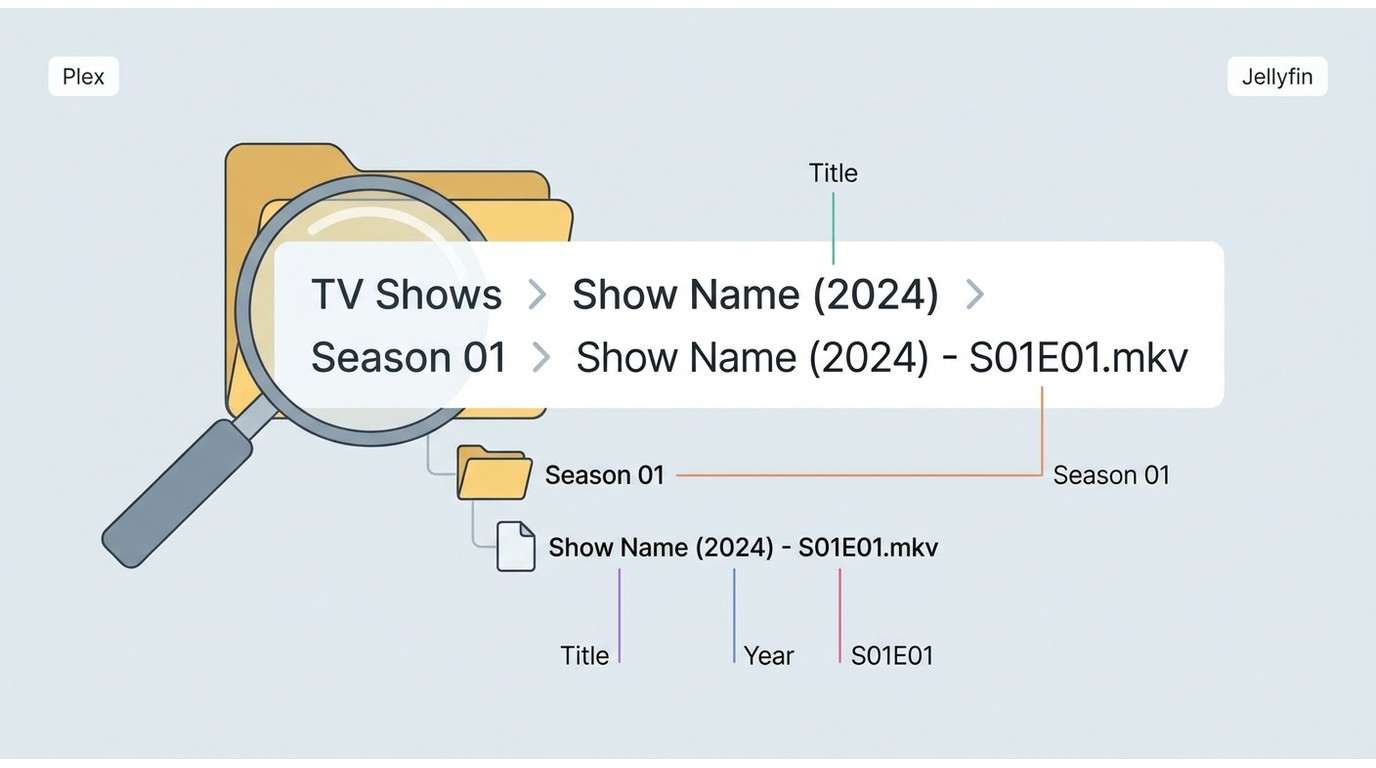
A dependable TV folder structure gives each scanner the same core clues: series title, release year, season, and episode number. Jellyfin TV show naming and Plex TV show naming share that foundation, but server settings and metadata agents still affect the final match.
Standard Show and Season Folders
Recommended pattern:
/TV Shows/Show Name (Year)/Season 01/Show Name (Year) - S01E01 - Episode Title.MKV
- Use a two-digit season and episode token such as S01E01.
- Keep the series title and release year consistent in both the show folder and episode filename.
- Use Season 00 for specials when the selected metadata order classifies them as specials.
- Avoid filesystem-reserved characters and do not rely on a bare filename such as episode_final.MKV.
- Add a supported provider ID to the series folder when the title and year remain ambiguous.
Platform-specific details can differ. The dedicated guide to organizing Plex TV shows covers the stricter Plex handoff without turning this cross-platform guide into a Plex-only page.
Specials, Multi-Episode Files, and Alternate Orders
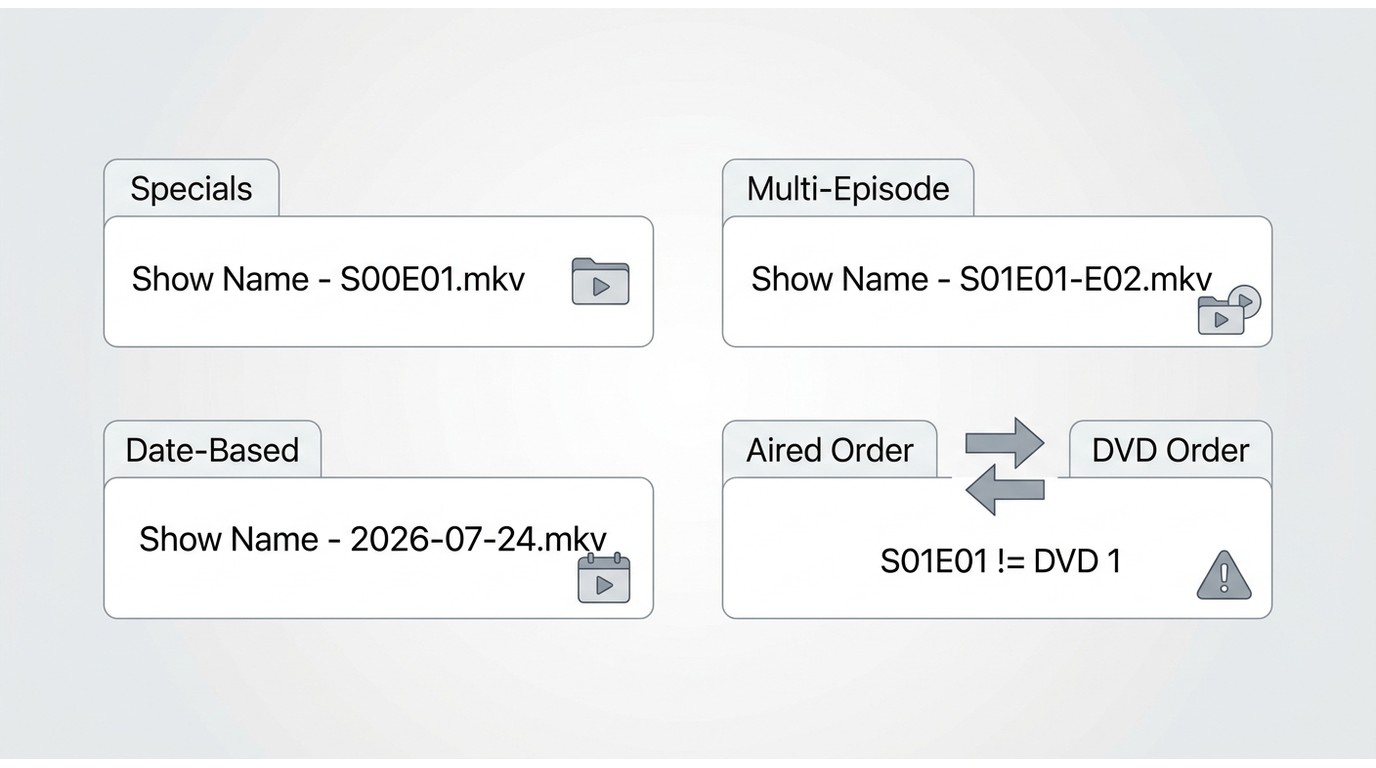
Edge cases need names that describe how the target metadata provider indexes the content, not how a download folder happened to label it.
- Special: Show Name (Year) - S00E01 - Special Title.MKV
- Two episodes in one file: Show Name (Year) - S01E01-E02 - Combined Title.MKV
- Multiple parts: Keep the same episode identity and append a consistent part marker accepted by the target server.
- Date-based show: Use the broadcast date only when the chosen provider catalogs episodes by date.
- Extras: Place trailers, interviews, and featurettes in the folder structure supported by the target server rather than mixing them with numbered episodes.
- Alternate order: Select aired, DVD, absolute, or another supported order before renaming, because S01E05 can represent different content under different orders.
No single pattern overrides the scanner's library type and ordering settings. The filename and the selected metadata order must describe the same episode.
Metadata, NFO, and Organizer Options
TV show metadata describes a series and its episodes; an NFO file format stores some of that information in a local sidecar. A TV show organizer can rename files, collect artwork, write sidecars, or convert video, but those are separate jobs.
Platform NFO Compatibility
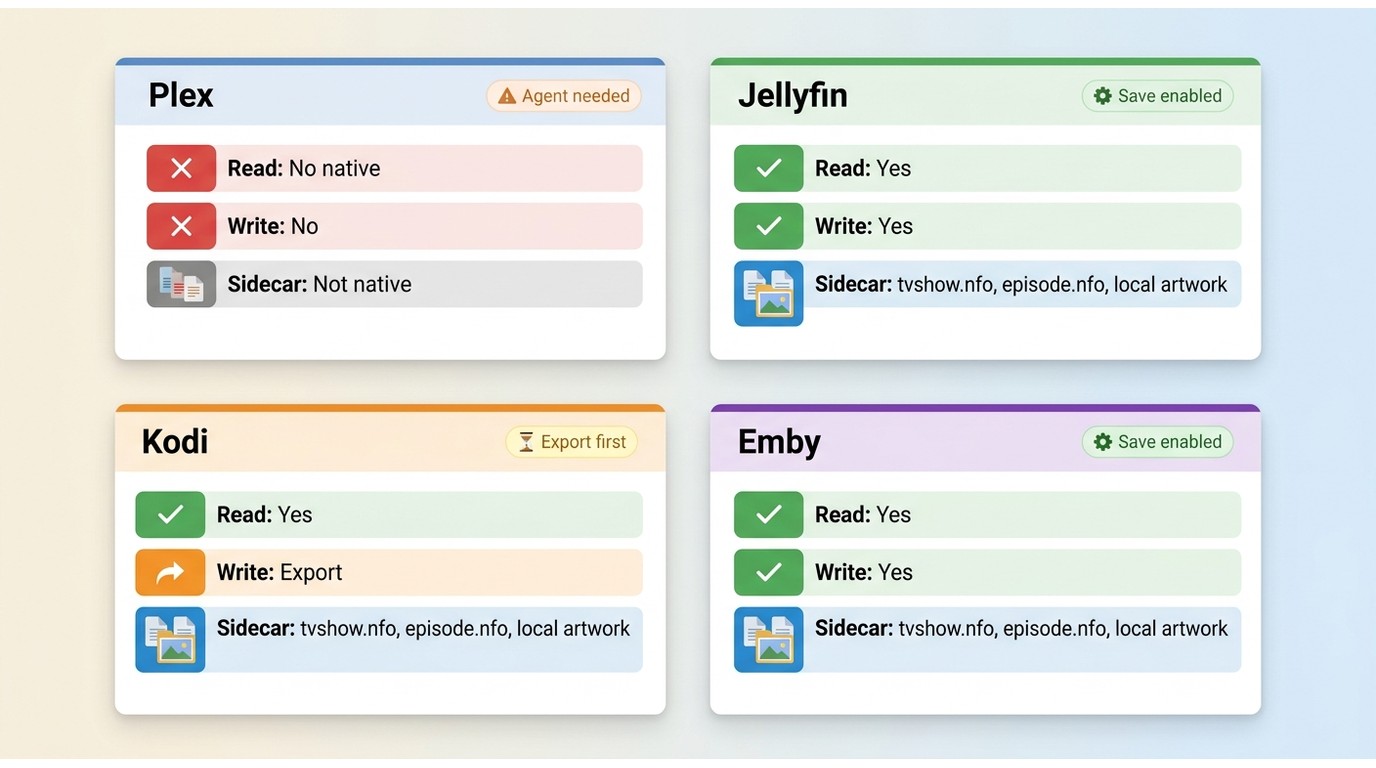
Plex, Jellyfin, Kodi, and Emby share basic naming ideas, yet their NFO behavior is not interchangeable. Use the target server's hierarchy and metadata settings when creating or migrating sidecars.
| Platform | Sidecar hierarchy | Read and write behavior | Provider identifiers | Key limitation |
| Plex | Series and season folders with supported local artwork naming | Built-in agents prioritize Plex metadata workflows rather than general NFO importing | Supported IDs in series folder names can reduce ambiguity | Local assets and agent behavior depend on library and scanner settings |
| Jellyfin | Series, season, and episode NFO files can sit beside the related media | Can read local NFO and save metadata when the NFO saver is enabled | Provider IDs can be stored in metadata or used during identification | Library type, provider order, saver settings, and locks affect results |
| Kodi | tvshow.nfo plus episode-level sidecars beside media files | Reads local NFO and can export library metadata to sidecars | Unique IDs help the selected scraper identify the title | Scraper choice and episode order must agree with the files |
| Emby | Series, season, and episode sidecars alongside the library | Reads NFO and can save local metadata when configured | Provider IDs support identification and migration | Metadata locks and saver options can preserve or block changes |
The practical upshot is that a sidecar set should be validated on the destination server. “NFO supported” does not mean that each platform reads the same fields, hierarchy, or artwork names.
MP4, MKV, Subtitles, and Audio
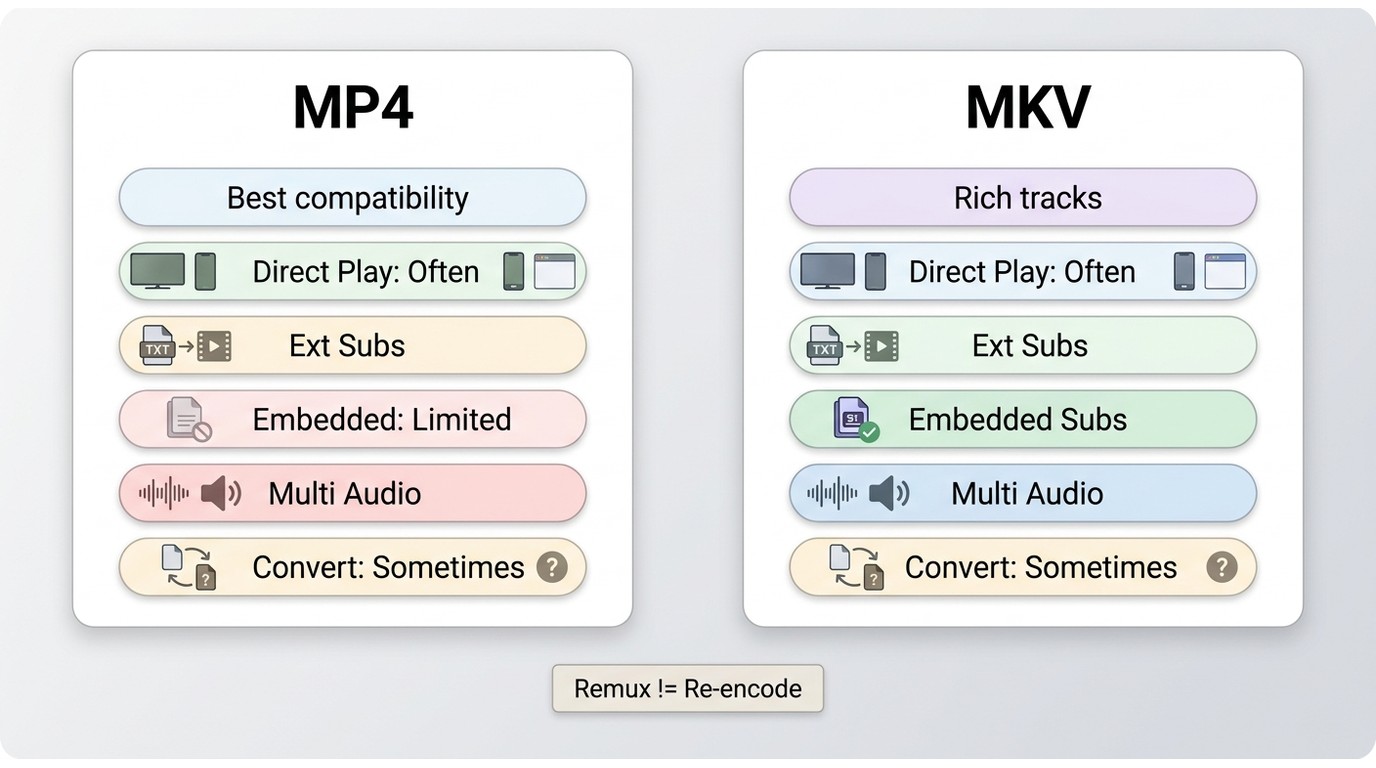
MP4 vs MKV is a playback decision, not an organizing requirement. You can rename files, repair matches, and manage metadata without converting video; convert only when a defined device, subtitle, audio, or direct-play problem remains.
| Need | MP4 | MKV | Conversion guidance |
| Broad direct playback | Often the simpler choice for TVs, phones, and browsers | Depends more on the client and codecs inside the container | Convert only when the target client cannot direct-play the current file |
| External subtitles | Works with sidecar subtitle files when the server and client support them | Works with sidecar subtitle files when supported | No conversion is needed solely to keep external subtitles |
| Embedded subtitle tracks | Supports common subtitle arrangements, with device-dependent limits | Usually more flexible for multiple embedded subtitle tracks | Choose based on the target playback devices |
| Multiple audio tracks | Can hold multiple tracks, but client support varies | Commonly used for multi-audio collections | Keep the existing container if tracks play and switch correctly |
| Quality preservation | Renaming or remuxing is different from re-encoding; avoid re-encoding when no playback problem requires it | Define the compatibility problem before changing the media | |
Manual and Automated Tools
TV series collection software should be selected by the remaining task. A renamer, metadata manager, converter, and server scanner solve different problems, so the most automated option is not automatically the best fit.
| Candidate | Primary job | Operating systems | Batch renaming | Metadata and artwork | NFO handling | Format conversion | License model | Best fit | Not ideal for |
| Manual workflow | Direct control over folders, names, and sidecars | Any desktop system | Possible with scripts or file tools | Collected and reviewed by hand | Hand-created or exported from a server | Requires a separate converter | No organizer license required | Small libraries or unusual ordering that needs close review | Large repetitive cleanups |
| FileBot | Rule-based matching and batch renaming | Windows, macOS, and Linux | Strong renaming focus | Can use online data during matching | Scriptable sidecar workflows require setup | Not its primary job | Limited evaluation use with paid licenses | Users who mainly need repeatable naming | People seeking a visual metadata and artwork manager |
| tinyMediaManager | Library metadata, artwork, naming, and sidecars | Windows, macOS, and Linux | Yes | Dedicated metadata and artwork management | Dedicated NFO workflows | Not its primary job | Limited free use with paid licenses | Libraries that need detailed metadata curation | Users whose main problem is video format compatibility |
| UniFab TV Show Converter | Batch local-file processing, metadata writing, and format normalization | Windows and Mac | Batch workflow for selected files | Writes TV show metadata during processing | Review output against the target server's sidecar requirements | Outputs MP4 or MKV | Commercial software with a lifetime license option | Libraries that need metadata work and conversion in one local workflow | Libraries that need renaming or NFO editing but no conversion |
As of July 2026, FileBot and tinyMediaManager both include paid licensing rather than being accurately described as simply free tools. The fit judgment is straightforward: use the narrowest tool that solves the unresolved job.
Where UniFab Fits Your Workflow
UniFab TV Show Converter is a TV show organizer option for Windows and Mac when local episodes need batch processing, metadata writing, or normalization to MP4 or MKV. It is most relevant after naming and scanner issues have been separated from playback compatibility.
For local files you are authorized to use, where permitted by applicable terms and law, UniFab TV Show Converter keeps processing on the computer instead of requiring a cloud upload. That local workflow limits unnecessary file transfers and keeps the source library under the user's control.
Libraries That Benefit Most
It fits users who need to organize TV shows in batches while also standardizing containers or writing metadata. The combined workflow is useful when a mixed-format incoming folder must be prepared before files enter a live media library.
The strongest reason to use it here is consolidation: local processing, MP4 or MKV output, and metadata writing can happen in one workflow instead of passing the same batch through unrelated apps.
When a Simpler Tool Is Enough
A dedicated renamer or metadata manager is simpler when the video already plays correctly and the remaining problem is naming, artwork, NFO editing, or manual matching. UniFab is not ideal for a library that needs no format work and requires detailed hand-editing of sidecars.
Organize Episodes with UniFab
Use UniFab after confirming the target naming and metadata rules. The three-step workflow imports local episodes, applies the selected output and metadata settings, then pauses for review before anything moves into the live library.
Essential Tool for Every TV Show Collector!
- Easily batch convert and organize your TV shows.
- Auto generate .nfo files with covers, descriptions, and more.
- 30-day free trial for full features—no watermark included.
TV Show Converter
Essential Tool for Every TV Show Collector!
- Easily batch convert and organize your TV shows.
- Auto generate .nfo files with covers, descriptions, and more.
- 30-day free trial for full features—no watermark included.
TV Show Converter for Mac
Step 1: Open the TV Show Converter Module
Install and launch UniFab, open the TV Show Converter module, and use the upload control to add the source episodes.
Step 2: Select Your Episode Files
Select the episodes or source folder. Set the destination, choose MP4 or MKV according to the playback decision above, and review the available metadata options before starting the batch.
Step 3: Review and Collect the Output
Open the destination and verify filenames, TV show metadata, artwork, sidecars, subtitles, audio tracks, and playback. Confirm that the output follows the target server's hierarchy before moving it into the live TV folder structure.
Processing time depends on file count, source format, output settings, hardware, and whether the video is re-encoded. Treat the completed batch as a review checkpoint, not as proof that every media server will interpret the same sidecar identically.
Keep the Library Stable Over Time
A stable library uses a small intake routine: stage new TV show files, verify the batch, preserve local metadata, and move it into the live folder only after the scanner recognizes it correctly.
Staging, Verification, and Backups
- Use an Incoming folder for new episodes rather than dropping unreviewed files into the live library.
- Apply the same series, year, season, and episode pattern to each new batch.
- Check one episode for identity, artwork, subtitles, audio selection, and direct playback before moving the season.
- Back up NFO files, posters, season art, and custom descriptions with the media.
- Record the server library type, metadata provider order, and episode ordering used by important series.
This routine is deliberately modest. Consistent intake prevents a backlog more effectively than an occasional full-library cleanup.
Migration Checklist
A media library migration needs its own preservation checklist because the destination may interpret sidecars, artwork, locks, and episode order differently.
- Back up all series, season, and episode NFO files plus local artwork.
- Export or record custom descriptions, ratings, tags, watched-state data, and locked fields that are not fully represented in sidecars.
- Document specials placement and the selected aired, DVD, absolute, or alternate order.
- Copy one representative season to the destination and scan it with the intended library type and metadata providers.
- Compare episode grouping, titles, artwork, subtitles, audio tracks, and custom fields with the source.
- Keep the source database and media paths unchanged until the copied sample passes review and a rollback path is available.
A Safer Library Workflow
The safest sequence is to stabilize naming, verify metadata behavior, test repairs on a copy, and choose software only for the job that remains. Maximum automation is less valuable than a workflow you can understand and reverse.
- Standardize the show, year, season, and episode identity.
- Confirm how the target server reads artwork, provider IDs, and the NFO file format.
- Use the rollback procedure above for repairs and the migration checklist for server moves.
- Select a renamer, metadata manager, or converter according to the unresolved task.
Frequently Asked Questions
These quick answers cover the TV show organizer decisions most likely to affect an existing library.
Can I reorganize a working library without losing custom metadata?
Yes, but do not edit the live collection first. Follow the migration checklist above so local sidecars, artwork, custom fields, episode order, and the original database remain recoverable while a copied season is checked.
Do I need to convert episodes before organizing them?
No. Naming, folders, artwork, and metadata can be fixed without changing the video. Convert only when the current container or codecs create a specific playback, subtitle, or audio compatibility problem.
Why can a correctly named episode still match the wrong show?
The title may be ambiguous, the release year or provider ID may be absent, the selected episode order may differ, or the server may retain an older match. Correct those identity signals, then refresh the item.
How do I keep new episodes from making the library messy again?
Use an Incoming folder, apply one naming pattern, review each batch, preserve sidecars and artwork, and move files into the live library only after a successful scan.