Choosing Movavi is harder than learning its timeline: the 7-day trial has export restrictions, the license choices are easy to confuse with Video Suite, and performance claims often lack a disclosed test. This Movavi Video Editor review separates the practical facts from the noise, then weighs pricing, safety, workflow, and alternatives.
The quick takeaway: Movavi is a sensible beginner video editor for short, straightforward projects, but it is less convincing for deep color work, multicam editing, complicated codec pipelines, or heavy long-form 4K timelines.
Movavi at a Glance
Movavi Video Editor is desktop video editing software built around a conventional media bin, preview window, multitrack timeline, effects panel, and export dialog.
Product Scope and Platforms
The editor runs on Windows and macOS. Movavi also sells separate or bundled tools, including Screen Recorder and Video Converter, so a feature shown on a Suite page should not automatically be treated as part of the standalone editor.
Quick Decision Summary
| Decision point | Editorial judgment |
| Suitable for | Beginners, casual creators, classroom projects, and short social videos that need quick cuts, captions, overlays, and simple exports. |
| Less suitable for | Editors who need multicam control, deep grading, extensive collaboration, or predictable performance on demanding long-form projects. |
| Main attraction | A short learning curve and a task-focused interface. |
| Main caution | Trial restrictions, offer-specific renewal terms, Effects upsells, and version scope require attention before checkout. |
My editorial priority here is workflow fit, not feature count. Movavi makes common tasks visible, but a simple interface does not erase licensing or performance limits.
Movavi Features That Matter
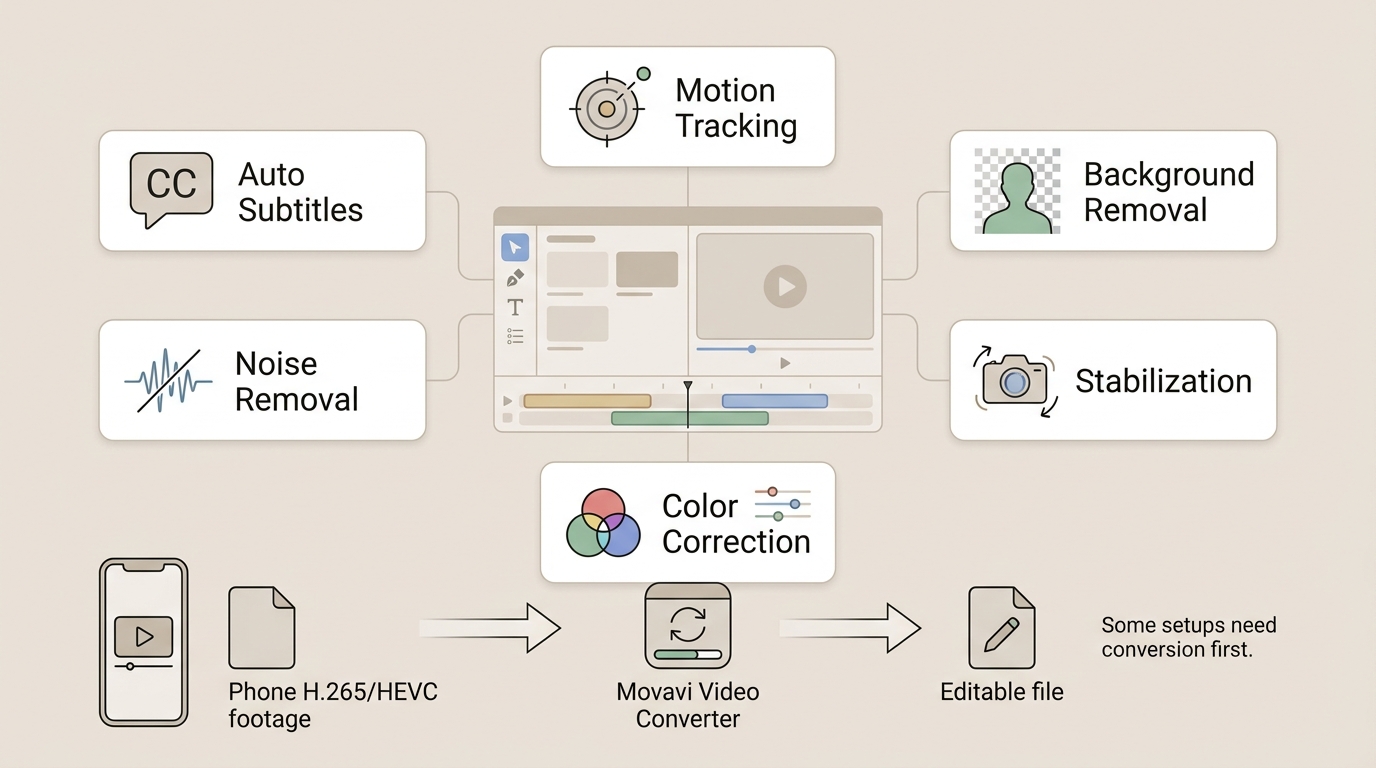
The useful features are the ones that shorten routine editing, not the longest list on a product page. Movavi covers core editing, captions, tracking, effects, cleanup, and export without requiring a professional post-production vocabulary.
AI Auto Subtitles and Motion Tracking
Auto subtitles can turn speech into editable captions, while motion tracking attaches text, graphics, or overlays to a moving subject. Both tools fit short explainers and social clips, although accuracy still depends on clean speech and clear subject separation.
Creative Effects and Overlay Blending
Titles, transitions, filters, stickers, and overlays are easy to place on the timeline. Blending controls can combine textures or light effects with footage, but extra effect packs may belong to a separate Effects offer rather than the base editor.
AI Background and Noise Removal
Background removal can isolate a subject without a green screen, and noise cleanup can reduce steady distractions in dialogue. These tools are convenient for quick content, but difficult edges and mixed audio should still be reviewed before export.
Color Correction and Stabilization
Movavi provides exposure, color, chroma key, stabilization, slow-motion, and picture-in-picture controls. They are accessible enough for basic correction and stylized edits, but they do not replace the node-based grading depth available in higher-end editors.
Screen Recording and Media Tools
Screen capture belongs to the broader Movavi ecosystem. The separate Movavi Screen Recorder review explains that workflow, while Video Suite can bundle recording and conversion tools with the editor.
Conversion and Compression
Movavi H.265 support needs precise wording. The editor does not offer a fully native HEVC workflow in every configuration; footage may depend on an installed codec extension, while Video Suite users can convert material with Movavi Video Converter before editing.
That distinction matters for modern phone and camera footage. Converting first adds a preparation step and storage overhead, so codec-heavy users should test their actual source files during the trial period.
Movavi Trial Limits and Watermarks
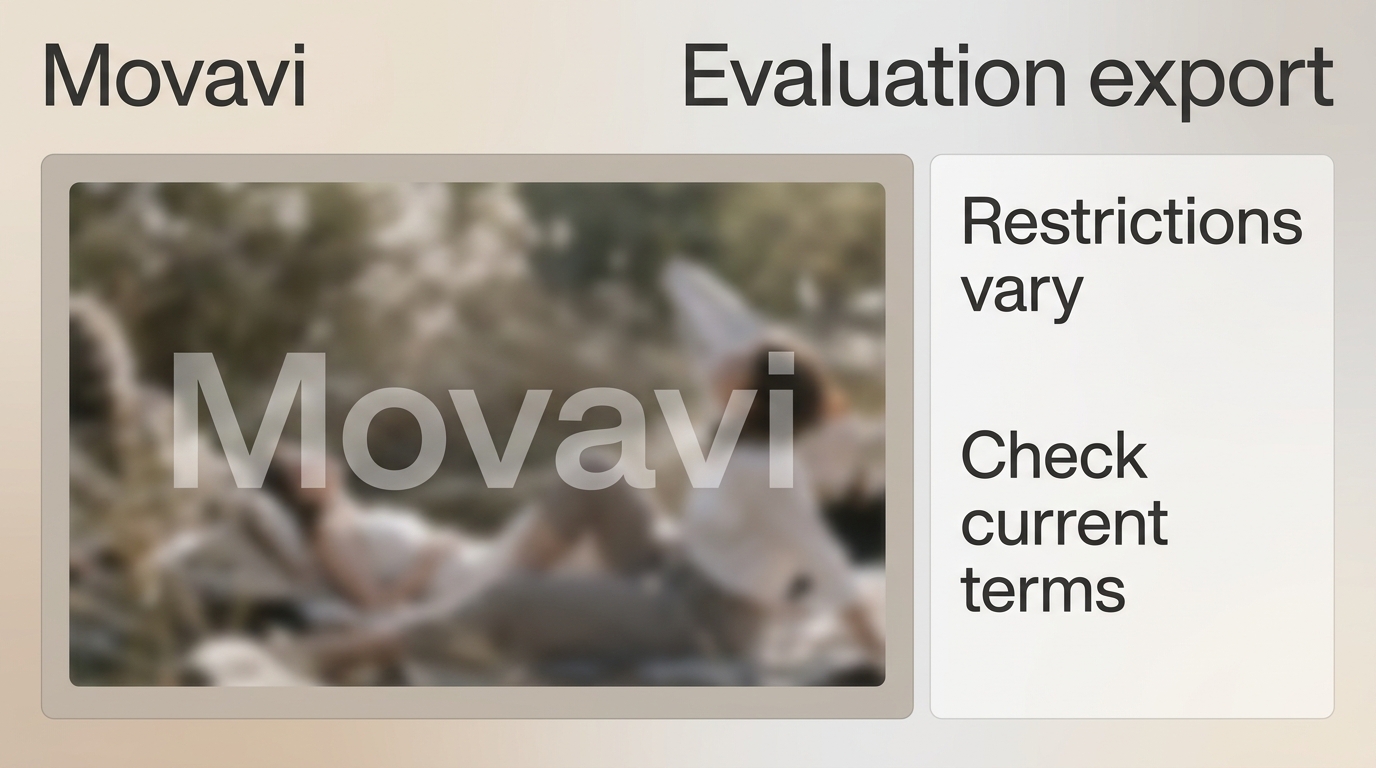
The 7-day trial is useful for checking the interface and hardware fit, but a Movavi watermark and export restrictions make it unsuitable for delivering finished work.
- Trial exports include a Movavi watermark.
- Export duration and audio use may be restricted under the offer presented at download or checkout.
- Some features or assets may require separate access.
- Renewal terms are offer-specific; a monthly renewal shown for a Suite or Effects promotion should not be described as a rule for every editor trial.
The practical use of trial access is evaluation: import your own footage, open the tools you expect to use, export a representative project, and inspect the checkout terms tied to that exact offer.
Movavi Pricing and License Terms
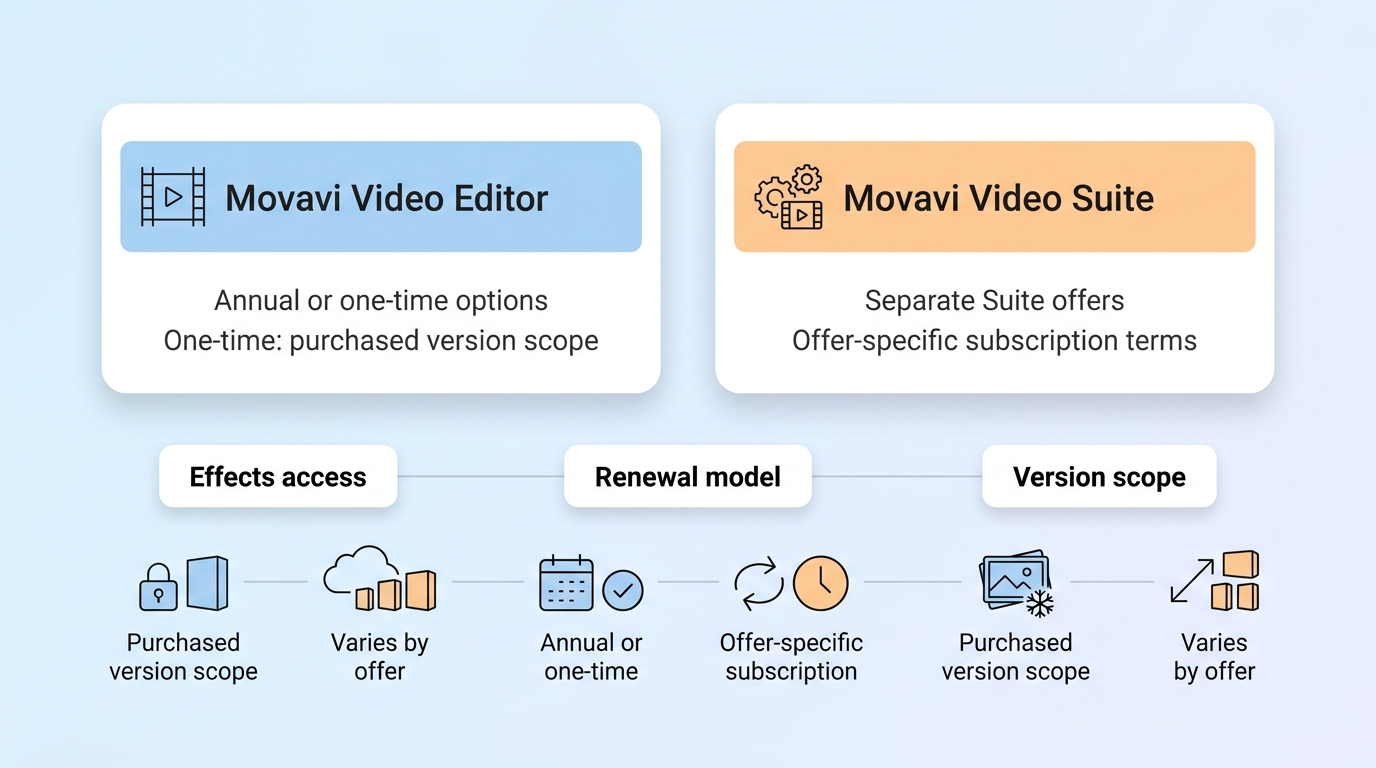
Movavi pricing is clearer when Video Editor and Video Suite are treated as separate products. The Movavi Video Editor cost depends on billing term and included access, not one generic Movavi price.
| Product | Billing term | Included scope | Effects access | Renewal model | One-time purchase |
| Movavi Video Editor | Annual or one-time options may be presented | Core timeline editor | Depends on the selected offer | Annual plans renew under checkout terms | Available for the purchased version scope |
| Movavi Video Suite | Separate Suite offers | Editor plus additional media tools such as conversion and recording | Depends on the selected bundle | Offer-specific subscription terms | Do not assume the editor's license terms apply to the Suite |
Offer structure summarized as of July 2026. Exact dollar prices are not combined here because the standalone editor and Suite use separate US checkout pages.
Annual and One-Time Options
An annual plan favors access to the currently offered version and plan benefits, while a one-time option reduces recurring billing but should be read as a license for its stated version scope. A Movavi lifetime license should not be interpreted as automatic access to every future major release.
Updates, Effects, and Renewal
Before buying, separate four questions: which app is included, whether Effects access continues, whether the plan renews, and whether a future major upgrade requires another purchase. Community complaints about upgrade prompts are useful caution signals, but they are not proof that every customer receives the same offer.
I would choose the billing model only after mapping it to editing frequency. Occasional users may prefer a one-time editor license if its version scope is sufficient; frequent users who want ongoing assets may value an annual offer more.
Movavi Interface and Workflow
Movavi's interface lowers the initial learning burden by keeping import, timeline tools, effects, and export in predictable locations. That makes it approachable, though not necessarily faster for every complex project.
Dashboard
The dashboard leads with project creation and media import rather than a dense configuration screen. New editors can start quickly, while returning users can reopen saved projects.
Workspace and Export
Import media, arrange clips on the timeline, add audio or effects, preview the sequence, and open Export to select the file settings and destination. Saving the project file separately protects the editable timeline.
- Import a representative source clip.
- Trim and arrange clips on the timeline.
- Add only the effects needed for the intended deliverable.
- Preview captions, audio, overlays, and transitions.
- Export a sample using the same format planned for the final project.
The interface earns its beginner-friendly reputation because the next action is usually visible. The trade-off is that specialists may reach the limits of trimming, grading, and project management sooner.
Movavi Test Setup and Results
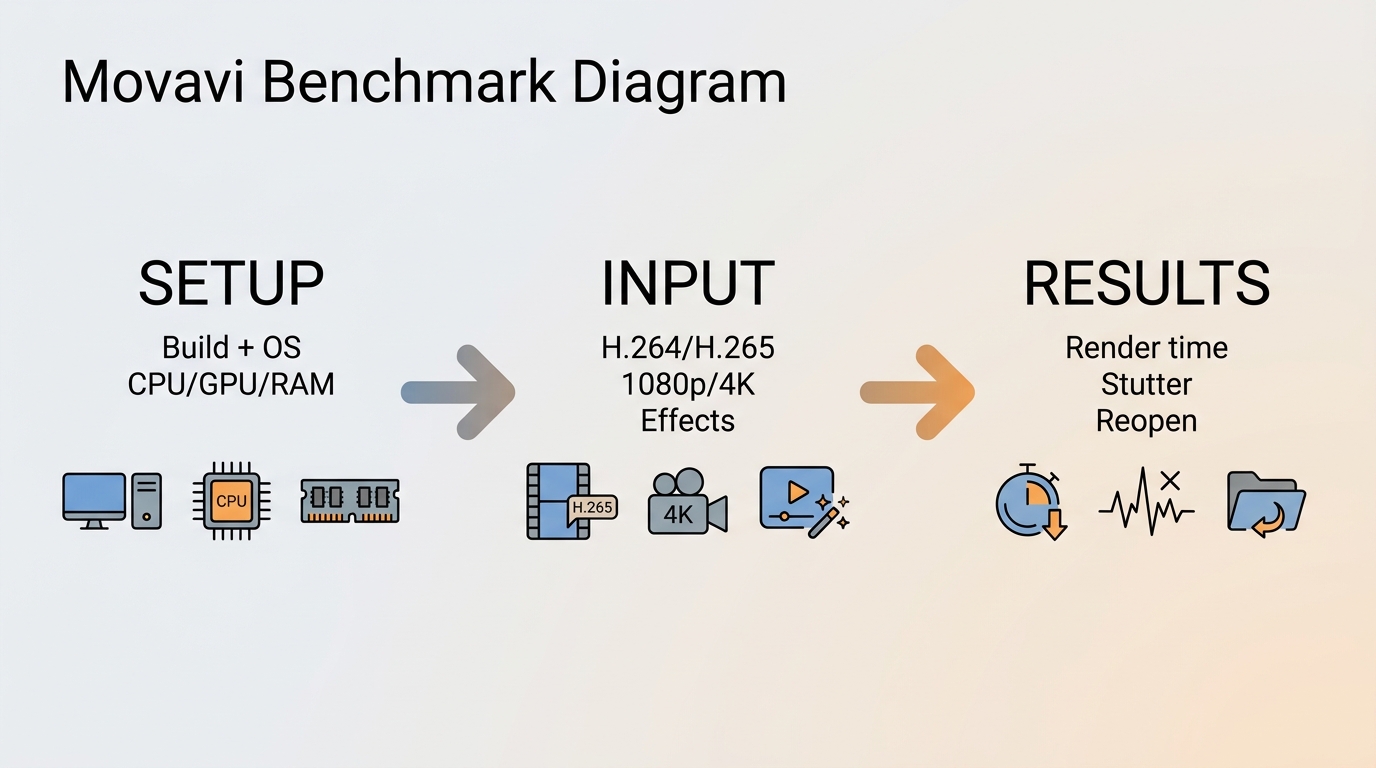
No timed editorial benchmark is presented, so the performance conclusions remain qualified. Movavi 4K editing depends on the exact build, operating system, hardware, source codec, effects chain, project duration, and export preset.
Test Configuration
A reproducible Movavi test should disclose the editor build, OS, CPU, GPU, RAM, source resolution and codec, timeline duration, effects used, export preset, render time, repeat count, and any crash or stutter. Without that record, broad speed claims are not dependable.
4K and Export Results
Movavi supports 4K editing, but that statement describes capability rather than guaranteed smoothness. Short clips with modest effects create a lighter workload than long timelines with stacked corrections, tracking, stabilization, and multiple high-resolution sources.
For a purchase decision, the repeatable check is to export a short 1080p project and a representative 4K project on the machine that will be used. Watch timeline responsiveness, preview quality, export completion, and whether reopening the project preserves every edit.
Stability and Codec Notes
Stability reports are mixed and should be treated as configuration-specific. H.264 material is generally the simpler test case; H.265 footage may require a codec extension or conversion workflow, which changes both preparation time and storage needs.
Four Common Movavi Editing Tasks
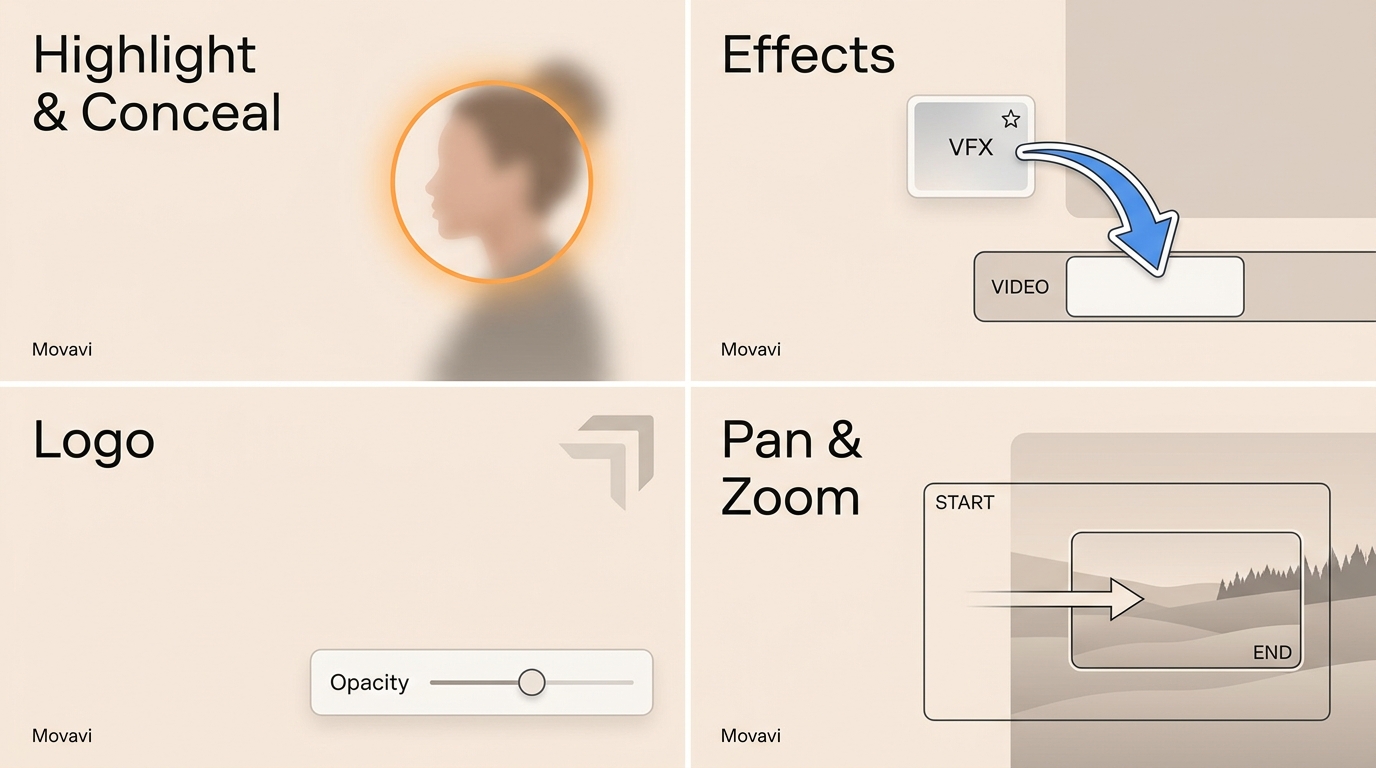
These four short cases show why Movavi works as video editing software for beginners: each task is discoverable without turning the section into a full tutorial.
Highlight and Conceal
Place the clip on the timeline, open Highlight and Conceal, choose a shape, then resize and position it over the subject. The task fits quick callouts or privacy masking, but moving subjects may require tracking and careful review.
Apply Effects
Open Effects, preview an option, drag it onto the timeline, and adjust its intensity or blending. The low friction suits short-form work; restraint matters because stacked effects can slow previews and distract from the footage.
Add a Logo or Watermark
Use the Logo tool to add an image, then set its position, scale, opacity, and duration. This user-added branding is separate from the Movavi watermark placed on trial exports.
Pan and Zoom
Select a clip, open Pan and Zoom, choose a preset or set the movement points, then preview the framing. It is useful for still images and screen details, but aggressive movement can make low-resolution sources look softer.
Together, these cases confirm the interface's main strength: common actions are easy to locate. They also lead directly to the purchase questions that matter next, including update safety, codec handling, and whether the project complexity exceeds Movavi's intended fit.
Safety, Billing, and User Feedback
Movavi safety has two separate dimensions: the legitimacy of the installer and the clarity of commercial terms. Official software can be legitimate while a buyer still needs to inspect renewal, update, and support details.
Official Downloads and Privacy
Download the installer from Movavi's official domain or an official app store. Avoid modified installers and unofficial activation packages, which create malware and license risks unrelated to the legitimate product.
- Confirm the domain and installer publisher.
- Read privacy and telemetry controls during setup.
- Keep the original installer and license details.
- Save project files before changing builds.
Renewal, Cancellation, and Support
At checkout, record the product name, billing term, renewal amount, renewal date, included Effects access, and cancellation route. A renewal disclosure tied to one Suite or Effects promotion should not be generalized to every Movavi purchase.
Reported support and post-update experiences vary. Some users describe smooth cross-platform use, while others report billing confusion, upgrade prompts, or launch trouble after updates. These are anecdotal signals, not universal outcomes.
Review Signals Without Rating Hype
Available Trustpilot figures conflict and can change over time, so this review does not freeze either number as a current rating. The linked Movavi review profile on Trustpilot is more useful for reading recurring themes than for treating one changing score as a verdict.
The material complaints are the ones that can affect a purchase: unclear offer boundaries, unexpected renewal expectations, version upgrades, update recovery, and support access. Praise for ease of use matters, but it should not cancel those checks.
Performance, Compatibility, Pros and Cons
Movavi's buying case rests on easy operation, while its limits appear in demanding projects and specialized workflows. Performance should be judged by project type and hardware, not by a universal fast-or-slow label.
4K and Hardware Fit
Movavi 4K editing is a realistic option for suitable systems and moderate timelines. Proxy-friendly habits, shorter sequences, and restrained effects reduce pressure; long projects with layered corrections and tracking demand more CPU, GPU, memory, and storage bandwidth.
Apple Silicon and Platform Support
Current Movavi releases support Windows and macOS, and Movavi states that the editor installs natively on Apple Silicon. Movavi Apple Silicon performance should still be evaluated with the exact Mac, macOS release, editor build, footage, and export settings.
H.265 and Export Workarounds
Movavi H.265 support is not a simple yes-or-no feature. If the editor cannot handle a source directly, an installed codec extension may enable import, or the footage can be converted to an editing-friendly format before it reaches the timeline.
Pros
- Clear timeline and task-oriented controls for beginners.
- Useful captions, tracking, cleanup, stabilization, overlays, and export tools.
- Windows and macOS support, including current Apple Silicon compatibility.
- Fast setup for short social, education, presentation, and casual projects.
Cons
- Trial exports have restrictions and a watermark.
- One-time license scope, major-version upgrades, Effects access, and renewal terms require careful reading.
- H.265 footage may add a codec or conversion step.
- Multicam, deep grading, collaboration, and demanding long-form workflows may outgrow the editor.
- Heavy AI or enhancement processing depends on hardware and can take time.
Movavi Alternatives for Editing and Enhancement
Movavi alternatives divide into two decisions: choose another timeline editor when Movavi lacks editing depth, or add a post-edit enhancement tool when the cut is finished but the image or audio still needs work.
Editor Alternatives at a Glance
| Editor | Learning curve | Free offering | License model | 4K and codec workflow | Advanced editing depth | Suitable user | Poor fit for |
| Movavi Video Editor | Low | 7-day restricted trial access | Annual and one-time offers | 4K capable; H.265 may need an extension or conversion | Moderate | Beginners and fast short-form projects | Deep grading, multicam, and demanding long-form work |
| DaVinci Resolve | High | Feature-rich free edition | Free edition plus Studio license | Strong 4K workflow; codec support varies by edition and system | High | Editors who want grading, audio, effects, and finishing depth | Users who want the shortest learning curve |
| CapCut Desktop | Low to moderate | Free tier with optional Pro features | Freemium subscription model | Convenient social-video workflow; feature access can vary | Moderate | Template-driven social creators | Traditional long-form and precision finishing workflows |
| Adobe Premiere | Moderate to high | Limited trial access | Subscription | Broad professional codec and 4K workflows | High | Professional editors and collaborative Adobe workflows | Occasional users avoiding recurring software costs |
For Movavi vs CapCut, choose based on desktop timeline habits versus template-led social creation. For Movavi vs DaVinci Resolve, the trade-off is speed of learning versus editing and finishing depth. No editor is the universal winner.
Where UniFab Fits After Editing
UniFab is a complement, not a Movavi editor alternative. It fits after the timeline edit when finished footage needs local video or audio enhancement, while Movavi remains responsible for cuts, titles, pacing, and sequence structure.
It is suitable for enhancement and format workflows, but not for replacing a full multitrack timeline editor. Its AI processing also depends on available hardware and may take meaningful time on large or high-resolution files.
Enhancing Finished Edits With UniFab
A practical post-edit case is footage that is already cut correctly but still looks flat on an HDR display or needs a wider speaker layout. UniFab Video Enhancer can process finished files locally, including SDR-to-HDR10 conversion and audio upmixing to 5.1 or 7.1 where the chosen module supports it.
30-day Free Trial with full feature access!
- Step 1Launch UniFab, Select Mode, and Import Your Video
Open UniFab, choose the desired module, and upload your video to start enhancing it.
- Step 2Adjust Output Settings
Customize output settings such as resolution format, quality, frame rate, audio, codecs, and subtitles according to your preferences.
- Step 3Start Video Enhancement
Press the 'Start' button to begin enhancing your video.
The restrained approach is better than stacking every available enhancement. One well-defined correction keeps the workflow understandable and makes the output easier to evaluate.
Who Should Buy or Skip Movavi
Buy Movavi for an approachable editing path; skip it when project complexity matters more than a short learning curve. That is the central verdict of this Movavi Video Editor review.
Buy If
- You are learning timeline editing and want common tools to be easy to find.
- You create short YouTube, social, classroom, presentation, or personal projects.
- You value captions, effects, tracking, basic cleanup, and straightforward exports.
- Your own trial project confirms acceptable codec handling and performance.
Skip If
- You need multicam editing, deep color grading, extensive plugin or collaboration workflows.
- You regularly edit long, effects-heavy 4K projects and need published benchmark certainty.
- Your camera workflow relies on frictionless native H.265 handling.
- You want a feature-rich free edition or prefer to avoid offer-specific upgrade decisions.
Our Verdict
Movavi is worth considering for beginners and fast social-video work because the interface removes much of the early friction. Editors who need advanced multicam, deep grading, broad collaboration, or predictable heavy 4K performance should compare DaVinci Resolve, CapCut Desktop, and Adobe Premiere before committing.
My final judgment is conditional rather than enthusiastic: Movavi succeeds when speed of learning is the priority, but the trial, license scope, codec path, and real project load must match the buyer's workflow.
Movavi Video Editor FAQ
These answers cover four purchase questions that are easier to use as quick references than as repeated full sections.
Is Movavi easier to learn than Filmora?
Movavi generally presents a simpler, more traditional timeline path, while Filmora leans heavily on templates and creative assets. Movavi may feel easier to users who want visible core tools; Filmora may suit creators who prefer template-led production. Neither fit is universal.
Which Movavi plan makes sense for occasional editing?
Start with frequency, included apps, Effects needs, and update expectations. A one-time editor option can fit occasional use when its version scope is enough; an annual offer makes more sense when continuing access or bundled services matter.
Is Movavi a good choice for YouTube and short videos?
Yes, for quick cuts, captions, overlays, simple audio cleanup, and standard exports. It is less suitable when a channel requires team collaboration, complex finishing, multicam production, or long projects with demanding effects.
What should I do before installing a Movavi update?
Save and duplicate active projects, record the installed build and license details, finish urgent exports, and keep the current installer or recovery path. Then update when there is time to reopen a representative project and confirm media, effects, and export behavior.