Audials 2026 looks attractive when you want one Windows application for streaming recording, Audials music capture, radio, and media organization. The tradeoff is active setup: this Audials One 2026 review finds that flexibility comes with more monitoring, source-dependent queues, and quality risks than a hands-off recorder.
The practical question is not whether Audials software has many features. It is whether its recording-centered workflow fits your job. Below, the editions, Audials Vision naming, licensing, performance concerns, and alternatives are separated so you can choose by task rather than by feature count.
Audials One 2026 Editions and Vision Naming
Audials One 2026 is organized around Standard and Premium. Current Audials Vision pages describe Premium's AI enhancement capabilities, so “Audials Vision 2026” is more useful as search language for those features than as a separately verified current edition.
Standard vs. Premium
Standard centers on recording and organizing movies, series, music, radio, podcasts, and other playable media. Audials One Premium adds AI-based video and audio enhancement to that core workflow.
- Standard fits: Windows users who mainly want capture, library management, conversion, and playback tools in one interface.
- Premium fits: Users who also want to improve existing local media after capture.
- Either edition requires: A willingness to manage sources, recording modes, queues, and output checks rather than expecting a fully unattended DVR.
My editorial read is simple: pay for Premium because enhancement is part of your regular workflow, not because the longer feature list looks safer.
Where Audials Vision Fits
Audials Vision is the name many readers still use for AI upscaling, frame interpolation, sharpening, and audio enhancement associated with Premium. The current naming makes “Vision” a capability explanation inside the Audials One family, not a clean standalone buying decision.
What Changed in Audials One 2026
Audials One 2026 refines the split between broad recording and media management in Standard and AI enhancement in Premium. That distinction matters more than unverified lists of new model names or engine counts.
- Video recording covers streaming playback, livestreams, and TV sources, with output and speed depending on the selected source and mode.
- Music tools cover songs, albums, playlists, radio, podcasts, metadata, and library organization.
- Premium adds local or optional cloud-assisted enhancement for video and audio.
- Planner and collection tools support queued jobs, series organization, editing, conversion, and storage management.
The useful change is clearer task separation. People who need recording and organization can avoid treating AI enhancement as mandatory, while enhancement-focused buyers can judge whether Premium's added workload is worth it.
Audials One Features and Workflow
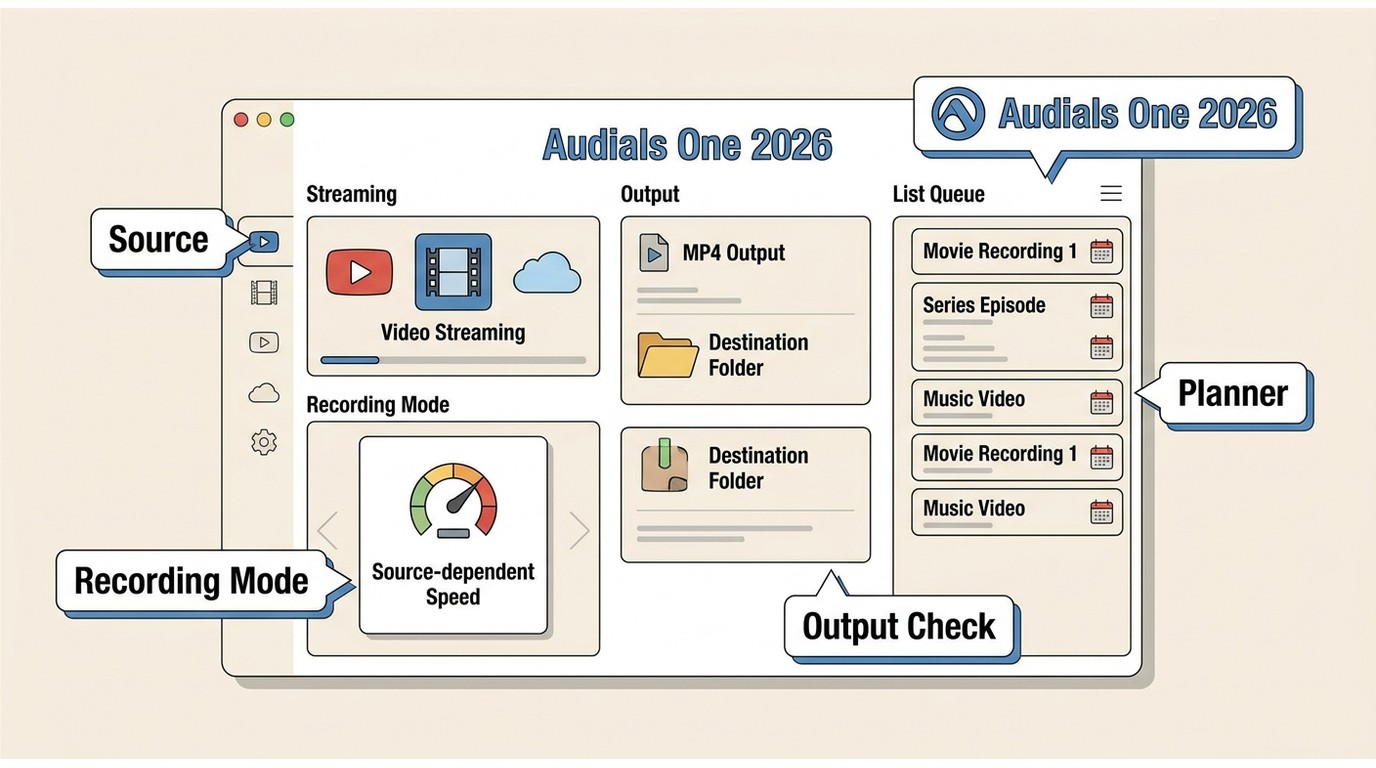
Audials One combines playback recording, Audials music capture, radio and podcast tools, conversion, editing, and library management. Its strength is breadth; its weakness is that different sources can require different setup and supervision.
A typical workflow is to choose the media source, select a supported recording mode, set the output location and format, add items to the planner or queue, then review the resulting file for sync, buffering artifacts, subtitles, and naming. For music, the emphasis shifts to track separation, tags, covers, playlists, and collection cleanup.
Users who enjoy tuning a media library may value the unified interface. People who want a single-click, season-scale queue with little intervention may find the suite excessive. That flexibility-versus-management tradeoff is the thread that should guide the rest of this Audials One review.
Audials One Pricing and License Options
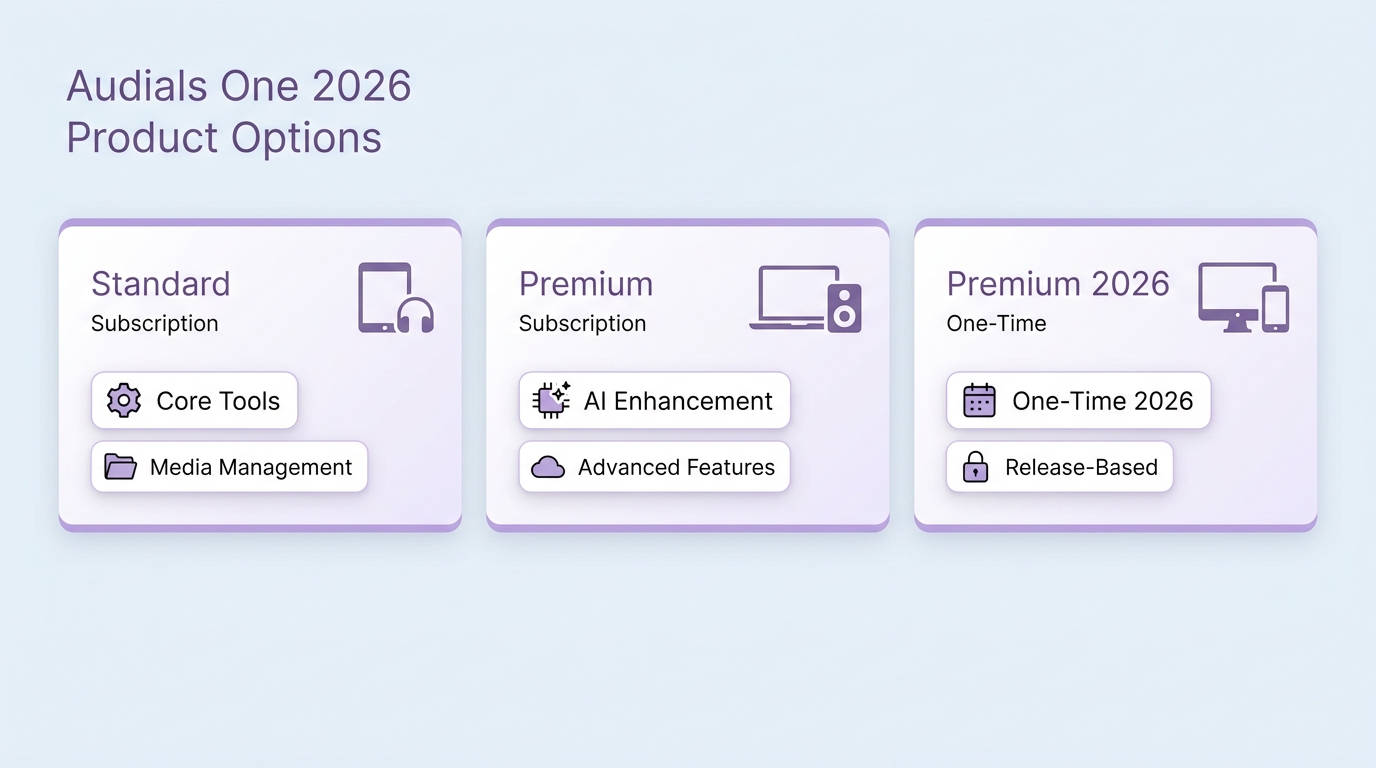
Audials One Standard and Premium are offered with subscription choices, while Premium 2026 also has a one-time purchase option. The old standalone Audials Vision price should not be used as the current reference.
| Choice | What it covers | Practical fit |
| Standard subscription | Core recording, music, radio, podcast, and media-management features | Use it when enhancement is not central to your work |
| Premium subscription | Standard capabilities plus AI enhancement | Use it when you want ongoing access to the broader toolset |
| Premium 2026 one-time purchase | A license for the purchased release with its stated support window | Use it when you prefer release-based ownership over recurring billing |
As of July 2026, the official US store presents monthly, annual, and one-time choices rather than a universal standalone Vision price. I would compare the license window and the exact features you will use, not just the billing label.
Recording and Enhancing Video With Audials
Audials recording captures media during playback; it is not the same workflow as retrieving the original streaming file. Use recording or local-copy features only for content you are authorized to access, where permitted by platform terms and applicable law.
Recording vs. Direct Downloading
Audials no longer uses YouTube-dl-based direct YouTube downloading, while YouTube playback recording remains available. A direct downloader obtains a delivered media file; a recorder plays the content and captures the visible and audible output.
This difference matters because a recording can preserve buffering, black screens, dropped frames, or audio drift that occurs during playback. My preference is to treat recording quality as a process to monitor, not as a file-transfer guarantee.
AI Enhancement Workflow
Audials Vision capabilities in Premium work on captured or imported media after the source stage. Keep the enhancement pass separate from recording so you can identify whether a defect came from playback capture or later processing.
- Record or import a source file and play it once before enhancement.
- Choose the enhancement task that matches the defect, such as upscaling, sharpening, smoother motion, or audio improvement.
- Preview a representative scene with faces, motion, texture, and dark areas.
- Set the output location and processing option, then run a short sample before a long queue.
- Compare the result with the source for detail, artifacts, color, motion, and audio sync.
Audials Performance and Common Failure Modes
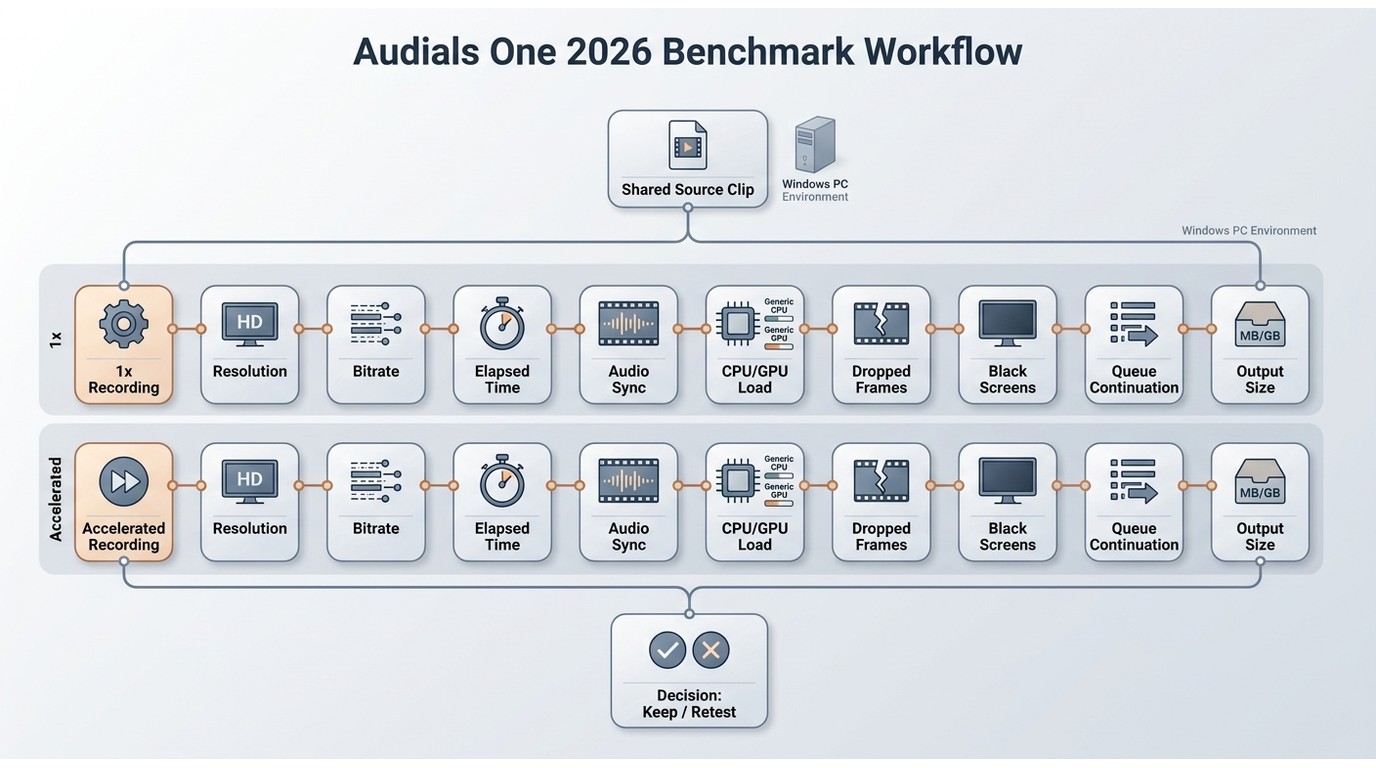
Audials reviews are most useful when they separate official capabilities from source-dependent failure reports. No controlled benchmark was run for this article, so the sound approach is a repeatable test template rather than invented speed or quality claims.
Use the same source clip for each mode and record the input resolution, output resolution, bitrate, elapsed time, CPU and GPU load, visible artifacts, audio sync, queue behavior, and any black-screen or playback failure. Repeat the test at normal speed and any accelerated mode you expect to use.
The Audials review page on Trustpilot can provide a broad sentiment signal, but fluctuating ratings are less useful than reports that identify a source, mode, and reproducible failure.
Speed, Sync, and Queueing
Audials forum and community discussions commonly focus on accelerated-recording choppiness, audio drift, queue errors, and repetitive URL entry for sources with limited batch support. These are reported pain points, not results that affect every source or PC.
- Check whether the source supports a true multi-item planner or requires individual URLs.
- Watch the first minutes of an accelerated capture for uneven motion and sync drift.
- Confirm that the queue advances after an error instead of stalling the remaining jobs.
- Use stable 1x recording when consistency matters more than finishing quickly.
Stable 1x capture may look inefficient, but it is often the more rational choice when the cost of re-recording a long queue exceeds the time saved by acceleration.
Enhancement Quality and Hardware Load
Audials Vision 2026 enhancement quality depends on the source and the processing hardware. Cleaner footage has more recoverable detail, while heavily compressed material can gain Edge artifacts, artificial texture, or unstable motion.
Test a short sample containing faces, fine lines, panning motion, subtitles, and low-light detail. Note the output size, processing load, and whether the improvement remains visible at normal viewing distance. For longer queues, verify thermal and storage headroom before committing the full batch.
The practical takeaway is that enhancement should solve a visible defect. Running every option because it exists adds time and can make the result less natural.
Audials Pros, Cons, and Best Fit
Audials One is a good fit for Windows users who value flexible recording and media management and accept active setup. It is less suitable for people who want Mac support, uniformly hands-off queues, or a dedicated enhancement-only workflow.
| Strengths | Limitations |
| One interface for video, Audials music, radio, podcasts, conversion, and collection management | Broad scope creates a learning and monitoring burden |
| Multiple recording modes and planner tools can fit varied sources | Batch support and URL entry can vary by source |
| Premium combines recording with post-capture video and audio enhancement | Users report queue errors, choppy accelerated capture, audio drift, and playback defects preserved in recordings |
Best for users who prefer control and do not mind checking each source's behavior. Not ideal for users who define success as starting a large queue and leaving it unattended.
Audials Safety, Legality, and YouTube Limits
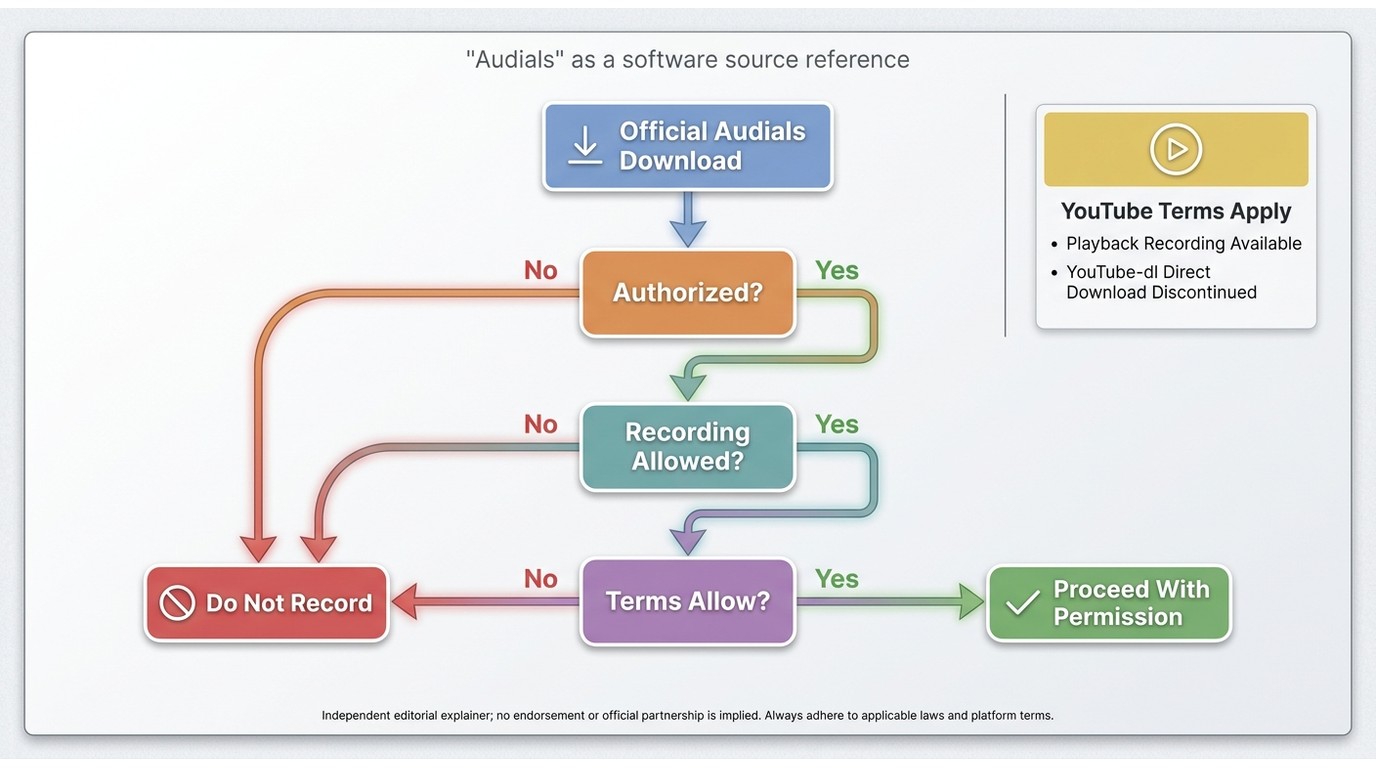
Audials is established commercial software, but safe use still depends on where you obtain it, what content you record, and whether your workflow follows the relevant service terms and law.
- Safe installation: Download Audials from its official distribution channels rather than unofficial bundles.
- Content authorization: Record content you are entitled to access and use the resulting copy within the permissions that apply to you.
- Platform rules: A service may restrict recording even when the software itself is legitimate.
- YouTube limit: Direct YouTube-dl-based downloading was discontinued, while playback recording remains available.
If your search is “Audials legal,” the answer cannot be a blanket yes for every recording. Separate the legitimacy of the application from permission to record a particular work and the rules governing that platform.
Which Audials Alternative Fits Your Job?
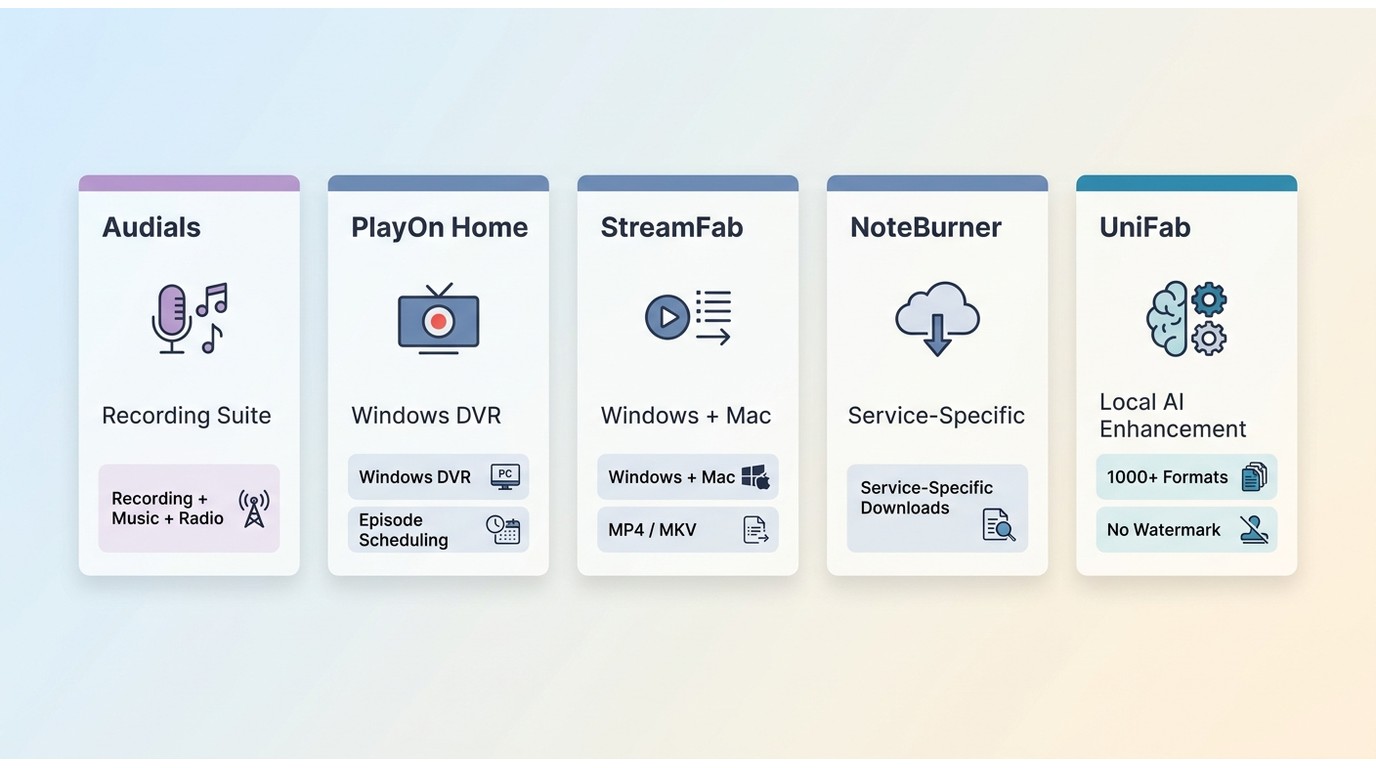
The right Audials alternative depends on the job: stream recording, direct downloading, music capture, Mac use, or AI video enhancement. No single tool replaces the entire Audials feature mix equally well.
Streaming Recording and Direct Downloads
For streaming recording, PlayOn Home emphasizes a Windows PC-based DVR workflow with season and new-episode recording. It suits viewers who prioritize scheduled capture; it is less suitable for Mac users or people who do not want a PC running during recording.
For direct downloads, StreamFab emphasizes Windows and Mac downloads, local MP4 or MKV output, subtitles, and season queues. NoteBurner offers service-specific video products on Windows and Mac. These fit users who want delivered files rather than playback capture, but service coverage, quality, and queue behavior still vary.
Mac and AI Enhancement
Mac users should split the decision in two. StreamFab and NoteBurner address supported streaming-download jobs. A focused AI video enhancer for Mac comparison can help when enhancement, not capture, is the actual need.
For personal offline viewing of content you're authorized to access, where permitted by platform terms and applicable law, choose a recording or download product by supported service. Choose an enhancer only after you already have a lawful local file.
Music Capture and Library Management
Audials remains the broadest fit in this group for radio, podcasts, Audials music capture, tags, covers, playlists, and a combined media library. NoteBurner is a more focused option for supported music services and common audio formats.
Audials is the better fit when radio and mixed-library management matter. NoteBurner is less suitable if you also need the broad video-recording and radio workflow found in Audials One.
UniFab for AI Video Enhancement
UniFab All-In-One is a task-specific Audials alternative for improving local video files, not a replacement for streaming recording, radio, or music-library management. Its clearest differences are Windows and Mac support, local processing, and dedicated picture and audio enhancement tools.
For the main decision, three capabilities matter: local video enhancement on both desktop platforms, SDR-to-HDR10 conversion, and stereo-to-5.1 or 7.1 audio upmix. The broader suite contains 23 tools, but suite breadth is not directly comparable with a single Audials enhancement capability.
A video quality enhancer is useful when the source file needs denoising, upscaling, motion improvement, or color work after capture. It is not ideal for users whose primary need is stream recording, radio management, or low-hardware processing.
Enhancing Video With UniFab
The UniFab workflow is short: import a lawful local file, choose the relevant enhancement task, preview a difficult scene, set the output, and export. Keep the first pass narrow so you can judge what each change contributes.
30-day Free Trial with full feature access!
- Step 1
On your Windows or Mac install and launch the UniFab program > Navigate to the 'All Features' section and choose the module that suits your needs.
Pro Tip: Try the Autopilot Module, which automatically detects enhancement requirements and creates efficient AI workflows for multitasking. - Step 2
Upload your selected poor quality video that you preferred to enhance.
- Step 3
Start customizing the output video profile while adjusting various parameters such as resolution, quality, format, codec, etc. Next, go for the “Strat” option to complete the upscaling process.
Local processing is worth the hardware demand when the footage is private or upload time would interrupt the workflow. It is less attractive on a lightly equipped computer or when streaming capture, not file enhancement, is the real task.
The dedicated UniFab Video Upscaler is the more focused entry point when resolution and detail are the primary defects.
Audials Alternatives Compared by Use Case
This matrix compares five candidates by job rather than declaring a universal winner. Product support and license terms can change, so the decision should start with your platform, source, and desired workflow.
| Candidate | Best-fit job | Windows and Mac support | Recording or direct-download workflow | AI video enhancement role | Music capture and management | Batch workflow | License model | Trial limits | Known caveats |
| Audials One 2026 | Mixed recording, radio, music, and library management | Windows desktop; companion mobile apps | Playback recording and source-specific planner modes | Premium adds post-capture enhancement | Strong fit for radio, podcasts, tags, playlists, and collections | Planner support varies by source | Standard and Premium subscriptions; Premium 2026 one-time option | Start option and refund terms are presented by Audials | Active setup; reported queue, choppiness, and sync issues |
| UniFab All-In-One | Local AI enhancement of existing video | Windows and Mac | Neither streaming recorder nor radio manager | Dedicated local picture and audio enhancement | Not designed for music capture | Batch local-file processing | License options vary by product | Terms vary by module | Hardware and processing time; not for streaming capture |
| PlayOn Home | Scheduled streaming recording | Windows PC workflow | Playback recording with season and episode scheduling | No dedicated AI enhancement focus | Not a music-library suite | Season and new-episode automation | Monthly service | Limited free recording tier is listed | PC must run; downloads are PC-only |
| StreamFab | Supported-service direct downloads | Windows and Mac | Local MP4 or MKV downloads with available tracks and subtitles | No dedicated post-production role in this comparison | Separate audio products may be required | Whole-season and scheduled queues are advertised | All-In-One and configurable packages | Downloadable evaluation; limits depend on product | Support and quality vary by service |
| NoteBurner | Service-specific video or music conversion | Windows and Mac | Dedicated products for supported video services | No central AI enhancement role | Focused converters for major music services | Capabilities vary by product | Individual products and bundled options | Downloadable evaluation; restrictions are product-specific | Video, music, and batch details differ across products |
The matrix reinforces the central decision: Audials offers the broadest mixed-media toolbox, while the alternatives become stronger when your task is narrower and clearly defined.
Is Audials One 2026 Worth It?
Audials One 2026 is worth considering for Windows users who value flexible recording, radio and music tools, and media organization enough to accept active setup. It is not the default answer for Mac, direct-download, unattended-queue, or dedicated AI-enhancement needs.
Choose Audials for a broad Windows media workstation. Choose PlayOn for scheduled playback recording, StreamFab or NoteBurner for supported direct-download tasks, and UniFab for local video enhancement. The strongest decision is the one that matches the job without paying for unrelated breadth.
Audials FAQ
Can I buy Audials One 2026 without a subscription?
Yes. Current official US choices include subscriptions for Standard and Premium plus a one-time Premium 2026 option. Treat that as a release-based license choice, not evidence for the old standalone Vision price.
Can Audials still record videos from YouTube?
Yes, playback recording remains available. The older YouTube-dl-based direct-download route was discontinued, so the practical result depends on clean playback during capture.
Can Audials batch-record every streaming service?
No uniform promise applies to every source. Planner and queue support can vary, and users report that some workflows require individual URLs or more supervision than a season-scale DVR.
Why can faster Audials recordings become choppy or lose sync?
Accelerated playback increases processing and synchronization pressure. If motion or audio timing matters, a stable 1x capture is often the safer editorial recommendation, followed by a short quality check before a long queue.