AI can often make a blurred face look clearer when the source retains usable structure, but it cannot guarantee the person's original features. Start by identifying the blur type, then choose a local desktop, browser, or mobile workflow based on privacy, clip length, and export needs.
What Makes a Blurry Face Recoverable?
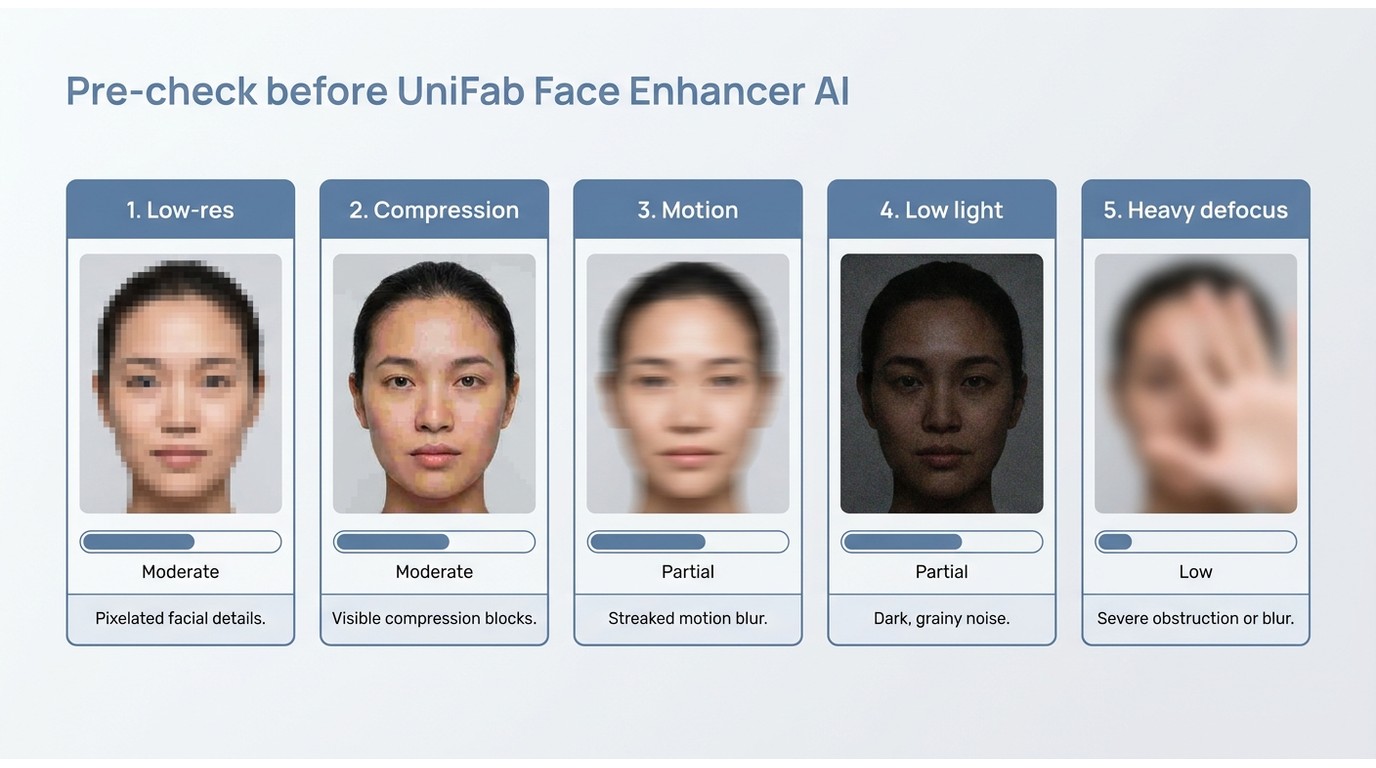
A blurry face video is a reasonable enhancement candidate when the eyes, nose, mouth, and face outline remain partly visible across several frames. Tiny faces, severe motion smear, heavy obstruction, or an out of focus video with little structure has much stricter face recovery limits.
The practical judgment is simple: low-resolution softness and compression damage often leave more usable structure than a distant, blocked, or strongly defocused face. Check several frames before choosing a tool because one frame may be worse than the surrounding sequence.
Blur Types, Likely Results, and Prevention
| Blur type | Likely improvement | Main failure mode | Prevention tip |
|---|---|---|---|
| Low-resolution capture | Moderate when facial structure remains visible | Fine features may be estimated rather than recovered | Record at a higher resolution when possible |
| Compression artifacts | Moderate for blockiness and soft edges | Repeated compression may erase stable detail | Keep the least-compressed source file |
| Motion blur | Partial when some nearby frames are clearer | Fast movement can smear features across frames | Stabilize the camera and improve capture lighting |
| Low light | Partial if the face is still exposed | Noise reduction can flatten skin and edges | Add light and avoid strong backlighting |
| Distance, obstruction, or heavy defocus | Low | Too little source information remains | Move closer, clear obstructions, and confirm focus |
If the goal is to remove face blur, judge success by a more coherent and readable face, not by whether the software appears to reveal details the camera never recorded.
What Is an AI Face Unblur Tool?
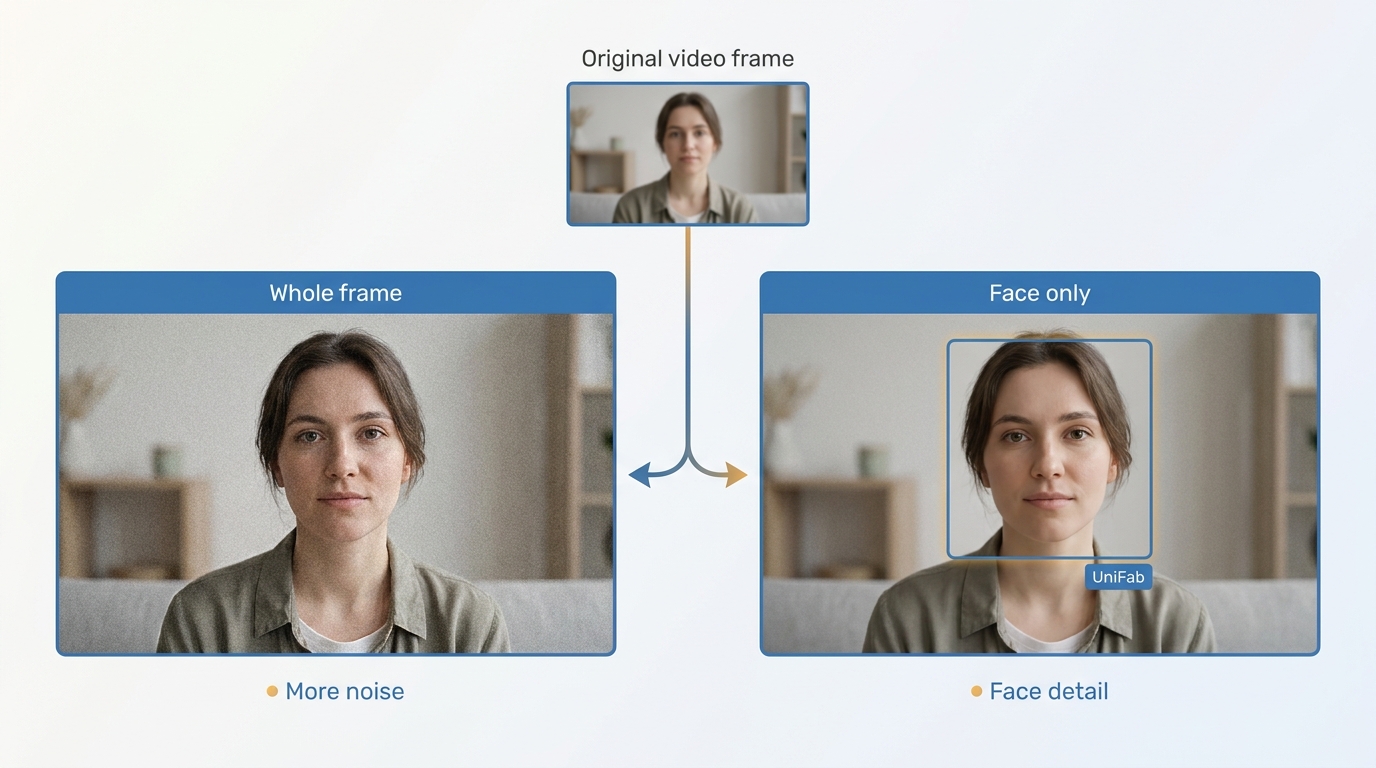
An AI face unblur tool is a face-focused video enhancer, not a stronger version of a normal sharpening filter. A conventional filter boosts edges across the frame, while an AI face blur remover detects facial regions and applies learned patterns to improve their visible structure.
This distinction matters because global sharpening can make compression blocks, noise, and halos more obvious. Face-focused processing can treat a face separately from the background, but the output still depends on the information present in the source frames.
- Use face-focused enhancement when faces are the main problem and the rest of the frame is acceptable.
- Use ordinary editing controls when the whole video mainly needs mild sharpening, contrast, or noise adjustment.
- Stop early when stronger settings create waxy skin, unstable eyes, or changing features between frames.
What AI Face Unblurring Actually Does
AI face unblur processing detects a face, aligns its main landmarks, evaluates the degradation, and generates a visually cleaner version that is blended back into each frame. The process can improve perceived clarity, but some fine detail may be plausible rather than historically accurate.
- Detect and align the face. The model tracks the face and its main features across frames.
- Assess the damage. It distinguishes softness, compression, noise, motion smear, and other visible problems.
- Build a cleaner facial image. The model estimates edges, texture, and contours from the available evidence and learned patterns.
- Check temporal consistency. The result should remain stable as the face moves rather than changing noticeably from frame to frame.
- Blend and export. Color, exposure, and texture are balanced with the surrounding frame.
My editorial rule is to compare a representative sequence, not a single flattering frame. A face that looks sharper in one still can remain distracting in motion if the eyes, mouth, or skin texture shift between frames.
Enhancement Is Not Forensic Identity Recovery
Visual improvement is not factual identity recovery. Generated eyes, skin texture, hair edges, or contours may look convincing without matching details that were actually present when the video was recorded.
Use face enhancement only on footage you are authorized to edit, and treat the output as an edited visual rather than identity evidence. It should not be used to claim that a deliberately blurred or anonymized person has been reliably identified. When privacy protection is the goal, use purpose-built anonymization that remains effective throughout the clip.
UniFab Face Enhancer AI: Fit and Limits
UniFab Face Enhancer AI is a Windows and Mac desktop option for local video processing, face-focused enhancement, and controlled export. It fits users who want to keep footage on their computer and process more than one file without relying on a browser upload.
Restore Blurry Faces with UniFab Face Enhancer AI!
- AI automatically restores facial details with high accuracy
- Significantly boosts face clarity in blurred or pixelated videos
- Free trial for full features with no watermark for 30 days
Face Enhancer AI
Restore Blurry Faces with UniFab Face Enhancer AI!
- AI automatically restores facial details with high accuracy
- Significantly boosts face clarity in blurred or pixelated videos
- Free trial for full features with no watermark for 30 days
Face Enhancer AI for Mac
Suitable for: portrait video or low-resolution faces that retain recognizable structure, especially when privacy and export control matter. Less suitable for: phone-only editing, computers without suitable graphics hardware, or any task that requires verified identity recovery.
Verified Features and Best-Fit Footage
UniFab supports Windows and Mac, uses GPU acceleration, handles batch processing, exports MP4 or MKV, and supports output up to 4K. These capabilities define the workflow, not a promise that every blurred face will become accurate.
- Face-focused enhancement: designed for portrait video and low-resolution facial areas.
- Local workflow: the source stays on the desktop system during processing.
- Batch processing: useful when several authorized clips need the same review-and-export workflow.
The practical fit is strongest when the face is large enough to inspect and appears across multiple usable frames. Start with restrained settings; aggressive enhancement can make generated texture more noticeable.
Results by Blur Type
The available image below is a product demonstration, not an independent benchmark. It can illustrate visible clarity changes, but it does not provide the source resolution, blur severity, hardware, settings, or full motion sequence needed for a controlled performance claim.
| Source condition | What to inspect | Reasonable success signal | Warning sign |
|---|---|---|---|
| Low-resolution face | Eyes, mouth edges, and face outline | Cleaner structure that remains stable in motion | Invented-looking pores or facial features |
| Compression damage | Blocks around cheeks, hair, and jawline | Reduced blockiness without plastic texture | Smearing or ringing around the face |
| Motion blur | Frames before and after the strongest smear | Partial improvement where adjacent frames retain detail | Features that jump or change between frames |
| Heavy defocus or obstruction | Amount of visible facial structure | Minor readability improvement | A sharp-looking face unsupported by the source |
For a defensible comparison, record the source resolution, blur type, enhancement settings, GPU model, and observed motion behavior. Without those conditions, describe the result as a demonstration rather than hands-on proof.
Formats, Export, and Hardware Requirements
For an MP4 face unblur workflow, import the source, preview a short segment, and export to MP4 or MKV at an appropriate resolution up to 4K. GPU acceleration is supported, but processing time depends on clip length, source resolution, settings, and the computer's graphics capability.
| Supported systems | Windows and Mac |
|---|---|
| Verified output containers | MP4 and MKV |
| Maximum verified output | Up to 4K |
| Acceleration | GPU acceleration supported |
| Queue workflow | Batch processing supported |
| Input focus | Portrait video and low-resolution faces |
A suitable GPU can reduce waiting, but no universal processing-time estimate is credible without a defined source clip and settings. Previewing a short section is the quickest way to judge both speed and facial stability on a specific computer.
Unblur Faces in Video with UniFab
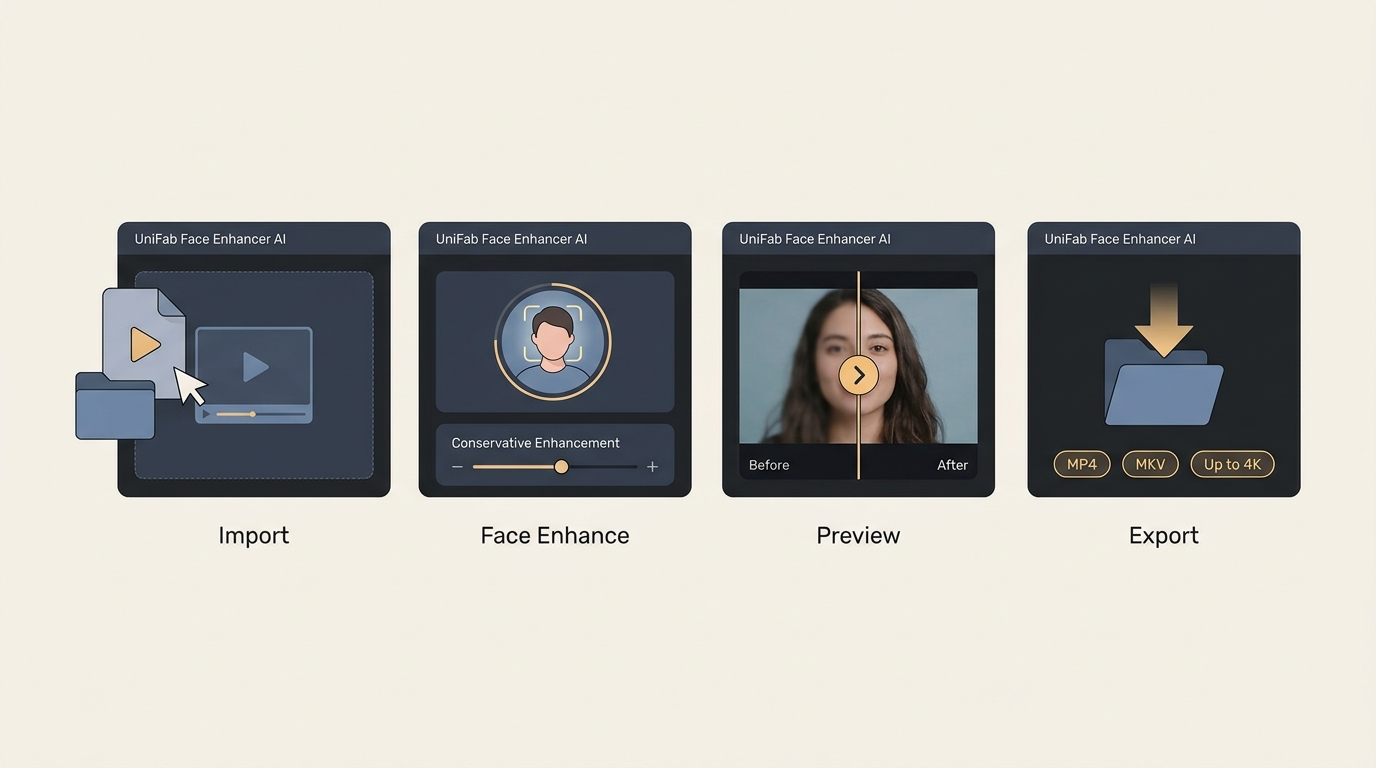
To unblur face in video with UniFab, use a four-stage workflow: import, configure face enhancement, preview a representative section, and export to a chosen folder. The preview step is where you decide whether the visible gain justifies processing the full clip.
Import, Enhance, Preview, and Export
- Import the video. Open Face Enhancer AI and add the authorized source clip. Keep the original file unchanged for comparison.
- Select face enhancement. Choose settings that fit the source and intended output. Begin conservatively to reduce unstable generated detail.
- Preview a representative section. Include movement, a clear face, and the worst blur in the sample. Check the sequence at normal speed as well as frame by frame.
- Choose export settings. Select MP4 or MKV, set an output resolution up to 4K, choose the destination folder, and start the export.
30-day Free Trial with full feature access!
- Step 1
Download and Launch UniFab on your PC. Select the Face Enhancer mode, then import the video file you want to enlarge from your local files.
- Step 2
Customize your preferred output format, quality, codec, and other parameters. Then, click on the Start button to begin enhancing your video.
I would test a short section before committing a long video. That small check exposes temporal inconsistency, over-smoothed skin, and unrealistic facial detail sooner, while also showing how the selected settings perform on the available hardware.
Choose Desktop, Online, or Mobile
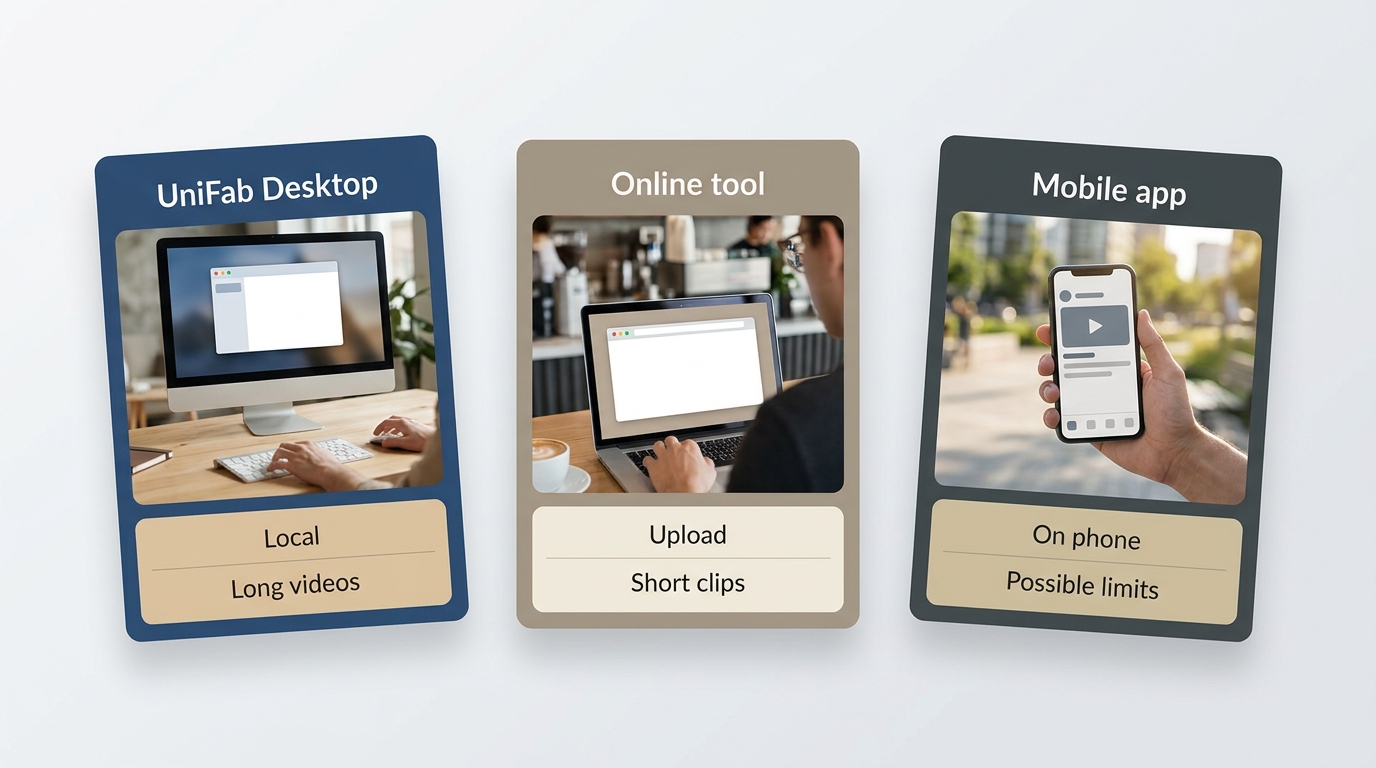
The right video unblur options depend less on convenience alone and more on privacy, clip length, export needs, and available hardware. Local desktop software suits controlled projects, an online face unblur tool suits quick low-stakes clips, and mobile video unblur prioritizes editing on the device.
Platform and Method Decision Table
| Platform | Best for | Not ideal for | Privacy and upload | Video length or file limits | Input and output formats | Export resolution | Watermark or credit limits | Hardware requirements |
|---|---|---|---|---|---|---|---|---|
| Local desktop software | Private, long, or repeated video work with export control | Phone-only use or computers without suitable graphics hardware | Local processing; no browser upload required | Usually governed by storage and hardware rather than web quotas | MP4 and MKV output | Output up to 4K | Varies by license and current offer | Windows or Mac system; GPU capability affects speed |
| Browser-based online tool | Short, low-stakes clips and quick previews | Sensitive footage, long videos, or detailed export control | Requires upload to a remote service | Provider-dependent; limits may apply | Provider-dependent | Provider-dependent | Credits, preview limits, or watermarks may apply | Modern browser and reliable internet connection |
| Mobile app | Convenience-first edits captured or received on a phone | Long clips, detailed inspection, or controlled batch work | May process on-device or upload, depending on the app | Device- and app-dependent | App-dependent | App- and device-dependent | Credits, export limits, or watermarks may apply | Compatible phone with sufficient storage and processing capacity |
No-cost access, credits, export caps, and watermark rules vary by provider as of July 2026. My fit judgment is to use local processing for sensitive or long footage, browser tools for quick non-sensitive checks, and mobile apps when immediate phone-based editing matters more than detailed control.
Private, Long, and Sent Videos
Private or client footage is generally better suited to local video processing because the file does not need to be uploaded to a browser service. A video someone sent you should also be checked for editing permission, source quality, and whether a less-compressed original is available.
- Sensitive footage: keep the workflow local when practical and restrict access to the source and export.
- Long footage: test a short representative segment before processing the complete file.
- Sent footage: request the original transfer rather than repeatedly compressed social or messaging copies.
When anonymity was intentionally added, do not treat enhancement as a reliable reversal method. The responsible path is to preserve the privacy intent and use material you are authorized to edit.
Conclusion: Match the Tool to the Footage
Successful face enhancement starts with diagnosis, not software selection. Check whether usable facial structure remains, choose a workflow that fits privacy and platform needs, preview a short segment, and accept that severe blur or missing detail can prevent a trustworthy result.
For Windows or Mac users who need local processing, MP4 or MKV export, batch work, and output up to 4K, UniFab Face Enhancer AI is a relevant option to evaluate. Its main limits remain important: it requires a desktop workflow and suitable hardware, and it cannot establish the original identity behind missing or intentional blur.
Key Takeaways
- Low-resolution softness and compression damage are often more workable than tiny, obstructed, heavily defocused, or strongly motion-blurred faces.
- AI face unblur output may contain generated detail, so visual clarity is not proof of identity accuracy.
- Test a short sequence and review motion consistency before exporting a long clip.
- Choose desktop, online, or mobile based on privacy, clip length, export control, and hardware.
- Retain the original source so the edited result can be compared honestly.
Face Unblur FAQs
These quick answers cover the decision points that matter after the main workflow: authenticity, platform fit, no-cost limits, processing time, and private footage.
Can AI recover the original face exactly?
No. AI can improve visible facial structure, but it may generate plausible details that were not recorded in the source. Treat the result as an edited interpretation, not verified identity evidence, especially with severe blur, obstruction, distance, or intentional anonymization.
Which face unblur option fits my video?
Choose desktop software for private, long, or export-sensitive work; a browser tool for a short, non-sensitive check; and a mobile app for convenience-first edits. Also consider source quality, available storage, graphics hardware, and whether you need frame-by-frame preview control.
Can I unblur a video free without a watermark?
Some no-cost tools allow limited previews or exports, but credits, duration caps, resolution limits, and watermarks vary. Do not assume that a no-cost option includes an unrestricted, watermark-free export; compare the actual export terms before processing a long clip.
How long will face enhancement take?
There is no reliable universal estimate. Processing time changes with clip length, resolution, enhancement settings, preview choices, and GPU capability. Run a short representative section first to estimate the full job on the actual computer.
Should private footage stay on my computer?
Yes, when practical. Local processing reduces the need to upload personal, client, or confidential video to a remote service. Confirm that you are authorized to edit the footage, control access to both source and export, and avoid attempts to defeat intentional anonymization.