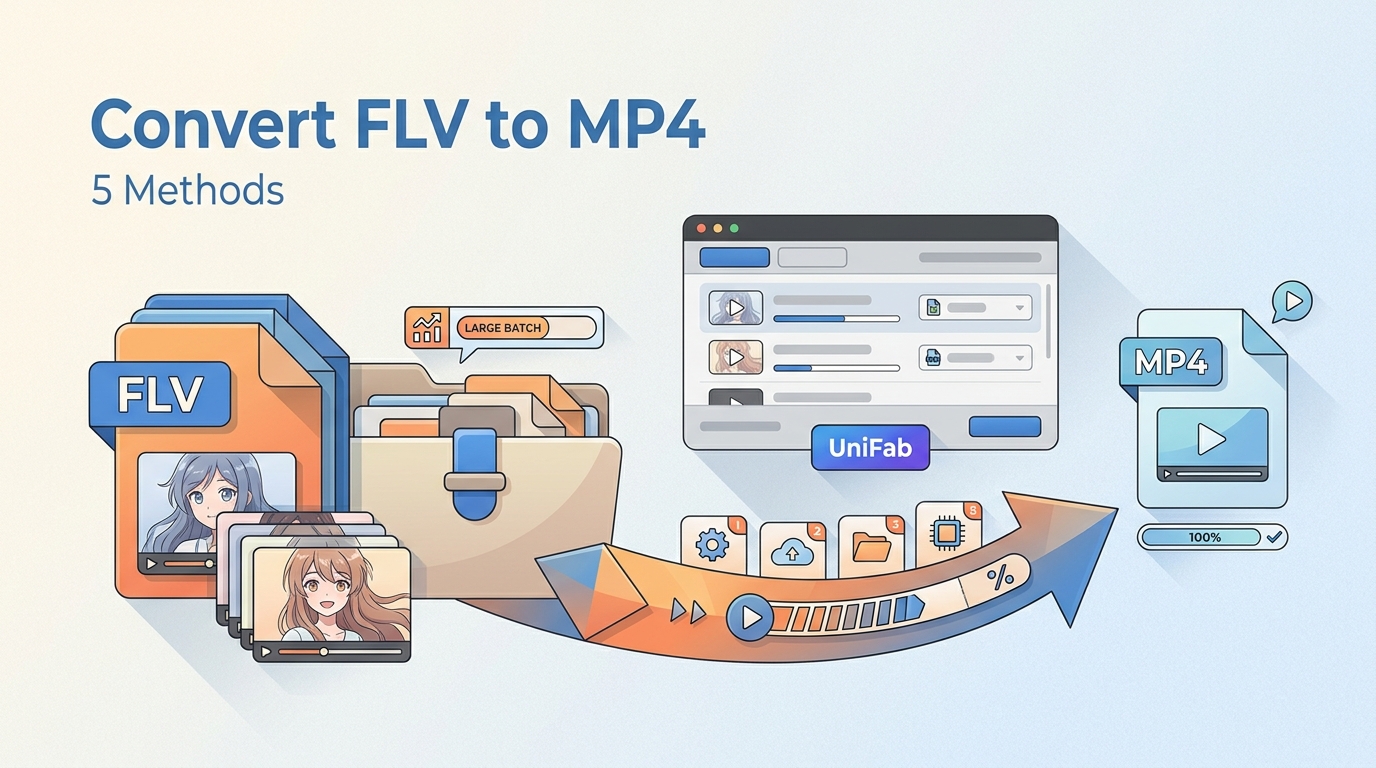
If an old FLV recording will not open in your player or editor, convert FLV to MP4 with an online FLV to MP4 converter for a small, nonsensitive file, local software for private or large batches, or FFmpeg stream copy when the video and audio codecs are MP4-compatible.
Use every workflow in this guide only for local or uploaded files you own or are authorized to process, including lawful personal backups. Before uploading, review the service's terms, retention policy, and permitted uses. You remain responsible for copyright and compliance with applicable terms.
Choose the Right FLV Conversion Method
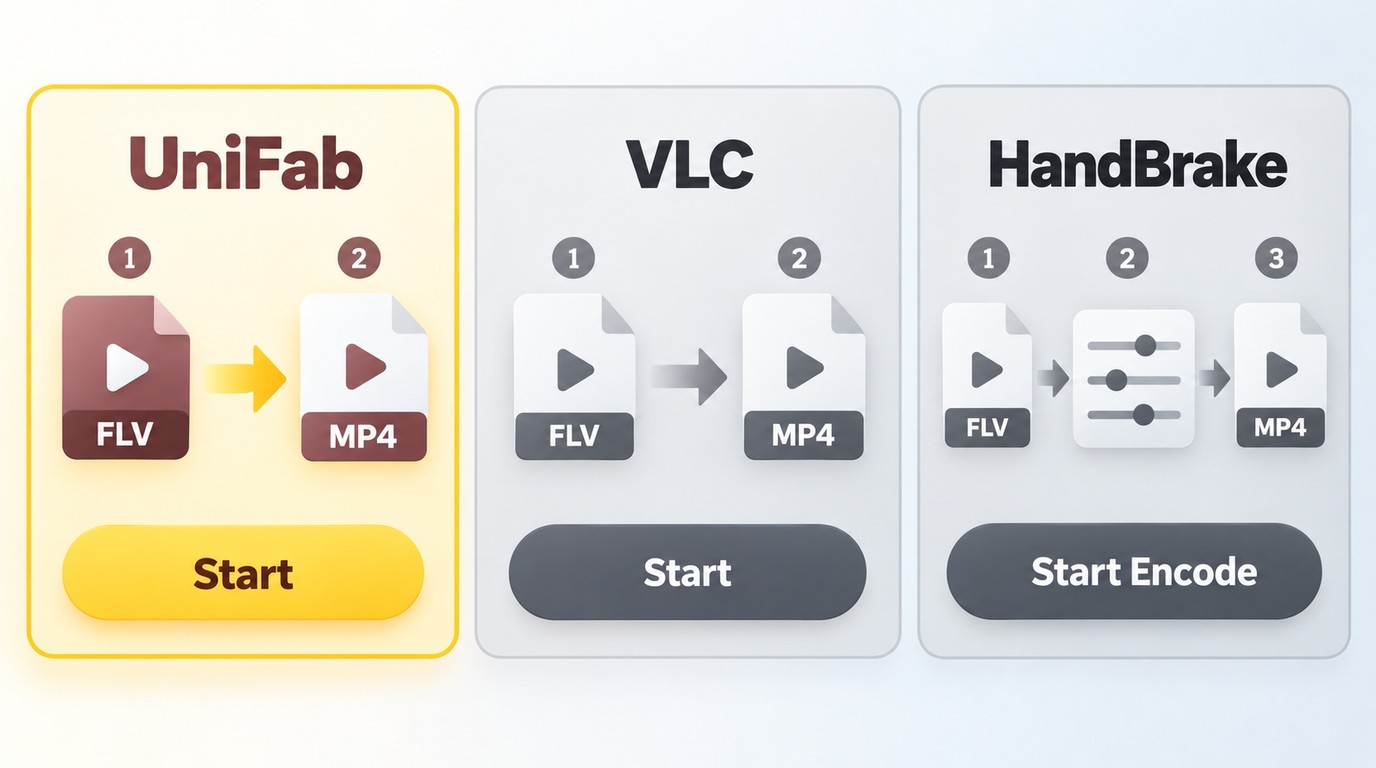
The right FLV to MP4 converter depends on file size, privacy, codec compatibility, batch volume, operating system, and how much control you want. My editorial rule is simple: choose the least complicated method that matches your privacy needs and produces a playable sample.
Quick Picks by File Size and Skill
For one small, nonsensitive clip, an FLV to MP4 online service is convenient. For a private recording, a multi-gigabyte file, or batch FLV conversion, use an FLV to MP4 offline workflow. If the streams are already MP4-compatible, FFmpeg can change the container without encoding the video again.
- One small file, no installation: use an online converter after checking its upload and deletion terms.
- Private or large source: use a local desktop app so the video stays on the computer.
- Occasional simple conversion: VLC may work, but verify the result before deleting the FLV.
- Predictable re-encoding: HandBrake is useful when you are comfortable choosing a preset and queueing files.
- Codec-aware remuxing: FFmpeg provides direct control and can copy compatible streams.
- Large anime folder: use a local GUI to import the folder and apply shared MP4 output settings across matching files.
Online Uploads vs. Local Processing
Online conversion avoids installation, while local processing avoids upload time and keeps personal footage on the device. As of September 2026, Zamzar limits files on its no-cost FLV conversion route to 50 MB. That is one service example, not a universal limit for online converters. Select an authorized FLV file, choose MP4 as the output, and start the conversion. Download the finished MP4 to your chosen folder, then open the saved file and check playback.
For sensitive footage, an unreliable connection, or a large archive, I would choose local processing. Uploading a file before the conversion even starts adds a privacy decision and can take longer than the actual format change.
Windows, Mac, VLC, and FFmpeg
FLV to MP4 Windows and FLV to MP4 Mac workflows use the same decision: inspect the source, choose remuxing when codecs fit MP4, and re-encode when they do not. Windows and Mac users can use FFmpeg, HandBrake, VLC, or a maintained desktop GUI.
In VLC, select the FLV source, choose an MP4 conversion profile and destination, start the conversion, and check the saved file in a player. In HandBrake, use the HandBrake Video Converter workflow: open the source, choose a suitable preset and MP4 container, set the destination, add the job to the queue or start it directly, and verify playback afterward.
What FLV Files Contain
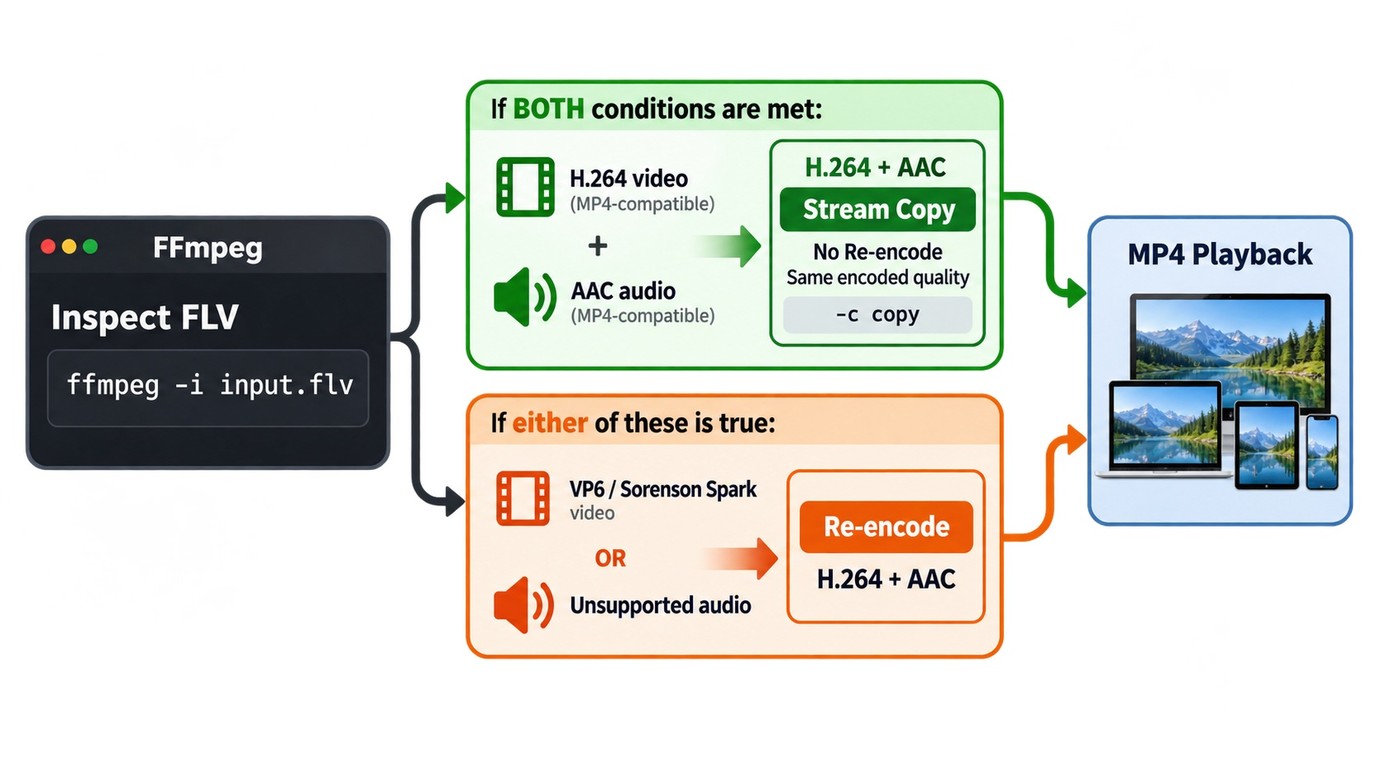
An FLV file is a container, not a single video codec. It may contain H.264 video and AAC audio that fit MP4, or older video such as VP6 or Sorenson Spark that requires re-encoding before an MP4 player can use it.
Flash Video was designed for older web playback, so files in an archived library may not open in the intended player or editor. Try opening a copy in VLC to see whether it can read the streams, then inspect the codecs before choosing a method. That check avoids re-encoding compatible media that could be remuxed and avoids copying a legacy stream that MP4 cannot carry reliably.
Why MP4 Is the Practical Target
MP4 is a practical target because current players, editors, and sharing platforms broadly support it when the file uses compatible video and audio codecs. Converting the container alone does not guarantee playback, so the codecs inside the MP4 still matter.
For most conversions, H.264 video with AAC audio is the conservative compatibility choice. Newer codecs can reduce file size at comparable visual quality, but an older TV, editor, or hardware player may support a narrower set of profiles. Keep the original FLV until the MP4 has been checked in the device or app that matters.
File size is determined by the source codec, target codec, bitrate, resolution, frame rate, audio settings, and whether the job is a remux or a re-encode. An MP4 may be smaller, similar in size, or larger; a fixed shrink percentage would be misleading.
FLV vs. MP4: Compatibility and Quality
FLV and MP4 are containers with different modern support. FLV remains useful as an untouched archive source, while MP4 is easier to play and edit. Quality depends on whether the streams are copied or encoded again, not on the filename extension by itself.
| Decision point | FLV source | MP4 target |
| Current device support | May need another player or conversion | Broad with common video and audio codecs |
| Editing | Varies by editor and codec | Commonly accepted by current editors |
| Quality change | Keeps the original encoded streams | Stream copy avoids re-encoding; re-encoding may change quality |
| File size | Depends on source encoding | Depends on copied streams or target settings |
| Archive role | Keep as untouched source until verification | Use as a playback or editing copy |
Remux or Re-encode?
Remuxing changes the container while copying compatible streams; re-encoding decodes and encodes at least one stream. Start by inspecting the FLV while keeping the original file unchanged:
ffmpeg -i input.flv
If the FLV contains H.264 video and AAC audio, this FFmpeg FLV to MP4 command can attempt stream copy with a different output name:
ffmpeg -i input.flv -c copy output.mp4
Stream copy avoids encoding work and keeps the existing encoded streams. Play the output and check video, audio, duration, seeking, and sync. If FFmpeg reports an incompatible codec, or if the source uses VP6, Sorenson Spark, or unsupported audio, a build with the required encoders can re-encode the main video and audio streams:
ffmpeg -i input.flv -c:v libx264 -c:a aac output.mp4
Keep the original FLV until the new file passes those checks. Converting pirated or unauthorized video may be illegal and may violate applicable platform terms, so do not use these commands for that purpose. Stream copy preserves the existing encoded media; it does not restore detail. Optional enhancement is a separate process and should not be described as lossless conversion.
UniFab for Local Anime Batch Conversion
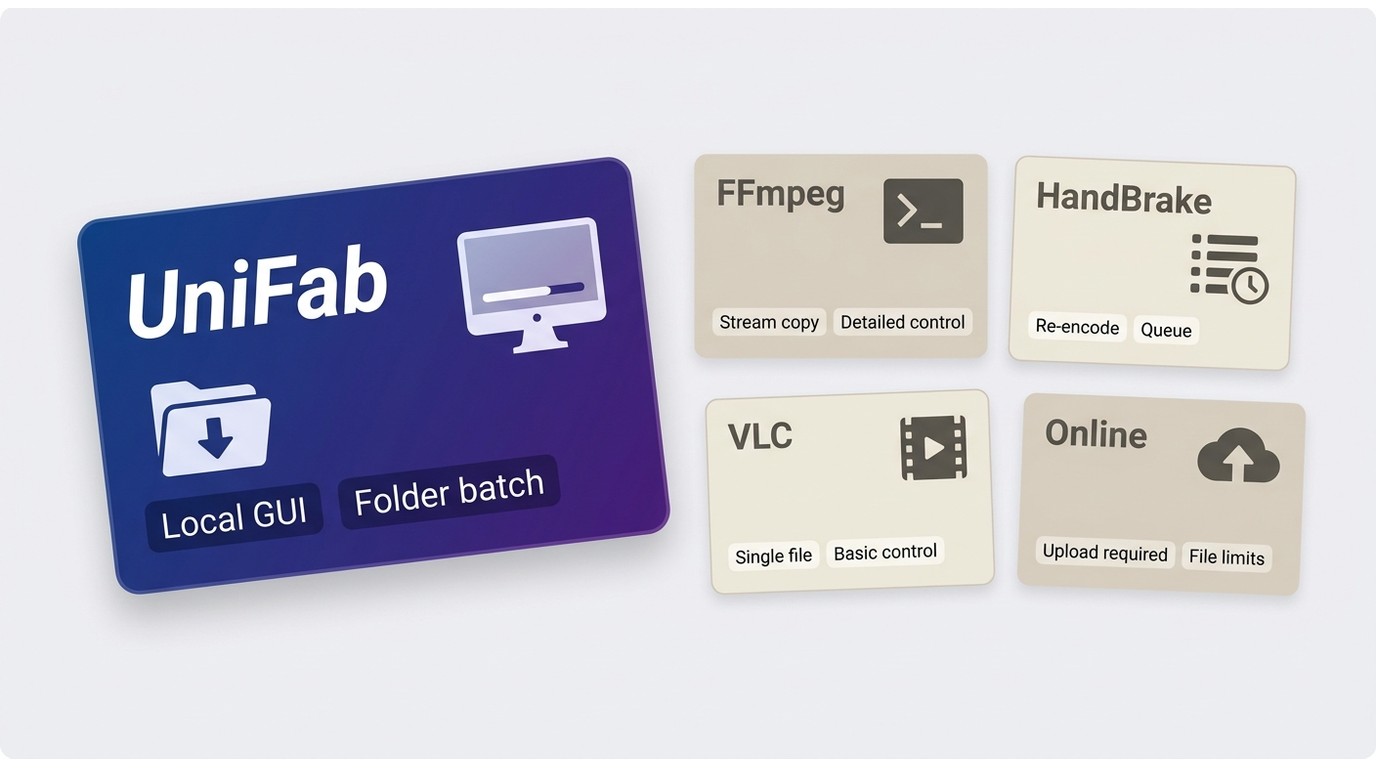
UniFab Video Converter fits readers who want a local Windows or Mac interface for folder-based anime conversion and shared MP4 output settings. It is free and watermark-free.
UniFab Video Converter processes batches locally and lets users check the selected audio and subtitle settings supported by the chosen output.
Best FLV to MP4 Converter
- 100% free with full features
- One-click format conversion
- Supports 1000+ formats
- High-Speed conversion
- Optimized for FLV anime batches
UniFab Video Converter AI
Best FLV to MP4 Converter
- 100% free with full features
- One-click format conversion
- Supports 1000+ formats
- High-Speed conversion
- Optimized for FLV anime batches
UniFab Video Converter AI
UniFab Compared With Other Methods
This comparison is a scenario guide, not a performance ranking. UniFab favors a local GUI and folder workflow; VLC favors occasional conversion; HandBrake favors preset-based re-encoding; FFmpeg favors precise control; online converters favor short, low-sensitivity tasks.
| Method | Good fit | Processing location | Workflow | Practical limit |
| UniFab Video Converter | Local folder batches | Local | GUI conversion | Desktop installation; enhancement is separate |
| VLC | Occasional conversions | Local | Conversion profile | Check source and output compatibility |
| HandBrake | Preset-based re-encoding | Local | Preset and queue | Video is re-encoded |
| FFmpeg | Compatible-stream remuxing | Local | Explicit stream copy or encoding | Command-line setup |
| Online converters | Small nonsensitive files | Uploaded | Upload, convert, download | Upload and retention terms |
For recurring formats, choose by codec fit and privacy needs, using a Video Converter software comparison to evaluate batch workflow and local processing.
Where UniFab Fits
UniFab is most useful when the problem is repetitive setup: importing a local folder and applying consistent MP4 output settings across matching files. Local processing also avoids sending an anime archive to an upload server.
Two limits matter. First, installing a desktop application adds a step for one small nonsensitive file; for a local folder batch, that setup supports repeatable output settings without repeated uploads. Second, enhancement is a separate stage from basic conversion. Convert and verify the MP4 first, then use optional enhancement only when the source needs a new visual result.
Convert FLV to MP4 With UniFab
To convert FLV to MP4 with UniFab, import the file or folder, choose an MP4 output, confirm tracks and frame-rate behavior, process a short sample, then verify playback and sync before starting the full batch. The sample check is the step I would not skip.
- Install and open the converter. Download and install UniFab Video Converter from the official product page, then open the Converter module on Windows or Mac.
- Import the source. Add one FLV for a check, or import the anime folder when the sample settings are ready.
- Choose the MP4 output. Select the intended video and audio settings and choose the destination folder. Keep the source frame rate unless there is a specific reason to change it.
- Review tracks. Select the audio and subtitle tracks needed for the final library. If the source has several tracks, verify the chosen output supports the intended result.
- Run a short sample. Convert a representative section or one episode before committing the folder.
- Verify and process the batch. Check picture, display aspect ratio, stretching, letterboxing, audio, subtitles, seeking, and lip sync, then apply the confirmed settings to the remaining files.
For an archive, use the first completed MP4 as a validation file rather than assuming the whole folder is uniform. Old collections may mix codecs, frame rates, damaged headers, or audio layouts even when all files share the .flv extension.
Conversion Problems and Reliable Fixes
Most FLV conversion failures point to an incompatible codec, an incorrect output profile, a damaged source, or settings that do not match the intended player. Diagnose the symptom before changing several options at once.
| Symptom | Likely cause | Practical fix |
| Blank or distorted video | Source codec or MP4 profile may be incompatible | Inspect codecs; try H.264, HandBrake, FFmpeg, or a desktop GUI |
| Audio-only MP4 | Video could not be copied or encoded | Re-encode with a compatible profile and test another player |
| Missing audio | Wrong track, unsupported audio, or omitted stream mapping | Select the intended track and encode MP4-compatible audio |
| Audio and video drift | Irregular timestamps or a frame-rate change | Keep the frame rate, normalize timestamps, and check the sample ending |
| Unsupported codec message | MP4 or the player does not accept a source stream | Re-encode the incompatible stream instead of copying it |
For aspect-ratio or framing problems, check display aspect ratio, stretching, and letterboxing in the target player, then complete the verification step above before processing the batch.
Final Recommendation by File Size
Use an online tool for one small nonsensitive file, VLC for an occasional simple attempt, HandBrake for preset-based re-encoding, FFmpeg for remuxing and precise codec control, and a local batch GUI for large folders that need repeatable settings.
- Small file: an online converter is convenient if its privacy and retention terms fit the material.
- Private or multi-gigabyte file: local processing avoids an upload and keeps the source on the computer.
- Compatible H.264/AAC source: try FFmpeg stream copy, then validate the MP4.
- Legacy or incompatible streams: re-encode with HandBrake, FFmpeg, VLC, or a desktop GUI and check the target player.
- Large anime library: use a local batch workflow, confirm needed tracks are supported and selected, test one representative file, and keep enhancement as a separate decision.
The most reliable FLV to MP4 method is the one that matches the source codecs and makes verification easy. Keep the original until the new file has passed a real playback check; a successful progress bar is not proof that audio, seeking, subtitles, and sync are correct.
FLV to MP4 Questions
Can FLV Be Remuxed Without Quality Loss?
Yes, when the FLV already contains streams that the MP4 container accepts, commonly H.264 video with AAC audio. FFmpeg can copy those streams without encoding the video again. If a codec is incompatible, re-encoding is required; raising resolution or applying AI enhancement is a separate process, not remuxing.
Why Does VLC Produce a Blank MP4?
A blank, distorted, or audio-only result usually means the source codec and selected VLC conversion profile do not work together. Check the FLV's video and audio codecs, try a compatible H.264/AAC profile, and use FFmpeg, HandBrake, or a desktop GUI if VLC still fails.
Which Method Fits a Large Anime Folder?
Choose a local batch tool that can import folders, reuse output settings, and let you confirm audio, subtitles, frame rate, and sync on a sample. A GUI suits readers who want repeatable setup; FFmpeg suits readers who need stream mapping or automation. Keep the original folder until the MP4 copies are verified.
Is an Online Converter Safe for Private Videos?
It depends on the service's upload security, retention, deletion, and content-use terms. For personal, confidential, or very large video, local conversion is the more controlled choice because the source does not need to leave the computer. Use online services only for files you are authorized to upload.