
In short, the right video enhancer app depends less on an AI label than on where you edit, how you export, and whether your footage stays local. This guide compares mobile video enhancer and desktop video enhancer options for Android, iPhone, and PC, with special attention to export limits, privacy, and long-video workflows.
Conclusion: Use a phone app for quick social edits, but choose a desktop workflow when local processing, batch work, or more control over longer footage matters.
Quick Picks by Use Case
- Best for local desktop workflows: UniFab Video Enhancer AI, for Windows and Mac projects that need batch processing or controlled exports.
- Best for quick social edits: CapCut, for short mobile-first projects.
- Best for face-focused clips: Remini, when portrait restoration is the priority.
- Best for multi-layer editing: KineMaster, for creators who need a mobile timeline rather than a one-tap enhancer.
- Best for simple clarity adjustments: HiQuality, for casual short clips.
- Best for creative mobile edits: Videoleap, for projects built around effects and compositing.
- Best for one-tap repair: Utool, for users who prefer automatic adjustments.
Our Video Enhancer App Test
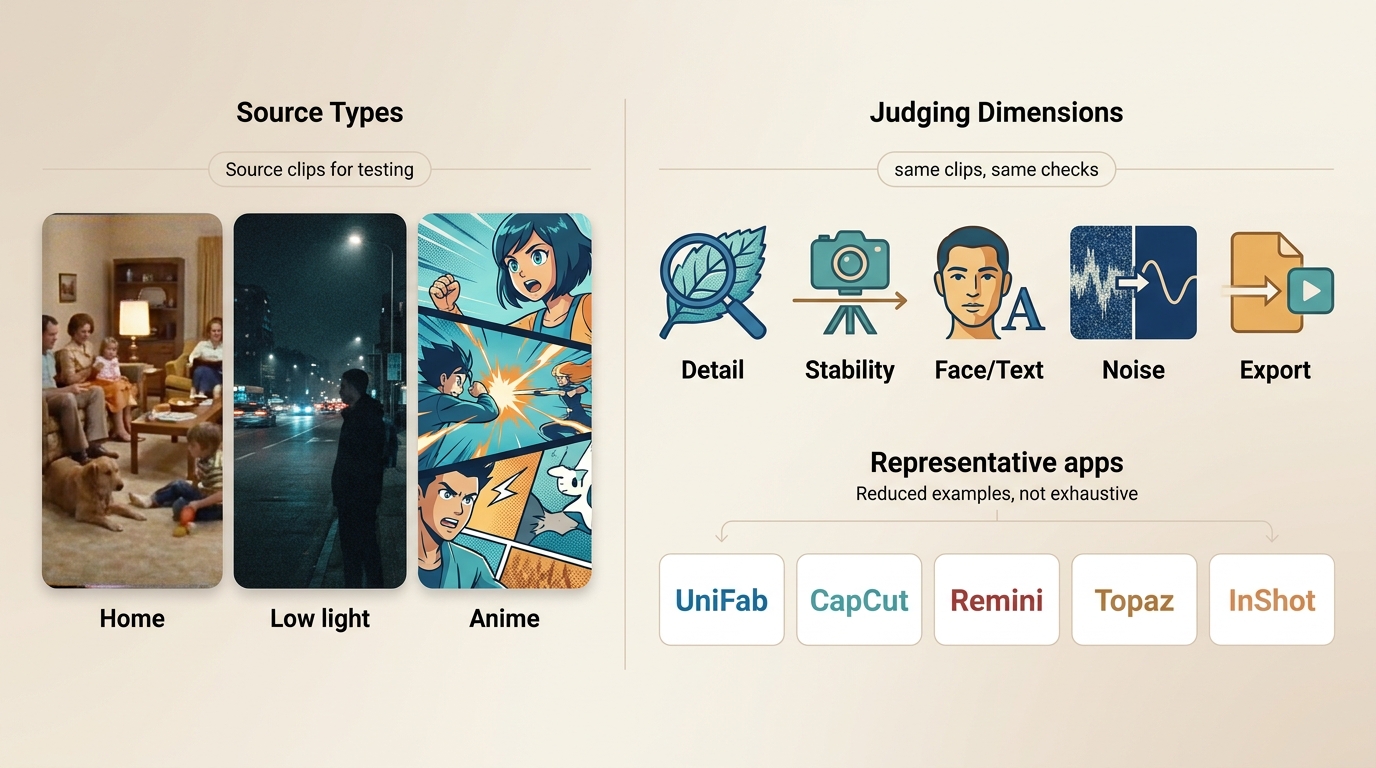
To compare video enhancer apps fairly, use the same source material across each tool: a low-resolution home video, a low-light phone clip, and an animation clip. Judge detail recovery, temporal stability, face and text handling, noise control, export behavior, and whether the app saves a usable new file. Desktop and mobile tools should be assessed on the devices they are designed for, not as if they share the same hardware limits.
What matters most: Resolution alone is not a useful score. A cleaner-looking frame can still fail if motion flickers, faces become artificial, or the app blocks the export you need.
What a Video Enhancer App Does
A video enhancer app uses AI models to improve video quality through upscaling, noise reduction, sharpening, stabilization, or color adjustment, often through a simplified workflow. For a broader look at what a video quality enhancer can do across desktop, browser, and app workflows, see the dedicated guide. The strongest 2026 engines behind any best video enhancer app combine frame-by-frame detail restoration, a face-specific pass, and temporal consistency to prevent flicker between frames.
Takeaway: If a clip is under 2 minutes and destined for social, a mobile app will usually do. If it is over 10 minutes or you need true 4K/8K, move to desktop.
Key Video Enhancer App Features
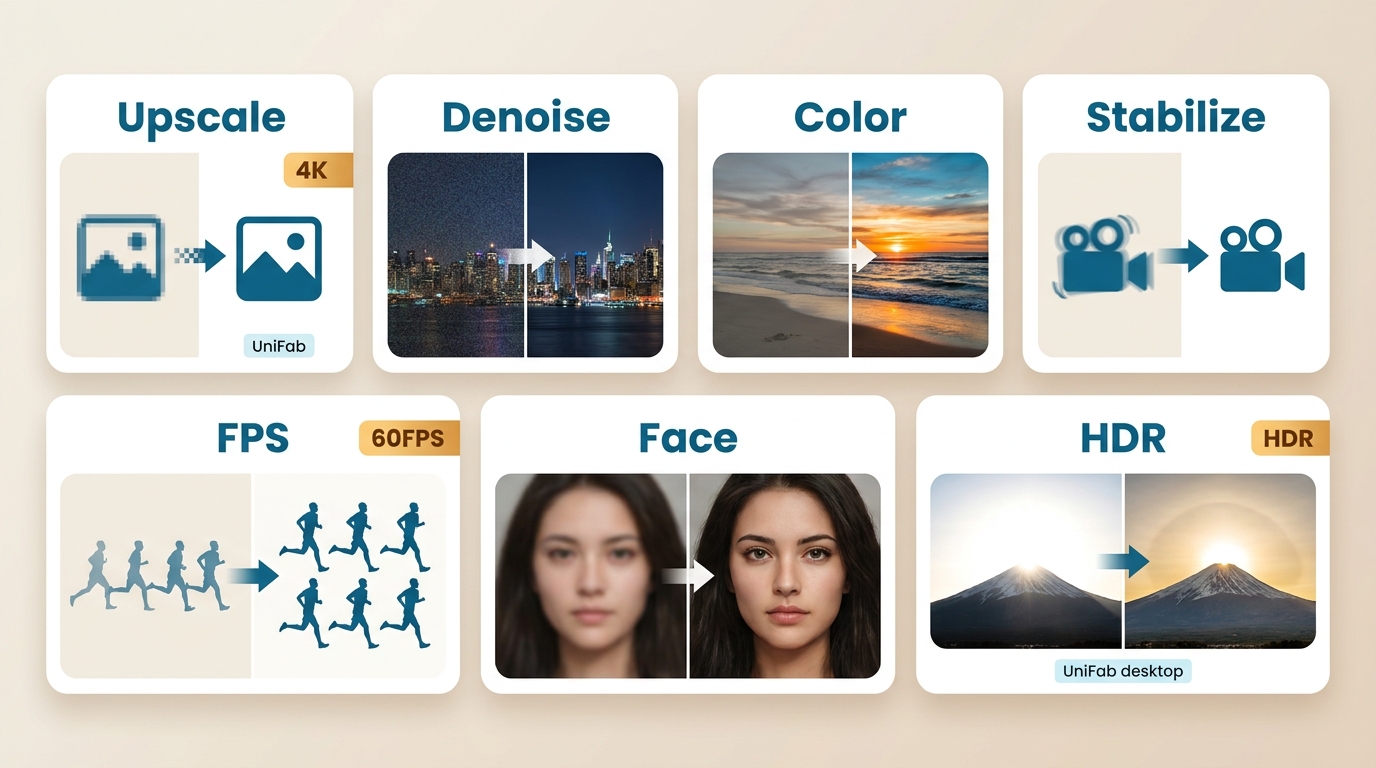
- AI Upscaling: Increases output resolution with a trained super-resolution model. Confirm the app's available export options before processing a full project.
- Noise Reduction: Removes grain and improves clarity in dark or heavily compressed videos.
- Color Correction: Balances brightness, saturation, and contrast for lifelike tones.
- Stabilization: Fixes shaky footage to ensure smoother motion.
- Frame Interpolation: Generates missing frames for natural slow motion or 24→60 fps conversion.
- Face Enhancement: A dedicated pass that sharpens eyes, skin, and hair without over-smoothing.
- HDR Conversion: Some desktop tools can convert SDR footage to HDR10. Mobile and browser apps may not offer the same option.
For longer projects that need a desktop workflow, UniFab All-In-One supports Windows and Mac, batch processing, MP4 and MKV output, and up to 4K output. It also offers SDR-to-HDR10 conversion for compatible workflows.
All-in-one solution for all your video enhancement needs
- 30-day free trial with no watermark or limitations
- AI-powered tools for automatic video enhancement
- Ultra-fast processing with GPU acceleration
- Easy-to-use interface for seamless experience
UniFab All-In-One
All-in-one solution for all your video enhancement needs
- 30-day free trial with no watermark or limitations
- AI-powered tools for automatic video enhancement
- Ultra-fast processing with GPU acceleration
- Easy-to-use interface for seamless experience
UniFab All-In-One for Mac
Takeaway: Before choosing an app, confirm three practical details: the export format, any watermark or usage limit, and whether the footage is processed locally, on-device, or in the cloud.
How AI Video Enhancer Apps Work
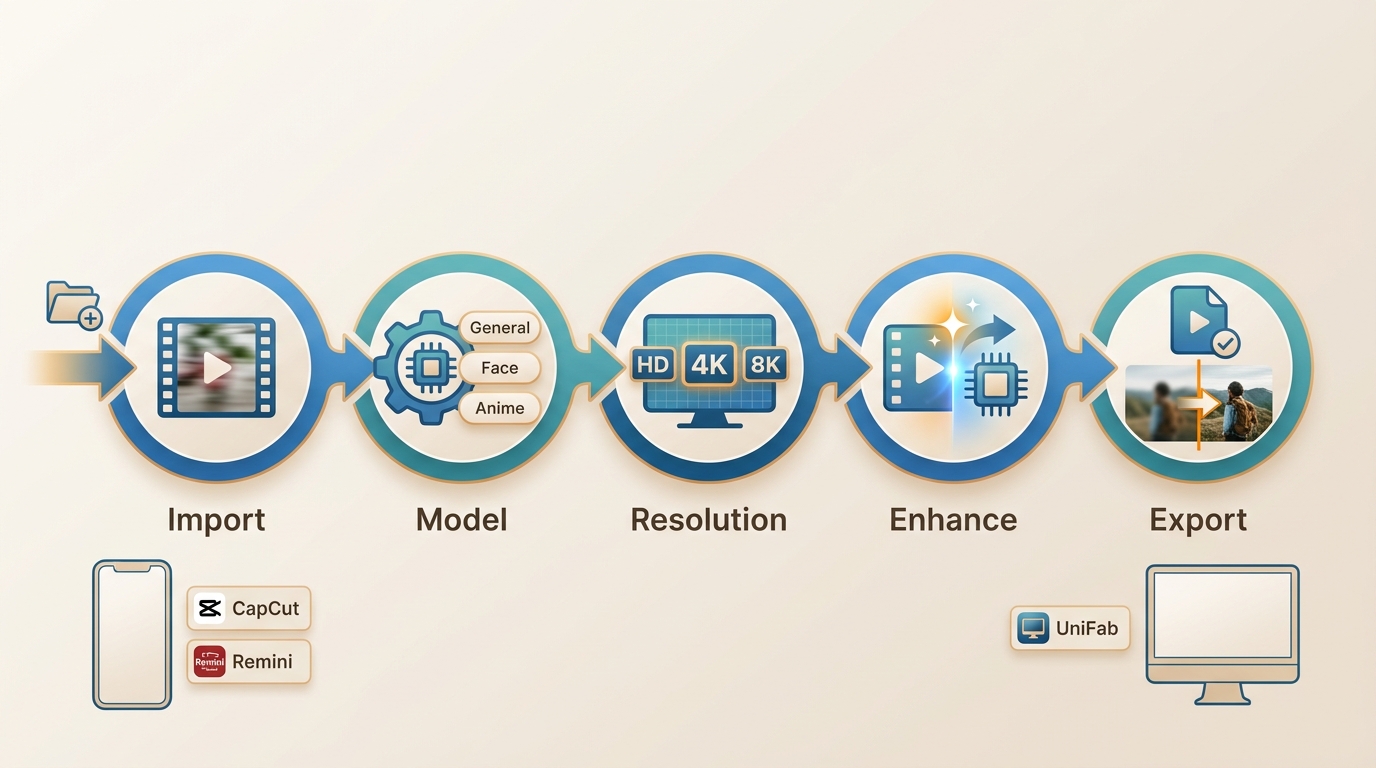
AI video enhancer apps analyze frames with a trained model and generate an enhanced output. The exact controls differ, but most follow a similar workflow:
- Import your low-quality or blurry video
- Select an AI model, such as General, Face, Anime, or Restoration
- Choose the target resolution (HD, 4K, 8K, or higher)
- Let the app analyze and enhance the footage; processing time depends on the device, source file, and selected settings
- Export the video and compare before/after results
Mobile and online workflow: Import or upload an MP4, choose an enhancement strength or target resolution, preview a representative segment, run the enhancement, then save or export to a new filename. Limits, save behavior, and cloud handling vary by app, so use the comparison details below before committing a long or sensitive clip.
Why Use AI Video Enhancer Apps
Video now dominates every platform — social media, marketing, education, and entertainment. Yet plenty of clips still suffer from blur, noise, poor lighting, or low resolution, often because they were captured on older phones or compressed by chat apps.
Modern AI-powered video enhancer apps can analyze frames, sharpen edges, reduce visible noise, and adjust color for a cleaner result. They can shorten routine editing, but they cannot recreate detail that was never captured, and aggressive settings can make texture or motion look less natural.
Takeaway: AI enhancement is most useful when it reduces routine cleanup without introducing flicker, oversharpening, or a restrictive export rule.
Types of Video Enhancer Apps
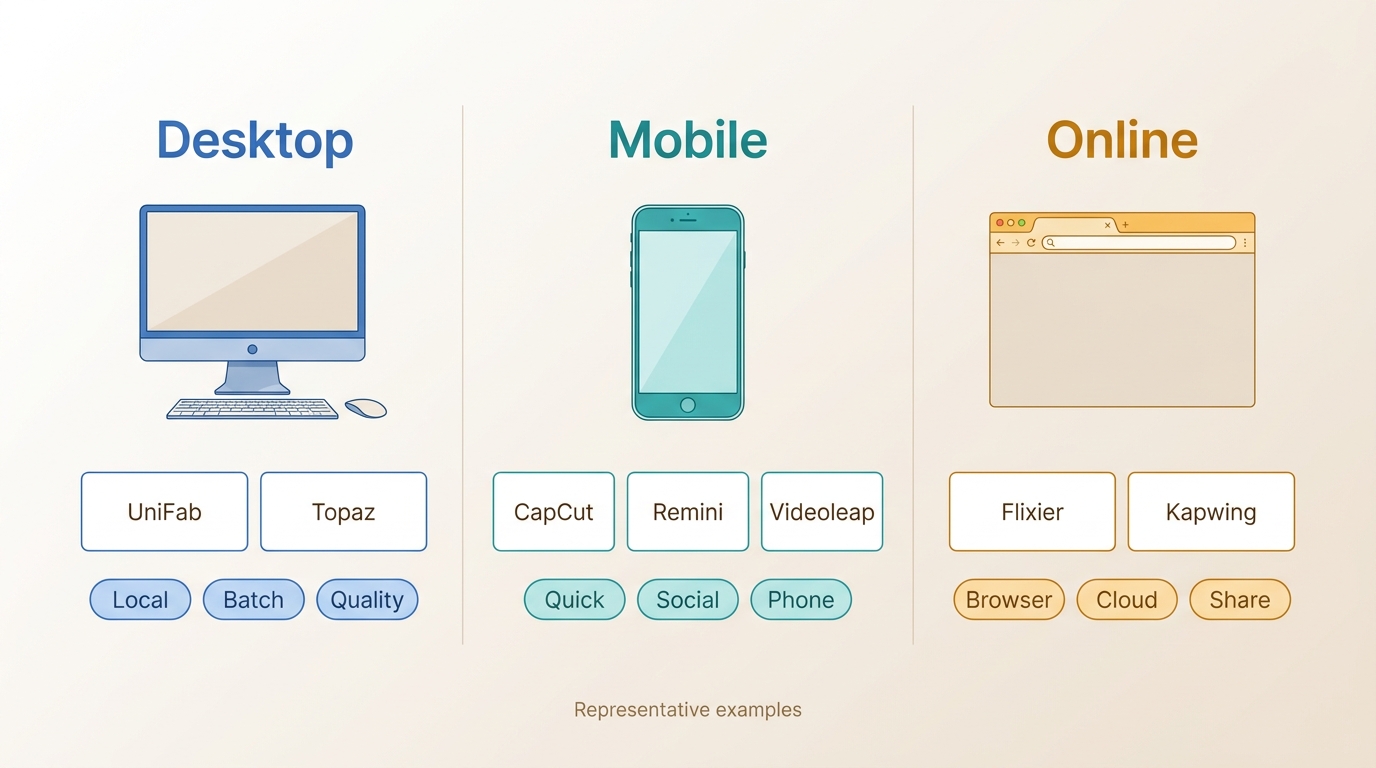
Video enhancement is available through desktop software, mobile apps, and online tools. Each category makes a different trade-off between control, convenience, file handling, and privacy.
Here is how they compare in 2026:
| Type | Description | Ideal For | Examples |
| Desktop Software | Typically offers local processing, more export control, and a workflow better suited to batches or longer files. | Long-form projects, sensitive footage, and users who want more control. | UniFab Video Enhancer AI, Topaz Video AI |
| Mobile Apps | Designed for quick edits and convenient sharing, but export rules, storage demands, and processing limits vary by app. | Short clips and social media workflows. | CapCut, HiQuality, Videoleap, Remini |
| Online Tools | Browser-based tools generally require an upload, so file-size limits and cloud handling should be checked before use. | Small, non-sensitive projects and occasional fixes. | Flixier, Kapwing |
Best App Type by Workflow
The best video enhancer app depends on your goal.
- For local desktop processing, batch work, and controlled exports, consider UniFab Video Enhancer AI.
- For short mobile and social projects, start with CapCut or another app whose export rules fit your project.
- For occasional browser-based fixes, use an online tool only after reviewing its upload and download limits.
The desktop example below is relevant to Windows users and to readers comparing an AI video enhancer for Mac, while the following mobile picks focus on shorter, phone-first workflows.
Takeaway: Desktop for quality, mobile for speed and convenience, browser tools for throwaway fixes.
Professional Desktop Video Enhancer: UniFab AI
UniFab All-In-One is a desktop video enhancer for Windows and Mac. It is most relevant when a project needs local processing, batch handling, or a more controlled workflow than a phone app provides.
UniFab supports Windows and Mac, batch processing, MP4 and MKV output, and up to 4K output. Its desktop workflow keeps processing on the computer rather than requiring a browser upload, which can matter when files are large or sensitive.
All-in-one solution for all your video enhancement needs
- 30-day free trial with no watermark or limitations
- AI-powered tools for automatic video enhancement
- Ultra-fast processing with GPU acceleration
- Easy-to-use interface for seamless experience
UniFab All-In-One
All-in-one solution for all your video enhancement needs
- 30-day free trial with no watermark or limitations
- AI-powered tools for automatic video enhancement
- Ultra-fast processing with GPU acceleration
- Easy-to-use interface for seamless experience
UniFab All-In-One for Mac
It is a better fit for longer restoration projects, batch queues, and SDR-to-HDR10 workflows than for a single short social clip that needs a quick phone edit.
Key Features of UniFab AI
| Relevant capability | What it means for this workflow |
| Windows and Mac support | A desktop option for users who prefer to work with local files. |
| Up to 4K output | Suitable for projects that need a higher-resolution desktop export. |
| MP4 and MKV output | Supports two common output formats for saved files. |
| Batch processing | Useful when multiple clips need the same enhancement workflow. |
| SDR-to-HDR10 conversion | Relevant for compatible HDR delivery workflows. |
UniFab AI Test Considerations
When evaluating a desktop enhancer, compare a short preview before committing a full export. Check moving edges, faces, fine text, and shadow detail, then confirm that the chosen output format and resolution fit the delivery platform.
Video Enhancement
Use a before-and-after preview to decide whether added sharpness and color adjustment help the source rather than making it look overprocessed.
SDR to HDR
SDR-to-HDR10 conversion can change tone and contrast, so previewing darker scenes is important before exporting the full project.
Denoise
Denoising can reduce visible grain, but excessive processing may also soften fine texture. Review a representative dark scene before processing a full video.
Deinterlace
For interlaced footage, inspect fast-moving edges for remaining comb artifacts and confirm that the output looks stable during playback.
Where UniFab AI Fits Best
Best for: Windows or Mac users handling multiple files, long projects, or footage they prefer to process locally. Not ideal for: someone who needs a fast one-off social edit on a phone, or a user who does not need desktop export controls.
Verdict: UniFab is a practical desktop option when local processing and batch workflow matter. For a short clip headed straight to social media, a mobile app may be the simpler choice.
Best Video Enhancer Apps for Android and iPhone
While desktop tools like UniFab AI offer professional precision, mobile AI video enhancer apps bring convenience and speed for creators on the go. These apps are ideal for editing social media videos, improving clarity, or upscaling short clips directly from your phone — with no editing experience required.
These mobile video enhancer apps serve different needs, from quick social edits to face-focused restoration and timeline-based editing. App-store policies, export options, and data handling can change, so treat the app's current listing as part of the selection decision.
Also considered: Wink, Vmake, YouCam Video, and PowerDirector are recurring options in this category. They are worth comparing when their editing style or current app-store terms better match your workflow.
1. CapCut: Fast Social Video Fixes
- Platform: Android & iOS (also Windows/macOS)
- Access: Availability and feature access vary by platform and account.
- Best For: Beginners and social media creators — especially TikTok users
CapCut is one of the most popular free video enhancer apps available today. Designed with ease of use in mind, it offers a rich set of features that let you quickly improve your videos and make them stand out on social media. With AI-powered tools, CapCut can automatically upscale videos to 4K resolution, stabilize shaky footage, and sharpen details — all with just a few taps.
More than just an enhancer, CapCut provides multi-layer editing, keyframe animation, and a large library of filters and effects. It integrates seamlessly with TikTok, allowing creators to edit and publish videos without leaving the app.
Free and packed with powerful tools.
Supports HD and 4K video upscaling.
Easy to use for beginners.
Direct TikTok integration for quick sharing.
Interface may feel overwhelming at first due to abundant features.
Some advanced features add a watermark unless you upgrade.
Limited options for manual adjustment of enhancement settings.
Best for: Short social-ready edits. Not ideal for: projects that need detailed local-processing controls or long batch workflows.
2. Utool: One-Tap Video Repair
- Platform: Android & iOS
- Access: Free to install, with ads and in-app purchases.
- Listing activity: 10M+ downloads; Google Play listing updated July 3, 2026.
- Best For: Users who want one-tap automatic AI repair
Utool is a user-friendly video enhancer app focused on fast, AI-driven video repair. It excels at improving low-resolution or noisy footage by automatically upscaling videos to HD or 4K, reducing grain and noise, and optimizing colors—all with minimal user input. The app is especially suitable for restoring old or imperfect videos without complex editing.
Besides video enhancement, Utool offers basic editing features like trimming and adding subtitles, making it a convenient all-in-one tool. Its intuitive interface makes it accessible for beginners, though some advanced AI features require a paid upgrade. Performance-wise, resource-intensive AI processing may slow older devices during enhancement tasks.
Powerful AI upscaling and noise reduction.
Fast processing, including batch video enhancement.
Simple and clean user interface for easy use.
Limited advanced editing functions.
Some key AI features locked behind subscription.
Can be demanding on device performance.
Best for: Users who want automatic adjustments with minimal setup. Not ideal for: creators who need detailed editing controls or predictable export terms for larger projects.
3. KineMaster: Editing Plus Enhancement
- Platform: Android & iOS
- Access: Feature access and export terms depend on the current plan and platform.
- Best For: Advanced users and mobile professionals
KineMaster is a powerful video editing app that offers a robust set of tools for those who want more control over their video projects. Unlike basic enhancers, KineMaster supports multi-layer editing, allowing you to stack videos, images, text, and effects with precision. Its AI-powered filters help improve video quality, but the app truly shines with its detailed manual controls over color, saturation, and speed.
Ideal for creators working on complex projects, KineMaster supports up to 4K video export and provides advanced features like keyframe animation and blending modes. However, the range of tools might feel overwhelming for beginners, and the free version includes watermarks that require a subscription to remove.
Supports professional-grade multi-layer editing and 4K export.
Offers comprehensive manual controls for fine-tuning.
Includes AI-powered filters and quality enhancements.
Steeper learning curve for new users.
Free version adds watermarks on exported videos.
Subscription needed for full access to premium features.
Best for: Mobile creators who need a multi-layer editing timeline as well as enhancement tools. Not ideal for: users who want a quick one-tap repair workflow.
4. HiQuality: Simple Clarity Enhancement
- Platform: Android & iOS
- Access: Available features and export options depend on the current app version and plan.
- Best For: Casual users and anime fans
HiQuality is a straightforward AI-powered video enhancer app focused on improving clarity and resolution with minimal effort. It’s especially popular among casual users who want to quickly sharpen videos without complicated editing, and among anime lovers seeking enhanced animation quality.
Using advanced AI, HiQuality enhances facial details, reduces blurriness, and can upscale videos to HD or 4K. It also features specialized tools for restoring old films and enhancing 2D/3D anime styles, making it stand out for animation enthusiasts. This AI video enhancer app's simple interface makes it easy to use, even for beginners.
However, HiQuality offers limited editing beyond enhancement and has restrictions on high-resolution output in the free version. It’s ideal if your main goal is fast, hassle-free quality improvement rather than comprehensive editing.
Efficient AI-powered video clarity and upscaling.
Special support for anime and animation enhancement.
Lightweight and beginner-friendly.
Basic editing features only.
Free version limits high-resolution exports.
Not suited for complex video projects.
Best for: Casual users who want simple clarity adjustments, including short animated clips. Not ideal for: projects that require a full mobile editing timeline or detailed export control.
5. Videoleap: Creative Mobile Editing
- Platform: Android & iOS
- Access: Available features and export options depend on the current plan and platform.
- Best For: Creators focused on artistic editing and storytelling
Videoleap offers a rich set of editing tools combined with AI-powered enhancement features, making it ideal for users who want to tell creative stories through their videos. Beyond basic enhancement like upscaling and noise reduction, Videoleap provides advanced options such as green screen effects, multi-layer editing, and keyframe animations—allowing you to craft visually stunning videos directly on your phone.
The app supports HD and 4K output, and its intuitive interface balances professional capabilities with ease of use. Videoleap also optimizes exports for popular social media platforms like Instagram, TikTok, and YouTube, helping your content look its best wherever it’s shared.
Complex edits can demand more from a phone, so preview and export a short segment before committing a larger project.
Powerful AI-enhanced upscaling and color correction.
Creative tools like green screen, masking, and animations.
Optimized exports for social media platforms.
Subscription needed for full feature access after trial.
Can slow on older or less powerful devices.
Slight learning curve for beginners new to advanced editing.
Best for: Creators who prioritize effects and layered storytelling on a phone. Not ideal for: users who need a lightweight repair tool or want to process long footage locally.
Mobile App Limits and Pricing
| App | Platform | Access and listing detail | Export and save behavior | Processing and key limitation | Best for |
| CapCut | Android, iPhone, desktop | Feature access varies by platform and account. | Confirm the current export settings before editing a full project. | Processing mode and limits vary by selected feature. | Short social edits |
| Utool | Android and iPhone | Free to install, with ads and in-app purchases; 10M+ downloads. | Confirm current output options in the app. | Automatic workflow with limited creative control. | One-tap repair |
| KineMaster | Android and iPhone | Feature access varies by current plan. | Confirm current export settings and save behavior in the app. | Timeline-based workflow can be more involved for simple repairs. | Layered mobile editing |
| HiQuality | Android and iPhone | Feature access varies by current plan. | Confirm current output options in the app. | Focused on enhancement rather than a full editing workflow. | Simple clarity adjustments |
| Videoleap | Android and iPhone | Feature access varies by current plan. | Confirm current export settings and save behavior in the app. | Complex effects can be demanding on a phone. | Creative mobile edits |
| Remini | Android and iPhone | Feature access varies by current plan. | Confirm current export and save behavior in the app. | Face-focused workflow may not suit general editing projects. | Portrait and face-focused clips |
App listings, feature access, export rules, and processing modes are presented as of July 2026.
In summary: Mobile apps are convenient for short, creative projects, but their export, storage, and processing rules can become more important as a file grows. For long or sensitive footage, a local desktop workflow is often easier to manage.
UniFab AI vs. Mobile Enhancer Apps
Desktop and mobile enhancers solve different workflow problems. Compare them by file handling, export control, privacy mode, and the time you are willing to spend, rather than assuming one category is universally better.
| Decision point | UniFab AI desktop workflow | Typical mobile workflow |
| Source clip | Useful for longer files and batch queues. | Usually more convenient for short phone clips. |
| Target output | Supports MP4 and MKV output up to 4K. | Available options vary by app, plan, and device. |
| Processing mode | Local processing on Windows or Mac. | May be on-device or cloud-based, depending on the feature. |
| Export result | Check the selected format and destination before processing. | Check export rules, storage, and save behavior before editing a full project. |
| Workflow fit | Batch, long-form, and privacy-sensitive projects. | Quick social edits and mobile-first creation. |
Verdict: Choose desktop when local file handling and longer workflows matter; choose mobile when convenience is the higher priority. Neither route eliminates the need to preview a short segment before a full export.
Using UniFab to Enhance a Video
Full feature access, without watermark!
Choose one module and import the videos you want to improve.
Set the parameters and output settings.
Click the "start" button and export the videos.
Choosing the Right Video Enhancer App
Choosing the best video enhancer app can feel overwhelming given all the options. To land on the right one, consider your specific needs, experience level, and device capabilities.
Here is how to match your situation to a tool:
| User Type | Recommended Apps | Why It Is a Good Fit |
| Beginners & Casual Users | CapCut, HiQuality | Simple interfaces, automatic AI enhancement, fast fixes for personal clips. |
| Social Media Creators | CapCut, Videoleap | Social-optimized exports and creative overlays. |
| Face / Selfie Restoration | Remini, UniFab AI (Face Enhancer) | Dedicated face models trained on portraits. |
| Long or Batch Projects | Desktop enhancer | Local file handling and batch workflows are generally easier to manage than a phone-only process. |
| Sensitive Footage | Local desktop enhancer | A local workflow avoids uploading the source file to a browser-based service. |
Tip: If you are enhancing a short social video, a mobile app is often enough. For a longer file, batch queue, or sensitive source, a desktop-grade tool such as UniFab AI may be a better fit. The hidden limitation to watch is the export path: confirm the format, save location, and any restrictions before doing the full job.
Takeaway: Match the app to the clip length, target resolution, and how much manual control you actually want.
Which Video Enhancer App Fits You
Choose CapCut for quick social edits, Utool for automatic repair, KineMaster or Videoleap when mobile editing matters as much as enhancement, HiQuality for simple clarity work, and Remini for face-focused clips. Choose a desktop workflow such as UniFab Video Enhancer AI when local processing, batch work, or longer footage is the real requirement. If you only need one short clip for social media, that desktop workflow may be more capability than you need.
Video Enhancer App FAQs
Can ChatGPT enhance a video file for me?
ChatGPT can help you plan settings, compare workflows, or troubleshoot an export, but a dedicated video enhancer app is needed to import, process, preview, and save an enhanced video file.
Can video enhancement make noise or blur look worse?
Yes. Strong sharpening can enlarge compression noise, while heavy denoising can erase texture and make faces look artificial. Preview a short segment with motion, faces, text, and dark areas before enhancing the entire file. In difficult footage, reducing obvious noise before upscaling can produce a more natural result.
Where should I download a video enhancer app?
Use the Apple App Store, Google Play, or the developer's verified download page. Third-party download mirrors can expose you to outdated versions, unclear privacy practices, or modified installation files.
Will a video enhancer overwrite my original video?
Do not assume it will preserve the source automatically. Keep the original file, export the enhanced version with a new filename and folder, confirm available storage, and review the output before deleting anything.