If you are searching for Video2X or a Video2X upscaler, the first challenge is finding the official project and choosing settings that do not waste a long render. Video2X is a capable open-source choice for Windows and Linux, but it is not a native Mac app.
When I first started looking for a free AI video upscaler, Video2X was the name that kept coming up. After spending quite a bit of time testing it, I decided to write this Video2X tutorial based on my real experience. Readers comparing best free AI video upscaler tools often land on outdated downloads or mismatched advice, so the guide follows the official Qt6 project from setup through fit decisions.
The practical takeaway: choose Video2X for open-source Windows or Linux control; choose a desktop alternative when native Mac support, shorter setup, or a guided batch workflow matters more.
Quick facts
- Official project: k4yt3x/video2x on GitHub
- Verified stable release: as of August 2026, version 6.4.0, released January 24, 2025
- License: GNU AGPL version 3
- Native paths: Windows and Linux
- Mac route: Google Colab or a container workflow, not a native Apple Silicon app
video2x.app is a separate browser-based service. It is not the official k4yt3x open-source desktop project, so its ownership, downloads, and documentation should not be treated as part of the GitHub application.
What Is Video2X (2026 Edition)
Video2X is an open-source video super-resolution and frame-interpolation framework. It combines several models behind a Qt6 interface and command line, giving Windows and Linux users more control than a single-purpose upscaler while demanding more setup judgment.
What Is Video2X, Exactly
Video2X decodes a source video, sends frames through the selected upscaling or interpolation path, and encodes the result as a new file. The GUI exposes the choices most people need, while the CLI adds repeatable commands for automation.
For readers evaluating the broader open source video upscaler landscape, the key distinction is that Video2X is a framework around multiple engines rather than one fixed enhancement model.
Key Features of Video2X 6.4
- Qt6 desktop interface: a visual path for choosing files, filters, scale, output, and GPU.
- CLI control: repeatable commands for scripted or headless workflows.
- Multiple processing paths: Real-ESRGAN, Real-CUGAN, Anime4K v4, RIFE, and compatible shaders.
- Vulkan acceleration: support spans qualifying NVIDIA, AMD, and Intel GPUs.
- Low temporary-storage demand: the 6.x pipeline processes frames without building a large folder of intermediate images.
The useful editorial judgment is simple: the multi-engine design is Video2X's strength, but it also makes filter selection more important than it is in a guided consumer app.
Video2X Core Engines
| Engine | Primary job | Practical fit |
| Real-ESRGAN | Video upscaling | Live action, mixed textures, and older camera footage |
| Real-CUGAN | Video upscaling | Anime, cartoons, and other line-based sources |
| Anime4K v4 | Shader-based upscaling | Faster anime processing when maximum restoration detail is not the priority |
| RIFE | Frame interpolation | Increasing frame rate after the resolution workflow is settled |
Video2X Supported Formats
Video2X uses FFmpeg libraries for decoding and encoding, so common containers such as MP4, MKV, AVI, MOV, and WebM fit the normal workflow. MP4 with H.264 is the safest compatibility default; H.265 reduces file size, while AV1 favors newer playback hardware and longer encoding time.
System Requirements and OS Support
Prebuilt Video2X binaries require an AVX2-capable CPU and a Vulkan-capable GPU. Official native installation paths cover Windows and Linux, while Mac users need a remote or container route.
| Component | Documented baseline | What it means in practice |
| CPU | Intel Haswell or newer; AMD Excavator or newer | Older processors may not run the prebuilt package |
| GPU | NVIDIA Kepler, AMD GCN 1.0, Intel HD Graphics 4000, or newer Vulkan-capable hardware | Driver quality and available memory still affect stability |
| Operating system | Windows or Linux | Mac users should use the dedicated workaround described below |
Video2X 6.4: What's New in 2026
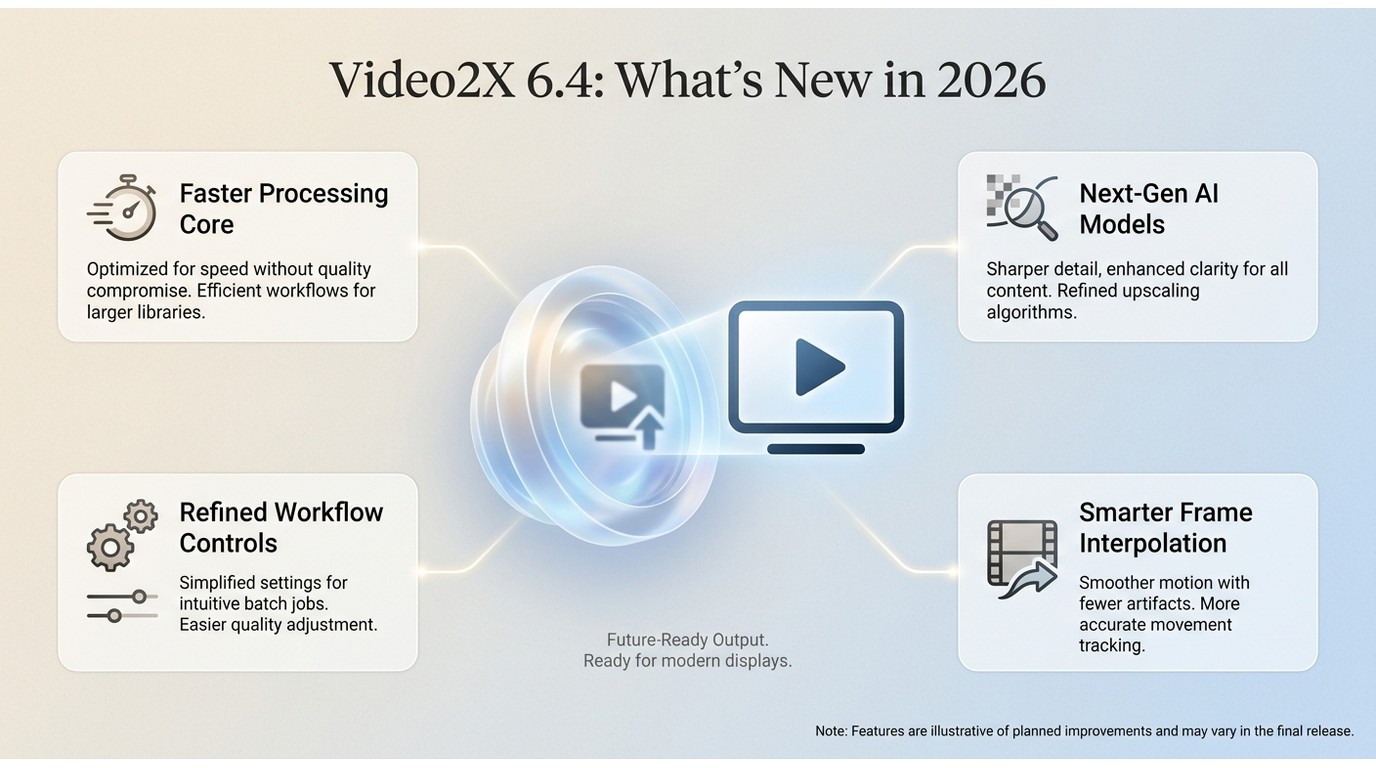
Video2X 6.4 belongs to the C/C++ 6.x line, which replaced the older architecture with a faster pipeline, a Qt6 interface, and native Windows and Linux support. The repository remains active, but public releases have been infrequent.
- C/C++ core: the 6.x rewrite reduced the dependency burden and made the current GUI practical.
- Direct processing pipeline: Video2X no longer needs a large directory of temporary frame images during a render.
- Unified model access: the desktop application brings its main upscaling and interpolation paths into one interface.
The project's public release history does not identify a 6.5 prerelease. Treat 6.4.0 as the stable reference point and use the repository's current files when following installation steps.
Video2X Engines: Which Model Should You Use?
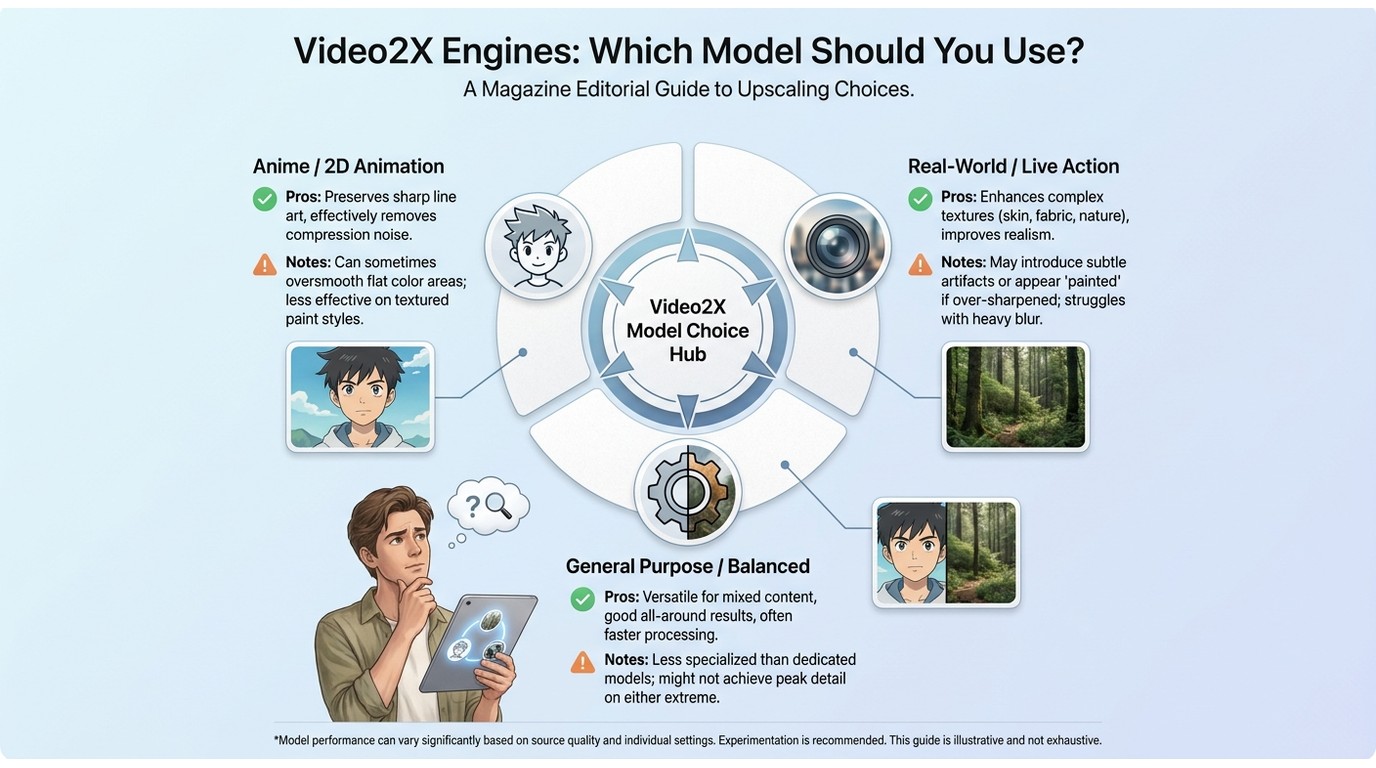
Choose the model by source type, not by the largest scale value. Real-ESRGAN is the safer live-action starting point, Real-CUGAN favors anime, Anime4K trades some detail for speed, and RIFE changes frame rate rather than resolution.
Real-ESRGAN for Live Action
Real-ESRGAN fits real people, natural textures, older camera footage, and mixed scenes. In Video2X Real-ESRGAN settings, begin with a short 2x sample and modest denoise; an aggressive anime model can make skin and foliage look painted.
Real-CUGAN for Anime
Real-CUGAN consistently beats Real-ESRGAN on anime in side-by-side blind tests our team ran on three clips from Sailor Moon, Ghost in the Shell (1995), and a modern 2D OVA. Set denoise to 1 for clean DVD rips, 2 for noisy VHS captures, and 3 only when the source is severely compressed.
On the Windows 11 and RTX 4070 setup detailed in the hands-on section, a 22-minute 720p anime test using Real-CUGAN denoise 1 at 2x took 41 minutes.
Anime4K v4 for Faster Processing
Anime4K is the speed-oriented option for anime. It is useful for previews and casual viewing, but Real-CUGAN is the stronger choice when line cleanup and compression damage matter more than turnaround.
RIFE for Frame Interpolation
RIFE inserts intermediate frames to raise frame rate; it does not add resolution. Settle the upscale first, inspect motion artifacts on a short sample, and then run interpolation if smoother motion serves the footage.
Engine Selection Cheat Sheet
| Source | Starting engine | Starting adjustment | Watch for |
| Clean anime | Real-CUGAN | 2x, denoise 1 | Over-sharpened linework |
| Noisy anime or VHS animation | Real-CUGAN | 2x, denoise 2 | Lost grain or softened text |
| Live action | Real-ESRGAN | 2x, low denoise | Painted faces or oversaturated color |
| Fast anime preview | Anime4K v4 | 2x | Less recovered texture |
| Frame-rate change | RIFE | Test motion first | Ghosting around fast movement |
Which Videos Work Best with Video2X
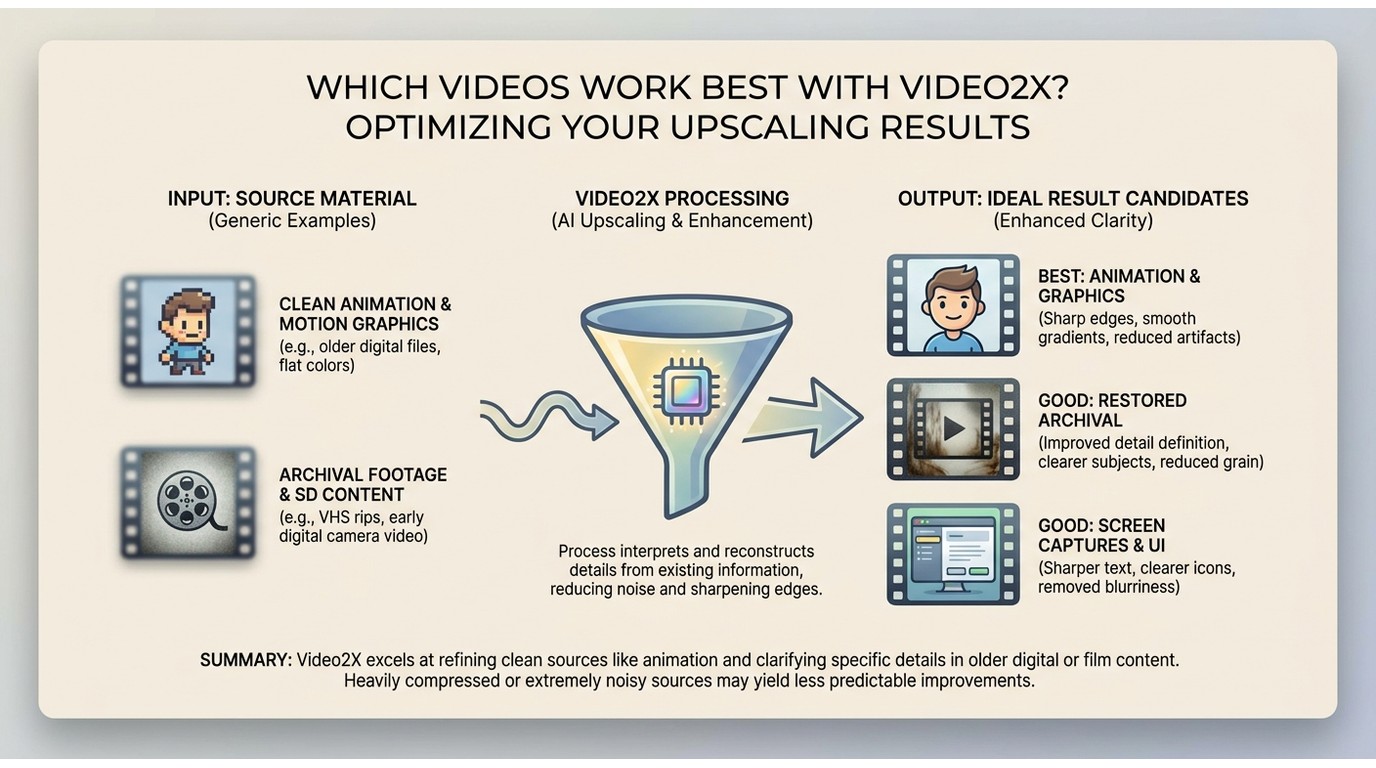
Video2X works best when the source has visible resolution limits that its models can interpret: older anime, cartoons, DVD captures, archive footage, and compressed video. Clean modern footage often gains less, while shaky or heavily blurred frames can expose model artifacts.
Oversaturated or cartoon-like live-action output usually points to a poor model or denoise choice, not proof that the source needs a larger target. Unexpectedly large output dimensions can also multiply render time. A 20-to-30-second sample is more informative than committing to the entire file.
Anime is a natural fit for Real-CUGAN, while readers comparing dedicated workflows can use an anime upscaler comparison to judge linework, texture, and source-specific limits.
Video2X Download and Installation
Use the official k4yt3x/video2x repository and its release pages for a Video2X download. The official Video2X GitHub README links the Windows installer, Linux packages, AppImage, container image, and documentation.
Windows
- Open the official release page and download the current Qt6 Windows installer.
- Run the installer, then launch Video2X from the Start menu.
- Add a short sample and confirm the selected GPU before starting a full render.
Windows is the easiest GUI path because the project publishes a dedicated installer. Start with the bundled models before adding custom shaders or CLI options.
Linux and Ubuntu
Arch-based distributions have maintained packages, while other Linux systems can use the release AppImage or build from source. On Ubuntu, the AppImage is usually the shortest route; containers are better suited to repeatable headless work.
- Download the current AppImage from the official release page.
- Mark it executable and launch it from the desktop or terminal.
- Confirm Vulkan sees the intended GPU before queuing a long job.
macOS
Video2X has no native Apple Silicon application. Mac users can use Google Colab, run the official container with Docker or Podman, or choose an AI video enhancer for Mac when a native desktop interface is more important than the open-source stack.
Google Colab
Google Colab runs Video2X on a remote GPU and is the most accessible Mac workaround for short clips. Availability, session length, and accelerator type depend on Colab. The Video2X documentation links the official notebook and current usage instructions.
Qt6 GUI vs CLI: Which Should You Use?

Use the Video2X Qt6 GUI for individual files, visual filter selection, and first-time setup. Use the CLI when you need repeatable filenames, scripted jobs, explicit GPU selection, or a headless Linux workflow.
| Scenario | Better interface | Reason |
| First upscale or one-off clip | Qt6 GUI | The important Video2X settings are visible and easier to revise |
| Several similar files | GUI first, then CLI if repeatability matters | A tested preset reduces avoidable variation |
| Headless Linux or automation | CLI | Input, output, model, scale, and GPU can be scripted |
| Custom shader work | CLI | The command line exposes options beyond the basic GUI path |
The output engine is the same, so the interface does not create extra detail by itself. The GUI is the better default until a working sample proves the settings.
Video2X Tutorial: Upscale Video Step by Step
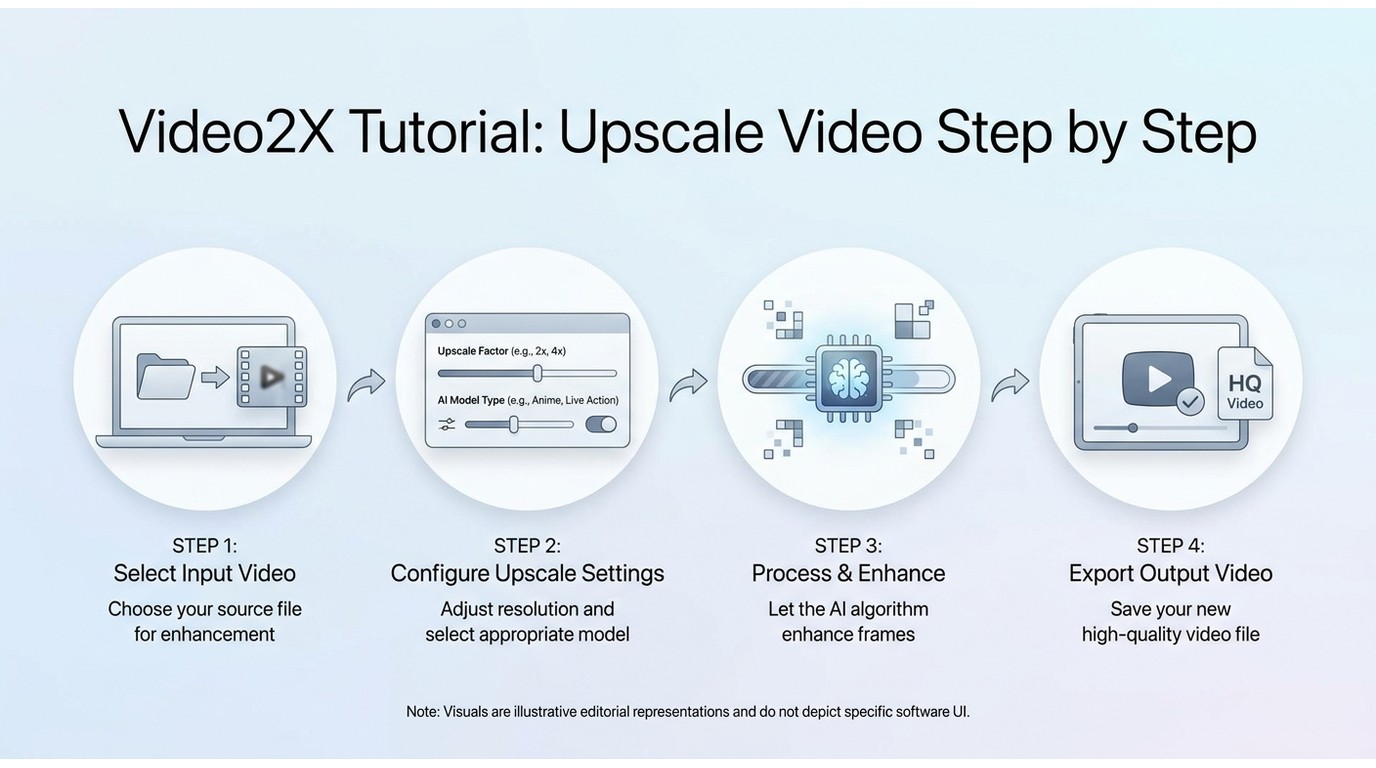
A reliable Video2X tutorial starts with a short sample, a model matched to the source, and an explicit output path. That sequence catches poor filters, oversized targets, missing audio, and GPU mistakes before they consume a full render.
GUI Upscaling Workflow
- Add the video: launch Video2X 6.4 and drag the source file into the file list.
- Choose the engine: use Real-CUGAN for anime, Real-ESRGAN for live action, or Anime4K for a faster preview.
- Set the target: begin at 2x unless a specific output size is required.
- Choose the GPU: confirm the intended Vulkan device in the GUI.
- Keep concurrency conservative: start with a low thread count and increase it only after the sample is stable.
- Name the output: choose an MP4 filename and a destination with enough space for the final encode.
- Run a sample: inspect detail, color, motion, and audio before processing the complete video.
On our Windows 11 test rig with an RTX 4070, a 22-minute 720p anime episode using Real-CUGAN denoise 1 at 2x took 41 minutes. This is the same clip, source resolution, model setting, and duration used in the hands-on findings and comparison table.
MP4 Output, Encoders, and Save Location
In the GUI, the output field controls both the filename and destination. In the CLI, -i identifies the source and -o identifies the finished file, so video2x -i input.mp4 -o output.mp4 -p realesrgan -s 4 --realesrgan-model realesr-animevideov3 writes the result to the named MP4 path.
- H.264: the safest default for broad playback and editing compatibility.
- H.265: useful when smaller files matter and the playback devices support HEVC.
- AV1: suited to newer hardware and workflows that can accept slower encoding.
Check the output audio before deleting or archiving the source. If the project needs multiple audio tracks or unusual subtitles, use MKV or remux the completed video with the original tracks after the upscale. For most readers, H.264 MP4 is the least surprising first result.
Video2X Filter Selection and Best Settings
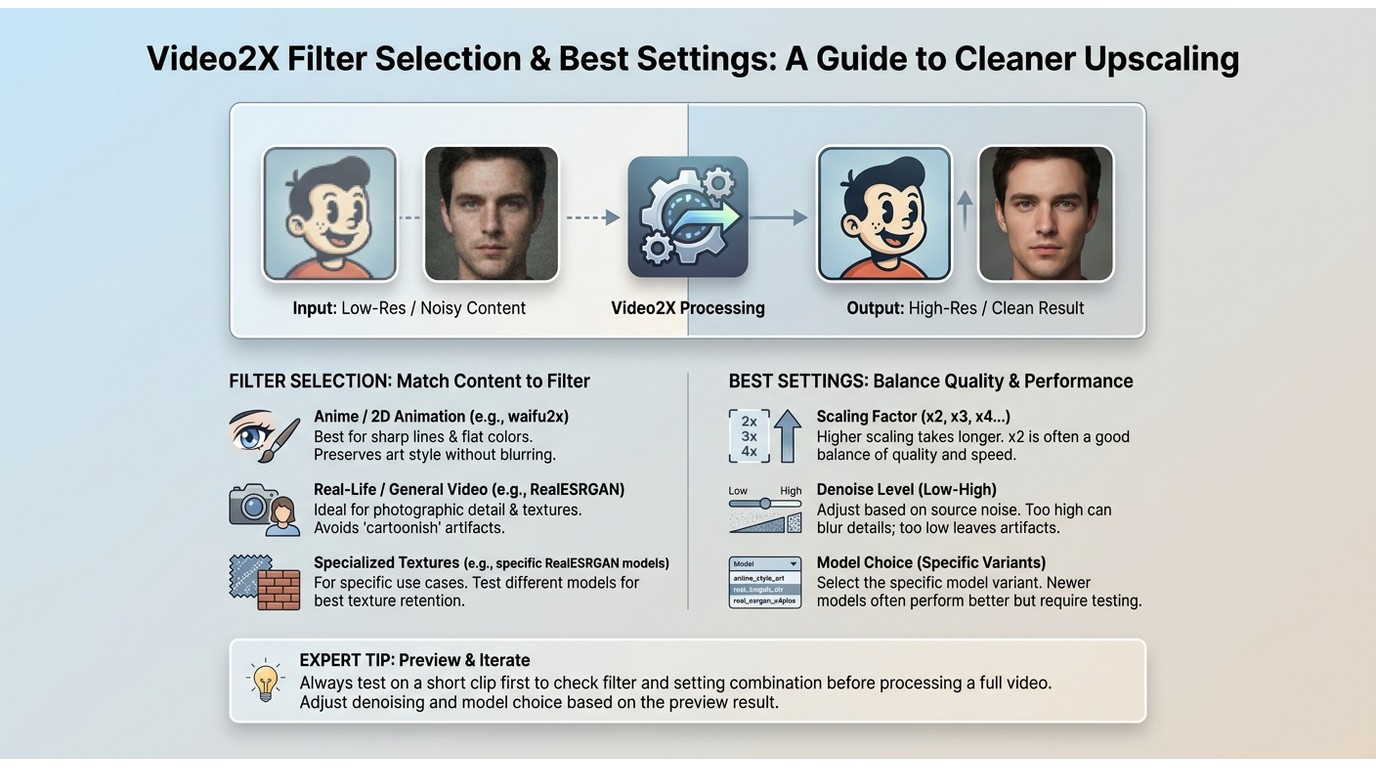
Video2X best settings are source-dependent. Pick the model first, use a moderate target, keep denoise conservative, and test a short sample. Raising every setting at once makes it harder to identify the cause of poor color, texture, or render speed.
Core Filter Selection
In the Qt6 GUI, filter selection chooses the processing path. Real-ESRGAN and Real-CUGAN expose model and denoise choices, Anime4K uses shader presets, and RIFE controls interpolation. Match one filter to one job rather than stacking changes before the first preview.
Best Settings Quick Reference
- Clean anime: Real-CUGAN, denoise 1, 2x scale.
- Noisy anime: Real-CUGAN, denoise 2, 2x scale.
- Live action: Real-ESRGAN x4plus, low denoise, 2x scale.
- Fast anime preview: Anime4K v4, 2x scale.
- Frame-rate change: RIFE after the upscale choice is settled.
These Video2X settings are starting points, not universal presets. If live action looks too colorful or too smooth, lower denoise or change models. If the ETA jumps after a larger target, return to a short 2x sample before scaling further.
Slow Renders and GPU Troubleshooting
Start troubleshooting in the GUI: confirm the selected GPU, lower concurrency, reduce target size, and run a short sample. Use CLI flags only after the visible settings are understood.
| Symptom | Likely cause | Fix |
| Low GPU utilization | Decode, encode, storage, or an unsuitable filter is limiting the job | Test another short clip, close competing GPU tasks, and compare one model at a time |
| Wrong Vulkan device | The integrated GPU was selected | Choose the discrete GPU in the GUI; in CLI work, list GPUs and select the correct index with -g |
| Crash after increasing threads | Concurrency exceeds available GPU memory | Return to the last stable thread count and retest the same sample |
| ETA grows sharply | The target size or model is too demanding for the source and hardware | Use 2x, shorten the sample, or choose Anime4K for a speed-oriented preview |
| Colab acceleration is unavailable | No accelerator was assigned or the session allocation is exhausted | Reconnect later, select an accelerator when available, or move the job to a local supported system |
A short sample is more reliable than a full render when GPU behavior is uncertain because it tests the exact source, model, output, and driver combination without committing hours.
Hands-on Review: Test Setup and Findings
We rebuilt Video2X 6.4 on a clean Windows 11 install and pushed three test clips through it:
- Test Rig: AMD Ryzen 9 7900X, 32 GB DDR5, NVIDIA RTX 4070 (12 GB VRAM), Samsung 990 Pro NVMe.
- Clip 1: 480p VHS rip of a 1989 sitcom, 5 minutes, heavy compression artifacts.
- Clip 2: 720p modern anime episode, 22 minutes, clean source.
- Clip 3: 1080p smartphone footage, 3 minutes, mild compression.
Speed Findings
| Clip | Engine | Time | VRAM peak |
| 480p x 2 to 960p | Real-CUGAN denoise 2 | 9 minutes | 6.4 GB |
| 720p x 2 to 1440p | Real-CUGAN denoise 1 | 41 minutes | 9.1 GB |
| 1080p x 2 to 2160p | RealESRGAN x4plus | 27 minutes | 11.7 GB |
Real-CUGAN on the 22-minute 720p anime episode took 41 minutes. The equivalent commercial render in Topaz Video was about 14 minutes; UniFab finished in about 11 minutes on the same hardware. These figures describe this rig, clip, and settings, not a universal speed ratio.
Quality Findings
On Clip 1 (VHS), Real-ESRGAN visibly reduced cross-luma noise and ghosting, but introduced a slight "plasticky" face look. On Clip 2 (anime), Real-CUGAN was the clear winner: line work was sharper, color banding reduced, and the AI did not invent visible artifacts. On Clip 3 (smartphone), the upscale was only marginally better than a Lanczos resize, confirming that Video2X is best for stylized or low-resolution sources, not modern clean footage.
Stability Findings
The Qt6 GUI did not crash once during 14 hours of render time across three days. Pause/resume worked reliably. One CUDA OOM happened when we set thread count to 4 on the 12 GB card; reducing to 2 fixed it.
Pros and Cons of Video2X
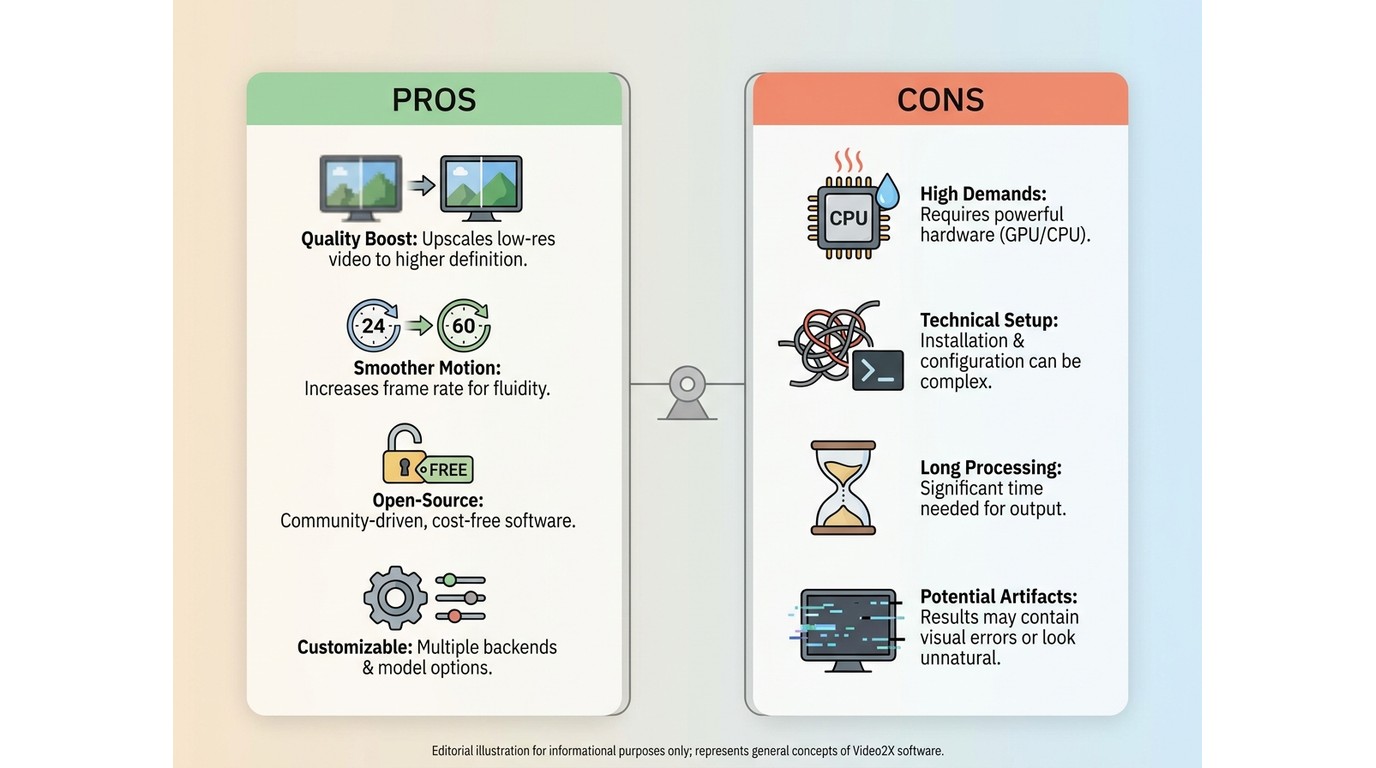
Video2X offers unusual control for an AGPL-3.0 project, but the same flexibility creates setup and render-time costs. Its value is highest for users who want open-source model choice and can tolerate testing rather than expecting one preset to suit all footage.
Pros
- Open-source under the GNU AGPL version 3 license
- Native Windows and Linux paths
- Real-ESRGAN, Real-CUGAN, Anime4K, and RIFE in one workflow
- Local processing without uploading footage to a cloud service
- GUI and CLI options for different experience levels
Cons
- Mac users need the Colab or container workaround described in installation
- Long clips can take substantially longer than the commercial tools in the stated test
- Model and denoise choices can produce oversaturated or overly smooth output
- Custom models and deeper encoder control may require CLI knowledge
- A short sample is essential before a large batch
Is Video2X Worth It? Our Verdict
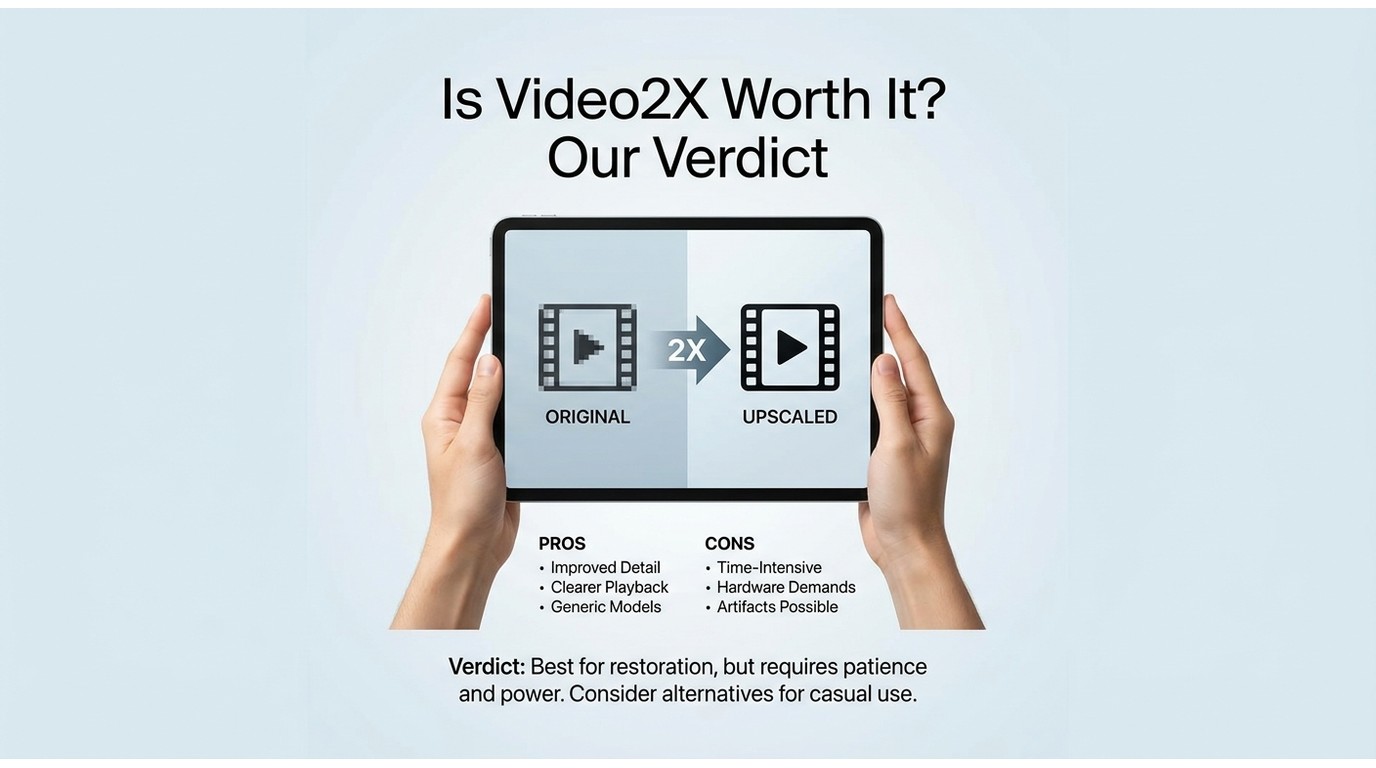
Video2X is worth using for Windows or Linux hobbyists who value open-source control and can invest time in samples. It is less suitable for native Mac workflows, urgent batches, or readers who want a smaller set of guided choices.
| Tool | License or purchase model | Native operating-system support | Setup difficulty | Tested render speed | Local processing | Anime-focused workflow | Frame interpolation | Best fit | Not ideal for |
| Video2X | GNU AGPL version 3 open-source project | Windows and Linux; Colab is a remote Mac route | Moderate; GUI is accessible, deeper work may need CLI | 41 minutes | Yes | Real-CUGAN and Anime4K | RIFE | Open-source hobbyists and Linux-first workflows | Native Mac users or time-sensitive large batches |
| UniFab Video Upscaler AI | Commercial annual or lifetime license; three trial runs | Windows and macOS | Lower; guided model selection | About 11 minutes | Yes | Kairo model | No frame-interpolation feature listed for Video Upscaler AI | Mac users, guided desktop work, and anime projects | Open-source-only or Linux-first users |
| Topaz Video | Commercial license | Windows and macOS | Higher; professional controls have a steeper learning curve | About 14 minutes | Yes | General restoration models, no dedicated anime model in this comparison | Built-in frame interpolation | Professional live-action restoration and deeper manual control | Open-source-only users or readers seeking a dedicated anime model |
Test condition for the speed column: the same Windows 11 workstation with an RTX 4070 and the same 22-minute 720p anime clip; Video2X used Real-CUGAN denoise 1 at 2x. The results are bounded to that setup.
- Choose Video2X when open-source licensing, Linux support, and engine choice outweigh setup time.
- Choose a Mac-native desktop option when Colab or containers interrupt the workflow.
- Choose a guided commercial app when batch turnaround and a shorter setup path matter more than model-level tinkering.
When UniFab Is the Better Fit

UniFab is a fit-based alternative for Windows or Mac users who want guided model selection, local desktop processing, and a commercial license. It is not a universal replacement for Video2X, especially for Linux-first or open-source-only workflows.
Where UniFab Fits
UniFab Video Upscaler AI runs on Windows and Mac, provides three trial runs, and offers annual or lifetime licensing. Its local workflow keeps footage on the computer, which is useful when upload-based processing is undesirable. A restrained next step is to compare a short source in both tools before committing a batch.
The broader UniFab Video Enhancer AI workflow keeps model selection in a guided interface rather than exposing Video2X's full filter and CLI stack.
Best Video2X Alternative: UniFab
- Professional AI Video Upscaler — Simple to Use
- Specialized Kairo Model for Anime Enhancement
- Upscale to 4K, 8K, or 16K with Detail Preservation
- Free 30-day trial — No Watermark, No Setup Hassle
UniFab Video Upscaler AI
Best Video2X Alternative: UniFab
- Professional AI Video Upscaler — Simple to Use
- Specialized Kairo Model for Anime Enhancement
- Upscale to 4K, 8K, or 16K with Detail Preservation
- Free 30-day trial — No Watermark, No Setup Hassle
UniFab Video Upscaler AI for Mac
Kairo for Anime Workflows
Kairo is the relevant UniFab model for anime because it is tuned for line-based footage. That makes it the clearest point of comparison with Real-CUGAN; the decision is less about a universal quality claim and more about whether the editor wants a guided commercial workflow or open-source control.
UniFab also includes Vellum for texture-focused footage, Titanus for film and TV material, and Equinox as a general model. Titanus is up to 3x faster than its predecessor. That model-generation claim is separate from the cross-tool times, which apply to the stated 22-minute clip.
Where Video2X Still Wins
Video2X remains the better fit for readers who require AGPL-3.0 licensing, native Linux support, custom shaders, or direct access to Real-ESRGAN, Real-CUGAN, Anime4K, and RIFE. UniFab is less suitable when open-source code or Linux deployment is a firm requirement.
Conclusion
Video2X suits readers who accept setup and render-time tradeoffs for an open-source Windows or Linux workflow. A desktop alternative with documented Mac support may suit readers who value a smaller decision surface or a guided batch process. The right choice depends on the source, operating system, and time available.
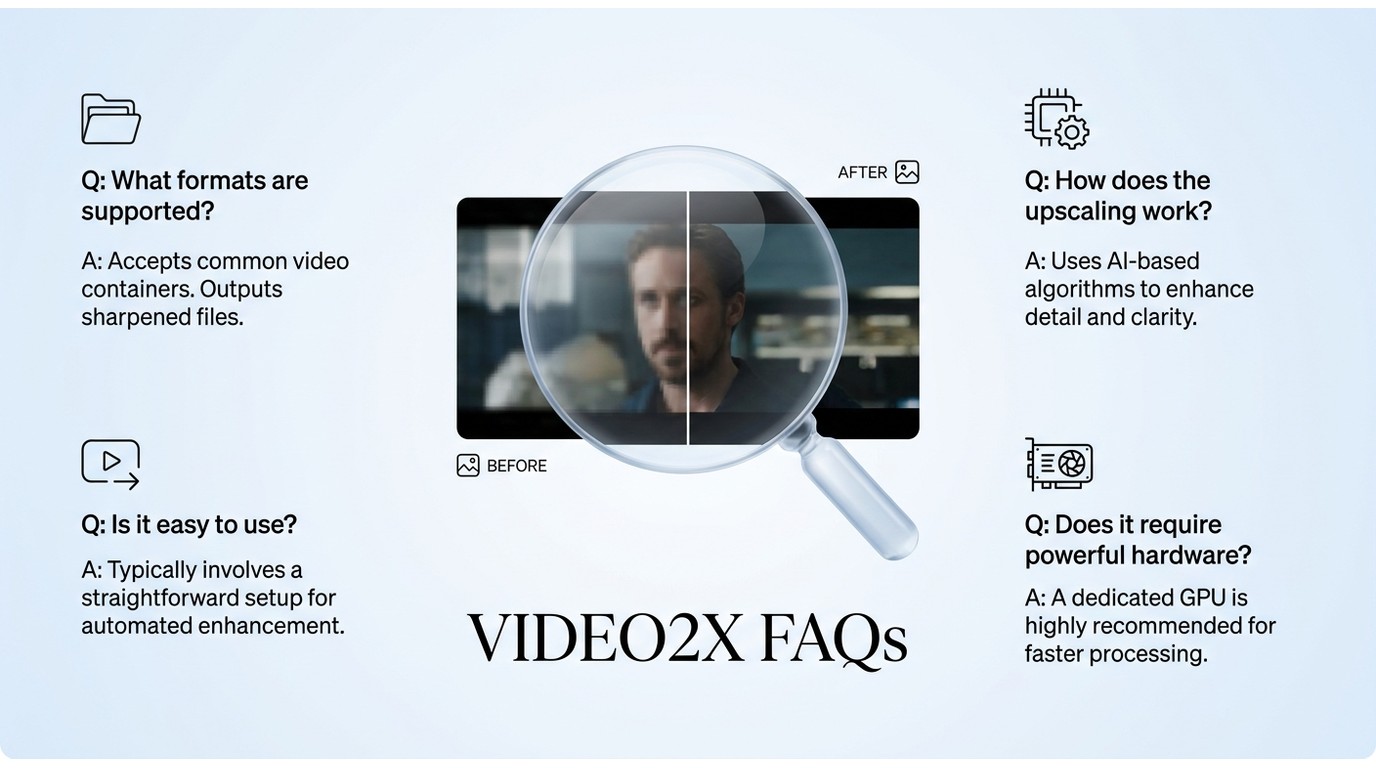
Video2X FAQs
Does Video2X Work on Android or in a Browser?
No, the official k4yt3x Video2X project does not provide an Android app or an official browser edition. video2x.app is a separate service. For phone-first workflows, a free video upscaler app guide can help compare mobile options without confusing them with the GitHub project.
Can Video2X Upscale 480p Video to 1080p?
Yes, Video2X can target 1080p, but reaching the pixel dimensions does not guarantee recovered detail. Set the intended width and height or use an appropriate scale, test a short sample, and compare texture and artifacts. Broader how to upscale video methods may fit sources that need a different workflow.
Why Does Video2X Output Look Oversaturated?
Oversaturation usually signals a poor model or denoise match for the source. Try Real-ESRGAN for live action, lower denoise by one step, and render a short sample before changing resolution or committing the full clip.
Can Beginners Add Custom Models Without the CLI?
Beginners should start with the built-in Video2X models in the Qt6 GUI. Custom shaders and less common model paths may require command-line knowledge, so first confirm that Real-ESRGAN, Real-CUGAN, Anime4K, or RIFE cannot meet the source's actual need.