![10 Best Adobe AI Audio Enhancer Alternatives [Free & Paid 2026]](https://artifact.dvdfab.me/2026/07/21/G_V6ywvq9hDsCXefWK-MrFfMeXySek9e/feature_cover.jpg)
Adobe is a sensible starting point for speech cleanup, but the right alternative depends on the job. Choose a speech cleaner for dialogue, a leveler for podcasts, a real-time filter for calls, a mastering service for music, a separator for stems, or an upmixer for surround playback. For Adobe AI audio enhancer alternatives, verify this point on the actual source before processing the complete file.
Quick Picks by Workflow
Quick answer: Adobe AI audio enhancer alternatives should be chosen or configured by matching the source, viewing device or platform, quality target, privacy needs, and export limits. Test a representative clip, compare the result at full size, and avoid settings that add artifacts or unnecessary recompression. The latest GSC comparison shows that the optimization priority is the page is not in a material click decline in this comparison window; optimization focuses on protecting gains and expanding high-intent query coverage.
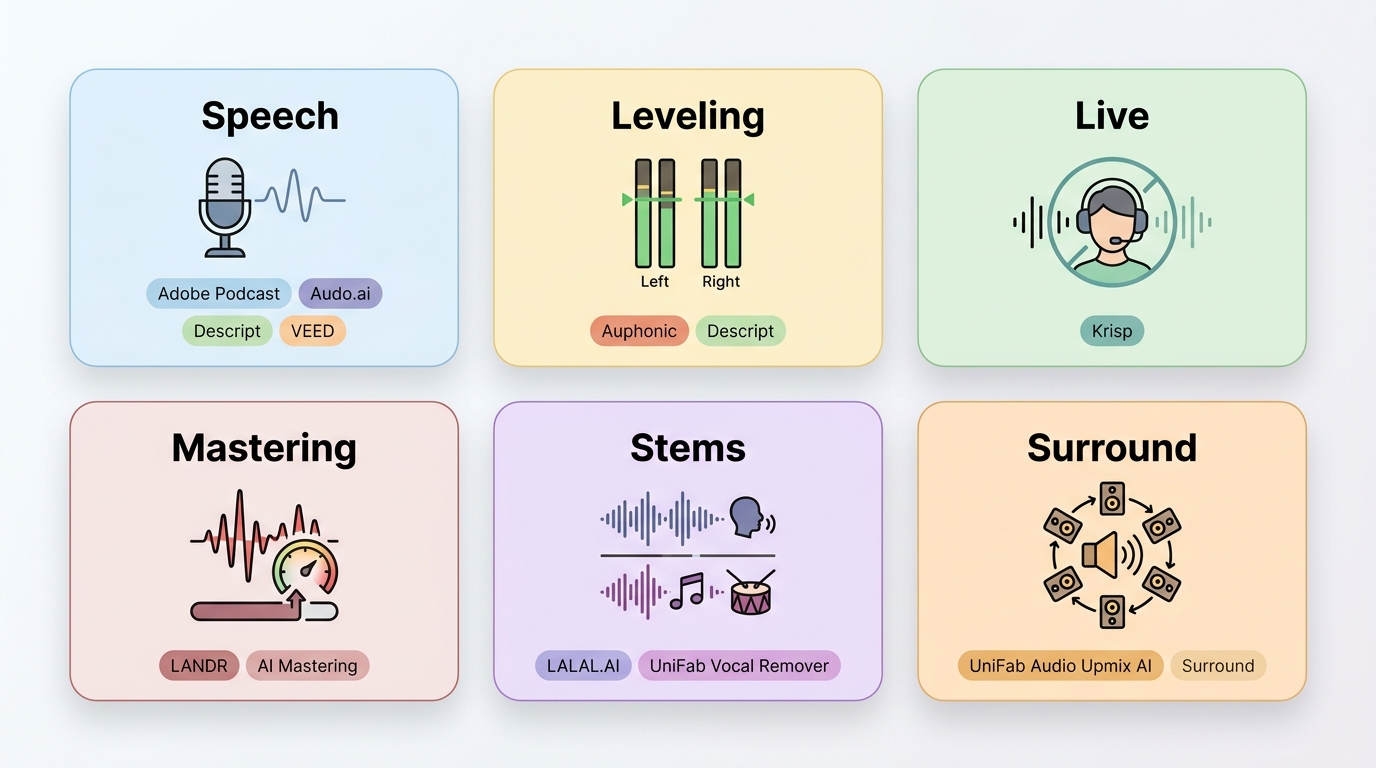
These Adobe audio enhancer alternatives solve different problems, so workflow fit matters more than the longest feature list. For quick speech cleanup, compare Adobe Podcast, Audo.ai, Descript, and Auphonic. Use Krisp for live calls, LANDR for music, LALAL.AI for separation, and UniFab for surround sound upmixing. For Adobe AI audio enhancer alternatives, verify this point on the actual source before processing the complete file.
- Speech cleanup: Adobe Podcast, Audo.ai, Descript, or VEED.
- Podcast leveling: Auphonic or Descript.
- Live meetings: Krisp.
- Music mastering: LANDR or AI Mastering.
- Stem separation: LALAL.AI or UniFab Vocal Remover.
- Video surround conversion: UniFab Audio Upmix AI.
A practical comparison uses the same short source clips: noisy speech, room echo, a weak voice, music, and a video file. Check processing time qualitatively, then listen for clipped words, softened consonants, pumping, or robotic tone. My editorial rule is simple: a smaller tool that fits the task is usually more useful than a broad suite used for the wrong job. For Adobe AI audio enhancer alternatives, verify this point on the actual source before processing the complete file.
Adobe Audio Enhancer Limits
The Adobe AI audio enhancer options set a useful baseline, but they serve different audiences. Adobe Podcast is an Adobe audio enhancer online for fast speech work, while Audition is a desktop editor built for detailed repair, mixing, and production. For Adobe AI audio enhancer alternatives, verify this point on the actual source before processing the complete file.
Adobe Podcast Enhance Speech
Adobe Podcast Enhance Speech is a browser-based Adobe Podcast alternative for spoken audio. As of July 2026, the Free plan provides 1 hour of enhancement per day, with a 30-minute and 500 MB limit per file. Premium raises the daily allowance to 4 hours and adds video support, bulk uploads, and enhancement controls. For Adobe AI audio enhancer alternatives, verify this point on the actual source before processing the complete file.
Suitable for: narration, interviews, and podcast dialogue that need fast noise and echo reduction.
Less suitable for: detailed spectral repair, music mastering, or recordings that require precise manual edits. Strong enhancement can make difficult speech sound processed, so preview the same sentence at more than one intensity. For Adobe AI audio enhancer alternatives, verify this point on the actual source before processing the complete file.
Adobe Audition
Adobe Audition is a professional desktop editor for spectral repair, multitrack mixing, noise reduction, and controlled post-production. It suits editors who need to isolate a problem and shape the result, but it is excessive for someone who wants a one-click speech cleaner. For Adobe AI audio enhancer alternatives, verify this point on the actual source before processing the complete file.
Suitable for: critical voice-over, restoration, multitrack production, and projects that need manual control. For Adobe AI audio enhancer alternatives, verify this point on the actual source before processing the complete file.
Less suitable for: occasional cleanup where speed and a short learning curve matter most. Current US pricing is not stated here because it was not confirmed for this update. For Adobe AI audio enhancer alternatives, verify this point on the actual source before processing the complete file.
When an Alternative Makes More Sense
An alternative makes sense when Adobe's audio enhancer file limits, cloud workflow, control level, or intended use do not match the project. Local audio enhancement can also be preferable for large or private video files that should remain on the computer.
- Choose speech restoration for noise, room echo, and muffled dialogue.
- Choose podcast leveling for consistent loudness across speakers and music beds.
- Choose music mastering for tonal balance, dynamics, and release preparation.
- Choose real-time cancellation for Zoom, Microsoft Teams, and similar calls.
- Choose stem separation when vocals or instruments must be isolated.
- Choose surround upmixing when stereo video audio needs 5.1 or 7.1 playback.
For device-specific background-noise instructions, a dedicated how-to guide is more useful than expanding this comparison into separate phone and desktop tutorials.
10 Adobe Audio Enhancer Alternatives Compared
The list includes direct speech cleaners and adjacent specialists. They should not be treated as interchangeable: a natural sounding speech enhancer is judged by voice intelligibility, while a mastering tool, separator, call filter, or AI audio enhancer for video has a different success criterion.
UniFab Audio Upmix AI: Surround Sound Conversion
UniFab Audio Upmix AI is a local surround specialist for Windows and Mac. It rebuilds stereo audio as 5.1 or 7.1 surround sound in video workflows, supports batch processing, and exports video in MP4 or MKV containers.
Suitable for: local video projects that need surround playback from a stereo source.
Less suitable for: repairing noisy dialogue, mastering a music release, or filtering a live call. It is a surround-upmix specialist, not a direct Adobe speech-cleanup substitute.
Mono and stereo describe different channel layouts; the full distinction is covered in this mono versus stereo guide.
The included AI Vocal Remover addresses a separate task: isolating vocals or accompaniment for remix and editing workflows.
Audio Noise Reducer: Free Online Option
Audio Noise Reducer is presented as a free online audio enhancer for basic noise cleanup, but its current official operating status, limits, supported formats, and registration requirements were not independently confirmed.
Suitable for: a quick experiment with a non-sensitive clip when the service is available.
Less suitable for: confidential recordings, repeatable production work, or any project that depends on documented limits and support.
VEED: Browser-Based Video and Audio Cleanup
VEED combines browser-based video editing with background-noise cleanup, making it relevant when audio enhancement is one step inside a video workflow. Its current paid starting price is not included because it was not confirmed for this update.
Suitable for: creators who want browser-based editing, captions, and basic audio cleanup in one workspace.
Less suitable for: private files that should stay local or demanding restoration that needs detailed spectral tools.
Descript: Podcast Editing and Studio Sound
Descript centers audio cleanup inside a transcription-led podcast and video workflow. Its current plan structure includes Free, Hobbyist, Creator, Business, and Enterprise, replacing the older Pro-plan framing.
Suitable for: podcasters and video editors who want to edit spoken content through a transcript while applying Studio Sound.
Less suitable for: someone who needs a small standalone cleanup utility without transcription, project management, or broader editing features.
AI Mastering: Automated Music Mastering
AI Mastering belongs in the music-mastering category, not the speech-restoration category. It is intended to shape loudness, dynamics, and tonal balance, but its current availability and free allowance were not confirmed from an official page for this update.
Suitable for: musicians exploring an automated finishing pass for a mix.
Less suitable for: dialogue denoising, meeting audio, or repairing a reverberant interview.
Audo.ai: One-Click Speech Cleanup
Audo.ai focuses on quick speech cleanup with automatic noise reduction and level adjustment. It currently advertises 20 free enhancement minutes per month and a Creator plan at $12 per month.
Suitable for: short voice recordings that need fast, low-effort cleanup.
Less suitable for: restoration work that requires granular control over frequencies, individual noises, or multitrack edits.
LANDR: Music Mastering and Distribution
LANDR combines automated music mastering with distribution and collaboration services. It is an active music platform, but its current US tier price is not included because it was not confirmed for this update.
Suitable for: musicians who want mastering connected to a release and distribution workflow.
Less suitable for: spoken-word cleanup or users seeking a direct Adobe Podcast alternative.
Krisp: Real-Time Meeting Noise Cancellation
Krisp is a real-time microphone and speaker filter for online meetings rather than an uploaded-file enhancer. Its current structure centers on Core and its higher team plan; Core is listed at $16 monthly or $8 per user per month when billed annually.
Suitable for: live calls in Zoom, Microsoft Teams, Google Meet, and similar communication apps.
Less suitable for: prerecorded podcast repair, music, video post-production, or exporting an enhanced media file.
LALAL.AI: Stem and Voice Separation
LALAL.AI specializes in separating stems, voices, noise, echo, and reverb. Separation is different from general speech enhancement, and output quality can vary with the complexity, overlap, and condition of the source recording.
Suitable for: remixing, vocal isolation, instrument extraction, and targeted separation tasks.
Less suitable for: automatic podcast leveling or a single control that polishes an entire spoken recording.
Auphonic: Podcast Leveling and Cleanup
Auphonic automates podcast leveling, loudness normalization, noise reduction, and post-production. Its Free plan includes 2 processed hours per month; Free output includes an Auphonic jingle and has restrictions on some workflow features.
Suitable for: podcasts, interviews, and recurring spoken-word production that needs consistent loudness.
Less suitable for: precise waveform editing, music mastering, or users who cannot accept a branded jingle in Free output.
Enhance Video Audio with UniFab
UniFab handles local audio enhancement for video when the goal is stereo-to-surround conversion, not dialogue repair. It accepts video on Windows and Mac, supports MP4 and MKV output containers, and can process multiple files in a batch.
30-day Free Trial with full feature access!
- Step 1
Open UniFab, go to "All Features" to choose the Upmix mode, and load your video to upmix.
- Step 2
Adjust the output parameters of your file to customize the video quality, audio codec, channel, etc.
- Step 3
Touch the Start button to begin the upmix process at an accelerated speed.
My practical judgment is to prefer local processing when a video is large, private, or part of a repeatable desktop workflow. Choose another category when the actual problem is hiss, room echo, vocal intelligibility, or music mastering.
Choosing the Right Alternative
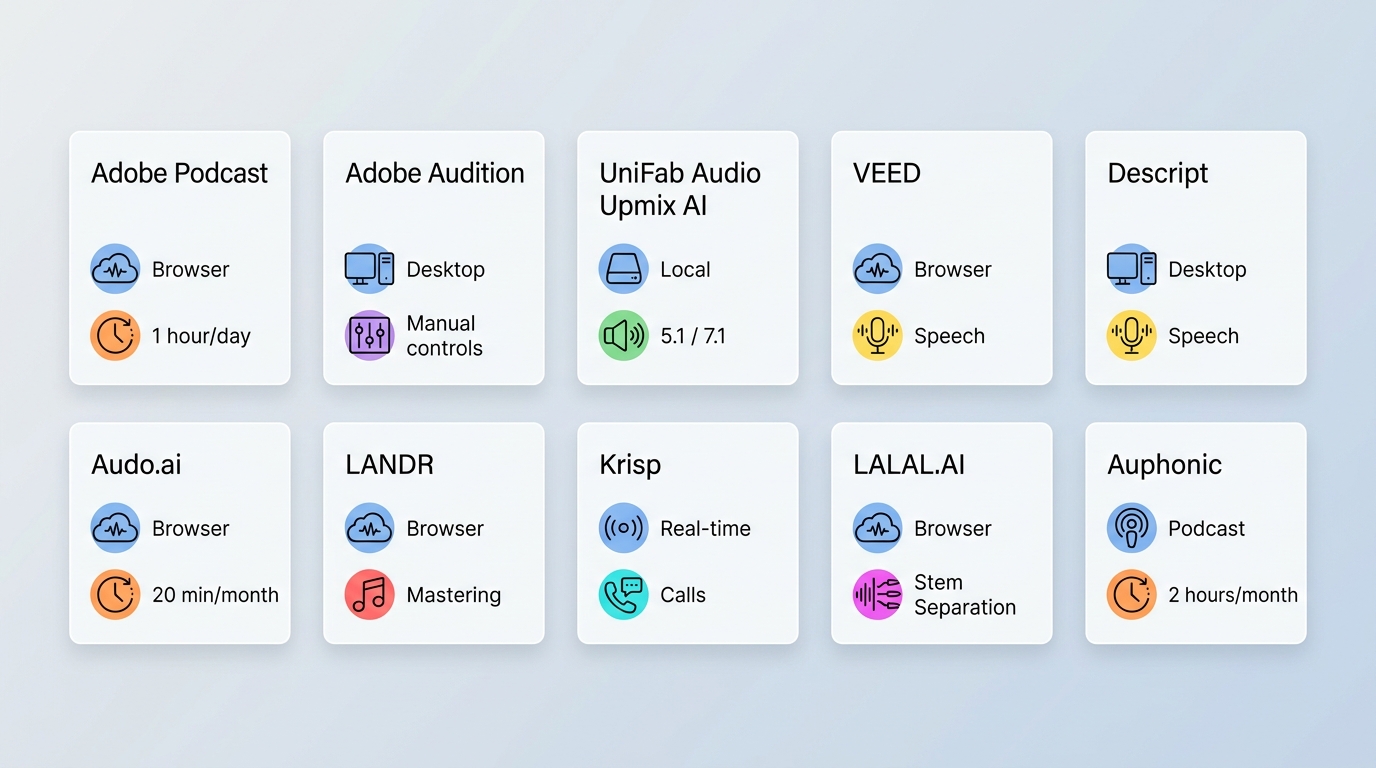
Start with the task, then compare processing mode, limits, controls, and artifact risk. The table uses concise verified values where available and marks other fields as not confirmed rather than filling them with assumptions.
| Tool | Primary workflow | Mode | Suitable for | Less suitable for | Access or allowance | Duration or size limit | Video support | Controls | Batch | Export or output | Naturalness or artifact risk | Pricing note |
| Adobe Podcast Enhance Speech | Speech cleanup | Browser | Narration and interviews | Detailed manual repair | Free: 1 hour/day | 30 minutes and 500 MB per file on Free | Premium supports video | Premium enhancement controls | Premium bulk upload | Enhanced speech media | Strong settings may sound processed | No dollar price stated |
| UniFab Audio Upmix AI | Surround upmixing | Local desktop | Stereo video to 5.1/7.1 | Noise repair and music mastering | Not stated | Not stated | Yes, local video | Channel and output settings | Yes | MP4 or MKV video with 5.1/7.1 audio | Check channel balance on the target system | No price stated |
| Audio Noise Reducer | Basic noise cleanup | Browser | Quick non-sensitive tests | Documented production workflows | Not confirmed | Not confirmed | Not confirmed | Not confirmed | Not confirmed | Not confirmed | Service details are not confirmed | Not confirmed |
| VEED | Video and audio cleanup | Browser | Creator editing workflows | Private local processing | Not stated | Not stated | Yes | Basic cleanup and editing | Not stated | Edited video or audio | Preview speech after noise removal | Current price not confirmed |
| Descript | Podcast and video editing | Desktop/cloud workflow | Transcript-led editing | Small standalone cleanup jobs | Free plan available | Plan-dependent | Yes | Studio Sound within editor | Plan-dependent | Podcast or video project | Heavy cleanup can alter voice character | Free, Hobbyist, Creator, Business, Enterprise |
| AI Mastering | Music mastering | Online service | Automated mix finishing | Speech restoration | Not confirmed | Not confirmed | Not confirmed | Not confirmed | Not confirmed | Mastered music file | Result depends on the source mix | Not confirmed |
| Audo.ai | Speech cleanup | Browser | Short voice recordings | Granular restoration | 20 free minutes/month | Allowance-based | Not stated | Automatic processing | Not stated | Cleaned speech file | Compare clipped words and consonants | $12/month Creator |
| LANDR | Music mastering/distribution | Cloud platform | Music release workflows | Speech cleanup | Not stated | Plan-dependent | Not the core workflow | Mastering choices | Plan-dependent | Mastered music | Result follows mix quality and style | Current US price not confirmed |
| Krisp | Live-call noise cancellation | Real time | Meetings and calls | Uploaded media repair | Plan access | Plan-dependent | No file workflow | Meeting noise controls | Not applicable | Filtered live audio | Strong filtering may soften speech | Core: $16 monthly or $8/user/month annually |
| LALAL.AI | Stem and voice separation | Browser/app | Vocal and instrument isolation | Podcast leveling | Not stated | Plan-dependent | Supports media separation workflows | Stem selection | Plan-dependent | Separated stems | Complex overlap can leave artifacts | Current price not stated |
| Auphonic | Podcast leveling | Cloud/desktop workflow | Consistent spoken-word output | Manual waveform repair | Free: 2 hours/month | Allowance-based | Workflow-dependent | Automated leveling and cleanup | Some workflow features restricted on Free | Leveled podcast audio | Review music beds and speaker transitions | Free output includes an Auphonic jingle |
The practical upshot is that the processing category narrows the field faster than pricing alone. After that, use the same difficult passage to compare intelligibility, voice character, controls, file handling, and the amount of manual correction still required.
Final Recommendations by Use Case
There is no single overall winner because these tools target different stages of an audio workflow. The most reliable decision is to match the input, desired output, privacy requirement, and tolerance for manual editing.
- Quick spoken-word cleanup: compare Adobe Podcast and Audo.ai on the same clip.
- Transcript-led podcast or video editing: consider Descript.
- Podcast loudness and automated post-production: consider Auphonic.
- Browser video editing with noise cleanup: consider VEED.
- Live-call filtering: choose Krisp.
- Music mastering: evaluate LANDR or AI Mastering as music tools, not speech cleaners.
- Stem extraction: use LALAL.AI or a dedicated vocal separator.
- Local stereo-to-surround video processing: UniFab fits that job, but it is not for noisy-dialogue repair.
Mobile video sound enhancer apps and broad video-audio roundups are separate topics. Keeping those searches separate makes this Adobe-alternative decision clearer and prevents a general app list from obscuring the actual workflow choice.
Frequently Asked Questions
What is the best way to use Adobe AI audio enhancer alternatives?
Start with the source quality, target platform, privacy requirement, and final export settings. For Adobe AI audio enhancer alternatives, use a short representative clip first, compare the result at 100% view, and keep the original file so you can revise the workflow without generation loss. This also applies to Adobe Podcast Enhance alternatives.
Is Adobe AI audio enhancer alternatives free?
Some Adobe AI audio enhancer alternatives workflows are free, while others limit file size, duration, resolution, credits, watermarks, or export formats. Verify the current plan on the provider's official page because free allowances can change. This also applies to AI audio enhancer.
Does Adobe AI audio enhancer alternatives reduce quality?
Adobe AI audio enhancer alternatives can reduce quality when it adds unnecessary recompression, aggressive enhancement, or incorrect output settings. Match resolution, frame rate, codec, and bitrate to the source and delivery platform, then inspect motion, edges, audio sync, and fine detail. This also applies to audio enhancement software.
Which formats or devices support Adobe AI audio enhancer alternatives?
Support depends on the chosen application and workflow. Check operating system, input and output formats, hardware acceleration, browser upload limits, and whether the destination platform accepts the selected settings before processing a full project. This also applies to Adobe Podcast Enhance alternatives.
How long does Adobe AI audio enhancer alternatives take?
Processing time varies with duration, resolution, codec, AI model, hardware, and export settings. A short test provides the most reliable estimate; online tools also add upload and download time, while local tools depend more heavily on CPU and GPU performance. This also applies to AI audio enhancer.
Can beginners use Adobe AI audio enhancer alternatives?
Yes. Beginners can use Adobe AI audio enhancer alternatives by following a conservative workflow: duplicate the source, choose an appropriate preset, process a short sample, compare before and after, and only then export the complete file. This also applies to audio enhancement software.
What should I check before choosing a tool for Adobe AI audio enhancer alternatives?
Compare source fit, output quality, privacy, platform support, batch capability, watermark policy, free limits, price, and control. Do not choose a Adobe AI audio enhancer alternatives tool only because it advertises the highest resolution, frame rate, or AI label. This also applies to Adobe Podcast Enhance alternatives.
Is desktop or online processing better for Adobe AI audio enhancer alternatives?
Online processing is convenient for short, non-sensitive files, but it can impose upload, retention, watermark, credit, and resolution limits. Desktop processing is usually better for private, long, high-resolution, or batch Adobe AI audio enhancer alternatives work. This also applies to AI audio enhancer.
What are the main limitations of Adobe AI audio enhancer alternatives?
The main limits are source quality, missing detail, motion artifacts, incompatible formats, hardware demand, upload constraints, and generation loss. Adobe AI audio enhancer alternatives cannot always reconstruct information that was never captured, so results should be described realistically. This also applies to audio enhancement software.
How does Adobe AI audio enhancer alternatives compare with manual editing?
Automated Adobe AI audio enhancer alternatives is faster and easier to repeat, while manual editing gives more local control and may avoid overprocessing. A practical workflow uses automation for the first pass and manual review for difficult scenes, transitions, faces, text, and audio sync. This also applies to Adobe Podcast Enhance alternatives.