Flixier reviews often leave one practical question unresolved: does its browser-first workflow justify the current pricing when uploads, long projects, and mixed user feedback matter? Flixier is worth considering for quick collaborative editing, but it is a weaker fit for local-first restoration or unreliable upstream bandwidth.
This review examines the Flixier editor, its 2026 AI workflow, current plans, safety and privacy trade-offs, public ratings, practical limitations, and the scenarios where another type of video tool makes more sense.
What Is Flixier?
Flixier is an online video editor that runs in a modern browser and handles the main processing away from the local device. It combines a conventional timeline with cloud media handling, collaboration, captions, recording, and AI-assisted creation.
- Core workflow: Import media, edit on a browser timeline, collaborate, and export.
- Common users: Social creators, educators, marketers, and teams sharing projects.
- Device fit: Useful on Windows, Mac, Chromebooks, and other devices with a current browser.
The practical advantage is access: a low-spec computer can remain usable because the heaviest processing is not confined to its hardware. The trade-off is that source media must move through an online workflow.
{{YELLOW_INFO_1}}
Flixier Features and 2026 AI Updates
Flixier editor features now span two layers: familiar timeline work and generative or transcript-based assistance. The useful question is not how many AI labels appear, but whether those tools reduce handoffs in a real project.
- Timeline editing: Cut, trim, crop, layer clips, add transitions, adjust color, and arrange audio.
- Recording: Capture a screen, camera, or both for tutorials and presentations.
- Text and speech: Generate subtitles, edit captions, create voiceovers, and work from a transcript.
- Visual creation: Generate footage inside the timeline, then trim and combine it with uploaded media.
- Collaboration: Share projects and coordinate edits without passing large project files between devices.
What Changed in 2026
Flixier AI tools now include Eva, transcript editing, in-timeline video generation, and access to multiple generation models alongside the regular timeline. This makes AI output editable in context instead of treating generation as a separate destination.
The update is most useful for creators who want a prompt or transcript to accelerate a first cut. Editors who need fine keyframing, deep color work, or extensive local media control may still find the browser controls too shallow.
Using the Flixier Video Editor
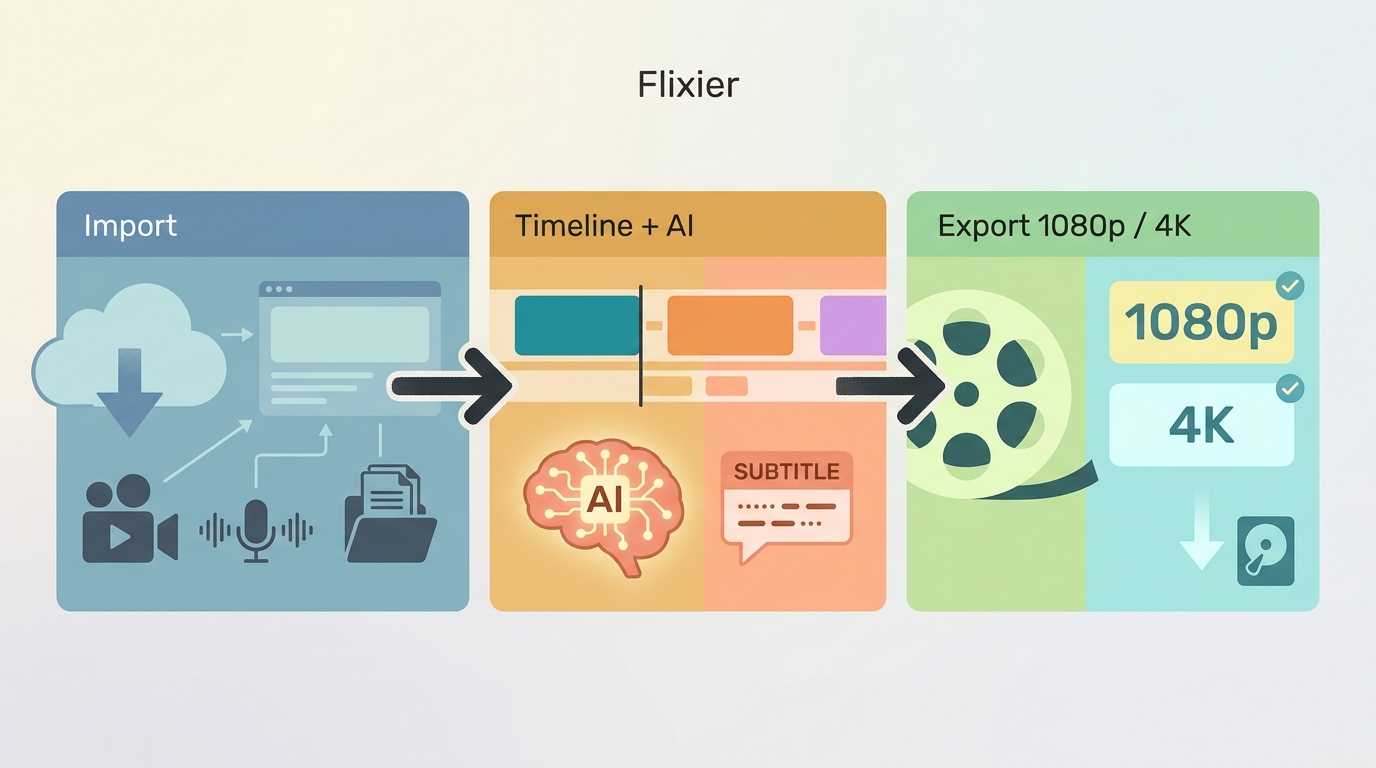
The Flixier video editor follows a four-stage browser workflow: import, edit, add AI assistance, and export. Organize source files before uploading, especially on slower connections, because the experience still depends on transferring media to the service.
Step 1: Import Media
- Open the official Flixier editor and sign in.
- Select Import, then choose a local file, supported cloud source, or media URL.
- Wait for the media to finish preparing before building the timeline.
Step 2: Edit Your Video
- Drag clips onto the timeline and arrange their sequence.
- Split, trim, crop, and layer clips as needed.
- Add text, captions, music, B-roll, transitions, and basic visual adjustments.
Step 3: Use AI Tools
- Generate or edit subtitles from the transcript panel.
- Use Eva for guided edits or content assistance within the project.
- Create visual material in the timeline, then review timing, continuity, and audio before export.
Step 4: Export Your Video
- Select Export after reviewing the full timeline.
- Choose the available format and resolution for the active plan.
- Set the project title or thumbnail, start the export, and download or share the result.
For deadline-sensitive work, leave time to review the completed file rather than treating the export button as the end of the quality check.
Flixier Pricing and Free Plan Limits
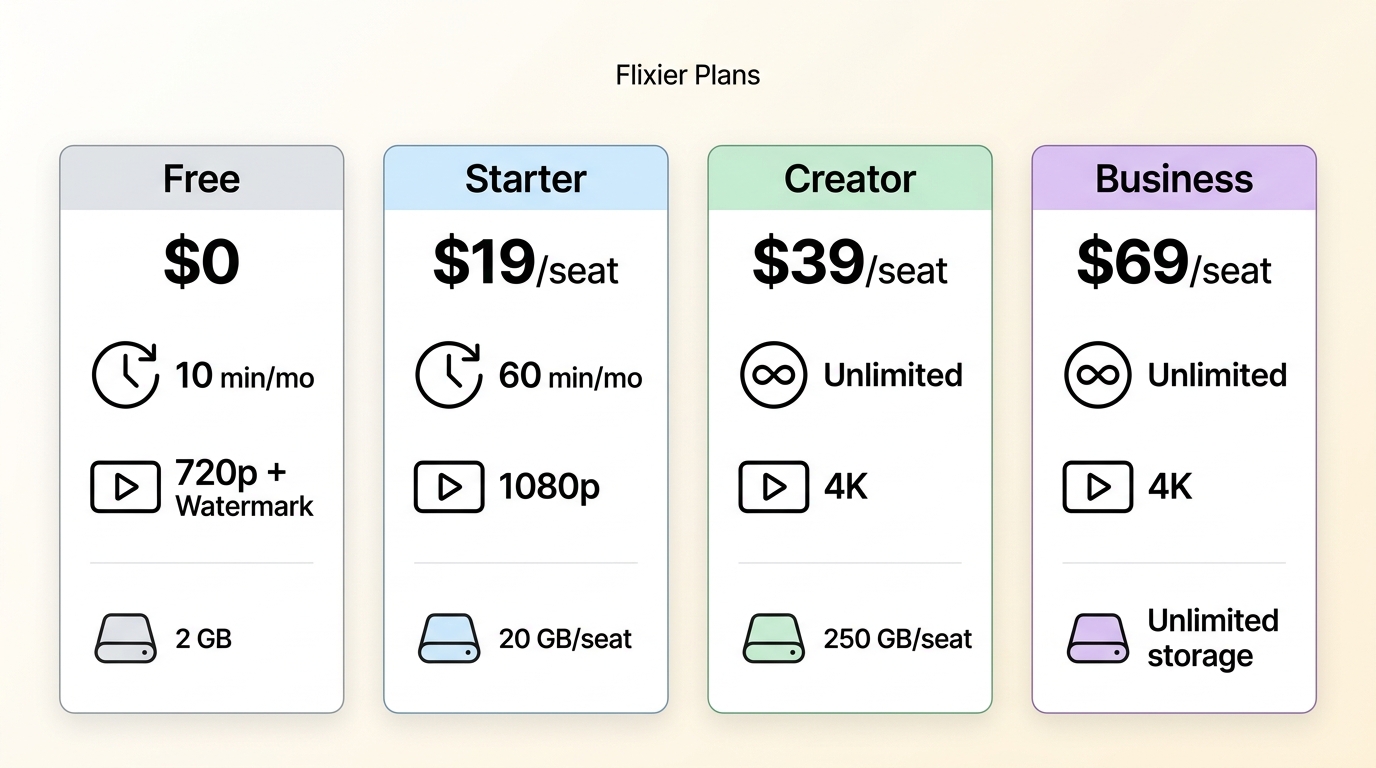
Flixier pricing now uses four US tiers: Free, Starter, Creator, and Business. The Flixier free plan is useful for short tests, while paid tiers expand resolution, exports, storage, and collaboration.
| Plan | Monthly price | Export allowance | Resolution and storage | Watermark |
| Free | $0 | 10 min/month | 720p; 2 GB | Yes |
| Starter | $19/seat | 60 min/seat/month | 1080p; 20 GB/seat | No |
| Creator | $39/seat | Unlimited | 4K; 250 GB/seat | No |
| Business | $69/seat | Unlimited | 4K; unlimited storage | No |
US monthly pricing and listed allowances as of August 2026.
Is Flixier free? Yes, but the free tier has a watermark, a 720p ceiling, and a short monthly export allowance. Starter fits occasional 1080p work, while Creator and Business are structured for more frequent output and team needs.
My editorial judgment is to choose a tier by the footage you can upload and finish in a month, not by the longest feature list. AI credits and storage matter only when the underlying browser workflow already fits the project.
Is Flixier Safe and Legit?
Flixier is a legitimate active browser service, but “is Flixier safe?” is better answered as a workflow decision than an absolute guarantee. The official service avoids local installation, while its cloud model requires uploading media and account data.
- Use the official Flixier website and avoid unrelated download packages using a similar name.
- Check whether client, workplace, or confidential footage is suitable for an online editing workflow before upload.
- Use a unique password and review sharing access before inviting collaborators.
- Keep a local copy of important source files and finished exports.
The safety decision is therefore less about malware from the official browser editor and more about whether cloud handling matches the sensitivity, ownership, and retention needs of the footage.
Flixier Reviews Across Platforms
Current Flixier reviews show a mixed but useful pattern: the strongest numeric signal is Trustpilot, while other platforms offer weaker or less complete evidence. That supports a qualified Flixier review, not a claim that all users share the same experience.
The current Trustpilot listing for Flixier shows the clearest public rating snapshot.
| Platform | Score | Review count | Evidence status | Scope note |
| Trustpilot | 4.1/5 | 253 | Current platform page | Broad consumer feedback |
| G2 | Not established | Not established | No firm current figure | Qualitative context |
| Capterra | 4.0/5 | Not shown | Search snippet only | Limited numeric signal |
Positive feedback commonly centers on browser access, quick setup, and an approachable timeline. Negative feedback is less uniform: some users raise billing expectations or support responsiveness, while creator discussions mention upload time, subtitle timing, unclear export errors, and long-form reliability.
Those concerns are decision signals rather than a prediction of any one project. The practical takeaway is to test the complete import-to-export path with representative footage before committing a deadline-sensitive workflow.
Flixier Pros and Cons
Flixier’s main advantages come from browser access and collaboration; its main risks come from uploads, lighter control depth, and project reliability. The trade-off becomes clearer when the workflow is evaluated instead of the feature count.
User-friendly and well-designed interface
Fast video rendering within around 3 minutes
AI & Cloud integration & no need for separate software installation
It works on any device, OS, and web browser
Frame rate goes down while giving reviews on video edits
It takes time to learn to editing process
Some features are tricky to tackle while editing
Users face glitches while using it
Rendering long videos is a challenge
- Pros: No desktop installation, usable on low-spec devices, shared browser projects, cloud rendering, captions, transcript editing, and in-timeline AI generation.
- Cons: Mandatory uploads can erase the speed benefit on slow upstream connections, while long projects create more exposure to import, subtitle, export, and recovery friction.
- Control limits: Editors who depend on detailed keyframes, color workflows, plug-ins, or local media management may outgrow the timeline.
- Account expectations: Billing cadence, renewal terms, and support response should be understood before a team standardizes on the service.
My editorial take is that Flixier earns its place through accessibility, not editing depth. It becomes harder to recommend when the uploaded footage is large, the deadline is rigid, or troubleshooting needs to be predictable.
Who Flixier Is Best For
The decisive question is whether browser collaboration is more valuable than local control. Flixier fits teams sharing projects across devices; it is less convincing when upstream bandwidth, long-form deadlines, or deep desktop control dominate the job.
Best for:
- Creators editing short or medium-length social, training, marketing, or presentation videos.
- Teams that value shared access, comments, and browser-based handoffs.
- People using Chromebooks or low-spec computers that struggle with local rendering.
- Editors who want captions, transcript edits, and AI-generated material in one timeline.
Not ideal for:
- Users with slow or restricted upload bandwidth.
- Long-form projects where import and export reliability carry high deadline risk.
- Editors who need detailed desktop controls, plug-ins, or local-first media management.
- Workflows involving sensitive footage that should not be uploaded to a cloud editor.
The fit is straightforward: choose Flixier when access and collaboration solve the largest problem. Teams comparing browser editors may also recognize the same upload trade-off in veed. Choose a desktop workflow when file control and restoration depth matter more.
Flixier vs UniFab at a Glance
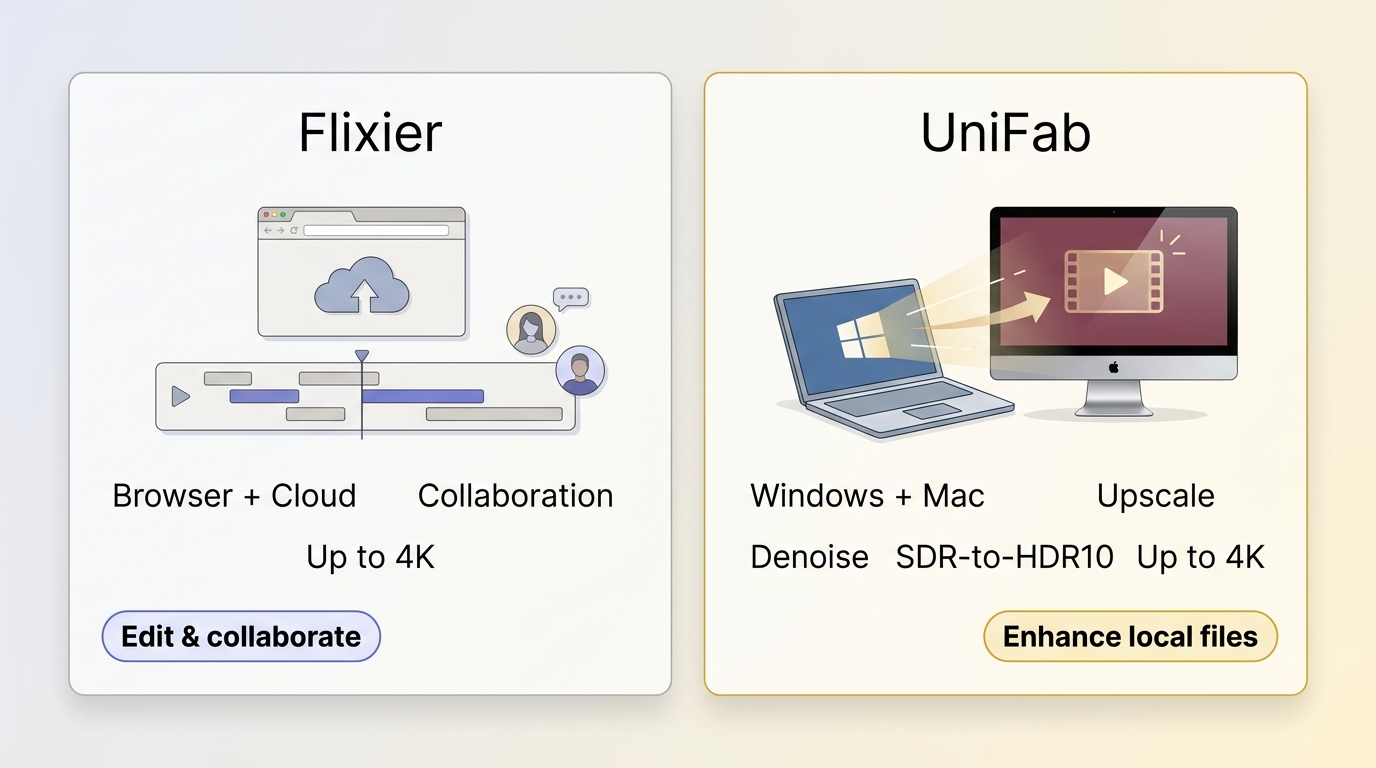
Flixier and UniFab solve different jobs. Flixier is an online video editor for timeline work and collaboration; UniFab is a Windows and Mac desktop suite centered on restoring local files.
| Tool | Primary workflow | Processing location | Maximum stated output | Restoration features |
| Flixier | Editing and collaboration | Browser and cloud | Up to 4K | Enhancement within editor |
| UniFab All-In-One | Local restoration | Windows and Mac | Up to 4K | Upscale, denoise, SDR-to-HDR10 |
Flixier uses monthly per-seat tiers, while UniFab offers a lifetime-license route. The Flixier video enhancer belongs inside a broader editing workflow; UniFab’s restoration tools focus on improving an existing source before delivery or a later edit.
The comparison is not a universal ranking. A collaborative edit and a restoration pass are different stages, and some projects may use both.
UniFab for Local Video Restoration
UniFab All-In-One is a Windows and Mac option for local video restoration, with AI upscaling, denoising, and SDR-to-HDR10 conversion. It suits editors repairing source files; it is not designed around shared browser timeline collaboration.
UniFab All-In-One
- All-in-One Suite for Video & Audio Enhancement
- Built-in Editing Tools for Seamless In-App Workflow
- Enjoy a 30-Day Free Trial — No Watermarks, No Limits
UniFab All-In-One
UniFab All-In-One
- All-in-One Suite for Video & Audio Enhancement
- Built-in Editing Tools for Seamless In-App Workflow
- Enjoy a 30-Day Free Trial — No Watermarks, No Limits
UniFab All-In-One for Mac
For soft or low-resolution footage, the UniFab AI video enhancer can upscale output to the verified 4K limit while targeting clearer edges and texture recovery. This video quality enhancer use case focuses on improving the source before delivery.
Low-light or compressed footage can go through UniFab’s denoise tool to reduce visible noise while retaining useful detail. SDR-to-HDR10 conversion is relevant when the source and display target support an HDR delivery workflow.
Enhance a Local Video File
A short restoration workflow keeps the decisions visible: inspect the source, choose a targeted model, preview the result, then export in the format required by the next stage.
30-day Free Trial with full feature access!
- Step 1Launch UniFab, Select Mode, and Import Your Video
Open UniFab, choose the desired module, and upload your video to start enhancing it.
- Step 2Edit Your Footage
You can edit your footage directly on this page.
- Step 3Adjust Output Settings (Optional)
Customize output settings such as format, quality, frame rate, audio, codecs, and subtitles according to your preferences.
- Step 4Start Video Enhancement
Press the 'Start' button to begin enhancing your video.
Is Flixier Worth It?
Flixier is worth it when browser access, collaboration, and off-device processing outweigh the cost of uploads and lighter control depth. It is a less comfortable choice for slow upstream connections, deadline-sensitive long projects, or editors who want a local-first restoration workflow.
For the narrower task of restoring a local source, UniFab is a relevant Flixier alternative. For collaborative assembly, captions, and shared browser editing, Flixier remains the more natural fit.
My recommendation is to judge Flixier with a representative project: upload the kind of footage you normally use, complete an edit, generate captions if needed, and inspect the downloaded export. That single workflow check is more informative than choosing from a feature list alone.
{{FREE_TRIAL_BTN_1}}
Flixier FAQ
These four answers cover quick decisions not fully resolved by the tables above.
Is Flixier an app or a browser editor?
Flixier’s core workflow is a browser editor, which is why people searching for a Flixier app may not find a conventional desktop installation. Open it in a supported browser, sign in, and work from the online project space.
Can I export from Flixier without a watermark?
Yes. Starter, Creator, and Business exports are listed without a Flixier watermark. The Free plan adds the watermark, so it works better as a short evaluation tier than a client-delivery workflow.
Is Flixier better than CapCut for team projects?
Flixier is better aligned with teams that prioritize browser collaboration, shared projects, and off-device processing. CapCut may fit creators centered on its own editing ecosystem and social workflow. The deciding factor is how the team collaborates, not a universal quality ranking.
Does Flixier work without an internet connection?
No. Flixier depends on an online browser and cloud processing for the core editing workflow. A desktop editor is the more appropriate category when offline access and local file control are requirements.