To remove background noise from video, match the tool to your device and noise type, apply reduction conservatively, preview the dialogue, then export a cleaned copy. Steady hum is usually easier to reduce than wind, echo, music, or another voice that overlaps the speaker. For how to remove background noise from video, verify this point on the actual source before processing the complete file.
What Background Noise Can Be Removed?
Quick answer: how to remove background noise from video should be chosen or configured by matching the source, viewing device or platform, quality target, privacy needs, and export limits. Test a representative clip, compare the result at full size, and avoid settings that add artifacts or unnecessary recompression. The latest GSC comparison shows that the optimization priority is the page is not in a material click decline in this comparison window; optimization focuses on protecting gains and expanding high-intent query coverage.
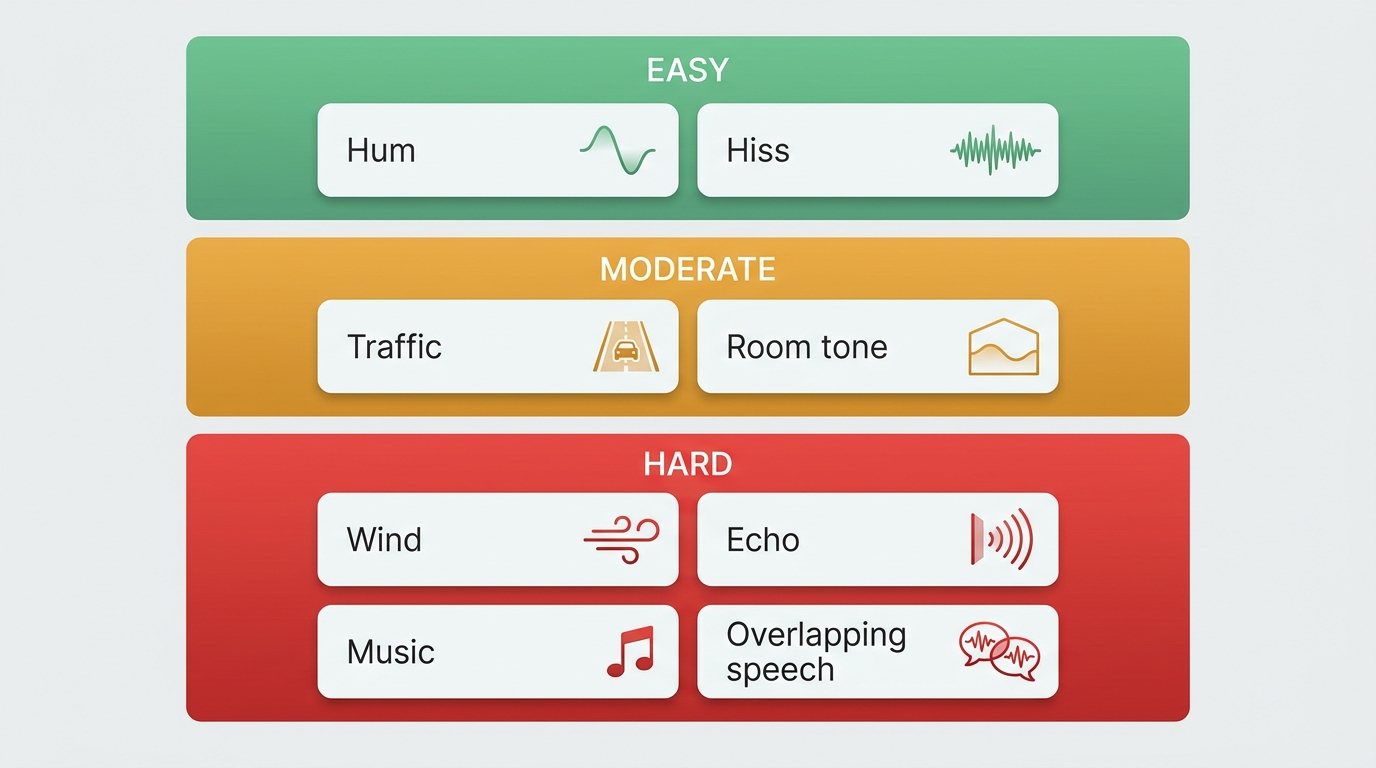
Background noise removal from video is most successful when the unwanted sound is steady and distinct from speech. Voice quality preservation becomes harder when wind, music, echo, or background conversation occupies the same frequencies as the main voice. For how to remove background noise from video, verify this point on the actual source before processing the complete file.
Hum, Hiss, and Steady Noise
Steady hum, fan noise, electrical buzz, and hiss are the most predictable targets when you need to reduce background noise in video. A profile-based editor can learn a short sample of the noise, while an AI model can identify it automatically. For how to remove background noise from video, verify this point on the actual source before processing the complete file.
- Steady hum or hiss: Usually responds well to a noise profile or moderate AI reduction.
- Intermittent clicks and pops: Often need a separate repair tool rather than one broad denoise pass.
- Traffic or room tone: May improve, but changing sound levels can leave audible traces.
My editorial rule is simple: remove enough noise to make speech comfortable, not enough to make the recording unnaturally silent. If consonants become dull or metallic, reduce the effect strength and compare against the untouched source. For how to remove background noise from video, verify this point on the actual source before processing the complete file.
Wind, Echo, and Overlapping Speech
A background voice remover cannot reliably isolate two people when their speech overlaps. Strong wind is similarly difficult because it spreads across much of the voice range, while echo often needs dereverberation, meaning a process that reduces reflected room sound. For how to remove background noise from video, verify this point on the actual source before processing the complete file.
- Mild wind: AI cleanup may reduce low rumble, but clipped or masked words cannot be rebuilt reliably.
- Echo: Speech-enhancement or dereverberation tools can tighten the voice, although heavy treatment may sound thin.
- Music or another speaker: Separation may be partial when the sounds overlap the main dialogue.
For irreplaceable footage, keep the original file and create a separate working copy before processing. That makes it possible to retry with lighter settings if the first pass damages the voice. For how to remove background noise from video, verify this point on the actual source before processing the complete file.
AI vs. Traditional Noise Reduction
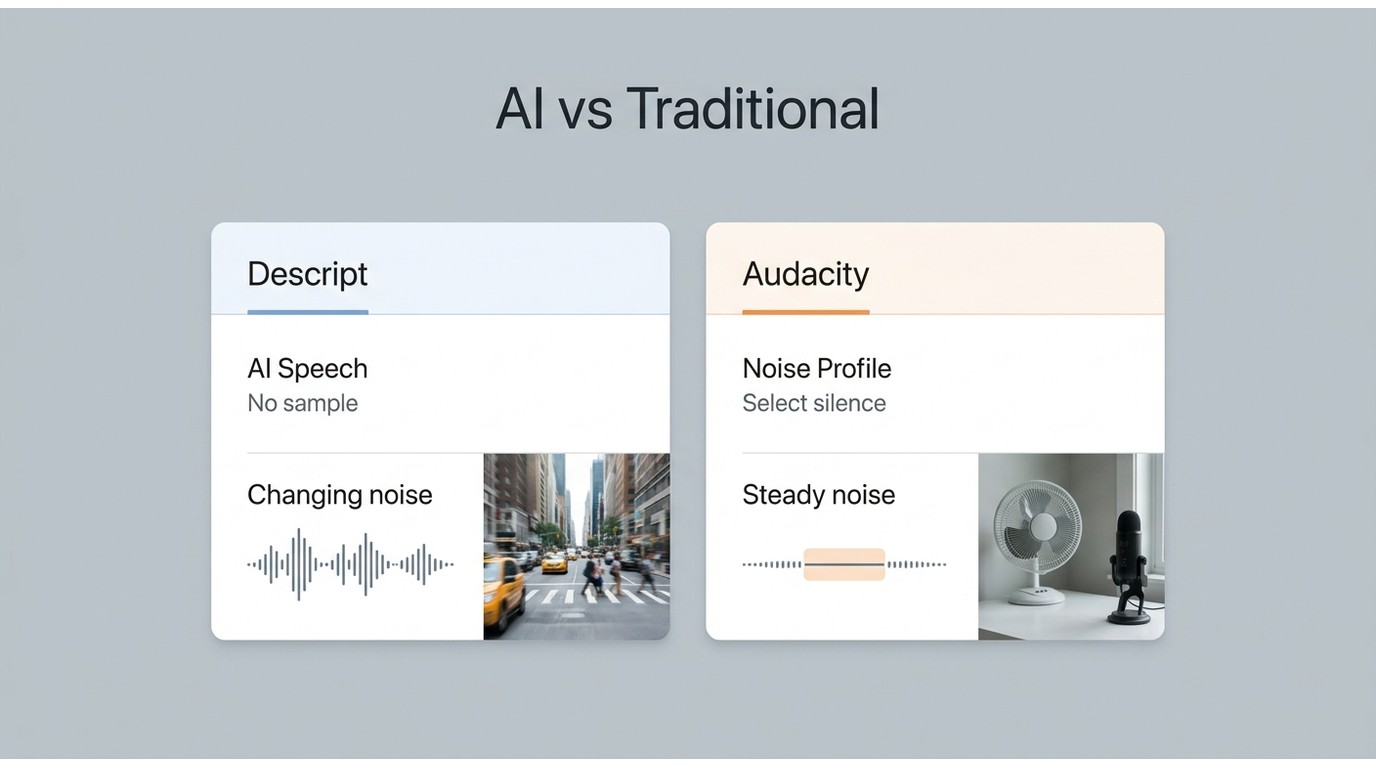
AI video noise removal is usually faster for mixed real-world sound, while traditional profile-based reduction gives more manual control over steady noise. Neither method guarantees clean dialogue when unwanted sound covers the same frequencies as the speaker. For how to remove background noise from video, verify this point on the actual source before processing the complete file.
- AI reduction: Identifies speech and common noise patterns without requiring a silent sample. It suits quick cleanup of changing room noise, traffic, or mixed ambience.
- Profile-based reduction: Learns a selected sample of hum or hiss and subtracts similar sound from the track. It suits consistent noise and users who want adjustable controls.
One-click cleanup is not ideal when the original voice is already weak, clipped, or distorted. In that case, a lighter pass, manual editing, or rerecording a voiceover is safer than pushing the reduction control until artifacts appear. For how to remove background noise from video, verify this point on the actual source before processing the complete file.
Remove Video Noise on Any Device
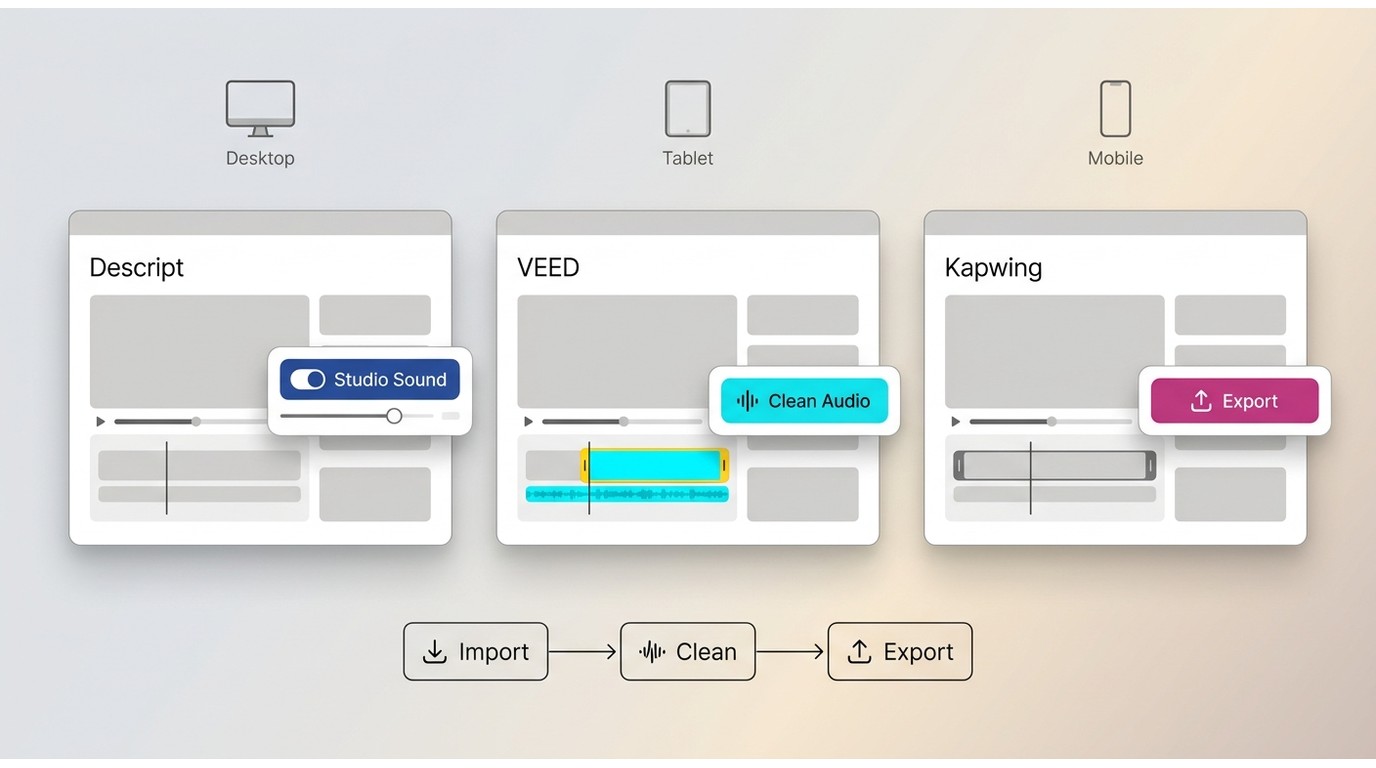
The fastest way to remove background noise from video is to choose a device-appropriate editor, import the clip, apply moderate noise reduction, preview the voice, and export the cleaned video as MP4 or another supported format. For how to remove background noise from video, verify this point on the actual source before processing the complete file.
- Choose a browser, desktop, or mobile tool that accepts the source format.
- Upload or import the video and select its audio track.
- Apply denoise or clean-audio processing at a conservative strength.
- Preview speech through headphones and compare it with the original.
- Export the cleaned result and keep the untouched source file.
Device chooser: A browser tool suits a quick one-off edit, Windows or Mac software gives more privacy and control, and PowerDirector covers phone-first iPhone video noise removal and Android video noise removal. For broader mobile sound-enhancer app comparisons, use the dedicated sound-enhancer app guide. For how to remove background noise from video, verify this point on the actual source before processing the complete file.
1. Adobe Premiere Pro for Windows and Mac
Premiere Pro suits an existing video-editing project where noise cleanup must stay inside the timeline. It offers adjustable audio effects, but it is more software than a user needs for a single short clip. For how to remove background noise from video, verify this point on the actual source before processing the complete file.
For a wider look at related Adobe audio tools, see these Adobe audio enhancer alternatives.
How to clean the audio track
- Open the project and select the clip that contains the unwanted noise.
- Open the audio effects area and locate the current denoise or noise-reduction control. Interface labels can differ by release.
- Apply the effect to the audio clip, then open its controls.
- Start with a low amount, play a dialogue-heavy section, and raise the setting only while the voice remains natural.
- Balance the output level if cleanup makes the track sound quieter, then export the project.
Suitable for: Editors already finishing a video in Premiere Pro. Less suitable for: Someone who wants a fast upload-clean-download workflow. For how to remove background noise from video, verify this point on the actual source before processing the complete file.
2. Audacity with an MP4 Remux Workflow
Audacity is a practical no-cost choice for MP4 audio cleanup when the noise is steady and manual control matters. It edits the audio track, so the cleaned track must be placed back into the original video afterward. For how to remove background noise from video, verify this point on the actual source before processing the complete file.
- Extract the audio from the MP4 with a video editor or import a supported audio track into Audacity.
- Select a short section containing noise but no speech, then capture its noise profile.
- Select the track, apply moderate noise reduction, and preview a speech-heavy section.
- Export the cleaned audio in a format accepted by the video editor.
- Replace the original audio track or remux it, which means putting the cleaned audio and unchanged video into a new MP4 container without re-editing the picture.
Suitable for: Steady hiss or hum and users who want free desktop control. Less suitable for: Anyone who expects one-step video import and export. For how to remove background noise from video, verify this point on the actual source before processing the complete file.
3. Descript for Browser-Based Speech Cleanup
Descript suits speech-led clips that also need transcript-based editing. Its Studio Sound workflow can clean up video audio quickly, but upload time, plan allowances, and processing intensity matter on longer projects. For how to remove background noise from video, verify this point on the actual source before processing the complete file.
- Import the video into a project and allow the speech track to process.
- Enable Studio Sound or the current speech-enhancement control.
- Preview several sections, especially quiet words and sibilant speech.
- Lower the intensity if the speaker starts to sound synthetic, then export the cleaned video.
Suitable for: Interviews, tutorials, and spoken presentations that benefit from text-based editing. Less suitable for: Sensitive footage that should remain on a local computer.
4. VEED for Quick Online Exports
VEED is a browser-based video noise reducer for short, quick edits where convenience matters more than detailed restoration controls. The workflow stays inside a video editor, so the cleaned result can be exported without a separate audio remux.
- Upload the video and select the clip in the timeline.
- Use the current clean-audio or noise-reduction option.
- Preview the dialogue and check whether music or ambience has been reduced too aggressively.
- Export in an available video format under the selected plan.
Suitable for: A quick browser edit with captions or simple trimming. Less suitable for: Large private files or work that needs detailed frequency control.
5. Kapwing for Collaborative Online Editing
Kapwing works as a background sound remover inside a shared browser workspace. It is useful when several people review captions, timing, and audio, although free-plan branding and export limits should be checked before committing to the workflow.
- Upload the clip to a workspace and select its audio.
- Apply the current clean-audio control.
- Preview the result with the rest of the team and reduce processing if the voice loses texture.
- Export the project under the workspace plan.
Suitable for: Collaborative social and training videos. Less suitable for: Local-only processing or detailed audio repair.
Podcastle Status and Current Alternatives
Podcastle is not counted as one of the six current methods. The podcastle.ai address redirects to Async, and the former Magic Dust workflow could not be confirmed on the successor page, so use a verified browser option above instead.
6. PowerDirector for iPhone and Android
PowerDirector is the phone-first option for iPhone and Android video noise removal. It keeps trimming, denoise, preview, and export in one mobile project, although labels and access can differ between app releases and store plans.
For a closer look at the editor beyond denoise, read the PowerDirector review.
- Create a project and import the video from the phone.
- Select the clip, open its audio tools, and choose the current denoise control.
- Adjust strength while previewing speech through headphones.
- Complete any trimming or caption edits, then produce the video in an available format.
Suitable for: Phone-shot clips that need editing and export on the same device. Less suitable for: Long projects where a desktop timeline and local storage are easier to manage.
Compare Noise Removal Tools and Limits
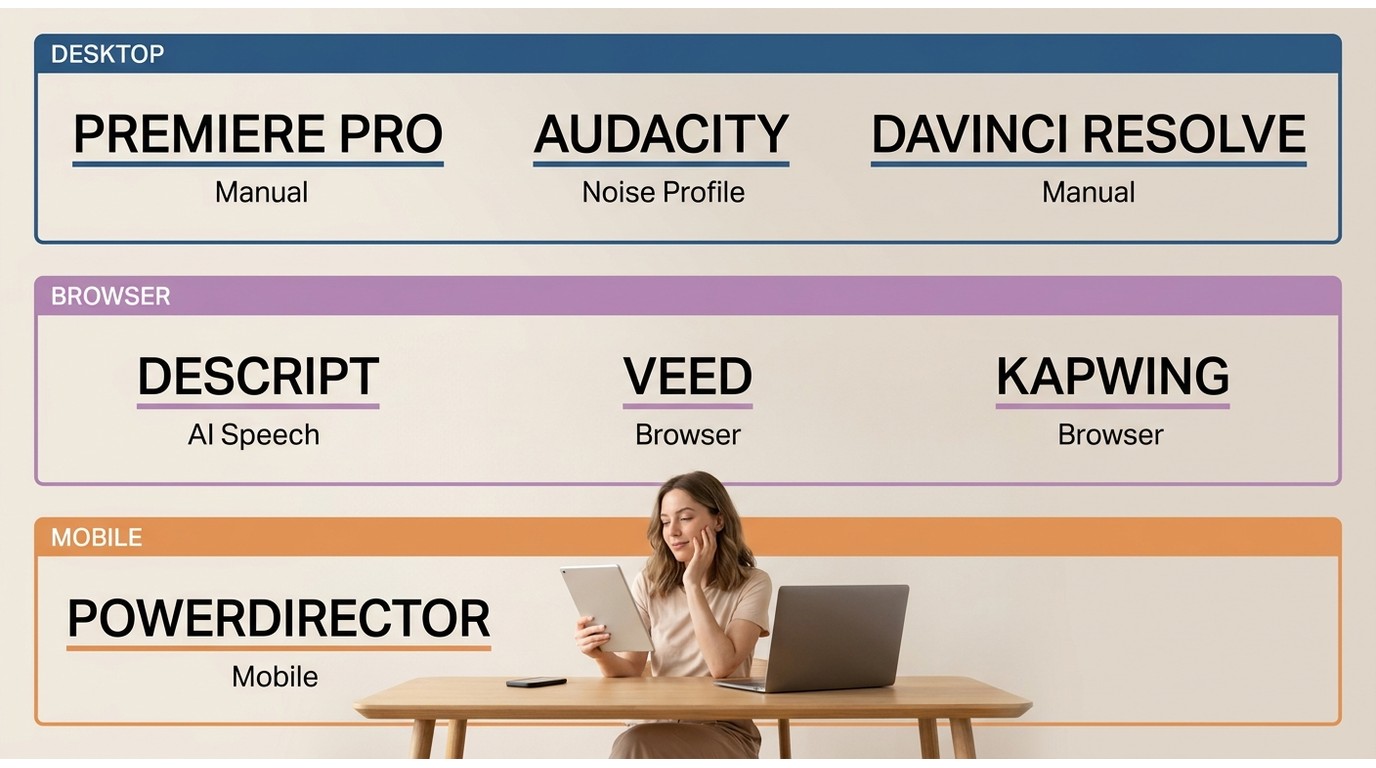
No single free online noise remover fits every project. Compare where the file is processed, whether the result is directly downloadable, how the plan handles watermarks and limits, and how much control you have over voice quality.
| Tool | Best fit | Device or platform | Workflow type | Supported input formats | Downloadable output | Free export limit | Watermark | File size or duration limit | Signup required | Privacy or local processing | Voice-quality control | Price and billing cadence |
| Adobe Premiere Pro | Full editing projects | Windows and Mac | Local timeline effect | Common professional video and audio formats | Video export through project settings | No separate free export allowance | No export watermark with an active license | Depends on storage, hardware, and project settings | Adobe account required | Local desktop processing | Adjustable effect controls | Subscription plans vary by region and term |
| Audacity | Steady hum or hiss | Windows, Mac, and Linux | Separate audio cleanup plus remux | Audio formats; MP4 may require audio extraction | Cleaned audio first, then a video editor creates the MP4 | No app-imposed export quota | No watermark | Depends on local storage and memory | No account required | Local desktop processing | Noise profile and manual settings | No-cost open-source software |
| DaVinci Resolve | Editing, mixing, and finishing | Windows, Mac, and Linux | Local video and audio project | Broad format support that varies by system and edition | Video export through the delivery page | Free edition available with feature boundaries | No standard export watermark | Depends on hardware, storage, codecs, and edition | Download registration may apply | Local desktop processing | Timeline mixing and audio controls | Free edition; Studio is licensed separately |
| Descript | Speech-led video and transcript editing | Browser and desktop app workflow | Upload, enhance speech, and export | Common video and audio uploads | Video or audio export under the plan | Media and processing allowances are plan-based | Export branding depends on plan and output | Usage allowances depend on plan | Account required | Cloud processing for uploaded projects | Studio Sound intensity and preview | Hobbyist: $24 month-to-month or $16 per month billed annually; Creator: $35 month-to-month or $24 per month billed annually |
| VEED | Fast browser cleanup with simple edits | Browser | Upload, clean audio, and export | Common browser-supported video formats | Video export under the selected plan | Resolution, duration, and feature access are plan-based | Free-plan branding can apply | Upload and export limits depend on plan | Account commonly required to save or export | Cloud upload and processing | Preview with limited restoration controls | Plan and billing term determine price |
| Kapwing | Collaborative browser projects | Browser | Shared workspace cleanup and export | Common online video and audio formats | Video export under workspace limits | Free workspace limits apply | Free exports may carry branding | Upload and duration limits depend on workspace plan | Account required for workspace features | Cloud upload and processing | Clean-audio preview with limited manual repair | Pro: $24 month-to-month or $16 per month billed annually |
| CapCut | Fast social-video editing | Mobile, desktop, and browser options | Integrated editing and audio cleanup | Common consumer video formats | Video export in the selected app | Feature access differs by platform and account | Template or asset choices can affect branding | Device, platform, and account limits apply | Some features require an account | Local or cloud behavior depends on the selected version | Simple enhancement and preview controls | Free and subscription features vary by platform |
| PowerDirector | Phone-first cleanup and editing | iPhone and Android | Mobile project with denoise and export | Formats supported by the device and app | Video export from the mobile project | Free-tier feature and export limits vary by store plan | Plan and selected assets can affect branding | Depends on device storage, app version, and plan | Some features require an account | Processing occurs through the mobile app; cloud features are optional | Denoise strength and preview | Store pricing and billing cadence vary |
Pricing and plan limits in this comparison are stated as of July 2026. The practical takeaway is that local editors offer stronger privacy and control, while browser tools reduce setup time but add upload, account, and plan considerations.
Prevent Noise Before Recording
Prevention protects the voice more reliably than aggressive repair. Better microphone placement, a quieter room, and basic wind control can reduce background noise in video before software has to separate speech from unwanted sound.
- Move the microphone closer: A stronger voice signal gives the cleanup tool less noise to fight.
- Use a directional microphone: Aim its pickup pattern toward the speaker and away from fans, traffic, or other people.
- Add a windscreen or pop filter: A windscreen reduces moving-air rumble, while a pop filter softens plosive consonants.
- Control room reflections: Curtains, rugs, and other soft surfaces reduce echo in an empty room.
- Turn off avoidable noise: Pause fans, air conditioners, and nearby electronics when the recording allows it.
- Watch clothing and accessories: Keep fabric and jewelry away from lavalier microphones.
From an editor's perspective, microphone distance and wind control deliver a cleaner result than trying to repair heavily masked speech later. A short test recording before the real take is usually the most efficient quality check.
When Noise Cleanup Is Worth It
Clean up video audio when noise distracts from information, weakens speech clarity, or makes valuable footage difficult to use. Mild or moderate noise is a better candidate than dialogue buried under loud wind, music, or overlapping voices.
- Interviews and documentaries: Clear dialogue supports comprehension and credibility.
- Tutorials and courses: Learners should not have to strain to understand instructions.
- Meetings and webinars: Reducing fan noise and room hum makes long speech easier to follow.
- Social videos and vlogs: A short cleanup pass can make phone footage easier to watch.
- Irreplaceable recordings: Careful restoration may rescue usable speech when rerecording is impossible.
I would stop processing when the artifacts become more distracting than the original noise. At that point, subtitles, a replacement voiceover, or a shorter edited segment may communicate the content more clearly.
After Cleanup: Optional Surround Upmix
Surround upmixing is an optional second stage after denoising. It changes a cleaned stereo track into a multichannel presentation; it does not remove background noise and is unnecessary when the goal is simply a clear stereo export.
UniFab Audio Upmix AI runs on Windows and Mac and converts cleaned stereo audio to 5.1 or 7.1 surround sound. It supports batch processing and works with MP4 and MKV projects in a local desktop workflow, which can reduce repeated setup and keep source media off a browser upload.
EAC3 and DTS are surround-audio encoding formats used for multichannel playback. The relevant choice here is 5.1 versus 7.1 speaker output, not additional noise reduction.
UniFab Audio Upmix AI
Upmix Audio to 8-Channel DTS 7.1
30-day free trial and no credit card required – TRY NOW!
UniFab Audio Upmix AI
UniFab Audio Upmix AI
Upmix Audio to 8-Channel DTS 7.1
30-day free trial and no credit card required – TRY NOW!
UniFab Audio Upmix AI
Suitable for: Users who have already cleaned the dialogue and want surround playback across several files. Less suitable for: Anyone who only needs a clean stereo track or still needs to remove noise. Broader sound-enhancer comparisons belong in the dedicated video sound enhancer guide.
Conclusion
To remove background noise from video without sacrificing the voice, choose by fit rather than by one-click claims. Browser tools suit quick one-off cleanup, Audacity gives free manual control over steady noise, full editors fit project workflows, and PowerDirector covers phone-first work.
Preview quiet and loud speech before exporting, lower the effect if the voice turns metallic, and keep the original recording. That combination is more dependable than pushing any background sound remover to its strongest setting.
Frequently Asked Questions
What is the best way to use how to remove background noise from video?
Start with the source quality, target platform, privacy requirement, and final export settings. For how to remove background noise from video, use a short representative clip first, compare the result at 100% view, and keep the original file so you can revise the workflow without generation loss. This also applies to remove noise from video audio.
Is how to remove background noise from video free?
Some how to remove background noise from video workflows are free, while others limit file size, duration, resolution, credits, watermarks, or export formats. Verify the current plan on the provider's official page because free allowances can change. This also applies to video noise reduction.
Does how to remove background noise from video reduce quality?
how to remove background noise from video can reduce quality when it adds unnecessary recompression, aggressive enhancement, or incorrect output settings. Match resolution, frame rate, codec, and bitrate to the source and delivery platform, then inspect motion, edges, audio sync, and fine detail. This also applies to background noise remover.
Which formats or devices support how to remove background noise from video?
Support depends on the chosen application and workflow. Check operating system, input and output formats, hardware acceleration, browser upload limits, and whether the destination platform accepts the selected settings before processing a full project. This also applies to remove noise from video audio.
How long does how to remove background noise from video take?
Processing time varies with duration, resolution, codec, AI model, hardware, and export settings. A short test provides the most reliable estimate; online tools also add upload and download time, while local tools depend more heavily on CPU and GPU performance. This also applies to video noise reduction.
Can beginners use how to remove background noise from video?
Yes. Beginners can use how to remove background noise from video by following a conservative workflow: duplicate the source, choose an appropriate preset, process a short sample, compare before and after, and only then export the complete file. This also applies to background noise remover.
What should I check before choosing a tool for how to remove background noise from video?
Compare source fit, output quality, privacy, platform support, batch capability, watermark policy, free limits, price, and control. Do not choose a how to remove background noise from video tool only because it advertises the highest resolution, frame rate, or AI label. This also applies to remove noise from video audio.
Is desktop or online processing better for how to remove background noise from video?
Online processing is convenient for short, non-sensitive files, but it can impose upload, retention, watermark, credit, and resolution limits. Desktop processing is usually better for private, long, high-resolution, or batch how to remove background noise from video work. This also applies to video noise reduction.
What are the main limitations of how to remove background noise from video?
The main limits are source quality, missing detail, motion artifacts, incompatible formats, hardware demand, upload constraints, and generation loss. how to remove background noise from video cannot always reconstruct information that was never captured, so results should be described realistically. This also applies to background noise remover.
How does how to remove background noise from video compare with manual editing?
Automated how to remove background noise from video is faster and easier to repeat, while manual editing gives more local control and may avoid overprocessing. A practical workflow uses automation for the first pass and manual review for difficult scenes, transitions, faces, text, and audio sync. This also applies to remove noise from video audio. This how to remove background noise from video guidance should be checked against the source and final delivery requirements.