If you need to change video resolution or resize an MP4, the wrong control can stretch the picture, add black bars, or soften detail. The practical route is to choose target dimensions, preserve the intended aspect ratio, and export once with settings suited to the destination.
This guide covers a fast MP4 workflow, a desktop video converter path for repeat jobs, and an online video resizer for convenient browser processing.
Change Video Resolution in Three Steps
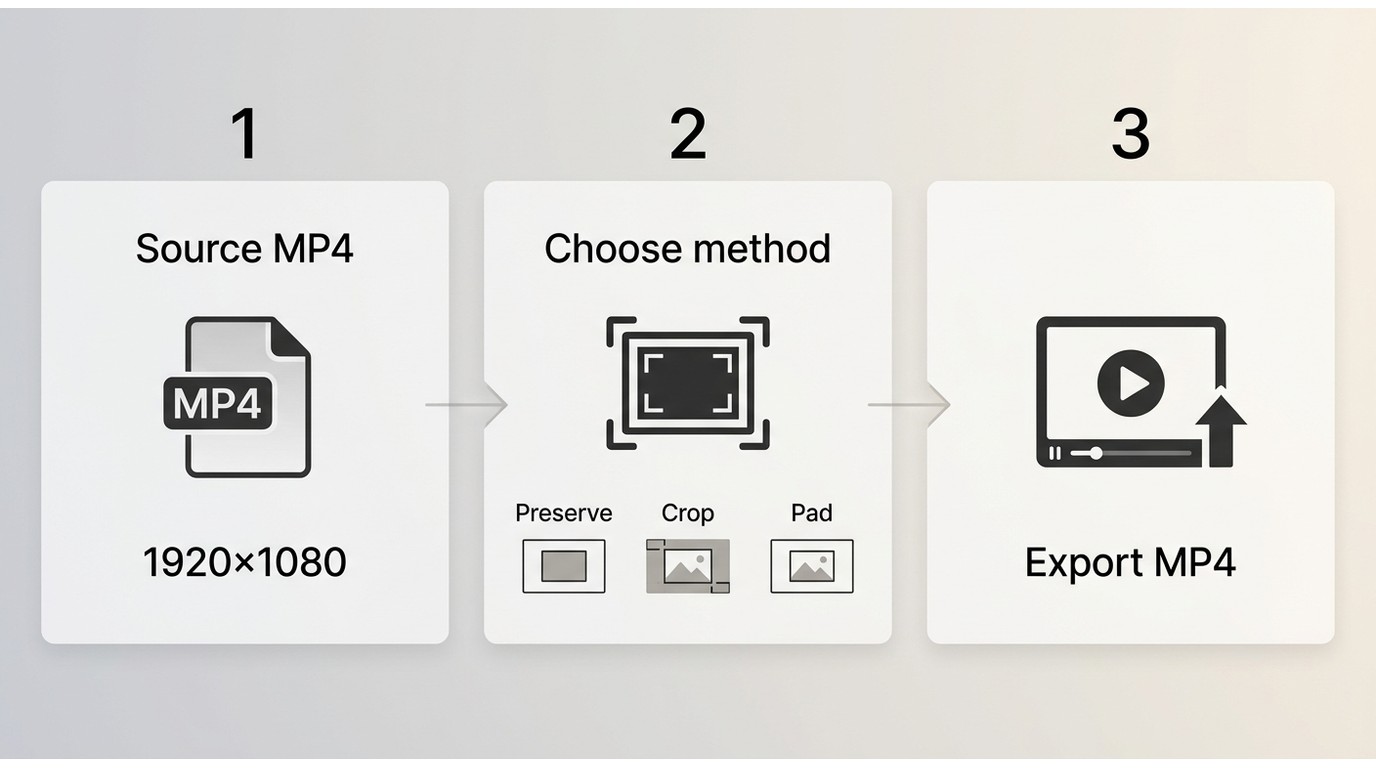
Most resolution changes follow the same short workflow: open the file, set the output dimensions and framing behavior, then export the re-encoded result.
- Open or upload the video. Keep the original file untouched so you can restart if the first export is not right.
- Choose a preset or custom width and height. Decide whether to preserve aspect ratio, crop, pad, or stretch.
- Export and review. Save or download the result, then check framing, sharpness, audio, and file size before deleting any working copy.
Changing the actual pixel dimensions normally triggers re-encoding, even when the file remains an MP4.
Resolution, Aspect Ratio, Crop, and Compression Differ
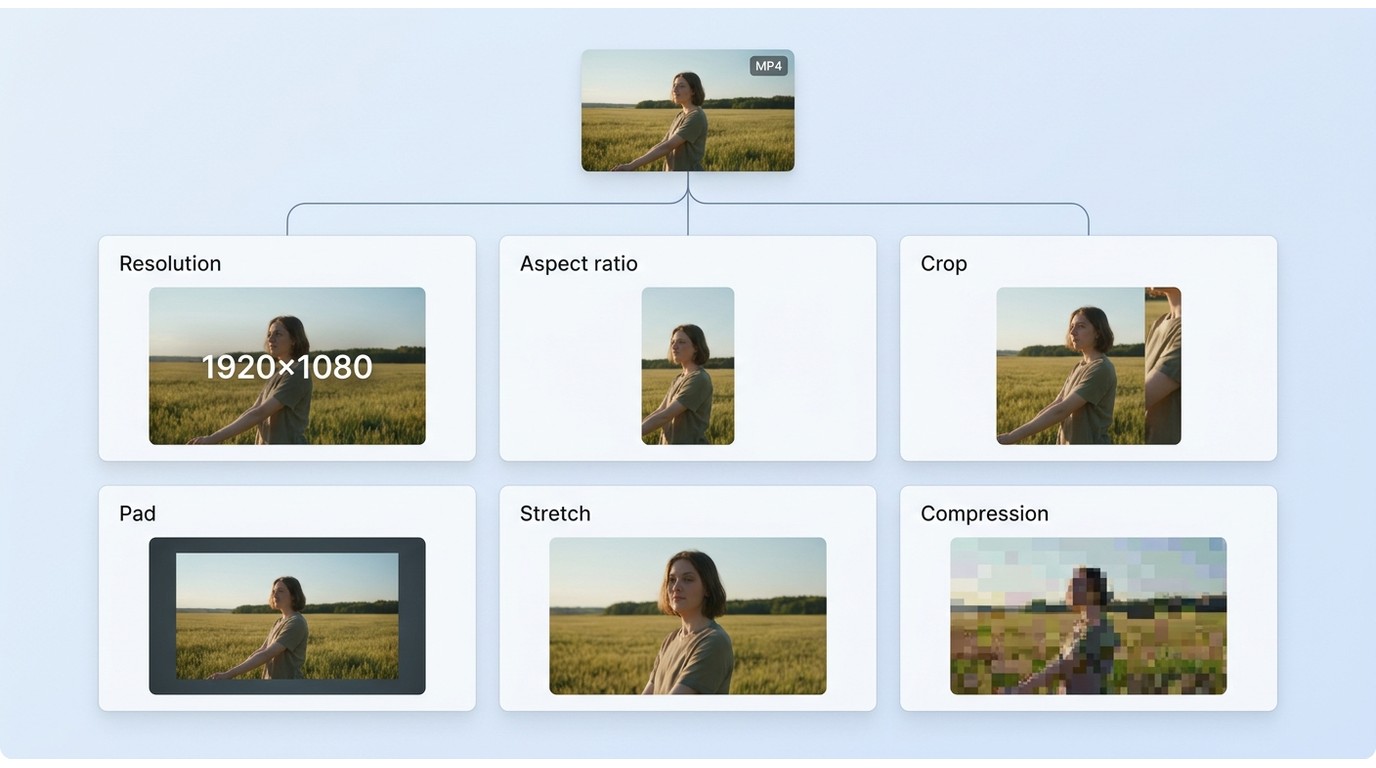
Video resolution is the pixel width and height of each frame. It is related to aspect ratio, cropping, padding, stretching, and compression, but those operations solve different problems.
| Operation | What changes | Typical goal | Main risk |
| Resolution change | Pixel dimensions | Match a screen or platform | Re-encoding loss |
| Aspect-ratio change | Frame proportions | Landscape, square, or vertical delivery | Distortion or bars |
| Crop | Visible frame area | Fill a new shape | Cut-off subjects |
| Pad or letterbox | Borders around the image | Keep the full frame | Visible bars |
| Stretch | Pixel proportions | Force an exact frame | Distorted faces and objects |
| Compression | Bitrate or codec | Reduce video file size | Artifacts and banding |
Pick the Operation That Matches Your Goal
Use custom video dimensions when the destination requires an exact frame size. Adjust bitrate or codec when the goal is a smaller file, and change the aspect ratio only when the delivery shape must change.
A useful rule is to change the fewest variables needed. Lowering resolution can shrink a file, but bitrate, codec, frame rate, and duration also influence the final size.
Preserve, Crop, Pad, or Stretch
Preserve the aspect ratio when the full picture matters. Crop when filling the frame matters more than Edge content, and pad when the entire source must remain visible. Stretching is rarely a good fit because it changes object proportions.
Quality Depends on Scaling and Encoding Settings
Video resolution quality depends on scaling direction and export settings. Downscaling discards pixels, ordinary upscaling enlarges existing information, and repeated exports can accumulate visible loss.
Bitrate, video codec, frame rate, crop settings, and source quality all affect the result. For detailed UHD decisions, 4K bitrate settings provide a more focused reference without turning a resolution change into a full encoding project.
Safe Starting Settings
The safest editorial workflow keeps the source file, matches the source frame rate unless a change is required, and reviews a short sample before processing a long video.
| Setting | Safe starting point | Check before export |
| Dimensions | Target preset or exact width × height | No unintended crop |
| Aspect ratio | Preserve source proportions | No stretch or unexpected bars |
| Frame rate | Match the source | Motion remains natural |
| Bitrate | Use a quality-oriented preset | No blockiness in motion |
| Codec | Choose for playback compatibility | Target device can decode it |
Change MP4 Resolution to 1080p or 720p
An MP4 resolution changer can export a file at 1920×1080 or 1280×720. Keeping MP4 as the container does not avoid re-encoding when the frame dimensions change.
Browser Workflow for MP4 Files
- Upload the MP4 to a browser tool that offers a resolution preset or custom video dimensions.
- Select 1920×1080 for Full HD or 1280×720 for HD, then choose preserve, crop, or pad behavior.
- Keep MP4 as the output when it matches the destination, start processing, and download the result.
- Compare the exported frame with the source before using it as the new master.
Clipchamp Workflow on Windows
- Import the MP4 into a new Clipchamp project and place it on the timeline.
- Set the project aspect ratio, then crop or fit the frame so the composition remains intentional.
- Export at 1080p or 720p and review the saved MP4 for framing and motion quality.
Clipchamp is convenient for a Windows edit that also needs trimming or reframing. A dedicated converter is a better fit for queues, exact codec choices, or repeatable batch settings.
Choose Online or Desktop Processing
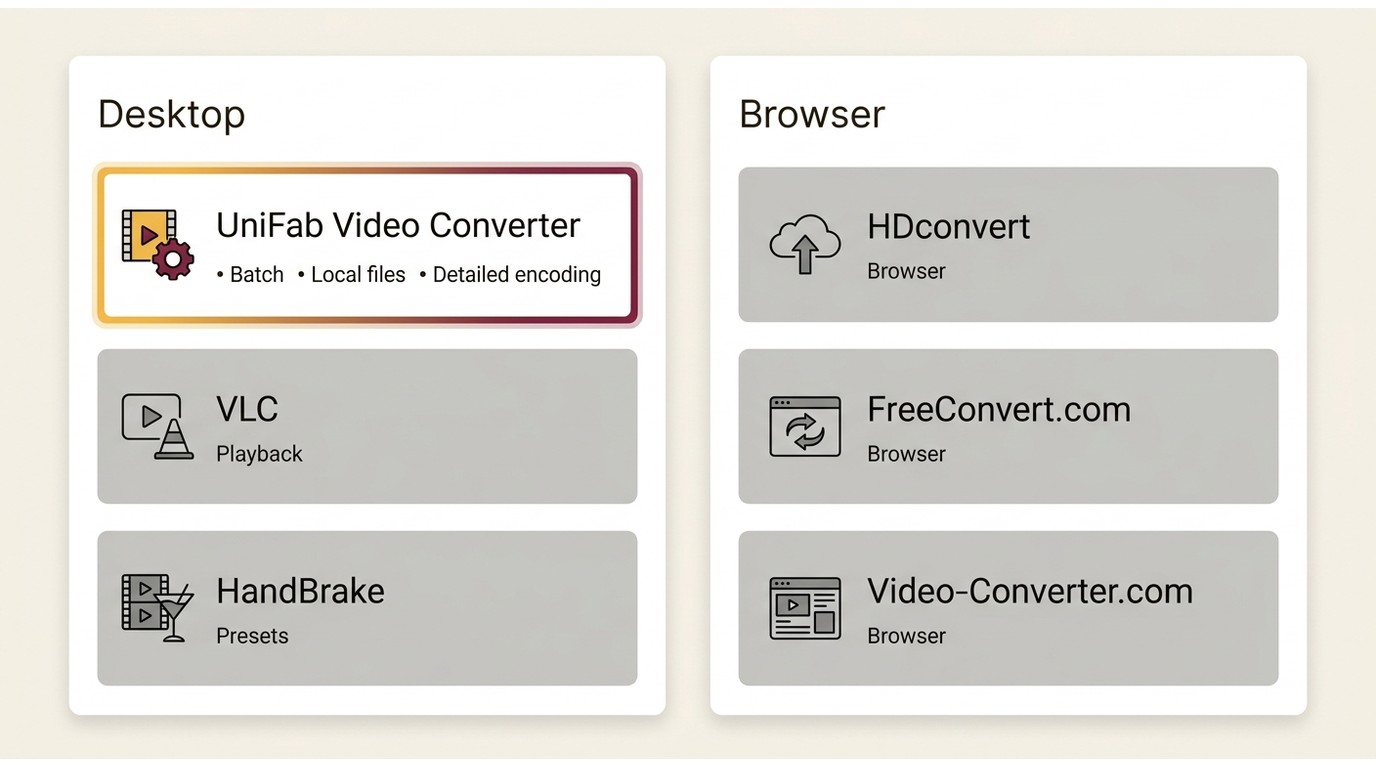
Online processing is convenient for a quick file, while desktop tools keep footage local and expose more encoding controls. Speed and quality depend on the file, hardware, service load, and chosen settings.
| Tool or method | Location | Resolution controls | Current cost or limit | Fits |
| UniFab Video Upscaler AI | Windows, Mac, Cloud | Preset resolution | Free trial; $69.99 lifetime | Batch jobs |
| UniFab Video Converter | Windows, Mac | Preset and custom; batch | No-cost desktop tool | Repeat local jobs |
| VLC | Desktop | Profile-based | No cost | Basic conversion |
| HandBrake | Desktop | Detailed dimensions and encoding | No cost | Encoding control |
| HDconvert | Cloud | Preset resolution | $5.98/$9.97/$14.96/$19.95 monthly | Browser conversion |
| FreeConvert.com | Cloud | Custom dimensions | Limits vary by tier | Occasional uploads |
| Video-Converter.com | Cloud | Preset resolution | 5 files/day; $6 month; $48 year | Simple browser use |
Pricing and limits as of August 2026.
The practical dividing line is control and privacy: use local processing for sensitive or irreplaceable footage, and use a browser service when upload time and published limits are acceptable.
Desktop Methods for Windows and Mac
A desktop video converter fits repeat work, local files, and jobs that need explicit resolution or encoding control. Use it to change resolution of video files in a repeatable workflow, while remembering that hardware and settings still determine the result.
UniFab Video Upscaler AI (Best for Upscaling Video Resolution)
UniFab Video Upscaler AI can upscale low-resolution video up to 16K using cutting-edge AI technology. Unlike traditional upscaling that simply stretches pixels, UniFab's AI models intelligently reconstruct detail, fix compression artifacts, reduce noise, and sharpen blurry visuals.
- Best For: Enhancing video clarity and quality with built-in AI models
- Price: Free 30-day trial; Lifetime license $69.99
- Platforms: Windows & Mac
How to Upscale Video Resolution with UniFab
30-day Free Trial for full feature, without watermark!
Launch UniFab and Import Video
Open the UniFab program on your PC, select the "Video Upscaler AI" mode, and import your desired video file from your local files.
Customize output settings
Make output customizations regarding resolution, model, format, quality, and codec.
Start the Process
Click on the "Start" option to initiate editing and obtain the enlarged video file quickly and efficiently.
UniFab Video Converter for Local Resolution Changes
UniFab Video Converter offers local batch conversion with controls for resolution, codec, frame rate, and bitrate. It suits repeated Windows or Mac jobs and privacy-sensitive footage, but it is unnecessary for one small browser resize.
- Price: Free
- Fits: Batch downscaling, format changes, and reusable export settings.
- Less suitable for: A single quick upload that needs no installation.
- Setting to watch: Preserve the source proportions and choose bitrate for the intended screen size.
Completely Free with full feature access! No watermark
Launch UniFab, Select 'Video Converter', and Import Your Video
Click 'Setting' icon to Change Video Resolution
Select your target resolution from the available presets or enter custom dimensions. You can also adjust codec, bitrate, and frame rate settings.
Click "Start" to initiate conversion
VLC for Basic Free Conversion
VLC handles basic conversion through export profiles. Check the selected profile because resolution, aspect ratio, audio, or subtitle tracks can change if the profile is not configured for the source.
- Fits: An occasional conversion with familiar playback software.
- Less suitable for: Users who want a guided batch workflow.
- Setting to watch: Confirm width, height, aspect ratio, and included tracks.
Open the conversion panel. Choose Media, then Convert/Save.
Add the source and select a profile. Open the profile editor before choosing the destination.
Under Video codec and Resolution, enter the required dimensions, save the profile, and start the export.
HandBrake for Encoding Control
HandBrake gives detailed dimension and encoding controls. Automatic crop, anamorphic behavior, and modulus constraints can turn a requested 1080-line output into 1072 lines unless the Dimensions panel is reviewed.
- Fits: Users who understand crop, scaling, codec, and quality controls.
- Less suitable for: A beginner who wants a single resolution selector.
- Setting to watch: Review automatic crop, anamorphic mode, modulus, and exact storage dimensions.
Other Desktop Options
Freemake and VSDC are preset-led Windows alternatives. They are secondary choices when the primary methods above do not fit, and their output profiles should be reviewed before conversion.
- Fits: Windows users who prefer preset-led conversion.
- Less suitable for: Mac users or anyone who needs a cross-platform workflow.
- Setting to watch: Confirm dimensions, aspect ratio, encoder, and bitrate in the selected profile.
VSDC output quality depends on the source footage, encoder, bitrate, scaling ratio, and export settings. A higher output resolution does not make a conversion lossless or restore missing source detail.
Online Tools for Quick Resolution Changes
To resize video online, choose a service by dimensions, upload limit, account requirement, processing location, and privacy terms.
Custom Dimensions and Simple Exports
Online-Convert.com uses credit-based pricing and offers custom dimension controls. Video-Converter.com allows five free files per day, with Premium at $6 per month or $48 per year. Online Converter is useful when direct width and height entry is the main need.
An online video resolution enhancer may expose ordinary resize controls, while a page that lets you upscale video online free may use AI reconstruction. Decide which operation you need before uploading.
File Limits, Pricing, and Privacy
HDconvert offers Lite at $5.98 per month, Plus at $9.97 per month, Pro at $14.96 per month, and Ultra at $19.95 per month. FreeConvert.com uses tier-based upload limits. In both cases, connection speed and service load affect turnaround.
Sensitive, confidential, or irreplaceable footage is better suited to local processing. For routine uploads, read the service's stated retention, deletion, account, and file-limit terms before choosing it.
AI Upscaling Is Different From Resizing
Ordinary resizing changes pixel dimensions. AI video upscaling attempts to reconstruct a more plausible high-resolution image, but it cannot recover source detail with certainty, and results vary by footage and model.
A browser-based UniFab AI Video Enhancer can suit a short preview workflow, while local software is a better match for larger or sensitive files. Neither path replaces careful review of faces, text, edges, and motion.
Common Output Presets by Use Case
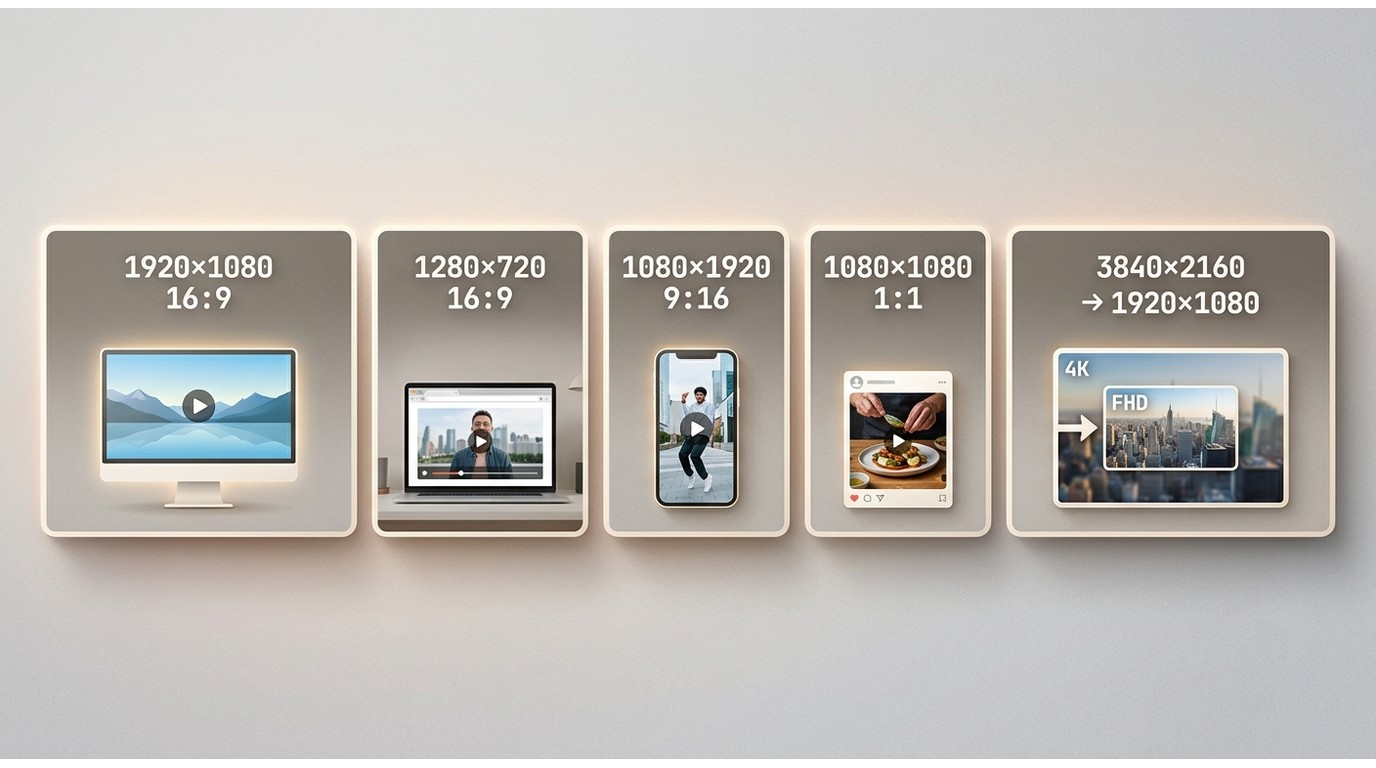
Choose a preset from the delivery platform and the source quality. A higher pixel count alone does not guarantee a better upload, especially when the source is soft or heavily compressed.
| Use case | Dimensions | Orientation | Editorial check |
| Widescreen Full HD | 1920×1080 | 16:9 landscape | Keep source framing |
| Widescreen HD | 1280×720 | 16:9 landscape | Review text readability |
| Vertical short video | 1080×1920 | 9:16 portrait | Reframe the subject |
| Square social post | 1080×1080 | 1:1 square | Check Edge cropping |
| UHD master to Full HD | 3840×2160 to 1920×1080 | 16:9 landscape | Inspect fine detail |
When the goal is a smaller delivery copy, a controlled 4K to 1080p conversion is often more useful than changing the aspect ratio or stretching the frame.
The Right Method Depends on Your Goal
Choose the method by priority: browser convenience, local batch control, encoding precision, or AI-assisted reconstruction. No single tool fits all four jobs.
- Quick browser resize: Use an online tool with the dimensions and limits your file needs.
- Repeat local conversion: Use UniFab Video Converter for batch controls, while accepting that installation is unnecessary for a one-off browser job.
- Detailed encoding control: Use HandBrake and review crop, anamorphic, modulus, codec, and bitrate settings.
- AI-assisted upscaling: Use UniFab Video Upscaler AI when low-resolution footage may benefit from model-based reconstruction, then inspect the result rather than assuming detail was restored.
The most reliable choice changes the fewest variables, preserves the source file, and produces one reviewed export for the intended screen or platform.
Frequently Asked Questions
Can I change video resolution for free without a watermark?
Yes. VLC and HandBrake are no-cost desktop options, while online services often limit daily files, upload size, or features. Check the exported frame and audio because a watermark-free result can still have poor scaling or track settings.
Why did my 1080p export become 1072p?
Automatic cropping, anamorphic settings, or modulus constraints can adjust the stored height to a codec-friendly value. Disable unintended crop, review anamorphic behavior, and enter exact dimensions before encoding.
Should I lower resolution or bitrate when an MP4 is too large?
Lower bitrate first when the current pixel dimensions still match the playback screen. Lower resolution when the destination does not need the existing frame size. Either choice requires a quality check around motion, gradients, and text.
Can I change video resolution without re-encoding?
Not when the actual frame dimensions change. Stream copy can move existing encoded video into another container, but it does not resize the frames. A true width or height change normally requires decoding, scaling, and encoding.