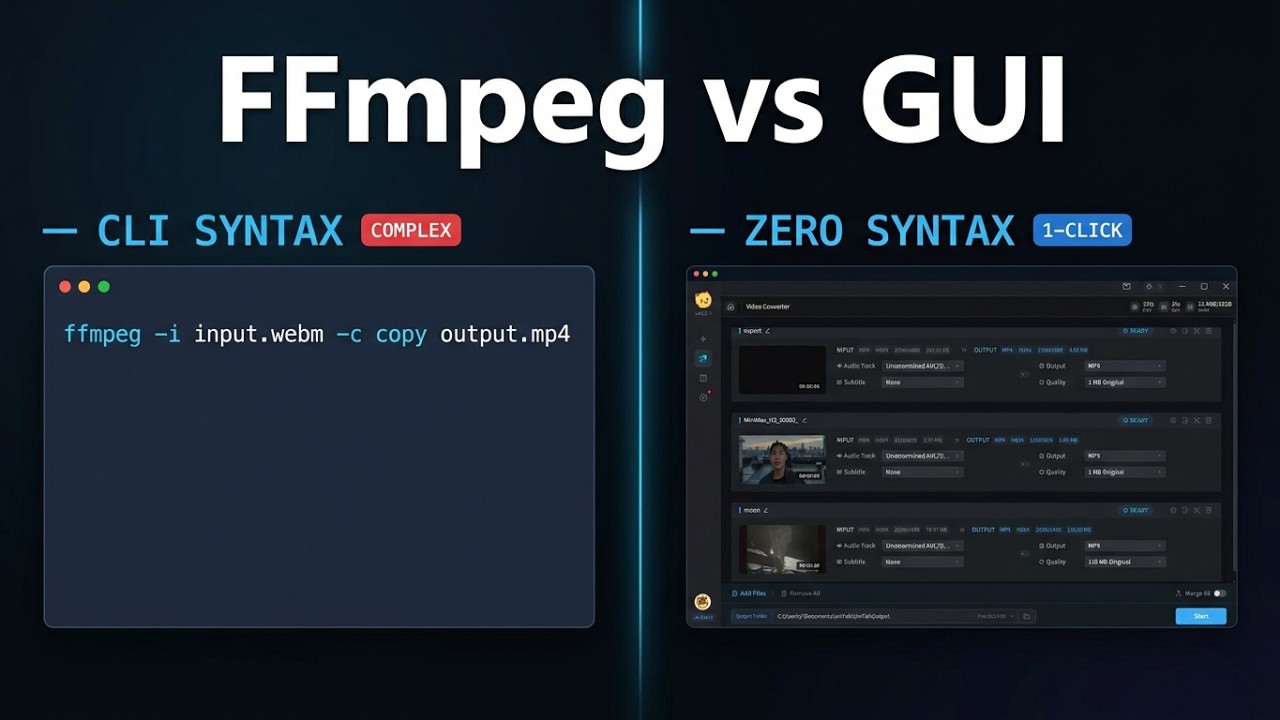
Quick Answer: FFmpeg Command and GUI Option
Here’s the short answer: To convert WebM to MP4 with FFmpeg for broad playback compatibility, encode H.264 video, AAC audio, and yuv420p pixel format, then add faststart for web playback. An MP4 extension alone does not ensure iPhone or Safari playback, and settings also determine whether WebM-to-MP4 output stays close to the source quality and size.
Use FFmpeg when you need repeatable commands, scripting, Linux support, or precise encoder controls. A local GUI is the secondary route when command syntax is the main obstacle; cloud converters are better reserved for small, non-sensitive files that you own or are authorized to process.
FFmpeg in the Conversion Workflow
FFmpeg is a free, open-source command-line tool for processing video, audio, and multimedia files. It supports virtually every video and audio codec in existence — H.264, H.265, VP8, VP9, AV1, AAC, Opus, and hundreds more — and runs identically on Windows, macOS, and Linux. Most video tools you use today (HandBrake, OBS Studio, VLC, even commercial converters) are essentially graphical front-ends to FFmpeg under the hood.
If you've ever wondered why one command-line tool can convert every video format, the answer is FFmpeg. The trade-off is the learning curve: FFmpeg has no GUI, accepts a long string of parameters, and unfamiliar errors can be cryptic.
WebM vs MP4 Compatibility
WebM and MP4 are container formats — wrappers that hold video, audio, and subtitle streams together. Both are modern. Both work in browsers. So why convert?
| Compatibility factor | WebM | MP4 |
| Common video codecs | VP8, VP9, AV1 | H.264, H.265, AV1 |
| Common audio codecs | Vorbis, Opus | AAC, MP3, Opus |
| Browser use | Strong in modern browsers | Broad browser support |
| Apple native playback | Can vary by app and codec | H.264/AAC is broadly compatible |
| Hardware decoding | Depends on codec and device | Depends on codec and device |
MP4 is broadly supported, but reliable playback still depends on the video codec, audio codec, pixel format, and player. If a .webm file will not play on your phone, import into an editor, or meet an upload requirement, converting it may help. For broader converter selection, the video format converter overview covers the larger workflow. In practice, the container matters less than the compatible streams and pixel format inside it.
When WebM-to-MP4 Conversion Helps
The five most common reasons users convert:
- Apple playback compatibility — native Apple apps and players can have stricter codec and pixel-format requirements than browsers
- Video editing software compatibility — Premiere Pro, DaVinci Resolve, Final Cut Pro, and most editors prefer MP4 for timeline ingestion
- Social media upload — Instagram, TikTok, X, and LinkedIn either reject WebM uploads or transcode them with quality loss
- More predictable device playback — H.264 video with AAC audio in MP4 is a common target for TVs, consoles, and embedded players
- Sharing or archiving in a common format — MP4 is widely supported, but no container alone guarantees future playback
If the original WebM already works in the target browser, editor, and device, conversion adds time and can introduce quality loss without solving a problem.
FFmpeg Commands for WebM-to-MP4 Conversion
Here's the full FFmpeg workflow. Open a terminal (Command Prompt on Windows, Terminal on Mac/Linux) and follow along.
Install FFmpeg on Windows, Mac, or Linux
Download an official Windows build through ffmpeg.org, extract it, and add its bin folder to your system PATH. On macOS, use brew install ffmpeg. On Ubuntu, use sudo apt install ffmpeg; other Linux distributions may use dnf install ffmpeg.
Verify the install with:
ffmpeg -version
You should see version information print. If you see "command not found", the PATH isn't set correctly — re-check the install step.
Run a Compatibility-First Command
For WebM-to-MP4 playback on a broad range of devices and browsers, start with an explicit command:
ffmpeg -i input.webm -c:v libx264 -crf 20 -preset medium -pix_fmt yuv420p -c:a aac -movflags +faststart output.mp4
This FFmpeg conversion command uses H.264 video, AAC audio, and the widely supported yuv420p pixel format. -crf 20 and -preset medium provide a practical starting point; adjust them later for smaller files or higher quality.
Choose H.264, AAC, and Pixel Format
The compatibility-first command names the settings that matter most:
-c:v libx264uses H.264 video, a common target for editors and devices-c:a aacuses AAC audio for broad MP4 player support-pix_fmt yuv420pavoids pixel formats that some Apple players reject
H.264 and AAC are a dependable MP4 combination when playback compatibility matters. H.265 can reduce file size in some workflows, but it is best used when the destination devices are known to support it.
Enable Fast Start for Web Playback
If the MP4 will be uploaded to a website or streamed, add the faststart flag so the metadata sits at the front of the file:
ffmpeg -i input.webm -c:v libx264 -c:a aac -movflags +faststart output.mp4
faststart moves MP4 metadata to the front of the file, which can enable earlier progressive web playback. It does not fix an incompatible codec or pixel format; for Apple playback, keep H.264, AAC, and yuv420p in the command.
Balance Quality, File Size, and Speed
Choose the path based on the source streams, player requirements, and how much file size you can accept:
| Path | When it fits | Main tradeoff |
| Stream copy | Probed streams suit target players | No re-encoding; limited compatibility |
| CRF 17–18 | High-quality H.264 output | Re-encodes; larger files |
| True lossless | Master files with ample storage | Very large output files |
| Higher CRF | Smaller web uploads | More visible compression |
-crf controls quality, while -preset trades encoding time for compression efficiency. Most readers want visually lossless output rather than mathematically lossless files: true lossless encoding can create impractically large MP4s.
A high-quality command for a video you want to keep:
ffmpeg -i input.webm -c:v libx264 -crf 18 -preset slow -c:a aac -b:a 192k output.mp4
A small-file command for web upload:
ffmpeg -i input.webm -c:v libx264 -crf 28 -preset medium -c:a aac -b:a 128k output.mp4
Step 6: Batch Convert Multiple Files
To convert every .webm in a folder to .mp4, use a shell loop. On Mac/Linux:
for f in *.webm; do ffmpeg -i "$f" -c:v libx264 -crf 20 -preset medium -pix_fmt yuv420p -c:a aac -movflags +faststart "${f%.webm}.mp4"; done
On Windows PowerShell:
Get-ChildItem *.webm | ForEach-Object { ffmpeg -i $_.Name -c:v libx264 -crf 20 -preset medium -pix_fmt yuv420p -c:a aac -movflags +faststart "$($_.BaseName).mp4" }
This is where FFmpeg dramatically beats GUI tools for power users — batch-converting 100 files takes one line.
Probe Codecs Before Stream Copy
Stream copy is an advanced conditional branch, not the default WebM-to-MP4 route. Inspect the file first:
ffprobe -v error -show_entries stream=codec_name,codec_type,pix_fmt -of default=noprint_wrappers=1 input.webm
If the existing streams suit both MP4 and the players you need, remux with ffmpeg -i input.webm -c copy output.mp4. When VP8, audio support, pixel format, or destination playback is uncertain, transcode to H.264, AAC, and yuv420p instead.
Preserve or Change Frame Rate Safely
Leave frame rate unchanged unless the destination requires a fixed rate. Forcing -r can duplicate or drop frames, especially with variable-frame-rate sources. To preserve source timing where appropriate, use -fps_mode passthrough.
To deliberately change frame rate during conversion:
ffmpeg -i input.webm -r 30 -c:v libx264 -c:a aac output.mp4
To resize:
ffmpeg -i input.webm -vf scale=1280:720 -c:v libx264 -c:a aac output.mp4
Combine for a downsized 30 fps preview:
ffmpeg -i input.webm -r 30 -vf scale=1280:720 -c:v libx264 -crf 23 -c:a aac output.mp4
WebM-to-MP4 Tools Compared
FFmpeg, desktop apps, and browser converters serve different workflows. The right choice depends on whether you need local processing, scripting, a graphical interface, or a quick one-off conversion.
For a local open-source interface, the HandBrake Video Converter review covers its workflow and controls in more detail.
| Tool | Best fit | Platforms | Local or cloud | Main tradeoff |
| FFmpeg | Scripts and exact controls | Windows, Mac, Linux | Local | Command-line learning curve |
| UniFab Video Converter | Desktop GUI conversion | Windows, Mac | Local | No Linux or headless workflow |
| HandBrake | Open-source GUI controls | Windows, Mac, Linux | Local | Less suited to scripting |
| CloudConvert | Small authorized one-offs | Web | Cloud | Requires file upload |
| VLC media player | Basic conversion when installed | Windows, Mac, Linux | Local | Limited conversion controls |
If VLC is already on your computer, the VLC WebM-to-MP4 conversion guide explains its separate conversion steps.
A Local GUI for Desktop Conversion
UniFab Video Converter fits readers who want a local Windows or Mac GUI instead of FFmpeg syntax. It converts supported files across 1,000+ formats, supports batch processing, and uses NVIDIA, AMD, or Intel GPU acceleration where available. It is not the right fit for Linux, headless servers, or fine-grained command automation.
Readers comparing a command-line route with a free Video Converter can use a local GUI when visual settings and direct file selection matter more than scripting.
UniFab Video Converter
- Originally $89.99 lifetime. Now 100% free forever.
- Convert videos to 1000+ formats with one click
- Compress videos without any quality loss
- Batch process multiple videos with ease
- Edit videos with built-in tools and settings
UniFab Video Converter
UniFab Video Converter
- Originally $89.99 lifetime. Now 100% free forever.
- Convert videos to 1000+ formats with one click
- Compress videos without any quality loss
- Batch process multiple videos with ease
- Edit videos with built-in tools and settings
UniFab Video Converter for Mac
UniFab WebM-to-MP4 Workflow
Full feature access! No watermark!
Launch UniFab and select the "Video Converter" module from "All Features". Then Click Add to import your WebM file(s)
Click the Output dropdown and select MP4 format
(Optional): Click the settings icon to customize: Video codec (H.264, H.265), Resolution and frame rate, Bitrate for video and audio, and more
(Optional): Use the built-in editor to trim, crop, or enhance your video
Click Start to begin conversion. UniFab will use GPU acceleration if available.
Before converting, choose MP4, review the output settings, and confirm that any resize setting preserves the intended aspect ratio. This check matters when the output resolution differs from the source.
FFmpeg or UniFab: Best-Fit Scenarios
| Path | Best for | Not ideal for |
| FFmpeg | Linux, servers, scripts, exact controls | Readers avoiding terminal commands |
| UniFab Video Converter | Local Windows or Mac GUI work | Linux, headless, scripted jobs |
| Cloud converter | Small authorized one-off files | Sensitive or large uploads |
Choose FFmpeg when reproducibility and control matter; choose a local GUI when the terminal itself is the bottleneck.
Reverse Conversion: Use the Dedicated Guide
If your task runs in the opposite direction, the MP4-to-WebM conversion guide covers that format-specific workflow.
Common FFmpeg Errors and Fixes
"Unknown encoder 'libx264'" The FFmpeg build may not include the H.264 encoder. Install a complete build from ffmpeg.org or a trusted package manager.
MP4 fails on iPhone or Safari The most likely cause is incompatible streams, not the .mp4 extension. Re-encode with -c:v libx264 -pix_fmt yuv420p -c:a aac; add -movflags +faststart for progressive web playback.
Output is much larger than the WebM WebM codecs can be more efficient than H.264 at similar visual quality. Raise CRF gradually, use a slower preset if time allows, and avoid true lossless output unless storage is not a concern.
Stream copy output will not play The remuxed streams may not suit the intended MP4 player. Probe the source first, then use H.264/AAC transcoding when compatibility is uncertain.
Frame rate drifts or motion looks uneven A forced -r setting may be duplicating or dropping frames. Preserve source timing unless a fixed-rate destination requirement calls for conversion.
"Invalid data found when processing input" The input WebM may be partial or corrupted. If VLC cannot play the source either, obtain a complete original file before converting.
Choose the Path That Fits Your Workflow
Use FFmpeg when control, Linux support, or automation matters, and start with the compatibility-first H.264/AAC command rather than relying on the MP4 extension. Use a local GUI when command syntax is the main obstacle. Cloud conversion is most appropriate for small, non-sensitive files you are authorized to process.
FFmpeg WebM-to-MP4 FAQs
Is FFmpeg safe and free to use?
Yes. FFmpeg is open-source software distributed under LGPL/GPL licenses. Download it from ffmpeg.org or a trusted package manager, and avoid unofficial installers that bundle unrelated software.
Can WebM become MP4 without re-encoding?
Sometimes. -c copy avoids re-encoding, but it works reliably only when the existing streams and intended players support the resulting MP4. For broad compatibility, use H.264 video, AAC audio, and yuv420p, understanding that this re-encodes the video.
Can FFmpeg batch-convert a folder of WebM files?
Yes. On Mac or Linux, use a quoted shell loop; on Windows, use the PowerShell loop shown in the batch-conversion section. Apply the same H.264, AAC, yuv420p, and faststart settings to each file when consistent compatibility matters.
How can I speed up FFmpeg on Apple Silicon?
On Apple Silicon, VideoToolbox hardware encoding can speed up compatible jobs. Use a VideoToolbox encoder such as -c:v h264_videotoolbox when turnaround time matters, but compare the result with CPU-based libx264 if compression efficiency and fine quality control are more important.
Why does the MP4 fail on iPhone or Safari?
An MP4 container can still hold unsupported streams. Re-encode with -c:v libx264 -pix_fmt yuv420p -c:a aac, then add -movflags +faststart for progressive web playback. If the source itself will not play in VLC, resolve the incomplete or damaged input first.
Why is the MP4 much larger than the WebM?
WebM codecs can be more efficient than H.264 at similar visual quality. File size also changes with CRF, preset, resolution, frame rate, and audio bitrate. Lower CRF improves quality but generally increases size, while slower presets can improve compression at the cost of encoding time.