An AI video sharpener can improve mild softness, compression damage, and noisy edges, but the right choice depends on whether you need same-resolution MP4 output, video upscaling, local privacy, or a quick browser workflow. Severe defocus and motion blur still have hard recovery limits.
The practical takeaway is to diagnose the blur first, then choose the least aggressive workflow that solves it. This comparison covers ten products, but it does not present a measured performance ranking because a shared clip and test machine were not available for this revision.
Traditional vs AI Video Sharpeners
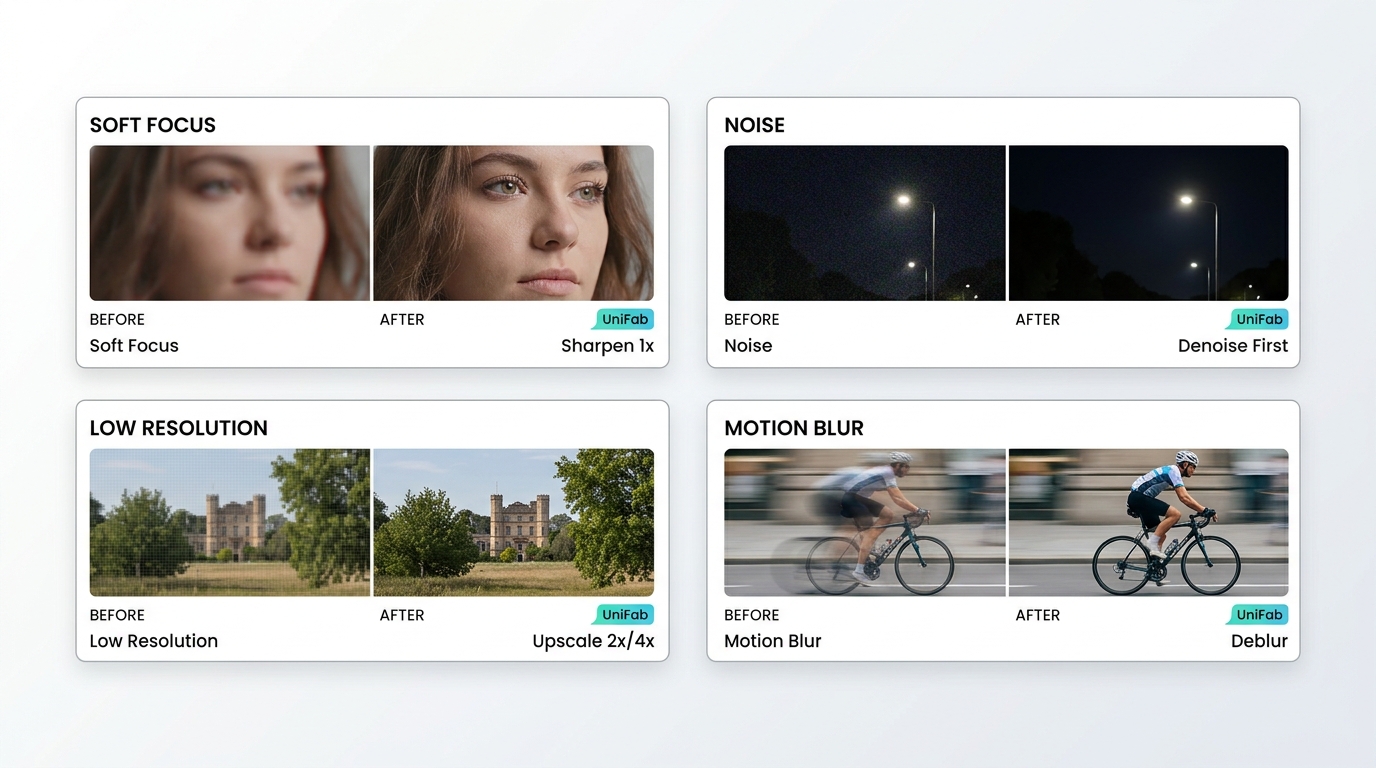
A traditional video sharpener increases Edge contrast, while an AI video sharpener may also analyze noise, compression artifacts, faces, or missing-looking texture. Neither approach can faithfully restore information that the camera never captured.
Match the Blur to the Right Fix
To sharpen blurry video without creating new defects, match the symptom to the correction before choosing software.
| Visible problem | Start with | Reason |
|---|---|---|
| Mild soft focus | Conservative sharpening | Edge contrast may improve clarity without changing pixel dimensions. |
| Motion blur | Motion deblurring | Ordinary sharpening often outlines the blur trail instead of correcting it. |
| Compression blocks or ringing | Artifact removal, then light sharpening | Sharpening first can make block boundaries and mosquito noise more visible. |
| Sensor noise or film grain | Video denoising, then light sharpening | Noise is high-frequency detail, so a sharpener can amplify it. |
| Pixelation or low resolution | Video upscaling, then a restrained finishing pass | The source needs more output pixels before Edge refinement becomes useful. |
| Severe defocus | Set a realistic recovery limit | AI may create plausible texture, but that texture is not proof of original detail. |
My editorial rule is simple: diagnosing the blur is more reliable than choosing a tool by its maximum resolution claim.
Sharpen at 1x or Upscale First?
Same-resolution sharpening keeps the original width and height while changing Edge definition. Upscaling is a separate workflow that increases pixel dimensions, so it should come first when the source is genuinely too small for the target display.
For an already adequate 1080p source, a 1x pass may be enough. For SD, VHS, old recordings, anime, or other low-resolution sources, an AI video enhancer may combine cleanup with enlargement. Readers comparing dedicated enlargement workflows can use the existing video upscaling guide as the next step.
How We Tested the 10 Sharpeners
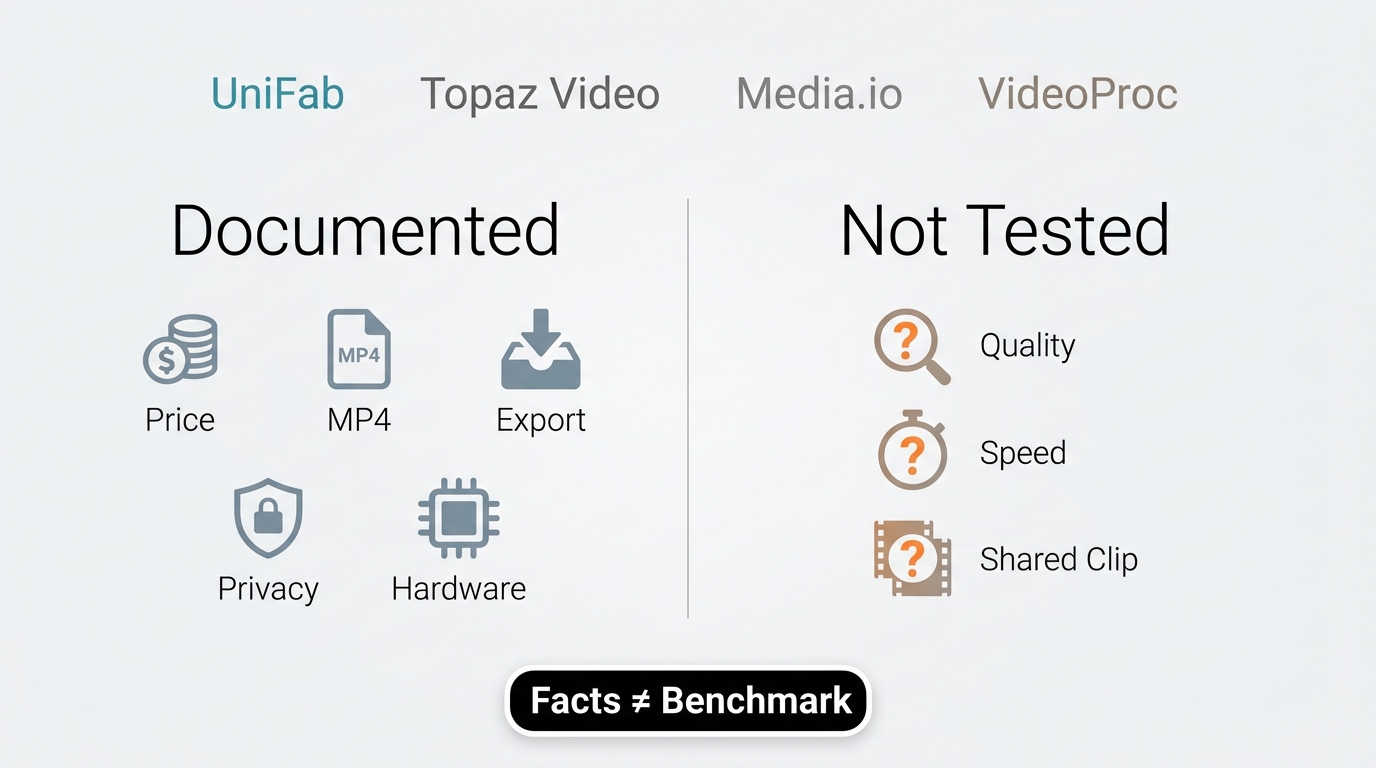
No common-clip benchmark was completed for this revision. To avoid a false tested ranking, the product decisions below use documented capabilities, current pricing evidence, export terms, privacy characteristics, and clearly stated limits instead of invented quality scores or render times.
Test Clip, Hardware, and Export Settings
A reproducible future video sharpener test should use one disclosed blurry MP4 video sharpening sample, one named Windows or Mac system, the same output dimensions and frame rate, and comparable sharpening strength. Because that run was not performed here, no test hardware or measured render time is claimed.
- Use one MP4 clip containing a face, hair, text, motion, fine texture, compression damage, and a static high-contrast Edge.
- Export at the source dimensions first, then run a separate upscale only where the product requires it.
- Keep frame rate, clip duration, codec target, and audio handling aligned across products.
- Record upload time separately from processing time for browser tools.
- Inspect moving frames, not just a selected still image.
Quality, Artifact, Speed, and Value Scores
The scorecard should cover recovered Edge definition, halos, amplified noise, temporal flicker, facial texture, ease of use, export options, privacy, hardware demand, measured speed, and price. Every criterion needs either a measured value or an explicit not-tested mark.
The most meaningful trade-off is not maximum sharpness. It is how much apparent detail a workflow adds before faces, grain, and moving edges stop looking natural.
Video Sharpeners at a Glance
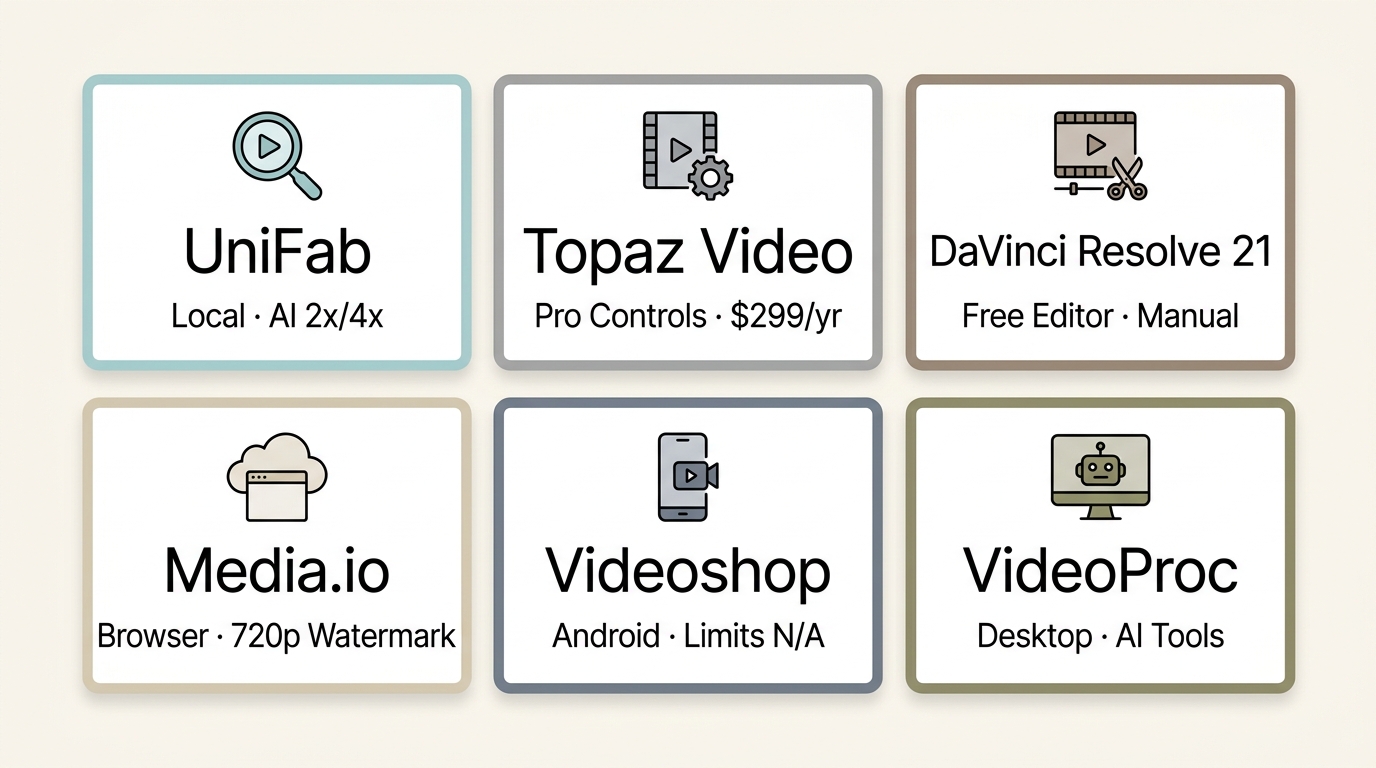
These scenario-based picks separate convenience from control and avoid treating one workflow as suitable for everyone.
| Scenario | Practical pick | Main constraint |
|---|---|---|
| Local desktop sharpening plus optional AI enlargement | UniFab Toolkit with Video Upscaler AI | Requires compatible Windows or Mac hardware; phone-only editing is not supported. |
| Detailed professional controls | Topaz Video | High annual cost and substantial hardware demand for local work. |
| No-cost full editing suite | DaVinci Resolve 21 | Manual workflow and a steeper learning curve than a one-click sharpener. |
| Browser convenience | Media.io Video Enhancer | The no-cost plan exports at 720p with a watermark, and AI enhancement clips are limited to five minutes. |
| Quick Android edits | Videoshop | The official listing does not publish exact sharpening-export limits. |
| Verified no-cost desktop exports | VideoProc Converter AI evaluation | AI tools allow five watermark-free exports, so it is an evaluation route rather than an unrestricted plan. |
Desktop Video Sharpeners (Windows & Mac)
Desktop video sharpening software is the stronger fit for long clips, batch work, local processing, and repeatable MP4 output. Hardware requirements and evaluation limits matter as much as the model name.
1. UniFab Video Upscaler AI and Toolkit
UniFab Toolkit handles same-resolution Sharpen/Unsharpen work, while Video Upscaler AI covers enlargement workflows for SD, VHS, old recordings, anime, and other low-resolution footage.
Video Upscaler AI runs on Windows and Mac, supports MP4 and MKV output, offers batch processing, and provides 1080p, 4K, 8K, and 16K output choices. Its four documented models are Equinox for general footage, Kairo for anime, Vellum for texture, and Titanus for film and television sources. Local processing keeps media on the computer, while GPU acceleration depends on compatible hardware.
The 30-day no-watermark evaluation provides a practical way to inspect output before purchase. Current pricing is $99.99 per year or $129.99 for a lifetime license, with a regular 35% discount bringing the lifetime option to $84.99.
The Toolkit workflow is straightforward:
- Open the Sharpen/Unsharpen module and import the source clip.
- Preview a mild sharpening setting at the intended output dimensions.
- Use denoising first if grain or compression noise becomes more visible.
- Queue compatible clips for batch output after checking one representative sample.
Fits: users who want a local desktop workflow with separate choices for 1x sharpening and AI enlargement. Less suitable for: phone-only editors and computers without compatible graphics hardware.
2. Topaz Video
Topaz Video targets editors who want model selection, detailed controls, and local rendering, with optional cloud rendering when local hardware is not suitable.
The documented output target is 4K, and the US Personal plan is $299 per year. Local rendering keeps files on the computer; some newer models have narrower local GPU support, making hardware compatibility part of the buying decision.
Fits: experienced editors who value granular controls. Less suitable for: occasional users who want a low-cost or lightweight workflow.
3. AVCLabs Video Enhancer AI
AVCLabs Video Enhancer AI combines sharpening with broader AI enhancement in a Windows desktop application.
Current listed prices are $39.95 per month, $119.95 per year, or $299.90 for a lifetime license. This entry does not repeat older resolution or speed claims that were not supported by the current evidence used for this revision.
Fits: Windows users who want sharpening inside a broader enhancement workflow. Less suitable for: users seeking a low-cost occasional editor or a verified Mac workflow.
4. TunesKit AceMovi Video Editor
TunesKit AceMovi Video Editor approaches sharpening as part of a conventional editing timeline, alongside color correction, keyframing, cropping, and other manual adjustments.
It is more useful when sharpening is one step in a larger edit than when the goal is automated restoration. A current price was not used in the purchase framework because the required official figure was not available in the evidence set.
Fits: editors who prefer timeline control. Less suitable for: users who want batch AI sharpening or a one-click cleanup model.
5. VideoProc Converter AI
VideoProc Converter AI combines AI enhancement with conversion, compression, editing, and batch processing on Windows and Mac.
It supports MP4 output, enhancement up to 4K, and GPU acceleration on NVIDIA, Intel, and AMD hardware. Its evaluation allows five watermark-free AI exports. Current plan evidence lists $39.95 per year and $65.95 for a lifetime license covering 3 to 5 PCs.
Fits: users who also need format conversion and batch jobs. Less suitable for: users focused only on high-control restoration models.
Notable no-cost desktop alternative: DaVinci Resolve 21
DaVinci Resolve 21 is not an eleventh ranked product. Its no-cost edition supports output up to Ultra HD 3840×2160 at 60 fps, while the $295 Studio tier adds UltraSharpen, Super Scale, and AI noise reduction. It suits editors who want manual control and a full editing suite, but it is not the quickest route for a single blurry clip.
Online Video Sharpeners
An online video sharpener is convenient for a short clip, but upload limits, watermarks, credits, login behavior, and cloud privacy can change the value of a no-cost offer.
6. Media.io Video Enhancer
Media.io Video Enhancer accepts browser uploads, can retain original resolution or apply 2x or 4x enlargement, and supports MP4 and MOV input with output up to 4K.
The AI enhancement page limits clips to five minutes. The no-cost account tier supports 512 MB uploads and 720p exports with a watermark; higher tiers increase export limits and remove the watermark. Because processing begins with an upload, it is less private than a local desktop workflow.
Fits: short, non-sensitive clips when installation is inconvenient. Less suitable for: confidential footage or users who require a no-cost, watermark-free full export.
7. Neural.love Video Enhancer
Neural.love Video Enhancer is a browser-based, credit-driven AI video enhancer, but the current public page used for this revision did not publish enough downloadable no-cost export details to support a firm free-export recommendation.
Its practical advantage is avoiding a local installation. The trade-off is cloud upload and a less transparent public description of watermark, MP4, and full-export limits.
Fits: users comfortable with a credit-based browser workflow. Less suitable for: buyers who need fully documented no-cost export terms before uploading.
8. Cutout.pro AI Video Enhancer
Cutout.pro AI Video Enhancer provides a browser workflow with MP4 delivery, output options up to 2K and 30 fps in the active interface, and support for short preview processing.
The interface lists MP4 or MOV uploads up to 500 MB, 2K input, and ten minutes, while a three-second preview uses three credits. A full no-cost downloadable export is not offered as a verified claim here.
Fits: short browser-based experiments. Less suitable for: long videos, sensitive footage, or users who need a clearly documented no-cost full export.
Mobile Video Sharpeners (Android & iOS)
A mobile video sharpener works for short social clips and quick adjustments. Longer footage, repeated exports, and high-resolution processing are usually easier to manage on a desktop.
9. Videoshop
Videoshop is an active Android editor with brightness, contrast, saturation, trimming, effects, and other general editing controls for quick phone-based work.
The Google Play listing states that the developer collects no data and shares no data with third parties, but it does not publish exact sharpening-export resolution, watermark, or MP4 limits. That makes it a convenience pick rather than an evidence-backed choice for controlled restoration.
Fits: short Android edits and social content. Less suitable for: long clips or workflows that require documented export specifications.
10. Sharpen Video: Enhance Quality
Sharpen Video: Enhance Quality has an active US App Store listing and supports iPhone and iPad devices running iOS or iPadOS 15.6 or later.
The app provides two sharpening algorithms plus exposure, gamma, saturation, brightness, contrast, hue, rotation, zoom preview, and saving to Photos or Files. It supports MP4, MOV, FLV, and other common formats. The download is no-cost, with Weekly Pro at $4.99, Monthly Pro at $9.99, and Lifetime Pro at $29.99. The listing does not specify watermark or batch-export terms and reports no data collection.
Fits: iOS users who want direct manual sharpening controls. Less suitable for: batch work or buyers who require documented no-cost export limits.
Full Comparison Table
This table uses concrete documented values and removes measured-speed and unsupported specification columns. No shared render benchmark was run, so speed is not presented as a comparative result.
| Tool | Platform | Sharpening route | Verified output or export fact | No-cost export status | Processing and privacy | Key constraint |
|---|---|---|---|---|---|---|
| UniFab Video Upscaler AI and Toolkit | Windows, Mac | 1x Toolkit sharpening plus AI enlargement | MP4/MKV; 1080p, 4K, 8K, 16K; batch | 30-day no-watermark evaluation | Local GPU processing keeps media on-device | No phone editor; compatible desktop graphics recommended |
| Topaz Video | Windows, Mac | Model-based enhancement and enlargement | 4K documented | No no-cost export claim used | Local rendering or optional cloud rendering | High cost and hardware demand |
| AVCLabs Video Enhancer AI | Windows | AI enhancement workflow | Local desktop export | No no-cost export claim used | Local application | Mac workflow not verified in the current evidence |
| TunesKit AceMovi Video Editor | Desktop editor | Manual timeline sharpening | Conventional edited-video export | No unrestricted no-cost export claim used | Local application | No verified batch AI sharpening |
| VideoProc Converter AI | Windows, Mac | AI enhancement plus conversion | MP4; up to 4K; batch | Five watermark-free AI exports | Desktop workflow with NVIDIA, Intel, or AMD acceleration | Evaluation export count is limited |
| Media.io Video Enhancer | Browser | Original resolution, 2x, or 4x | MP4/MOV input; up to 4K | 720p export with watermark on no-cost tier | Browser upload | Five-minute AI clip limit |
| Neural.love Video Enhancer | Browser | Credit-based AI enhancement | Full-export specifications not published on the reviewed page | Not selected for the no-cost export recommendation | Cloud upload | Public export terms lack detail |
| Cutout.pro AI Video Enhancer | Browser | AI enhancement | MP4; up to 2K and 30 fps in the active interface | Three-second preview uses three credits | Cloud upload | 500 MB, 2K input, ten-minute interface limits |
| Videoshop | Android | Mobile editing adjustments | High-resolution video claimed without a numeric limit | No-cost download; export terms not published | Developer reports no data collection or sharing | Exact watermark and format limits not documented |
| Sharpen Video: Enhance Quality | iOS, iPadOS | Two manual sharpening algorithms | MP4, MOV, FLV and other common formats | No-cost download; export terms not published | Developer reports no data collection | No batch or watermark terms documented |
| DaVinci Resolve 21 | Windows, Mac, Linux | Manual editing; UltraSharpen in Studio | No-cost edition up to 3840×2160 at 60 fps | No-cost edition available | Desktop editor with GPU/CPU acceleration | Steeper learning curve |
Third-party prices and limits were checked in July 2026. The price snapshot includes six verified figures and omits unsupported amounts.
| Product | Verified US price |
|---|---|
| UniFab Video Upscaler AI | $99.99 per year; $129.99 lifetime; regular 35% discount price $84.99 lifetime |
| Topaz Video Personal | $299 per year |
| AVCLabs Video Enhancer AI | $39.95 per month; $119.95 per year; $299.90 lifetime |
| VideoProc Converter AI | $39.95 per year; $65.95 lifetime for 3 to 5 PCs |
| DaVinci Resolve 21 | No-cost edition; Studio $295 |
| Sharpen Video: Enhance Quality | Weekly Pro $4.99; Monthly Pro $9.99; Lifetime Pro $29.99 |
For a buying decision: choose local software for sensitive or long footage, a browser service for short non-sensitive clips, a mobile app for quick edits, and a full editor when sharpening must fit into a larger timeline.
Avoid Artifacts and Get Better Results
A natural result is more useful than the sharpest-looking frame. Reduce the setting when outlines, skin, grain, or moving textures start attracting more attention than the subject.
Halos, Grain, Flicker, and Plastic Skin
| Symptom | Likely cause | Practical fix |
|---|---|---|
| Bright or dark halos | Edge strength is too high | Lower sharpening radius or intensity and inspect at 100% scale. |
| Video looks grainy | Noise was sharpened with real texture | Apply a restrained video denoising pass before sharpening. |
| Temporal flicker | Detail changes from frame to frame | Use a model with temporal processing or reduce enhancement strength. |
| Plastic skin | Denoising or face enhancement removed natural texture | Restore a lighter setting and compare moving facial areas. |
| Texture loss | Cleanup was too aggressive | Preserve a small amount of grain instead of flattening the image. |
| Invented detail | The source lacks enough recoverable information | Use a lower output target and present the result as enhancement, not authentic recovery. |
My preference is to stop one step before the effect becomes obvious. A restrained frame that remains stable in motion is more credible than a dramatic still with ringing or artificial texture.
When Sharpening Cannot Recover Detail
Severe defocus, long motion trails, clipped highlights, and large compression blocks may not contain enough original information for faithful recovery. AI can generate plausible detail, but plausible is not the same as historically or visually authentic.
When sharpening fails, use motion deblurring for directional blur, artifact removal for block damage, and upscaling only when the output dimensions need to increase. If faces or text remain ambiguous, lowering the claim and preserving the original is the honest choice.
FAQs About AI Video Sharpeners
Can I sharpen a video without increasing its resolution?
Yes. Same-resolution sharpening changes Edge contrast while retaining the source width and height. Choose a 1x or original-resolution output, then confirm the export dimensions before processing the full clip.
Why can a video look worse after sharpening?
Sharpening can amplify noise, create halos, make skin look synthetic, or cause details to flicker between frames. Start with denoising when the source is grainy, use a mild setting, and judge motion rather than a single still.
Can I sharpen a video online for free without a watermark?
The verified browser options in this comparison do not establish an unrestricted, watermark-free full export. Media.io adds a watermark on its no-cost tier, Cutout.pro documents a credit-based preview, and Neural.love does not publish enough full-export detail for that recommendation.
Can I sharpen a video on my phone?
Yes. Videoshop covers quick Android edits, while Sharpen Video: Enhance Quality provides direct controls on iOS and iPadOS. A desktop is a better fit for long clips, batch work, sensitive media, or high-resolution AI processing.
Will the sharpened file stay MP4 and keep its original dimensions?
That depends on the selected tool and export setting. UniFab supports MP4 and MKV, VideoProc supports MP4, and Cutout.pro delivers MP4. Original dimensions remain unchanged only when you select same-resolution or 1x processing instead of an upscale.
Can video software fix severely blurry or old footage?
It can improve mild softness, compression damage, noise, and some low-resolution material. Severe defocus or motion blur may lack enough source information, so generated texture can look convincing without accurately representing the original scene.